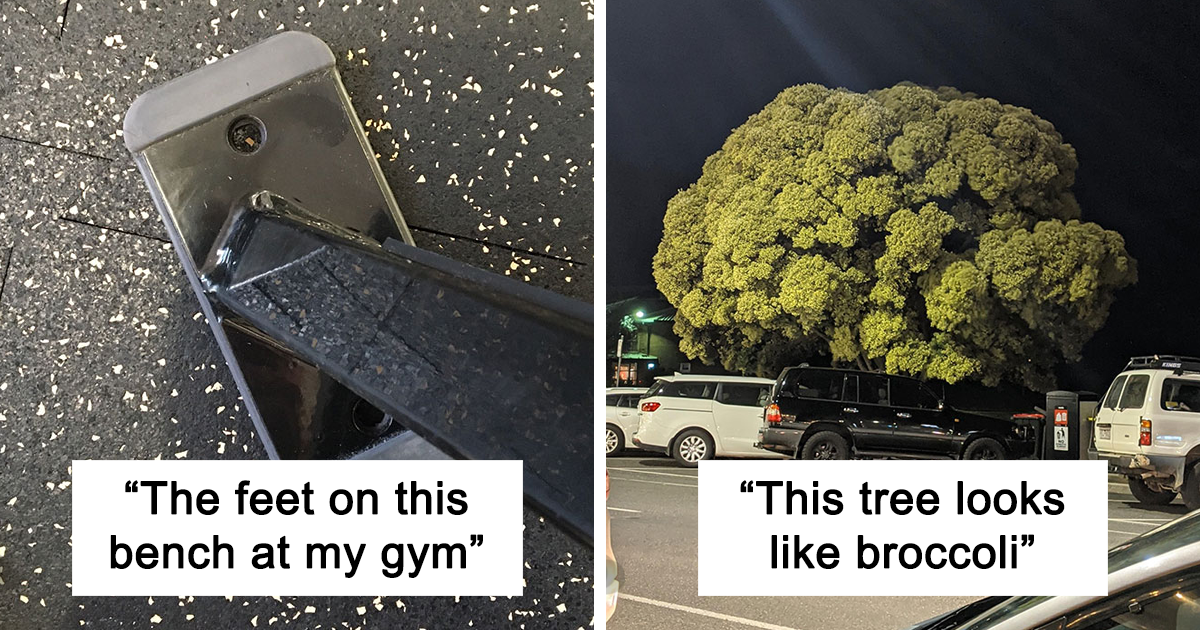
There are moments when your eyes confidently send a report to your brain, and your brain replies, “Absolutely not. Please resubmit.” That is the magic behind double-take photos: a dog that looks like a rug, a shadow that looks like a monster, a pile of laundry that briefly becomes a sleeping cat, or a perfectly normal chair that appears to be hovering like it has finally had enough of gravity.
The phrase “50 Times People Had To Look Twice At Things To Realize What They Were” captures a very human experience. We are pattern-hunting creatures. Our brains are built to identify faces, shapes, danger, movement, food, animals, and familiar objects as quickly as possible. Most of the time, that system works beautifully. Other times, it mistakes a backpack for a crouching raccoon and gives us a free comedy show before breakfast.
These funny visual misunderstandings are not just internet entertainment. They reveal how perception works. Our eyes collect light, but our brains interpret meaning. That interpretation is shaped by context, lighting, distance, memory, expectation, shadows, perspective, and even mood. In other words, seeing is not a simple camera function. Seeing is a negotiation, and sometimes the brain shows up to the meeting wearing clown shoes.
Why Double-Take Moments Happen
1. Your Brain Loves Shortcuts
The human visual system processes an enormous amount of information every second. To keep life moving, the brain uses shortcuts. It fills in missing details, groups similar shapes, guesses what hidden parts of objects might look like, and compares new images with familiar patterns. This is why a jacket on a chair can look like a person in the dark. Your brain is not trying to scare you; it is trying to make a fast prediction with incomplete data. Unfortunately, its emergency drawing skills are not always museum-quality.
2. Pareidolia Makes Faces Appear Everywhere
Pareidolia is the tendency to see meaningful images, especially faces, in random or ambiguous patterns. Two screws and a slot on an electrical outlet become a shocked little robot. A cheese grater looks judgmental. A cloud resembles a dragon with excellent posture. This happens because recognizing faces quickly has long been important for social connection and survival. A false alarm is usually harmless; missing a real face, animal, or threat could matter. So the brain often chooses “maybe face” before “definitely toaster.”
3. Perspective Can Turn Ordinary Objects Into Visual Pranks
Forced perspective is another major reason double-take photos go viral. When objects line up at just the right angle, a tiny dog can look bigger than a car, a person can appear to hold the moon, and a lamp can seem attached to someone’s head like a futuristic antenna. The camera flattens three-dimensional space into a two-dimensional image, and that flattening can make distance and scale wonderfully confusing.
4. Shadows Are Drama Queens
Shadows can stretch, bend, merge, and exaggerate shapes until the original object becomes almost unrecognizable. A coat rack becomes a spider. A tree branch becomes a hand. A child’s toy becomes a suspicious creature lurking in the hallway. Shadows remove color and detail, leaving the brain to guess from outline alone. Naturally, the brain often chooses the most dramatic option available.
50 Double-Take Examples That Make the Brain Say “Wait…”
Below are 50 classic types of optical confusion, funny misidentifications, and “look twice” moments people commonly experience in everyday life and viral photography.
- A black cat on a black blanket: At first glance, it is just a mysterious lump. Then two glowing eyes appear, and suddenly the blanket has opinions.
- A pile of clothes shaped like a sleeping dog: Laundry is already annoying; now it is pretending to breathe.
- A tree stump that looks like an owl: Bark patterns, knots, and shadowy holes create a forest security guard.
- A rock that resembles a baked potato: Nature occasionally opens a fake deli.
- A shadow that looks like a giant spider: The actual object may be a tiny plant, but the shadow has blockbuster ambitions.
- A dog lying on a rug of the same color: Camouflage level: household ninja.
- A cloud shaped like a running horse: Sky art appears, refuses to explain itself, and disappears before anyone can prove it.
- A cracked wall that looks like a map: Suddenly, your living room has discovered a new continent.
- A chair with clothes on it that looks like a person: The unofficial mascot of 2 a.m. panic.
- A reflection that makes a building look transparent: Glass turns architecture into a magic trick.
- A sandwich that appears to be smiling: Lunch becomes emotionally supportive.
- A puddle reflecting the sky like a portal: The sidewalk briefly opens a branch office in another dimension.
- A backpack that looks like a crouching animal: School supplies become wildlife.
- A tree root shaped like a snake: Perfect for improving your heart rate during a peaceful walk.
- A sleeping baby’s hair that looks like a tiny wig: Cute, confusing, and somehow ready for a courtroom drama.
- A cat whose head blends into a pillow: You know the cat is there, but the cat has joined the furniture union.
- A building corner that looks paper-thin: Perspective makes concrete seem like cardboard.
- A banana peel shaped like a bird: Breakfast leftovers enter their sculpture era.
- A car covered in snow that looks like a marshmallow: Winter turns transportation into dessert.
- A dog’s ears lined up with another dog’s face: One pet briefly becomes a two-headed mythological roommate.
- A perfectly timed photo of someone “holding” the sun: Vacation photography’s oldest and still undefeated trick.
- A shadow that gives someone extra-long legs: The sidewalk creates an accidental fashion editorial.
- A lamp behind someone’s head that looks like a halo: Ordinary people become saints of awkward composition.
- A coffee stain shaped like a face: Your mug has seen things.
- A dog nose close to the camera that looks enormous: Perspective turns a pet into a friendly meteor.
- A bird sitting on a statue’s head like a hat: Public art receives unsolicited styling advice.
- A cat stretched across stairs that looks liquid: Cats continue their campaign against physics.
- A towel hanging like a ghost: Laundry day meets haunted-house energy.
- A leaf that looks like a tiny fish: Autumn becomes an aquarium.
- A close-up of bread that looks like a landscape: Suddenly toast has mountains, valleys, and possibly tourism potential.
- A person’s shadow merging with a dog’s shadow: One walk, two bodies, one confusing silhouette.
- A fence pattern that looks like an optical maze: The eyes start exercising without permission.
- A dog’s fur pattern that forms a heart: Nature adds a cute sticker.
- A rock formation that resembles a face: The mountain is watching, but probably not judging.
- A plastic bag floating like a jellyfish: Not magical, still alarming.
- A reflection in a spoon that distorts a face: Breakfast turns into a funhouse mirror.
- A house with windows arranged like eyes: Architecture accidentally develops facial expressions.
- A carrot with legs: Vegetables occasionally try to leave.
- A dog under a glass table that looks flattened: No dogs were harmed; perspective was simply being rude.
- A scarf curled like a sleeping cat: Soft, warm, and emotionally misleading.
- A cracked egg that looks surprised: Breakfast reacts to its own situation.
- A tree branch that resembles a hand: Nature reaches out, and everyone steps back.
- A car headlight that looks like an angry eye: Some vehicles have resting villain face.
- A plant pot with drainage holes like a smile: Even your fern has a cheerful roommate.
- A stack of boxes that looks like a robot: Moving day builds a temporary employee.
- A dog sleeping upside down that looks like a different animal: The belly appears, the identity disappears.
- A curtain fold shaped like a face: Home decor gets suspiciously expressive.
- A photo where someone’s arm looks like someone else’s leg: Group pictures: where anatomy goes to improv class.
- A bird’s shadow that looks bigger than the bird itself: Tiny animal, huge cinematic presence.
- A mirror angle that creates an impossible room: You know the room is normal, but your eyes file a complaint.
The Psychology Behind “Look Twice” Photos
Context Changes Everything
Context is one of the strongest forces in visual perception. Put a gray square on a dark background and it may look lighter; place it on a light background and it may look darker. Place a small object beside something huge, and it looks even smaller. Remove familiar surroundings, and the brain loses important clues. That is why close-up photos are especially tricky. A macro shot of a sponge can look like alien terrain, while a zoomed-in strawberry can look like a red field full of seeds trying to organize a meeting.
Scale Can Fool Even Careful Observers
When scale cues disappear, ordinary objects become mysteries. A tiny mushroom photographed close-up can resemble a huge umbrella. A toy car shot from a low angle can look like a real vehicle. A close-up of salt crystals might resemble icebergs. Without a hand, coin, doorway, person, or horizon line for comparison, the brain has to guess size. And when the brain guesses, it often guesses with confidence that is completely undeserved.
Lighting Decides the Mood
Good lighting can clarify an object. Strange lighting can turn it into a riddle. Backlighting creates silhouettes. Harsh side lighting exaggerates texture. Low light removes details. Colored light changes emotional tone. This is why the same hallway can look cozy at noon and deeply suspicious at midnight. The hallway did not change. Your lighting did, and your brain added a soundtrack.
Why These Images Are So Shareable
Double-take images work beautifully online because they create a tiny puzzle. The viewer has to pause, inspect, reinterpret, and then experience the little reward of recognition. That reward is satisfying. It feels like solving a harmless visual mystery. Even better, these images invite comments: “I thought it was a dog,” “I saw a face,” “I can’t unsee it,” or the classic, “My brain is broken.”
They are also universal. You do not need expert knowledge to enjoy a cat blending into a carpet. You do not need a degree in neuroscience to laugh at a shadow that looks like a dinosaur. The joke happens instantly, but the reason behind the joke is surprisingly deep. That combinationquick humor plus hidden scienceis why optical illusions, accidental camouflage, and confusing perspective photos continue to perform well on social media, blogs, and visual humor sites.
How To Spot Double-Take Moments In Your Own Life
Slow Down for One Extra Second
Most double-take moments happen because the first interpretation is too fast. Pause for one extra second and ask: What else could this be? Is the object connected to the background? Is a shadow adding shape? Is the camera angle flattening distance? That tiny pause often reveals the trick.
Look for Missing Clues
If an image seems impossible, check for missing depth clues. Are you seeing the full object or only part of it? Is there a reflection? Is the object closer to the camera than it appears? Are two separate objects visually overlapping? Many confusing images become obvious once the eye finds the edge, shadow, or boundary that separates one thing from another.
Change Your Angle
In real life, the easiest solution is to move. Take one step left or right. Crouch down. Stand up. Walk closer. Visual illusions often collapse when the viewing angle changes. The monster coat rack becomes a coat rack again. The snake root becomes a root. The ghost towel becomes laundry, which is less terrifying but still emotionally difficult.
Bonus Experience: What It Feels Like To Look Twice
Everyone has a personal double-take story, and most of them begin with complete confidence. You glance at something, your brain names it, and then a second later you realize the name was hilariously wrong. Maybe you walk into the kitchen and think there is a small animal near the fridge. Your pulse jumps. You freeze. Then you notice it is just a crumpled brown paper bag sitting in a shadow. The bag has done nothing wrong, yet for three seconds it had the dramatic presence of a raccoon with a mortgage.
One of the funniest parts of these experiences is how emotional the first reaction can be. The object is harmless, but the interpretation feels real. A hoodie over a chair can look so much like a person that you may actually say “hello” before realizing you have greeted cotton. A pair of boots beside the bed can look like feet. A dark towel on the floor can look like a pet. A houseplant near a window can look like someone standing outside. The brain does not politely whisper, “This may require further review.” It slams the big red button labeled “Possible Situation.”
Double-take moments also create a strange kind of delight. Once the mistake is solved, fear often turns into laughter. You feel tricked, but not cheated. In fact, you may admire the accident. The towel really did look like a ghost. The backpack really did look like a turtle. The shadow really did look like a monster reaching across the wall. These are tiny reminders that the world is visually playful, even when nobody arranged the joke on purpose.
There is also a social pleasure in sharing these moments. When someone posts a confusing photo and says, “What am I looking at?” everyone becomes a detective. People zoom in, argue, guess, laugh, and proudly announce when they finally see it. The image becomes a group puzzle. Some people see the real object immediately. Others cannot see it even after reading the answer. That difference is part of the fun. Our brains do not all prioritize the same clues in the same order.
These experiences teach a useful lesson: perception is powerful, but it is not perfect. We do not simply see the world; we interpret it. Our memories, expectations, surroundings, and attention all shape what appears obvious. Most of the time, this system helps us move through life smoothly. Occasionally, it turns a sock into a hamster. And honestly, life is better with a few sock hamsters in it.
Conclusion
“50 Times People Had To Look Twice At Things To Realize What They Were” is more than a funny title. It is a celebration of everyday visual confusion, accidental art, and the wonderfully imperfect way human perception works. From pareidolia and forced perspective to shadows, reflections, camouflage, and scale tricks, double-take moments remind us that the brain is not a passive camera. It is an active storyteller. Sometimes that storyteller is brilliant. Sometimes it mistakes a bathrobe for a burglar. Either way, it keeps life interesting.
The next time you see a face in your coffee, a dragon in the clouds, or a suspicious creature that turns out to be a grocery bag, take a second look and enjoy the tiny mystery. Your brain may be wrong, but at least it is entertaining.
SEO Tags
Note: This original article is written for web publishing in standard American English and is based on established concepts in visual perception, optical illusions, pareidolia, perspective, shadows, reflections, and everyday photography.