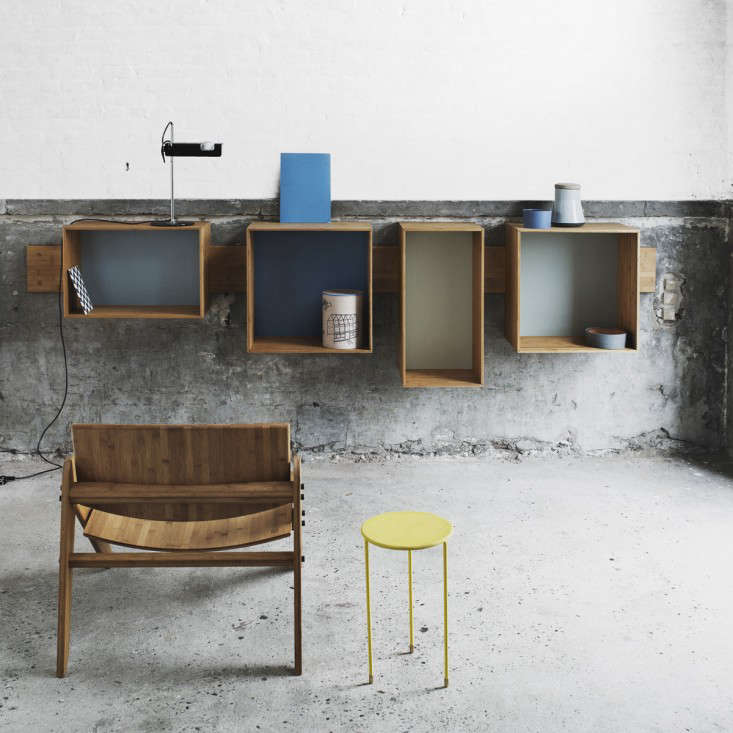
A normal bookcase stands on the floor, squares its shoulders, and quietly waits for paperbacks. The We Do Wood SJ Bookcase Set takes a more theatrical approach. It climbs the wall, breaks storage into geometric boxes, and turns books, plants, records, and small treasures into part of the composition. It is storage, certainly, but it behaves more like functional wall artan organized little rebellion against the beige rectangle.
Designed within the Danish modern tradition, the SJ system is best known in its classic form as a set of differently sized box modules mounted on horizontal wooden rails. The modules can be repositioned, allowing the arrangement to move from disciplined and symmetrical to deliberately offbeat. That flexibility explains the product’s lasting appeal: the furniture does not dictate one permanent display. It provides a framework and then politely gets out of the way.
What Exactly Is the SJ Bookcase Set?
The classic We Do Wood SJ Bookcase Set was introduced as a wall-mounted storage system featuring four open boxes in different proportions. Archival product descriptions identify a horizontal box, two square boxes, and a taller vertical box, each independently attached to wooden mounting bars. Because the components are separate, owners can move them along the rails and create numerous balanced, staggered, or intentionally asymmetric arrangements.
The modules are not restricted to books. Retailer and design-publication descriptions have suggested using them for plants, ceramics, photographs, artwork, and everyday objects. In practical terms, the product sits somewhere between a bookcase, a display cabinet, and a three-dimensional gallery wall.
Do Not Confuse the Different SJ Versions
There is an important shopping detail: “SJ Bookcase” has referred to more than one configuration over the years. The original full Set is commonly documented as a four-box bamboo design. A smaller SJ Bookcase Midi uses three modules, while newer listings describe an updated SJ Bookcase made with FSC-certified oak and veneer and fitted with movable shelf elements.
That means shoppers should not purchase by product name alone. Confirm the module count, material, dimensions, color, rail length, mounting hardware, and production version shown in the exact listing. A vintage bamboo Set and a newer oak SJ Bookcase share the same design family, but they are not necessarily identical products wearing different outfits.
A Bookcase That Treats the Wall Like a Canvas
Traditional bookcases create a grid. The SJ Bookcase Set creates a rhythm. Its boxes vary in height and width, so the empty wall between them becomes part of the design. A narrow gap can add visual tension, while a wider gap makes the composition feel lighter. Move one module farther along the rail and the entire piece develops a new personality without requiring new furniture, another delivery truck, or a dramatic weekend involving twelve paint samples.
Asymmetry Without Chaos
The design is asymmetric, but it does not feel random. The straight edges and rectangular modules provide enough visual discipline to keep the arrangement orderly. This balance between strict geometry and playful placement reflects the work of Danish designer Sebastian Jørgensen, whose furniture combines simple forms with practical interaction. His designs are often intended to be understood and used without excessive explanation.
The approach works especially well in modern interiors because it introduces shape without adding a heavy visual footprint. Since the boxes are mounted on the wall, the floor remains visible beneath them. Wall-mounted shelving can help preserve usable floor area in smaller rooms and make an interior feel less crowded than a deep freestanding cabinet.
The Removable Modules Are the Main Event
The SJ system’s most useful feature is not merely that its boxes have different dimensions. It is that they can be rearranged. A strict horizontal layout may suit a formal home office, while an uneven arrangement can loosen up a living room, studio, or creative workspace.
The modules can also respond to the objects placed inside them. Tall books get a tall compartment. Small ceramics gain a more intimate square frame. Frequently used items can be positioned within easy reach, while purely decorative pieces can occupy higher spaces.
As needs change, the layout can change with them. A vertical compartment may begin with art books, later hold a trailing plant, and eventually become the official parking garage for mail that was absolutely going to be sorted yesterday.
Materials: Bamboo Heritage and Oak Evolution
The Classic Moso Bamboo Edition
The original SJ Bookcase Set is closely associated with Moso bamboo, a material that played an important role in We Do Wood’s early furniture collections. Design publications highlighted the company’s use of bamboo as a refined furniture material rather than treating it as a shortcut to tropical décor. The finished panels offered a warm, clean appearance that suited the collection’s simple geometric forms.
Some classic versions combined natural bamboo surfaces with colored fronts or edges. Documented color combinations included muted greens, blues, grays, black, and white, although finishes differed by size, year, and market. The color blocks gave the Set a playful character without requiring additional decoration.
The Later Oak-and-Veneer Version
Later descriptions identify the SJ Bookcase as an FSC-certified oak and wood-veneer product. FSC certification relates to forest-management and chain-of-custody standards, but buyers should still verify that the certification applies to the exact item being purchased rather than assuming every SJ edition uses the same materials.
Words such as “natural,” “sustainable,” and “responsible” can be broad. More useful questions include: What is the primary material? Is the product solid wood, veneer, bamboo panel, or another composite? Which certification is documented? What finish and adhesives were used? Is the item newly manufactured, old retailer inventory, or a secondhand example?
What U.S. Buyers Should Check
When a furniture product contains regulated composite wood, U.S. buyers should look for TSCA Title VI compliance information. EPA requirements cover products such as hardwood plywood, medium-density fiberboard, and particleboard sold or imported into the United States. This does not make veneer or composite construction undesirable; it simply gives buyers a useful labeling standard to check.
SJ Bookcase Set Dimensions and Space Planning
The original large Set is a substantial wall installation. Archival specifications list the following approximate module dimensions:
- Horizontal module: 32 × 63 × 30 centimeters
- Square modules: approximately 49 × 49 × 31 to 31.5 centimeters each
- Vertical module: approximately 55 × 36 × 28 to 28.5 centimeters
- Mounting bars: approximately 115 centimeters long
Some listings describe two mounting bars for the full four-module arrangement and place the total weight of the large version at roughly 22.7 kilograms. Because surviving retailer pages show small differences in measurements, these figures should be treated as planning references rather than permission to drill immediately. Measure the actual components and compare them with the installation instructions supplied with the product.
Dimensions of the Midi Version
The SJ Bookcase Midi is more compact. Documented measurements include a horizontal module of approximately 27 × 37 × 22 centimeters, a square module measuring roughly 32 × 32 × 24 centimeters, and a vertical module around 42 × 26 × 26 centimeters. A single mounting bar is listed at approximately 115 centimeters.
Remember the Depth
Depth matters as much as width. Depending on the version, the boxes project roughly 9 to 12 inches from the wall. That makes them more useful than a slim picture ledge, but it also means they should not be installed where shoulders, opening doors, dining chairs, or enthusiastic vacuuming equipment will repeatedly collide with them.
Before ordering, use painter’s tape to mark the proposed arrangement on the wall. Include the full depth, not only the front-facing outline. Walk through the room, open nearby doors, sit in adjacent chairs, and make sure the modules will not turn an ordinary hallway into an obstacle course.
Installation: Beautiful Geometry Needs Serious Fasteners
The SJ Bookcase is wall-mounted, so installation is not the moment for optimism-based engineering. The total load includes the modules, mounting rails, hardware, books, plants, and decorative objects. Books are compact, innocent-looking bricks; a row of large hardcovers becomes heavy surprisingly quickly.
Manufacturer videos demonstrate how the SJ system is positioned and mounted, but the correct fasteners depend on the wall itself. Wood studs, hollow drywall, plaster, brick, and concrete require different anchors. Home-improvement guidance generally recommends fastening substantial shelving into studs where possible and choosing properly rated toggle bolts, molly bolts, or masonry anchors when direct attachment to framing is unavailable.
Plan Before Drilling
Use a level and map the complete arrangement with painter’s tape. Confirm the spacing between modules and check that each box can be removed or repositioned without hitting a ceiling, adjacent wall, light switch, or piece of furniture.
Locate studs and consider where wiring or plumbing may run. Fastener ratings should comfortably exceed the expected combined load, and product-specific instructions should take priority over generic advice. This Old House recommends accounting for a substantial safety margin rather than treating a fastener’s maximum laboratory rating as the ideal everyday load.
If the original instructions, load limits, or hardware specifications are missing, professional installation is a sensible expense. A crooked shelf is annoying; a falling box full of hardcovers is an extremely committed book club.
How to Style the We Do Wood SJ Bookcase Set
The SJ Bookcase rewards restraint. Filling every module edge to edge can hide the geometry that makes the product special. Interior-design guidance often emphasizes negative space, varied heights, mixed book orientations, and a cohesive color story when arranging shelves. Those principles are particularly effective here because each box already acts like a frame.
Mix Vertical and Horizontal Books
Stand frequently used books vertically so their titles remain easy to read. Place a few larger volumes horizontally to create visual platforms for a small object, bowl, or framed photograph. Alternate the direction of the stacks so the complete arrangement does not lean visually toward one side.
Use Fewer, Larger Objects
One sculptural object often works better than seven tiny objects having a committee meeting. A larger vase, carved figure, or piece of pottery can provide a clear focal point. Smaller items are easier to appreciate when grouped intentionally rather than scattered across every available surface.
Repeat Color Across the Modules
Repeating one or two colors helps connect boxes that are physically separated. A blue book spine in one module can echo a blue ceramic object in another. Neutral versions can borrow colors from the rug, artwork, or upholstery, while multicolored SJ Sets already provide their own palette.
Add Plants Carefully
A small plant can soften the straight lines, but use a waterproof cachepot or saucer. Avoid placing a thirsty plant directly above valuable books or electronics. Choose compact or trailing varieties that will not overwhelm the box, and remember that plants continue growing even after the shelf arrangement has achieved peak photographic perfection.
Where the SJ Bookcase Set Works Best
Living Room
In a living room, the SJ Bookcase can replace a conventional display cabinet and create a focal point above a low console, bench, or reading chair. It works especially well when the surrounding wall is left relatively quiet, allowing the box arrangement to become the main architectural feature.
Home Office
In a home office, the modules can separate reference books, notebooks, awards, stationery, and personal objects without making the wall resemble corporate storage. The repositionable layout is useful when a desk, monitor, or chair changes location.
Dining Area or Kitchen
The boxes can display cookbooks, small ceramics, glassware, or bar accessories. Fragile objects should sit securely, and the unit should remain away from persistent steam, grease, and sink splashes.
Small Apartment
The wall-mounted format helps preserve floor space, making the SJ system appealing for compact apartments. Renters, however, should consider lease restrictions, wall construction, repair costs, and whether the installation can be safely removed later.
Children’s Room
In a child’s room, secure installation and careful placement are nonnegotiable. Keep heavy objects low, avoid placing tempting toys where children may climb to reach them, and never allow the boxes to be treated as climbing holds. U.S. Consumer Product Safety Commission guidance consistently recommends securing bookcases and other furniture to reduce tip-over and climbing hazards.
Advantages of the SJ Bookcase Set
- Flexible configuration: The modules can be rearranged as storage needs or room layouts change.
- Strong visual identity: The geometric boxes function as both furniture and wall decoration.
- Floor-saving design: Wall mounting preserves visible and usable floor space.
- Multiple uses: The compartments can hold books, plants, artwork, photographs, and household objects.
- Material choices: Buyers may encounter classic bamboo editions as well as later oak-and-veneer versions.
- Long-term adaptability: The display can evolve without replacing the complete furniture system.
Potential Limitations
- Installation effort: Precise measuring and suitable wall anchors are essential.
- Limited hidden storage: Open boxes reveal clutter and provide nowhere for a chaotic cable collection to hide.
- Regular dusting: Open shelves naturally collect visible dust.
- Version confusion: Dimensions, materials, colors, and module counts vary among SJ editions.
- Moderate book capacity: The design prioritizes display and composition rather than maximum linear storage.
- Possible resale pricing: Older or discontinued versions may command design-market prices unrelated to basic storage capacity.
Who Should Buy the SJ Bookcase Set?
The SJ Bookcase Set is a strong match for someone who wants storage to contribute to the architecture of a room. It suits design-conscious readers, collectors with a curated number of objects, small-space owners who value visible floor area, and people who enjoy rearranging their interiors without replacing furniture.
It is less suitable for a person with thousands of books, a reluctance to drill into walls, or a deep spiritual commitment to hiding clutter behind doors. A traditional full-height bookcase provides more straightforward storage. The SJ wins when flexibility, visual impact, and personality matter as much as raw capacity.
Care and Maintenance
For routine care, dust the boxes with a soft microfiber cloth. Wipe fingerprints or light marks with a slightly damp cloth and a small amount of mild soap, then dry the surface promptly. We Do Wood product-care guidance for its wooden and bamboo furniture generally favors gentle cleaning rather than abrasive chemicals.
Avoid soaking bamboo, oak, veneer edges, mounting bars, or joints. Do not use abrasive pads, harsh solvents, or strong household cleaners unless the manufacturer specifically approves them. Persistent moisture can affect wood-based materials and finishes.
Keep the bookcase away from strong heat sources and prolonged harsh sunlight, which may contribute to uneven fading. Check the rails and fasteners periodically, especially after rearranging modules or adding heavier books. Movement, cracking sounds, loose screws, pulled anchors, or widening gaps between the rail and wall are reasons to unload the unit and inspect the installation immediately.
Living With the SJ Bookcase Set: A Realistic Ownership Experience
The first experience is spatial rather than practical. Once mounted, the SJ Bookcase changes how the wall feels. A standard shelf reads as a line; this system reads as a collection of volumes. Even before anything is placed inside, the modules create shadows and depth. In morning light, the boxes look crisp and architectural. At night, a nearby lamp gives them softer edges.
It is the rare storage product that can improve a blank wall while still empty. That quality is particularly noticeable in small or minimally furnished rooms, where a traditional cabinet might feel too heavy. The SJ creates a focal point without swallowing the wall from floor to ceiling.
The First Styling Attempt
The second experience is the temptation to overstyle it. On the first day, every favorite object suddenly campaigns for a position: art books, pottery, framed photographs, a small plant, three travel souvenirs, and the mysterious wooden bird received as a gift in 2017.
The SJ Bookcase quickly teaches editing. When each module has one clear purpose, the complete arrangement looks intentional. When every inch is occupied, it becomes a colorful wall-mounted junk drawer with excellent Danish credentials.
A practical layout might dedicate the horizontal box to books, one square box to ceramics, the second square box to mixed books and a photograph, and the vertical box to taller volumes or a plant. The asymmetry helps ordinary belongings appear composed. A modest flea-market vase can suddenly look important when it receives its own geometric stage.
Rearranging the Modules
After a few weeks, the movable format becomes more valuable. Perhaps a chair has been relocated beneath the shelf, so one module needs to shift. Perhaps the tall compartment feels visually heavy on the left and works better on the right. With a conventional built-in, that realization becomes a renovation fantasy. With the SJ system, it becomes an afternoon adjustment.
The boxes should still be emptied before they are moved. Decorative flexibility does not cancel gravity, and attempting to slide a module while it contains books, ceramics, and a stubborn plant is an excellent way to turn interior styling into an insurance discussion.
Display Storage Versus Library Storage
Daily use reveals the difference between display storage and library storage. Frequently used books should be positioned where they can be removed without disturbing a carefully balanced stack. Large reference books may dominate a smaller module. Tiny objects can disappear visually unless they are grouped or placed beside a larger form.
The SJ is most satisfying when it functions as a hybrid: part bookcase, part gallery, and part organizer. Filling every module entirely with dense hardcovers may provide storage, but it reduces the visual lightness that makes the design distinctive.
Dust, Plants, and Everyday Reality
Open modules collect dust, especially on darker finishes. Fortunately, their simple construction makes wiping relatively easy. There are no deep cabinet corners, sliding doors, or elaborate hinges to navigate. The less enjoyable discovery is that carefully arranged horizontal book stacks must occasionally be moved so the shelf beneath them can be cleaned.
Plants introduce another routine. Trailing stems need pruning before they begin auditioning for a jungle documentary. Pots must be lifted carefully, and water should never be allowed to collect on bamboo or veneer surfaces. Artificial greenery is easier, although it comes with the emotional burden of dusting individual leaves.
Learning Weight Discipline
The largest ownership consideration is weight. The boxes may look sturdy, but safe capacity depends on the exact SJ edition, mounting rail, fasteners, wall construction, and installation quality. When a verified load rating is unavailable, weight should be distributed conservatively.
Heavy books can be divided among several modules rather than concentrated in one compartment. Valuable or breakable objects should not sit near an edge. Any shelf movement should be investigated rather than dismissed as the house “settling into its personality.”
How the Bookcase Changes Over Time
Over the long term, the best part of the ownership experience is that the SJ Bookcase can evolve. Seasonal decorations can rotate in and out. Children’s books may eventually give way to travel books. Bright modules can anchor a playful interior, while neutral bamboo or oak versions can mature alongside changing furniture and wall colors.
The bookcase does not disappear into the background, but it also does not demand one permanent identity. It remains a framework for the owner’s changing collectionand occasionally a very attractive reminder to stop buying tiny ceramic bowls.
Conclusion
The We Do Wood SJ Bookcase Set succeeds because it turns storage into composition. Its wall-mounted modules, varied proportions, and rearrangeable layout offer a visual freedom that ordinary rectangular bookcases rarely provide. The classic bamboo Set remains the most recognizable edition, while later oak-and-veneer versions demonstrate how the underlying idea has evolved.
Whichever version you encounter, confirm the exact specifications before purchasing. Measure the wall carefully, use appropriately rated mounting hardware, distribute weight responsibly, and resist the urge to fill every square inch. The geometry needs a little breathing room to perform its best work.
For the right home, the SJ Bookcase is more than a place to put books. It is a flexible piece of Scandinavian design that gives a blank wall structure, makes everyday objects feel more considered, and allows the room to change without starting over. It is practical, expressive, and just unusual enough to make guests ask where it came fromwhich is furniture’s polite way of accepting applause.