If you have ever looked at a painting in a museum gift shop and thought, “Nice, but I’m not paying $38.99 for a poster,” the upper tier of the art market may feel like a completely different universe. In that universe, collectors do not blink at eight figures, auctioneers talk faster than sports commentators, and a single canvas can cost more than a private island, a luxury penthouse, and a fleet of very smug yachts combined.
Still, these sky-high prices are not just about bragging rights. The most expensive paintings ever sold sit at the crossroads of rarity, art history, prestige, museum-level demand, and good old-fashioned billionaire competition. Some are masterpieces by artists who changed the direction of modern painting. Some are iconic works that rarely appear on the market. And some, frankly, got an extra push because a collector somewhere decided losing was not an option.
This list blends confirmed auction results with widely reported private sales, because the art world loves two things equally: beauty and secrecy. That means exact positions can shift a little depending on the source, but the overall picture is clear. These 50 paintings are among the biggest money magnets the art market has ever seen, and together they reveal what collectors will pay when scarcity, status, and history collide.
Why Do These Paintings Cost So Much?
The short answer is that great art is rare, and billionaire egos are not. The longer answer is that price at this level usually comes from a mix of factors: the artist’s reputation, the work’s condition, its place in the artist’s career, its exhibition history, provenance, cultural importance, and whether another version already lives in a major museum. Add in private advisors, global wealth, auction-house guarantees, and the fear of missing the one chance to buy a masterpiece, and prices start climbing like they are late for a space launch.
Another important detail: the very top of the list is dominated by a handful of names. Picasso appears over and over because he produced an astonishing body of work and collectors never seem to tire of him. Klimt, Modigliani, Warhol, Rothko, de Kooning, and van Gogh also show up repeatedly. That is not random. These artists combine instant recognizability with historical weight, which is exactly the kind of combination that makes wallets nervous and auction paddles rise.
The 50 Paintings That Fetched the Biggest Prices
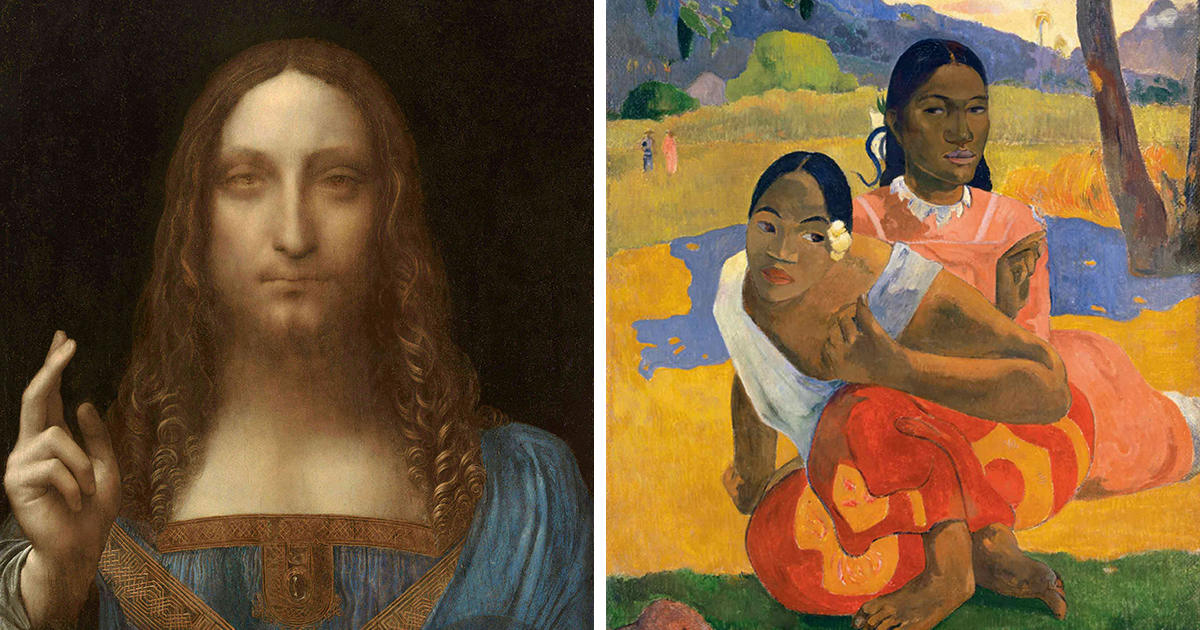
- Salvator Mundi by Leonardo da Vinci $450.3 million. The king of the mountain. Part masterpiece, part mystery, part global headline machine.
- Interchange by Willem de Kooning about $300 million. A towering Abstract Expressionist trophy that turned a private sale into legend.
- The Card Players by Paul Cézanne more than $250 million. Quiet peasants, monumental importance, and a price tag loud enough to wake the whole market.
- Portrait of Elisabeth Lederer by Gustav Klimt $236.4 million. A spectacular 2025 auction result that vaulted Klimt into an even more elite price bracket.
- Nafea Faa Ipoipo (When Will You Marry?) by Paul Gauguin about $210 million. Proof that Tahitian color and mystery can make collectors spend like royalty.
- Number 17A by Jackson Pollock about $200 million. One of Pollock’s drip-era heavyweights, sold in a private deal with blockbuster status.
- The Standard Bearer by Rembrandt about $198 million. A rare Old Master flex that reminds everyone the seventeenth century can still hit hard.
- Shot Sage Blue Marilyn by Andy Warhol $195 million. Marilyn keeps smiling, and the market keeps losing its mind.
- No. 6 (Violet, Green and Red) by Mark Rothko about $186 million. A vast field of color that somehow manages to be calm, intense, and expensive all at once.
- Wasserschlangen II by Gustav Klimt $183.8 million. Klimt plus shimmering sensuality equals a number with a lot of zeroes.
- Pendant portraits of Maerten Soolmans and Oopjen Coppit by Rembrandt about $180 million. Technically a pair, but together they became one of the market’s great power purchases.
- Les Femmes d’Alger (Version O) by Pablo Picasso $179.4 million. Bold, restless, and unmistakably Picasso, this one arrived at auction ready to make history.
- Nu couché by Amedeo Modigliani $170.4 million. The reclining nude that practically announced Modigliani’s arrival in the nine-figure club.
- Masterpiece by Roy Lichtenstein $165 million. The title is not shy, and neither was the market.
- Nu couché (sur le côté gauche) by Amedeo Modigliani $157.2 million. Another Modigliani nude, another reminder that collectors clearly got the memo.
- Le Rêve by Pablo Picasso $155 million. Dreamy, famous, and almost too iconic for its own good.
- Portrait of Adele Bloch-Bauer II by Gustav Klimt about $150 million. Not as universally famous as the first Adele, but the market treated it like royalty anyway.
- Les Poseuses, Ensemble (Petite version) by Georges Seurat $149.2 million. Pointillism never looked so precise, elegant, and wildly expensive.
- Three Studies of Lucian Freud by Francis Bacon $142.4 million. A triptych with psychological voltage turned up to maximum.
- Twelve Landscape Screens by Qi Baishi $140.8 million. A landmark result that underscored the global force of major Chinese painting.
- No. 5, 1948 by Jackson Pollock $140 million. One of the canonical Pollocks, and priced accordingly.
- Femme à la montre by Pablo Picasso $139.3 million. A late-entry record chaser that reminded the market never to underestimate a strong Picasso portrait.
- La Montagne Sainte-Victoire by Paul Cézanne $137.7 million. A mountain in Provence, a mountain of importance in modern art.
- Woman III by Willem de Kooning $137.5 million. Ferocious brushwork, huge reputation, huge number.
- Portrait of Adele Bloch-Bauer I by Gustav Klimt $135 million. The golden Klimt that became a symbol of restitution, glamour, and museum ambition.
- The Empire of Light by René Magritte $121.2 million. A surreal scene of daylight and nightfall sharing the same canvas, and apparently the same astronomical value.
- Otahi by Paul Gauguin $120 million. Gauguin’s market power is not subtle, and neither is this price.
- The Scream by Edvard Munch $119.9 million. One of art history’s most recognizable panic attacks sold for a price that might cause another.
- Reclining Nude With Blue Cushion by Amedeo Modigliani $118 million. Modigliani’s elegant distortions continue to enchant buyers with very deep pockets.
- Verger avec cyprès by Vincent van Gogh $117.1 million. Orchard, cypresses, blazing brushwork, and serious auction drama.
- Young Girl with a Flower Basket by Pablo Picasso $115 million. From the Rockefeller sale to the upper end of the market in one very expensive leap.
- Meules by Claude Monet $110.7 million. Haystacks, light, atmosphere, and the magical ability to attract nine-figure bids.
- Untitled (1982) by Jean-Michel Basquiat $110.5 million. A raw, electric Basquiat that helped cement him as the postwar market’s rebel superstar.
- Flag by Jasper Johns about $110 million. Familiar image, radical painting, astonishing price.
- Lady with a Fan by Gustav Klimt $108.4 million. Klimt’s final portrait swaggered into the record books with style.
- L’Homme assis au verre by Pablo Picasso $107.5 million. Cubist Picasso rarely comes cheap, and this one definitely did not.
- Nude, Green Leaves and Bust by Pablo Picasso $106.5 million. One of the defining auction stars of the 2010 season.
- Maternité II by Paul Gauguin $105.7 million. Tender title, fierce market appetite.
- Anna’s Light by Barnett Newman more than $105 million. A massive color-field statement that collectors treated like a secular cathedral.
- Silver Car Crash (Double Disaster) by Andy Warhol $105.4 million. Warhol’s cool detachment meets the market’s very warm enthusiasm.
- Birch Forest by Gustav Klimt $104.5 million. A landscape from Klimt proving he did far more than gilded portraits.
- Garçon à la pipe by Pablo Picasso $104.2 million. The painting that stunned the auction world in 2004 and still holds up as a landmark result.
- Femme assise près d’une fenêtre (Marie-Thérèse) by Pablo Picasso $103.4 million. Bright, curving, highly collectible Picasso at full volume.
- La Montagne Sainte-Victoire vue du bosquet du Château Noir by Paul Cézanne about $100 million. Another Cézanne mountain, another reminder that structural painting changed everything.
- Eight Elvises by Andy Warhol about $100 million. Pop Art plus repetition plus Elvis equals market rocket fuel.
- Boy and Dog in a Johnnypump by Jean-Michel Basquiat about $100 million. Basquiat’s street-born energy now trades at blue-chip altitude.
- Nurse by Roy Lichtenstein $95.4 million. Comic-book cool with a museum-grade finish and a serious auction pedigree.
- Dora Maar au Chat by Pablo Picasso $95.2 million. A glamorous, unsettling portrait from Picasso’s endless parade of market favorites.
- In This Case by Jean-Michel Basquiat $93.1 million. Basquiat at his most intense, and collectors responded accordingly.
- Portrait of a Young Man Holding a Roundel by Sandro Botticelli $92.2 million. Renaissance elegance meets modern trophy hunting.
What These Mega-Sales Tell Us About the Art Market
First, the market loves names people already know. Picasso, Klimt, Warhol, Modigliani, and van Gogh are not exactly obscure, and that familiarity matters. The wealthiest buyers are not just purchasing pigment on canvas. They are buying instantly recognizable cultural capital. The ideal trophy painting says something before anyone reads the label.
Second, private sales are just as important as auctions, even if they are far murkier. Some of the biggest prices on this list come from discreet deals brokered behind closed doors. Auctions are louder and easier to verify, but private transactions often produce the biggest gasps once the numbers leak out.
Third, modern and postwar art dominate the upper end. Old Masters still matter, of course, but the list is crowded with works made between the late nineteenth century and the later twentieth century. That reflects taste, yes, but also visibility: collectors, museums, and advisors all know these works are central to the story of modern art, and they bid like they mean it.
Finally, these prices reveal an uncomfortable truth that art lovers already know: market value and artistic value are related, but they are not twins. A painting can change art history without ever selling for nine figures, and a nine-figure sale does not magically make a painting profound. But when historical importance, rarity, and status align, the market tends to act like it has discovered caffeine for the first time.
The Experience of Encountering Paintings Worth a Fortune
Reading about nine-figure paintings on a screen is one thing. Standing in front of them is another experience entirely. The first surprise is usually scale. Reproductions flatten everything. A Rothko that looks politely rectangular on your phone can feel like a wall of atmosphere in person. A Basquiat can seem less like an object and more like a visual argument happening at high speed. A Monet haystack, which sounds almost comically humble on paper, can suddenly turn into a master class in light, temperature, and patience.
The second surprise is how human these paintings remain, even at absurd prices. You expect a $100 million artwork to feel remote, polished, maybe even a little snobbish. Instead, many of them feel intimate. You notice a hurried brushstroke, an adjustment in color, a section where the paint thins out, or an outline that was clearly reconsidered. These are not magical files downloaded from the heavens. They are handmade things. Someone stood there, made choices, changed their mind, and left evidence behind.
That is part of what makes the experience weirdly emotional. The money is impossible to ignore, of course. Your brain does the math whether you want it to or not. You think about schools, hospitals, apartment buildings, or entire neighborhoods that could be bought for the same amount. Then, almost against your will, the number falls away and the painting starts doing what great painting does. It pulls you into color, rhythm, tension, silence, movement, or memory.
There is also something fascinating about the crowd around famous works. People behave differently around a painting rumored to be worth a fortune. They lean in more carefully. They whisper. They stare longer, as if high price might reveal hidden layers to anyone patient enough. Sometimes that behavior is silly. Sometimes it is honest. A huge price tag can create hype, but it can also make people pay attention, and attention is where real looking begins.
Maybe that is the strangest lesson of all. The market turns these paintings into financial thunderbolts, but the best of them still succeed on their own terms. Warhol remains funny and eerie. Klimt still glows. Cézanne still rearranges how you think about form. van Gogh still feels alive in every mark. Even when the money gets ridiculous, the experience of seeing great painting in person remains surprisingly simple: you look, the painting looks back, and for a moment the auction headlines go quiet.
Conclusion
The most expensive paintings ever sold are not just expensive because they are old, famous, or fashionable. They sit at the center of art history, scarcity, mythology, and wealth. Some changed how painting works. Some became symbols of taste, power, or cultural ambition. And some proved that if enough determined collectors enter the same room, even a canvas can start behaving like a luxury empire.
But the real fascination of these paintings is not only the money. It is the fact that images created decades or even centuries ago can still ignite fierce desire in the present. In a world full of fast content and disposable trends, these works remain stubbornly, gloriously valuable. Not every masterpiece will fetch millions, and not every million-dollar painting is a masterpiece. Yet the best works on this list earn their reputation twice: once in art history, and once again when the bidding starts.