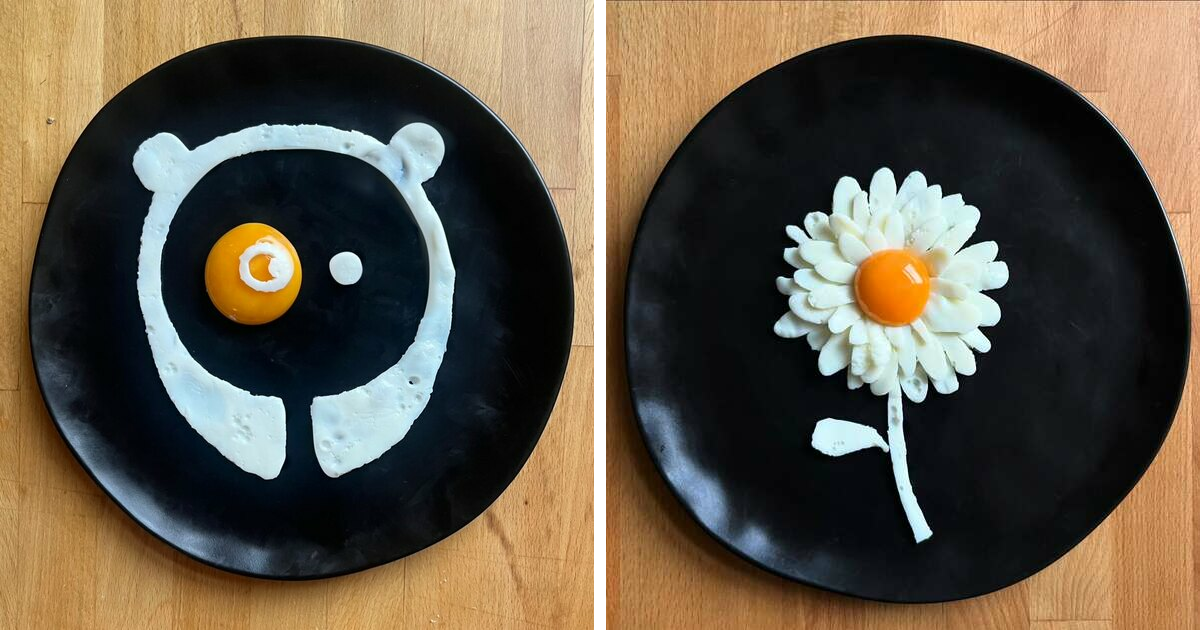
Most people fry eggs because they are hungry. Michele Baldini fries eggs because his breakfast apparently woke up one day and decided it wanted a gallery opening.
If you have ever looked at a sunny-side-up egg and thought, “Nice protein, but what if it were also a panda, a skyline, or a tiny surreal masterpiece?” then welcome. You are among friends. Baldini, the artist behind The Eggshibit, has built a wildly recognizable style by using egg whites as shape, the yolk as spotlight, and a dark pan as his stage. The result is part breakfast, part design exercise, part visual prank, and somehow still very edible.
That is what makes his work so magnetic. Fried egg art sounds like a joke until you see how much control it takes. One wobble too many and the panda becomes abstract sadness. One second too long in the skillet and the moon turns into a rubber coaster. Baldini’s pieces work because they are playful without being sloppy. They feel casual, but they are carefully composed. In other words, they are the culinary version of someone saying, “Oh, this old thing?” while wearing a jacket that clearly took three fittings and a mood board.
Why Fried Eggs Work So Well as an Art Medium
Eggs are ridiculously expressive for such humble ingredients. The white gives you line, silhouette, texture, and negative space. The yolk gives you contrast, mood, and a built-in focal point. On a black pan, that color contrast becomes dramatic fast. Baldini has said that this visual tension between bright yolk, pale white, and dark background is one of the reasons eggs remain his favorite medium.
There is also the thrill of impermanence. A painting can hang on a wall for decades. A fried egg masterpiece has a much shorter career path. It lives in the pan, gets photographed at its prime, then becomes breakfast. That temporary quality is part of the charm. It is art with a countdown timer and a side of toast.
Technique matters, too. Great fried eggs rely on heat control, pan choice, and fat selection. Home cooking authorities in the United States tend to agree on a few basics: use a reliable nonstick or well-seasoned pan, control the heat, and decide whether you want gentle whites or crispy edges before the egg ever hits the skillet. Some methods lean on medium-low heat and a lid for cleaner, more delicate shapes; others embrace hot oil for dramatic browning and lacy edges. For an artist like Baldini, that choice is not just culinary. It is aesthetic.
The Artist Behind the Viral Egg Art
Baldini’s egg art journey reportedly began with a simple yin-yang idea. That one experiment led to more designs, more complexity, and eventually the launch of The Eggshibit in 2017. Over time, his work evolved from clever food photos into a recognizable visual identity. He has spoken about pushing into new backgrounds, new subjects, and more layered compositions, while still returning to eggs as the medium that feels most calming and captivating.
That detail matters because his work is not just “food shaped like stuff.” It is a sustained creative practice. Some pieces are quick and witty. Others reportedly take far longer, especially when they reference famous paintings, city skylines, or intricate graphic forms. He has also emphasized that the food is not wasted, which is important in a world where spectacle can sometimes outrun common sense.
There is another reason the work connects so strongly online: it sits at the crossroads of food culture, social media, and visual art. American audiences are already primed to love photogenic breakfast, clever plating, and highly shareable kitchen creativity. Baldini just cracked that formula open and found a yolk in the middle.
50 Creative Ways That This Artist Has Fried His Eggs
Across his better-known Eggshibit pieces and the newer works that keep appearing in his portfolio, Baldini has turned fried eggs into a surprisingly broad visual universe. Here are 50 standout directions his egg art has taken.
Animals, Nature, and Living Things
- A yin-yang symbol that helped launch the whole obsession.
- A panda face that somehow makes breakfast look cuddly.
- A daisy-like flower with the yolk glowing at the center.
- A snail shape that proves slow food can also be literal.
- A bird silhouette perched in elegant simplicity.
- A sheep made from soft curves and woolly suggestion.
- A hippopotamus that looks delightfully oversized for one egg.
- A flower scene finished with a tiny pepper ladybug.
- A mountain sunrise where the yolk becomes the morning sun.
- A sun-and-moon composition that feels half breakfast, half mythology.
People, Faces, and Body-Inspired Designs
- Two tiny figures with bright yolk heads, like a minimalist stage play.
- A person lifting or holding a glowing sphere.
- A head with a brain-like yolk pattern that turns anatomy into design.
- A neuron-inspired composition with branching white lines.
- A smiling face made from a few well-placed curves.
- A clown face that somehow manages to be funny and slightly unsettling.
- A colorful character portrait with playful costume energy.
- A ghostly figure facing a stick figure, like a tiny breakfast haunting.
- A uterus-inspired piece using yolks as symbolic focal points.
- Hands reaching toward a yolk sun, turning the pan into a dramatic little universe.
Objects, Symbols, and Visual Wordplay
- A clean spiral design that reads like edible graphic art.
- A cartoon-style bomb with a fuse, because subtlety took the day off.
- A skeleton hand cradling a yolk sun.
- A question mark with the yolk serving as the dot.
- A tooth silhouette that would make any dentist pause respectfully.
- A gold medal complete with white “ribbons.”
- A wristwatch with the yolk as its glowing face.
- A birthday cake with candles, because apparently eggs can celebrate too.
- The words “Coming Soon,” staged like a tiny teaser poster.
- An Instagram-style logo that feels both clever and self-aware.
Travel, Places, and Architecture
- The Taj Mahal, with the yolk doing dome duty.
- The Leaning Tower of Pisa, because eggs appreciate architecture too.
- A skyscraper composition that stretches the medium vertically.
- A New York City skyline built from whites and yolk emphasis.
- A cathedral-like facade with dramatic structure.
- A castle scene where the yolk becomes a theatrical sun.
- A map-like outline that turns the skillet into a tiny atlas.
- A landscape scene that feels more painterly than breakfasty.
- A celestial planet-with-rings design, like Saturn got invited to brunch.
- A sun-and-mountains panorama with postcard energy.
Pop Culture, Play, and Big Imagination
- A simple car silhouette with smooth, cartoon confidence.
- A second car design using yolks as bright little wheels.
- A soccer ball pattern that looks almost too neat to eat.
- A guitar silhouette for the breakfast rock star.
- A fiery matchstick made from sharp contrast and heat-themed irony.
- A Starbucks-inspired visual riff from his earlier viral work.
- A Pac-Man-inspired piece that leans fully into playful nostalgia.
- A spider web composition that shows how intricate the medium can get.
- A Van Gogh-inspired Starry Night tribute, because modest ambition is overrated.
- A rotating cast of famous characters, iconic artworks, and pop references that keep the series feeling fresh.
What Makes These Fried Egg Ideas More Than a Gimmick
The obvious answer is skill, but the deeper answer is design thinking. Baldini understands that an egg already contains hierarchy. The yolk grabs attention first. The white frames it. A hot pan creates edges. A black surface creates drama. He is not fighting the ingredient; he is collaborating with it.
That is why his best pieces read clearly at a glance. In visual media, especially on social platforms, instant recognition matters. The panda looks like a panda quickly. The skyline reads as skyline quickly. The humor lands quickly. But when you linger, you also notice the precision: how little material he really has, how controlled the edges are, and how much mileage he gets from shape alone.
There is also a surprising connection here to the longer history of eggs in art. Eggs have carried symbolism in painting, design, and material culture for centuries. They can signal fragility, transformation, domestic life, fertility, breakfast comfort, or pure absurdity, depending on context. Baldini does not need to lecture the viewer on any of that. He just places a yolk in the right spot, and somehow your brain does the rest.
If You Want to Try Egg Art at Home
You do not need to aim for the Taj Mahal on your first attempt. Frankly, that way lies heartbreak. Start with shapes that forgive you: flowers, suns, faces, or simple silhouettes. Use a dark nonstick pan so the contrast works in your favor. Keep the heat controlled. Decide whether you want crisp edges or softer lines. Some cooks prefer oil for hotter frying and more browning; others use gentler heat, lids, or a little steam to help the whites set without tearing the design apart.
And yes, safety matters. If you are making egg art for actual eating and not just a dramatic photo shoot for your kitchen alter ego, handle eggs properly, keep them refrigerated, and cook them thoroughly enough for the people who will be eating them. Art is wonderful. Food poisoning is a terrible creative direction.
The Experience of Seeing and Making Fried Egg Art
There is something weirdly joyful about watching an ordinary egg become an image. It begins with the familiar little kitchen sounds: the pan warming, the faint pop of fat, the crack of shell against the skillet. Nothing about that opening act suggests artistry. It feels like a weekday. A routine. A quick breakfast before emails, errands, deadlines, or the thousand tiny chores that try to swallow a day whole. Then the white starts spreading, the yolk settles into place, and suddenly the pan stops being a pan. It becomes a blank canvas with breakfast privileges.
That shift is the real magic of Baldini’s work. He reminds us that creativity does not always need a studio, a giant budget, or an intimidating set of tools. Sometimes it needs one egg, one pan, a little patience, and the willingness to look at familiar things as if they are not finished becoming themselves. A fried egg is usually treated like the end of a process. Crack, cook, eat, done. In egg art, it becomes the beginning of a possibility.
There is also a delicious tension in the whole experience. You are making something that is fragile, temporary, and perishable, yet you are treating it with the seriousness of design. That contradiction makes the process more exciting. A painting can wait. A fried egg cannot. You have minutes, not days. Heat is changing the material while you work. The whites tighten, the edges firm, the yolk threatens to drift, and every second matters. It is improvisation with consequences. Tiny, breakfast-shaped consequences, but consequences all the same.
And then there is the emotional side. Good egg art often makes people laugh first. Not because it is silly in a dismissive way, but because it feels unexpectedly clever. The brain enjoys that kind of surprise. A panda made from breakfast is funny. A skyline made from breakfast is delightful. A flower, a guitar, a sheep, or a ghost made from breakfast can feel oddly comforting. There is play in it, and adults do not always give themselves enough permission to play with visual ideas unless the setting looks official. Put a sketchbook on a table and people get shy. Put an egg in a pan and suddenly everybody has opinions.
There is something personal about the aftermath, too. Once the photo is taken and the admiration is over, the art still becomes a meal. That part keeps the whole thing grounded. It never drifts too far into preciousness. The image matters, but breakfast still matters. You can appreciate the artistry and still reach for toast. In a strange way, that balance is what makes fried egg art feel so human. It is ambitious and domestic at the same time. It says beauty belongs in ordinary places, including the skillet you forgot to wash last night.
Maybe that is why Baldini’s work sticks with people. It does more than show off technical skill. It invites viewers to reimagine routine. It suggests that even a fast breakfast can hold surprise, wit, and composition. It turns a pan into a stage, a yolk into a spotlight, and a small kitchen moment into something worth sharing. Not bad for an ingredient that usually gets eaten in six minutes flat.
Final Thoughts
Michele Baldini’s fried egg art works because it combines discipline with mischief. It respects design, embraces humor, and never loses sight of the fact that eggs are both beautiful and a little ridiculous. That is a hard balance to strike. Across pandas, planets, skylines, flowers, landmarks, and surreal little symbols, he proves that breakfast can be far more expressive than most of us give it credit for.
So the next time someone tells you not to play with your food, consider offering a gentle amendment: maybe not mindlessly. But thoughtfully? Creatively? With a camera nearby and toast on standby? Absolutely.