Bob Einstein was the kind of comedian who could walk into a scene, say almost nothing, stare as if the universe had personally offended him, and somehow steal the entire show. The Super Bob Einstein Movie, HBO’s affectionate documentary about the late actor, writer, producer, and comedy original, reminds viewers that Einstein was far more than “the Super Dave guy” or Marty Funkhouser from Curb Your Enthusiasm. He was a precision engineer of awkwardness, a deadpan assassin, and a comedy insider so beloved that legends lined up to explain why he was impossible to duplicate.
This article explores five fascinating Bob Einstein facts highlighted by the documentary and supported by the real arc of his career. If you know him only as Super Dave Osborne, prepare to meet the writer behind the helmet. If you know him only as Funkhouser, prepare to discover the earlier comedy machinery that made that character so devastatingly funny. And if you already worship at the altar of Bob Einstein’s gravelly voice and volcanic pauses, congratulationsyou have excellent taste and probably enjoy making dinner guests uncomfortable in the best possible way.
Why Bob Einstein Still Feels Like a Comedy Secret
Bob Einstein’s career was unusual because it did not follow the classic show-business staircase. He was not a stand-up who became a sitcom star, nor a sitcom star who became a talk-show regular. He was a writer, performer, character creator, producer, and professional mood disruptor. His comedy often worked because he treated ridiculous situations as if they were deadly serious. That seriousness made the ridiculousness louder.
The Super Bob Einstein Movie celebrates that strange magic through archival clips, interviews with family members, and commentary from comedians who understood how rare his timing was. The film brings together his work on The Smothers Brothers Comedy Hour, his creation of Super Dave Osborne, and his unforgettable later role as Marty Funkhouser on Curb Your Enthusiasm. The result is not just a biography. It is a map of how one dry, stubborn, deeply funny mind influenced generations of comedy.
1. Bob Einstein Was Born Into ComedyThen Tried to Avoid It
One of the most compelling Bob Einstein facts is that comedy was practically built into his childhood, though not always in a cheerful way. Born Stewart Robert Einstein in Los Angeles in 1942, he was the son of comedian Harry Einstein, known professionally as Parkyakarkus, and actress-singer Thelma Leeds. His younger brother, Albert Brooks, would also become a major comic voice, filmmaker, and actor. In other words, the Einstein home was not exactly a quiet suburban bunker of normal small talk.
But the documentary does not present Bob’s family history as a simple “born funny” origin story. His father died after performing at a Friars Club event in 1958, when Bob was still a teenager. The aftermath affected him deeply. Accounts of his life often note that the young Einstein was disturbed by the way comedians continued joking around grief, and for a time he wanted no part of comedy at all.
That detail matters because it gives his humor a sharper edge. Bob Einstein was not merely chasing applause. He understood comedy’s strange relationship with pain, embarrassment, ego, and denial. His best characters are funny because they are wounded by the world but refuse to admit it. Super Dave always insists everything is under control when it clearly is not. Marty Funkhouser says outrageous things with the emotional temperature of a man discussing municipal parking. That tensionbetween chaos and controlfeels rooted in a performer who knew comedy was powerful, complicated, and not always polite.
2. His “Unlikely Discovery” Led to an Emmy-Winning Comedy Career
Bob Einstein did not glide into television as a perfectly packaged celebrity. Before his major TV break, he worked in advertising and was not initially planning to become a comedy performer. Then his dry, straight-faced style caught the attention of Tom Smothers, who invited him into the orbit of The Smothers Brothers Comedy Hour.
That opportunity changed everything. Einstein became one of the young writers connected to a groundbreaking variety show that mixed music, sketches, political satire, and countercultural energy. The show’s writing staff has become the stuff of comedy-history legend, and Einstein’s early work there placed him among rising talents who would shape American comedy for decades.
He also appeared on the show as Officer Judy, a character that showcased one of his greatest weapons: absolute commitment to an absurd premise. Officer Judy was not funny because Einstein winked at the audience. He was funny because he refused to wink. That deadpan approach would become his career-long signature.
The payoff was not just cult admiration. Einstein won a Primetime Emmy for his work on The Smothers Brothers Comedy Hour in 1969, and he later earned another major Emmy recognition connected to Van Dyke and Company. These awards are important because they remind viewers that Bob Einstein was not merely a “funny character actor.” He was a respected comedy writer with serious credentials long before many fans discovered him through cable television or HBO.
3. Super Dave Osborne Was a Perfect Parody of Show-Biz Confidence
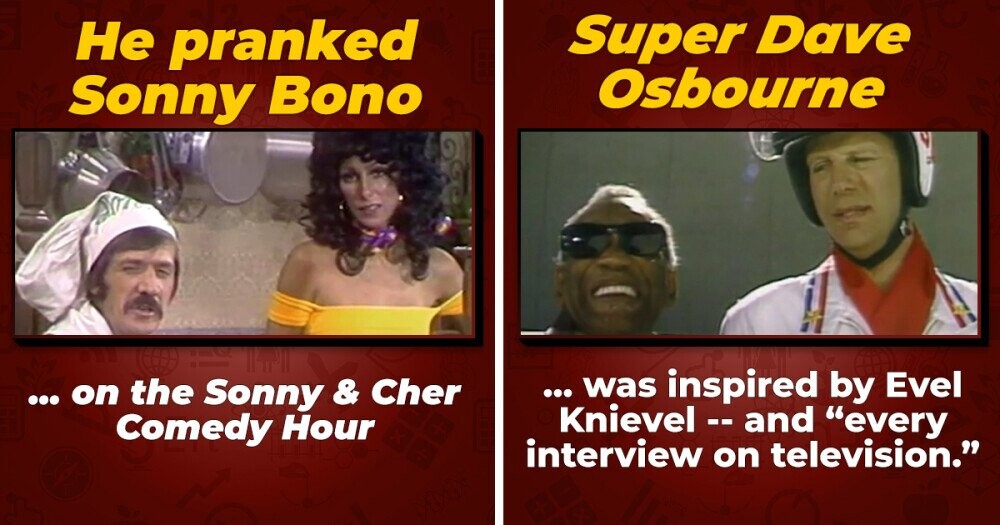
To many viewers, Bob Einstein will always be Super Dave Osborne, the delusionally confident stuntman whose plans rarely survived contact with reality. Super Dave wore the costume, spoke with heroic certainty, and carried himself like an entertainment icon. Then the bit would collapse into beautifully staged disaster. The joke was not just that Super Dave failed. The joke was that he never seemed to learn the correct lesson from failing.
The Super Bob Einstein Movie treats Super Dave as more than a silly recurring character. He was a satire of television spectacle, masculine bravado, sports-show hype, celebrity self-importance, and the old show-business belief that enthusiasm can fix bad planning. Super Dave was always introduced with confidence, surrounded by production language, assistants, equipment, and a promise that something incredible was about to happen. Then the comedy came from the gap between the promise and the result.
What made the character brilliant was Einstein’s refusal to make him openly goofy. Super Dave did not think he was ridiculous. He thought he was a professional. He gave instructions, corrected people, and reacted to setbacks with wounded dignity. That is why the character endured across shows, specials, talk-show appearances, and pop-culture memory.
Super Dave also reveals Einstein’s understanding of visual comedy. His sketches often used timing, editing, repetition, and obvious artificiality as part of the joke. Rather than hiding the fake nature of television stunts, he leaned into it. The audience was invited to enjoy both the character and the machinery of the gag. In a world now filled with viral fail videos and overproduced online spectacles, Super Dave feels oddly ahead of his time. He was parodying hype culture before hype culture got Wi-Fi.
4. Marty Funkhouser Turned Bob Einstein Into a Late-Career Icon
If Super Dave made Bob Einstein a cult hero, Marty Funkhouser introduced him to a new generation through Curb Your Enthusiasm. As Larry David’s friend and frequent social irritant, Funkhouser was a masterpiece of dry discomfort. He could be sincere, inappropriate, wounded, smug, or strangely noblesometimes within the same sentence.
The genius of Marty Funkhouser is that he never seems to be trying to be funny. He simply exists with absolute confidence in his own perspective. That made him ideal for Curb Your Enthusiasm, a show built on social friction, petty rules, conversational landmines, and the terrifying possibility that someone might say exactly what everyone else is trying not to say.
Einstein’s performance worked because he had decades of experience playing characters who believed in themselves too much. Funkhouser was not loud in the way Super Dave could be loud, but he carried the same comic DNA: dignity under pressure, misplaced certainty, and a face that suggested he had just tasted a lemon but did not want to discuss it.
His scenes with Larry David became fan favorites because they felt unpredictable. Funkhouser could function as Larry’s antagonist, victim, moral judge, or co-conspirator. He could make a small moment feel enormous simply by pausing a beat longer than expected. That is a rare skill. Many performers chase punchlines. Bob Einstein could make silence feel like a punchline that hired a lawyer.
5. The Documentary Shows How Deeply Other Comedians Respected Him
One of the most touching elements of The Super Bob Einstein Movie is the number of major comedy figures who appear to celebrate him. The documentary features family, friends, and fellow performers discussing his work, including people associated with stand-up, late-night television, sitcoms, sketch comedy, and film. That wide range says a lot about his reach.
Bob Einstein was a comedian’s comedian, but not in the vague way people use that phrase when they cannot think of a better compliment. He was admired because other comics could see the craftsmanship. They understood how difficult it is to maintain a character’s reality while the audience is laughing at the absurdity around him. They understood that his timing was not accidental. They understood that his cranky seriousness was a musical instrument.
The documentary also highlights how personal his comedy felt to those who knew him. He was not simply delivering jokes written on a page. He was bringing a worldview into the room: skeptical, precise, mischievous, stubborn, and allergic to anything fake. That is why people who worked with him often describe him not just as funny, but as singular. There are performers who are replaceable within a format. Bob Einstein was not. A scene changed when he entered it.
What Makes The Super Bob Einstein Movie Worth Watching?
The documentary works because it understands that Bob Einstein’s career cannot be reduced to one role. Some viewers arrive for Super Dave. Others arrive for Funkhouser. Some come because they love old-school variety television, and others because they want to understand why so many comedy legends speak about him with such affection.
The film’s best quality is that it lets the clips do real work. You can hear people describe Einstein’s timing, but then you get to see it. You can hear someone explain his deadpan style, then watch him hold a straight face inside a scene that would make a lesser performer start mugging like a tourist trapped in a selfie museum. The documentary respects the audience enough to show why the praise is deserved.
It also gives the viewer a fuller picture of his range. Bob Einstein wrote sharp sketches, built an iconic alter ego, played memorable supporting roles, appeared in films, and became a late-career HBO standout. The common thread was not format. It was sensibility. He had a comic worldview, and he carried it from writers’ rooms to stunt parodies to improvised social chaos.
How Bob Einstein’s Comedy Style Still Influences Modern Humor
Bob Einstein’s influence can be felt in several corners of modern comedy. First, there is the fake-serious character who treats nonsense as professional obligation. You see that style in mockumentaries, anti-comedy sketches, awkward interviews, and social-media characters who never admit they are the joke. Einstein mastered that approach early.
Second, there is the art of the slow burn. In a fast-cut world, Bob Einstein trusted pauses. He allowed discomfort to expand. He understood that the audience often laughs harder when a performer refuses to rush. That kind of timing is harder than it looks, because silence can either build tension or simply die on the floor. Einstein knew how to keep it alive.
Third, his work reminds writers that a character’s confidence can be funnier than a character’s stupidity. Super Dave was not just foolish. He was certain. Funkhouser was not just odd. He was convinced. That difference matters. A confident character creates friction with reality, and friction creates comedy.
Experiences Related to Watching The Super Bob Einstein Movie
Watching The Super Bob Einstein Movie feels a little like being invited to a private comedy wake where everyone is sad, everyone is laughing, and everyone secretly knows the guest of honor would have corrected the seating arrangement. The experience is warm without becoming syrupy. That is important because Bob Einstein’s comedy was never syrupy. It was dry toast served with a side of dynamite.
For viewers discovering him for the first time, the documentary can feel like opening a trapdoor under American comedy history. Suddenly, the connections appear everywhere: variety television, Steve Martin’s early orbit, the Smothers Brothers, cable comedy, late-night appearances, HBO improvisation, and the long tradition of performers who use seriousness as a weapon. You may start the film thinking, “Oh, I know that guy,” and finish it thinking, “Wait, why didn’t anyone make me study him in school?”
For longtime fans, the experience is more emotional. Super Dave clips bring back the joy of watching a character commit completely to a terrible idea. Curb Your Enthusiasm moments remind you how much texture Einstein gave to scenes that could have belonged entirely to Larry David. He did not need to dominate the frame. He could sit inside it, wait, and then tilt the whole room with one line or one look.
There is also a practical lesson for writers and performers: Bob Einstein trusted specificity. Super Dave was not “a silly stuntman.” He had a voice, wardrobe, rhythm, ego, vocabulary, and professional code. Marty Funkhouser was not “Larry’s weird friend.” He had grief, pride, irritation, loyalty, and a strange personal logic. The more specific the character, the bigger the laugh. That is one reason Einstein’s work still feels fresh. He did not chase generic funny. He built precise comic machines.
Another experience the film offers is the pleasure of seeing famous comedians become fans. When comedy stars talk about Bob Einstein, they do not sound like publicists reading polite tribute cards. They sound like people still trying to figure out how he did what he did. That kind of admiration is contagious. It encourages viewers to rewatch his scenes more carefully, not only for the joke but for the construction underneath it.
The documentary is especially rewarding for anyone interested in the invisible labor of comedy. A great joke may look effortless, but Einstein’s career shows the value of structure, patience, and character integrity. He knew when to push absurdity and when to underplay it. He knew that a performer can be outrageous without acting like they know they are outrageous. He knew that the straight face is sometimes the sharpest punchline in the room.
By the end, The Super Bob Einstein Movie leaves viewers with a rare feeling: gratitude for a comedian they may not have fully appreciated while he was alive. Bob Einstein’s work was never desperate for approval. It simply stood there, arms crossed, daring reality to get its act together. That confidence made him funny. The humanity beneath it made him unforgettable.
Conclusion: Bob Einstein Was the Master of Serious Nonsense
The five most fascinating Bob Einstein facts from The Super Bob Einstein Movie reveal a performer who turned contradiction into comedy. He came from a legendary comedy family but resisted the business. He became an Emmy-winning writer before many viewers knew his face. He created Super Dave Osborne, a parody of fearless confidence powered by glorious failure. He later became Marty Funkhouser, one of the great deadpan supporting characters in modern television. And behind all of it, he earned the admiration of comedy’s most respected voices.
Bob Einstein’s legacy is not just that he made people laugh. It is that he made people laugh in a way that felt entirely his own. He did not beg for attention. He tightened the screws, raised an eyebrow, and let the absurdity do its job. In a comedy world full of noise, Bob Einstein proved that the funniest person in the room might be the one acting like nothing funny is happening at all.