Spotting a French Bulldog sounds easy until you meet a Boston Terrier with attitude, an English Bulldog in travel size, or a mixed-breed pup wearing suspiciously Frenchie-looking ears. The French Bulldog, often called the “Frenchie,” is one of the most recognizable small dog breeds in the United Statesbut only when you know what details to look for.
A true French Bulldog is not simply “a small dog with big ears.” This breed has a specific combination of features: a compact, muscular body, a square head, upright bat ears, a short smooth coat, a naturally short tail, and a charming personality that says, “I am tiny, but I own this couch.” Whether you are trying to identify a dog at the park, choose the right breed, understand a rescue listing, or simply win a friendly debate with someone who keeps calling every flat-faced dog a pug, this guide will help.
Below are four practical ways to identify a French Bulldog using appearance, size, coat, behavior, and breed-specific clues. Think of it as a friendly field guideno magnifying glass required, although a treat in your pocket may improve cooperation.
1. Look at the Body Shape: Compact, Muscular, and Built Like a Tiny Tank
One of the easiest ways to identify a French Bulldog is to study the overall body shape. Frenchies are small dogs, but they are not fragile-looking. They usually have a sturdy, muscular build with heavy bone, a broad chest, and a compact frame. A healthy French Bulldog should look balanced and solid, not long-legged, narrow, or delicate.
The breed is often described as “a Bulldog in miniature,” but that does not mean it should look exactly like a tiny English Bulldog. French Bulldogs are generally lighter, more agile, and less wrinkled than English Bulldogs. Their bodies are short and close to the ground, but they should still appear active and alert rather than overly bulky or sluggish.
Check the Size and Proportions
Most adult French Bulldogs are under 28 pounds. They typically stand around 11 to 13 inches tall at the shoulder, though individual dogs vary. The important clue is proportion. A Frenchie’s body should appear short, strong, and well-balanced. The back may show a slight rise behind the shoulders, often called a “roach back,” which gives the breed its distinct outline.
If the dog is very tall, long-bodied, and athletic-looking, it may be a Boston Terrier, Frenchton, or another mixed breed. If the dog is much heavier, lower, and has a large rolling gait, it may be an English Bulldog. French Bulldogs sit somewhere in the middle: small enough for apartment life, sturdy enough to look like they have been secretly lifting weights.
Notice the Chest, Legs, and Stance
French Bulldogs usually have a broad chest and strong front legs set fairly wide apart. Their rear legs are often slightly longer than their front legs, which can contribute to the breed’s unique posture. When standing, a Frenchie often looks confident and square, as if it has just remembered it is the mayor of the sidewalk.
Avoid judging by size alone, especially with puppies. Young French Bulldogs may look round, floppy, and unfinished. The overall structure becomes easier to identify as they mature. Still, even a young Frenchie usually shows a broad head, short muzzle, thick little body, and those famous ears beginning to make an appearance.
2. Study the Head and Ears: The Famous Frenchie Signature
If the body gives you the first clue, the head and ears usually seal the case. The French Bulldog’s head is one of its most defining features. It is large in proportion to the body, broad, square, and expressive. The face is short and flat, with a wide muzzle, rounded forehead, and noticeable wrinkles around the nose and brow.
But the real giveaway is the ears. French Bulldogs are known for their large, upright “bat ears.” These ears are broad at the base, rounded at the top, and carried erect. They should not fold forward like a Labrador’s ears or curl like classic “rose ears” seen in some Bulldogs. If the dog has a compact body and those unmistakable upright ears, you are probably looking at a Frenchie or a Frenchie mix.
French Bulldog Ears vs. Other Dog Ears
French Bulldog ears are not just big; they are shaped in a particular way. Boston Terriers also have upright ears, which is why the two breeds are often confused. However, Boston Terriers usually have a more refined, tuxedo-like appearance, longer legs, and a less heavy build. Their heads may look cleaner and less deeply wrinkled than a French Bulldog’s.
English Bulldogs, on the other hand, generally have smaller folded ears, a much heavier body, and more pronounced facial wrinkles. Pugs have folded ears, curled tails, and rounder bodies. A French Bulldog’s bat ears stand up like two adorable satellite dishes tuned permanently to the sound of snack bags.
Look at the Muzzle and Face
French Bulldogs are brachycephalic dogs, meaning they have short muzzles and flat faces. The nose is short, the muzzle is broad, and the lower jaw may appear slightly undershot. Their eyes are usually round, dark, and expressive, giving them a comical yet thoughtful look. A Frenchie can seem deeply philosophical while thinking about absolutely nothing except your sandwich.
Because of the short face, French Bulldogs may snort, snuffle, or breathe noisily, especially when excited. However, noisy breathing should not be ignored. Extreme breathing trouble is not a “cute Frenchie thing”; it can be a health concern. When identifying the breed, remember that the flat face is typical, but severe distress is not something to romanticize.
3. Check the Coat, Colors, Tail, and Overall Finish
Another practical way to identify a French Bulldog is to examine the coat and tail. Frenchies have short, smooth, fine coats that lie close to the body. They do not have long hair, fluffy furnishings, feathering, or a wiry texture. A typical French Bulldog coat should feel sleek and easy to groom.
Common French Bulldog colors include brindle, fawn, cream, white, and combinations such as pied patterns. Brindle dogs may have dark coats with lighter streaking. Fawn dogs range from light tan to deeper reddish shades. Cream Frenchies are pale and smooth-looking, like a cappuccino that learned to bark.
Understand Standard and Nonstandard Colors
Coat color can be helpful, but it should not be your only identification method. Some French Bulldogs appear in popular “rare” colors such as blue, lilac, chocolate, merle, or black-and-tan. These colors are widely advertised, but they are not always accepted in traditional breed standards. A dog may still look like a French Bulldog and even be registered, but color alone does not prove quality, health, or responsible breeding.
If you are identifying a French Bulldog for casual purposes, focus on the complete picture: body, head, ears, coat, tail, and temperament. If you are choosing a puppy, pay more attention to health testing, breeder ethics, veterinary records, and the dog’s overall well-being than to a trendy coat color. A “rare” color is not a personality, no matter how fancy the sales page sounds.
Look at the Tail
French Bulldogs have naturally short tails. The tail may be straight or screwed, but it should be short and set low. Unlike Pugs, Frenchies do not have long curled tails carried over the back. Unlike many small terriers, they do not have long whip-like tails. The Frenchie tail is more of a punctuation mark than a full sentence.
However, because tails can vary and some mixed-breed dogs inherit short tails, this clue works best when combined with other features. A short tail plus bat ears plus square head plus compact muscular body? Now the evidence is stacking up.
4. Observe Personality, Movement, and Everyday Behavior
Physical traits are the easiest way to identify a French Bulldog, but behavior can add useful confirmation. Frenchies are companion dogs. They tend to be affectionate, playful, people-oriented, alert, and often hilariously stubborn. They are not usually high-endurance athletes, and most would rather enjoy moderate play, short walks, and serious sofa supervision.
A French Bulldog often moves with a confident, slightly rolling gait. It may trot with purpose, stop suddenly to greet a stranger, then refuse to continue walking because the sidewalk has offended it. That stubborn streak is part of the breed’s charm, though training and socialization are still important.
Frenchies Are Social, Not Usually Hyperactive
Many French Bulldogs enjoy attention and bond strongly with their people. They can be playful and silly without needing hours of intense exercise. This makes them popular with apartment dwellers and families who want a small companion dog with a big personality.
That said, no breed personality is guaranteed. A dog’s behavior depends on genetics, training, socialization, environment, and health. Some Frenchies are outgoing comedians. Others are quieter observers. A few behave like tiny security guards who believe every delivery driver is part of an international biscuit conspiracy.
Watch for Breed-Specific Care Clues
French Bulldogs often need careful management in hot weather because their flat faces can make cooling themselves more difficult. Many Frenchies are sensitive to heat, heavy exercise, and humidity. They may also require regular cleaning around facial folds, ears, and skin. These care needs do not identify the breed by themselves, but they are common signs that you are dealing with a brachycephalic companion breed.
Another important clue: French Bulldogs are generally not strong swimmers. Their heavy front bodies, short muzzles, and compact structure can make water risky. If someone says, “My Frenchie loves the pool,” the correct response is not panic, but it is wise to think “life jacket, supervision, and no unsupervised water access.”
French Bulldog vs. Similar Breeds
French Bulldogs are often confused with Boston Terriers, English Bulldogs, Pugs, and Frenchie mixes. The differences become easier once you compare them feature by feature.
French Bulldog vs. Boston Terrier
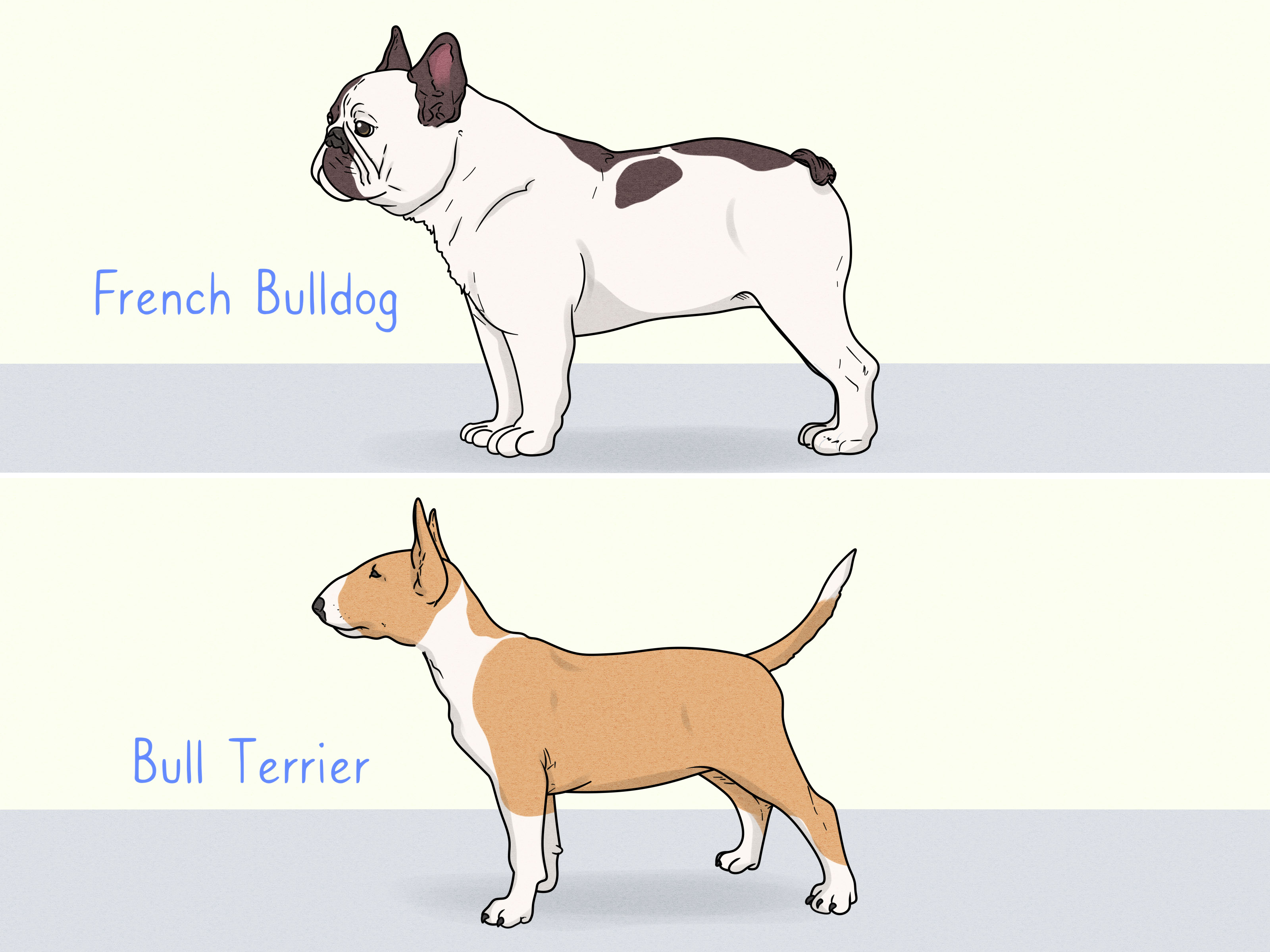
Boston Terriers are usually leggier, lighter, and more athletic-looking. They often have a sharper tuxedo pattern and a less heavy head. French Bulldogs are stockier, broader, and more muscular, with a heavier bone structure and rounder bat ears. If the dog looks like it is wearing a formal suit and ready for a debate tournament, it may be a Boston Terrier. If it looks like a compact comedian with gym membership energy, it may be a Frenchie.
French Bulldog vs. English Bulldog
English Bulldogs are larger, heavier, lower to the ground, and more wrinkled. Their ears are usually not upright bat ears. French Bulldogs are smaller, more alert-looking, and have the famous erect ears. Think of the English Bulldog as the slow-moving old uncle of the Bulldog family and the Frenchie as the mischievous younger cousin who steals attention at every gathering.
French Bulldog vs. Pug
Pugs are rounder, have curled tails, and usually have folded ears. Their faces are flat, but their overall body shape is different. French Bulldogs have upright ears, broader chests, and naturally short tails. If the dog has a cinnamon-roll tail, it is probably not a French Bulldog.
Quick Checklist: How to Identify a French Bulldog
- Body: Small, compact, muscular, and sturdy.
- Weight: Usually under 28 pounds as an adult.
- Head: Large, square, broad, and expressive.
- Ears: Upright bat ears, wide at the base and rounded at the top.
- Muzzle: Short, broad, and flat-faced.
- Coat: Short, smooth, and close to the body.
- Tail: Naturally short and set low.
- Temperament: Affectionate, alert, playful, and sometimes delightfully stubborn.
Common Mistakes When Identifying a French Bulldog
The biggest mistake is relying on one feature. Big ears alone do not make a French Bulldog. A flat face alone does not make a French Bulldog. A compact body alone does not make a French Bulldog. The breed is identified by the combination of traits.
Another mistake is assuming every “rare color Frenchie” is automatically a better French Bulldog. Coat color does not replace structure, health, temperament, or responsible breeding. In fact, buyers should be cautious when a breeder focuses more on exotic colors than on health testing and breed knowledge.
A third mistake is expecting every French Bulldog to look exactly like a show dog. Pet Frenchies may vary. Some have longer legs, smaller ears, lighter frames, or unusual markings. Mixed-breed dogs may also carry many Frenchie traits. Identification is often about probability, not courtroom-level certainty. Unless you have registration papers or DNA results, the best answer may be “French Bulldog type” or “Frenchie mix.”
Personal Experiences and Practical Observations About Identifying French Bulldogs
After observing French Bulldogs in parks, neighborhoods, pet-friendly cafés, and online adoption listings, one thing becomes clear: the ears get all the attention, but the body tells the deeper story. Many people spot the bat ears first and immediately shout “Frenchie!” with the confidence of a game-show contestant. Sometimes they are right. Sometimes the dog is a Boston Terrier mix who simply has excellent ear posture.
The most reliable identification comes from slowing down and looking at the whole dog. A true French Bulldog usually has a dense little body that feels visually heavier than expected. Even when small, the dog has a broad chest, strong neck, and compact shape. It does not look fragile. It looks like someone compressed a full-sized Bulldog into a carry-on suitcase and gave it opinions.
In real-life situations, the head is often the second clue. French Bulldogs have a very distinct expression: alert, curious, slightly dramatic, and deeply convinced that humans exist to open doors. The square head, short muzzle, round eyes, and forehead wrinkles create a face that is hard to miss. When paired with upright bat ears, the look becomes unmistakable.
One useful experience-based trick is to compare how the dog stands. Boston Terriers often appear more upright, springy, and athletic. French Bulldogs tend to look broader and more grounded. They can be playful, but they rarely look like they are preparing for a track meet. A Frenchie’s energy often comes in short bursts: zoom, snort, pause, demand applause, repeat.
Another practical observation involves sound. Many French Bulldogs make little snorts, grumbles, and snuffles during normal excitement. This does not mean every noisy small dog is a Frenchie, but the combination of short muzzle, compact body, bat ears, and expressive snuffling is very French Bulldog-like. Still, breathing difficulty should never be brushed off as normal. Cute sounds are one thing; struggling to breathe is a veterinary concern.
Coat texture is also helpful in person. A Frenchie coat is short and smooth, with no fluff, feathering, or long hair. If a dog looks like a fluffy French Bulldog, it may be marketed that way, but it does not match the traditional breed standard. That does not make the dog less lovable, of course. Dogs do not care about breed standards; they care about snacks, naps, and whether you dropped cheese.
When identifying puppies, patience matters. French Bulldog puppies can look like round potatoes with ears still deciding their career path. Some ears stand early; others take time. A young puppy may not show adult proportions yet, so it is better to look at the parents, breeder information, veterinary records, and overall structure instead of guessing from one photo.
Rescue dogs can be trickier. Many dogs listed as French Bulldogs are actually mixes, and that is perfectly fine as long as expectations are clear. A Frenchie mix may share the bat ears and compact size but have a longer muzzle, longer tail, different coat, or more athletic build. In adoption situations, the goal should not be “Is this dog perfectly standard?” but “Do I understand this dog’s needs, health, and personality?”
The most memorable French Bulldogs tend to confirm the breed description through personality. They are often affectionate without being overly delicate, funny without trying, and stubborn in ways that make training both important and entertaining. A Frenchie may learn a command quickly, then pause as if reviewing the contract terms before obeying. That mix of intelligence, charm, and selective cooperation is part of why the breed has become so popular.
In short, the best experience-based method is this: do not identify a French Bulldog by one “cute” trait. Identify the pattern. Bat ears, square head, short muzzle, compact muscular body, smooth coat, short tail, affectionate personality, and moderate activity level all work together. When those clues line up, you are probably looking at a French Bulldog. When only one or two clues appear, you may be meeting a mixand possibly a wonderful one.
Conclusion
Learning how to identify a French Bulldog is mostly about recognizing the full breed picture. Look for a small but sturdy body, a square head, large upright bat ears, a short smooth coat, a naturally short tail, and a playful companion personality. French Bulldogs are charming, expressive, and easy to love, but they also have real care needs, especially related to breathing, heat sensitivity, and responsible breeding.
Whether you are comparing similar breeds, researching before adoption, or simply trying to understand the adorable little dog snorting beside you at the park, these four identification methods will help you make a smart, informed guess. And if the dog turns out not to be a Frenchie? Congratulationsyou still met a dog. That is rarely a bad day.
SEO Tags
Note: This article is written for general breed-identification and educational purposes. For confirmation of a dog’s breed, pedigree documents, responsible breeder records, rescue history, veterinary guidance, or a dog DNA test may provide more accurate information.