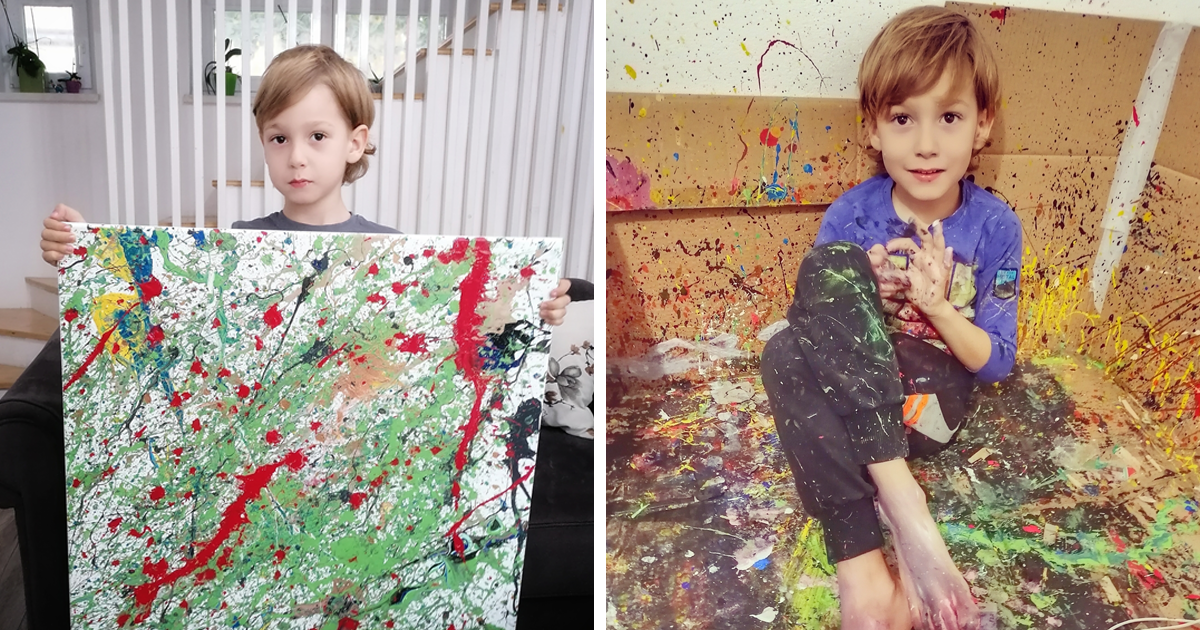
There are days when parenting feels like being handed a map written in invisible ink. You know there is a destination somewherebreakfast without tears, shoes on the correct feet, a grocery trip that does not become a Broadway production in aisle sevenbut the route keeps changing. Then, one afternoon, your 5-year-old walks up to a table, dips a brush into blue paint, and suddenly the map appears.
That is how these 29 paintings began: not as a formal art project, not as a perfectly staged “creative childhood” moment with matching smocks and organic apple slices, but as a quiet discovery. My son, who is autistic, found color before he always found words. He found rhythm in brushstrokes, order in repeating shapes, comfort in mixing paint, and joy in making something that did not ask him to explain himself first.
Autism spectrum disorder affects how a child may communicate, interact, learn, process sensory information, and respond to the world. But no two autistic children are the same. Some speak early and in paragraphs. Some use few words. Some love noise; others treat a blender like a household dragon. Some line up toys, memorize train schedules, notice tiny details, or fall in love with textures, numbers, maps, music, orlike my sonpaint.
This collection of 29 paintings is not a claim that every autistic child is a hidden genius with a tiny beret. That stereotype is too heavy for real children to carry. Instead, these paintings are a window into one child’s way of exploring, regulating, playing, communicating, and saying, “Here I am,” without needing to say it in a sentence.
When Paint Becomes a Language
For many autistic children, communication is not limited to spoken language. A child may use gestures, facial expressions, hand-leading, pictures, sounds, movement, or behavior to share needs and feelings. Art can become another form of expressionnot a replacement for speech therapy, occupational therapy, or other supports, but a meaningful bridge between inner experience and the outside world.
When my son paints, he does not begin with a title. He begins with motion. A thick stripe of yellow may come first, followed by tiny green dots marching across the page like determined ants. Then he pauses, leans close, and studies the wet surface with the seriousness of a museum curator who has just discovered the snack drawer is empty.
Sometimes he paints in silence. Sometimes he hums. Sometimes he repeats a phrase from a cartoon while making the same curved line again and again. To an adult in a hurry, it might look repetitive. To him, it looks organized, predictable, and satisfying. Repetition can be calming. Patterns can feel safe. A brush moving across paper can offer sensory feedback that is easier to manage than a room full of questions.
The Story Behind the 29 Paintings
The number 29 was not planned. We did not sit down and say, “Today, young master, you shall produce a gallery-ready body of work.” We started with one painting, then another, then another. Soon the refrigerator was out of real estate. The dining table had suspicious purple fingerprints. The floor had what I now describe as “limited edition washable acrylic accents.”
Each painting became a small record of a day: a mood, a sensory preference, a new fascination, a brave experiment. Some pieces are full of bold color, as if the page is laughing. Others are soft and careful, with pale layers of blue and gray. A few look like storms. A few look like outer space. One looks exactly like our cat if our cat were made of orange lightning and had recently discovered jazz.
1. The Blue One That Started Everything
The first painting was almost entirely blue. Not sky blue. Not ocean blue. More like “my child has found one color and formed a lifelong business partnership with it” blue. He covered the page slowly, corner to corner, and smiled when the white disappeared. It was less about making a picture and more about creating a world he could control.
2. The Dots That Became a Parade
Another painting featured rows of dots in red, green, and yellow. They were not random. He placed them carefully, almost ceremonially. Dot, pause, dot, pause, dot. I watched him build order from color, and I realized that what looked simple to me may have felt beautifully complete to him.
3. The Storm Painting
One day after a difficult morning, he painted fast. The brush moved hard across the paper. Black mixed with purple. Lines crossed and collided. I did not ask, “What is it?” That question can turn art into a quiz. Instead, I said, “You used strong lines.” He looked at the painting, then at me, and pressed the brush into the paper one more time. Strong lines indeed.
4. The Rainbow With No Rules
Many children paint rainbows as neat arches. My son painted one as blocks, spirals, and sudden explosions of color. It did not follow the usual order, and that was exactly what made it wonderful. Autism often reminds adults that “different” is not a broken version of “typical.” Sometimes different is simply a new design system.
5. The Painting That Took 42 Minutes
One piece took nearly three-quarters of an hour. For a 5-year-old, that is basically a feature-length film. He layered green over yellow, then scratched lines through the paint with the back of the brush. It became a field, or a forest, or maybe just the joy of texture. The final image mattered less than the sustained focus it gave him.
Why Art Can Be Meaningful for Autistic Children
Art-making can support several areas that matter deeply for many autistic children: communication, sensory exploration, fine motor practice, emotional regulation, flexibility, and confidence. It is not magic. It will not “cure” autism, and it should never be used to force a child to perform normality. Autism is not a smudge to paint over. But creative activities can provide a child-friendly, flexible way to engage with the world.
Art Supports Nonverbal Expression
Some feelings are too big, too fast, or too slippery for words. Painting allows a child to express intensity without needing to name it immediately. A red page can say “angry,” “excited,” “hot,” “loud,” or simply “I like red today.” The adult’s job is not to decode every mark like a detective in a crime drama. The job is to notice, respect, and stay curious.
Art Offers Sensory Exploration
Paint has texture, temperature, resistance, smell, shine, and sound. For a child with sensory sensitivities, that can be either inviting or overwhelming. Some autistic children love finger painting; others would rather shake hands with a cactus. Offering choicesbrushes, sponges, cotton swabs, rollers, gloves, thick paper, thin paperlets the child control the sensory experience instead of being ambushed by it.
Art Builds Fine Motor Skills
Holding a brush, squeezing a sponge, peeling tape, opening paint caps, and making controlled strokes all involve small hand movements. These activities can support coordination and strength without feeling like a worksheet wearing a boring little hat. When practice is playful, children often stay engaged longer.
Art Creates Predictable Routines
Many autistic children benefit from predictable structure. Our painting routine became simple: choose paper, choose colors, paint, dry, wash hands, display. That routine gave my son freedom inside a safe frame. He knew what would happen next, which made it easier to try something new within the activity.
How We Created a Calm Painting Space at Home
Our setup is not fancy. We do not have a studio. We have a table that has survived snacks, slime, crayons, dinosaurs, and one tragic yogurt incident. The goal was not perfection; it was access.
We used washable paints, thick paper, a cup of water, a few brushes, wipes, and an old shirt as a smock. I put only two or three colors out at a time at first. Too many choices can be exciting, but they can also turn into chaos. Ask me how I learned this. Actually, do not ask. The answer involves brown paint, enthusiasm, and a chair that still remembers.
We also made cleanup part of the routine. Some days he helped rinse brushes. Some days he refused, and that was okay. A creative activity should not become a battlefield over sink participation. The long-term goal was comfort, not compliance theater.
What the 29 Paintings Taught Me
Looking at all 29 paintings together, I saw more than color. I saw patterns in his attention. I saw his preferences shift. I saw days when he wanted bold contrast and days when he needed soft repetition. I saw that he often returned to circles, dots, and layered stripes. I saw that he liked painting edges, filling empty space, and watching two colors meet.
Most importantly, I saw how easily adults underestimate children when communication looks different. A quiet child is not an empty child. A child who avoids eye contact may still be deeply engaged. A child who repeats a motion may be learning through rhythm. A child who cannot explain a painting may still know exactly what it means.
Do Not Rush the Meaning
One of the best changes I made was to stop asking, “What did you paint?” Sometimes he answered. Sometimes he echoed the last word I said. Sometimes he walked away. So I switched to observations: “You used a lot of green.” “That line is very long.” “You made the dots close together.” These comments invited connection without demanding performance.
Celebrate Process Over Product
Children know when adults are fishing for a cute result. If every painting must become a recognizable flower, house, dinosaur, or grandparent-approved keepsake, the activity can lose its freedom. Some of my son’s paintings are frame-worthy. Some look like a cloud had an argument with a marker. Both belong in the story.
Tips for Parents Who Want to Encourage Painting
If your child is autistic and you want to introduce painting, begin gently. Start with low pressure and high flexibility. You are not auditioning them for an art academy. You are offering a tool for exploration.
Start Small
Use one sheet of paper and one or two colors. A giant table full of supplies may look fun to adults, but it can overwhelm a child. Small beginnings are easier to repeat.
Follow Sensory Preferences
If your child dislikes wet textures, use brushes, rollers, stamps, or sealed paint bags taped to a table. If your child loves texture, try thick paint, sponge painting, or safe collage materials. The best art activity is one the child can tolerate and enjoy.
Use Visual Supports
A simple picture schedule can help: paint, dry, wash hands, finished. Visual routines reduce uncertainty and make transitions smoother. They also reduce the number of times a parent must say “almost done,” which is good because that phrase has carried many families through history and deserves retirement.
Offer Choices Without Overloading
Instead of asking, “What do you want to paint with?” try, “Blue or yellow?” Instead of presenting ten brushes, offer two. Choice supports autonomy. Too much choice can feel like being asked to select a college major before breakfast.
Respect Refusal
If your child pushes the paint away, that is communication. Try another day, another material, or another setup. Creativity grows best when it is invited, not dragged into the room wearing a tiny apron.
Autism, Creativity, and the Danger of Easy Labels
When people see an autistic child’s artwork, they sometimes jump quickly to labels: gifted, savant, miracle, genius. These words may sound complimentary, but they can flatten a child into a performance. My son is not inspiring because he paints despite autism. He is interesting because he is himself: playful, sensitive, stubborn, observant, funny, and occasionally convinced that pants are optional technology.
Autistic creativity does not need to be extraordinary to be valuable. A painting does not need to hang in a gallery to matter. The value may be in the calm it created, the choice it allowed, the motor practice it offered, or the connection it opened between child and parent.
My Favorite Painting in the Collection
Out of the 29 paintings, my favorite is not the most beautiful one. It is a piece with uneven orange circles floating over a dark blue background. The circles are different sizes, some carefully closed and some left open. When he finished, my son tapped each circle with his finger and made a soft sound, almost like counting but not quite.
I do not know what he intended. Planets? Bubbles? Lights? Cookies in space? Honestly, cookies in space would be a strong artistic direction. What I know is that he was peaceful while making it. He was focused. He was proud enough to bring it to me with both hands. That was the masterpiece.
Experience Section: What Living With These Paintings Has Been Like
Living with 29 paintings by my 5-year-old son with autism has changed the way I understand both parenting and art. Before this, I thought of painting as an activity: set up supplies, make a picture, clean up, display the best one. Now I see it as a conversation that happens in layers. Some conversations are loud and red. Some are quiet and blue. Some are mostly about the fascinating fact that wet paint can make a squishing sound if you press the brush hard enough.
The first lesson was patience. My son does not always enter an activity the way I expect. He may watch the paint for several minutes before touching it. He may paint the same corner repeatedly. He may abandon the brush and use the wooden end instead. In the beginning, I wanted to guide him toward what I thought painting should look like. “Try this.” “Use this color.” “Paint over here.” I meant well, but I was accidentally crowding the process. When I stepped back, his choices became clearer.
The second lesson was that mess is not the enemy. Yes, I still believe in washable paint with the devotion of a person who has scrubbed green fingerprints off a doorframe. But a little mess can be evidence of exploration. My son learned how much pressure makes a thick mark. He learned that yellow and blue can become green. He learned that paper gets soggy if you use too much water. These are small discoveries, but childhood is built from small discoveries stacked like blocks.
The third lesson was emotional. Some paintings seemed to help him settle after overstimulating moments. After a noisy outing or a tough transition, painting gave him something predictable to return to. The page did not talk too much. The brush did not ask him to make eye contact. The colors waited. That waiting mattered. In a world that often rushes autistic children to respond, perform, transition, or explain, a blank page can be unusually kind.
The fourth lesson was about connection. I learned to sit beside him without taking over. Sometimes we painted on separate papers. Sometimes I copied his dots, and he noticed. Sometimes he copied my line, then improved it, because apparently I am not the lead artist in this household. Parallel painting became one of our easiest ways to be together. We did not need a perfect back-and-forth conversation. The shared rhythm was enough.
The fifth lesson was advocacy. Sharing these paintings taught me how carefully autistic children should be represented. I never want people to look at his art and say, “Autism is beautiful” in a way that ignores his hard days. Some days are beautiful. Some are exhausting. Some include meltdowns, communication frustration, sensory overload, or heartbreak over a banana breaking in half. The paintings do not erase those realities. They simply add dimension. They remind people that an autistic child is not a checklist of challenges. He is a full person with preferences, humor, frustration, curiosity, and a point of view.
Finally, these paintings taught me to save evidence of joy. Not every piece needs a frame, but every piece deserves respect. We photographed them, dated some of them, and kept the ones that felt especially meaningful. Together, they became a visual diary of growthnot a straight line, not a miracle story, but a collection of moments when my son met the world through color and left proof that he had been there.
Conclusion
The 29 paintings by my 5-year-old son with autism are not just pictures. They are moments of communication, regulation, discovery, and joy. They show how art can give children a flexible way to explore feelings, textures, patterns, and choices. They remind parents to look beyond standard milestones and notice the quieter forms of expression happening right in front of them.
If you are raising an autistic child, painting may or may not become your child’s favorite activity. That is perfectly fine. The larger lesson is to keep offering safe, respectful opportunities for expression. Maybe your child finds joy in music, water play, building blocks, letters, numbers, movement, or lining up toy cars with the precision of a tiny city planner. Follow the interest. Protect the joy. Celebrate the process.
And if paint does become part of your family’s story, buy the washable kind. Trust me. Your walls have dreams too.
Note: This article is written for storytelling and educational purposes. It is not medical advice, therapy guidance, or a substitute for evaluation by qualified health, developmental, educational, or mental health professionals.