Everyday life is already strange. We stand in lines to buy things we could order while standing in the same line. We argue with machines that respond only with cheerful error messages. We spend years avoiding awkward conversations, then voluntarily join group chats containing 47 people and someone’s uncle.
Comic artist James Sandoval understands this peculiar condition. Through his webcomic series But a Jape, he takes familiar experiences, fantasy clichés, social habits, horror-movie logic, financial anxiety, pop culture, and random intrusive thoughts, then pushes them one step beyond reasonable behavior. Sometimes he pushes them several blocks beyond reason, steals reason’s parking spot, and leaves reason arguing with a ghost about plumbing.
This collection of 25 new comics demonstrates why funny comics about everyday life remain so appealing. Sandoval’s drawings do not merely repeat recognizable situations. They reinterpret them, twist their assumptions, and give minor absurdities enough room to become full-blown disasters.
The result is colorful, unpredictable comedy that can move from a frightened bear to medical debt, fantasy adventurers, celebrity culture, ancient inventions, and supernatural roommates without asking the reader to fasten a seat belt.
Meet James Sandoval, the Artist Behind “But a Jape”
James Sandoval publishes his work under the name But a Jape. He describes the series as his thoughts about life, the world, and art presented in picture form. The comic has appeared through Sandoval’s independent website as well as major webcomic platforms, where it is categorized as comedy and slice-of-life storytelling.
That description sounds simple until one begins exploring the archive. “Life” can mean a person reacting to a social trend. “The world” may involve healthcare bills, internet hypocrisy, or the way people turn criticism into entertainment. “Art” can mean anime conventions, video-game mechanics, superhero logic, horror tropes, or storytelling traditions that Sandoval cheerfully dismantles with a cartoon hammer.
His early comics were often created as self-contained gags. Characters initially existed because a joke needed someone to deliver a line, misunderstand a situation, or receive the consequences. Over time, recurring figures gained personalities, relationships, and fictional histories. A one-panel employee created to serve a punchline might eventually acquire friends, fears, moral contradictions, and what appears to be a disturbingly detailed insurance problem.
Sandoval has explained that he develops a character by asking what kind of person would naturally perform a particular role in the joke. That practical approach helped produce recurring personalities such as Beary, a friendly bear whose encounters repeatedly turn wilderness advice into panic, and Feitr Sordsmann, a supposed champion of justice built partly to parody heroic characters who solve every inconvenience with violence.
Why These 25 Funny Comics Feel So Fresh
1. Ordinary Advice Becomes Spectacularly Unhelpful
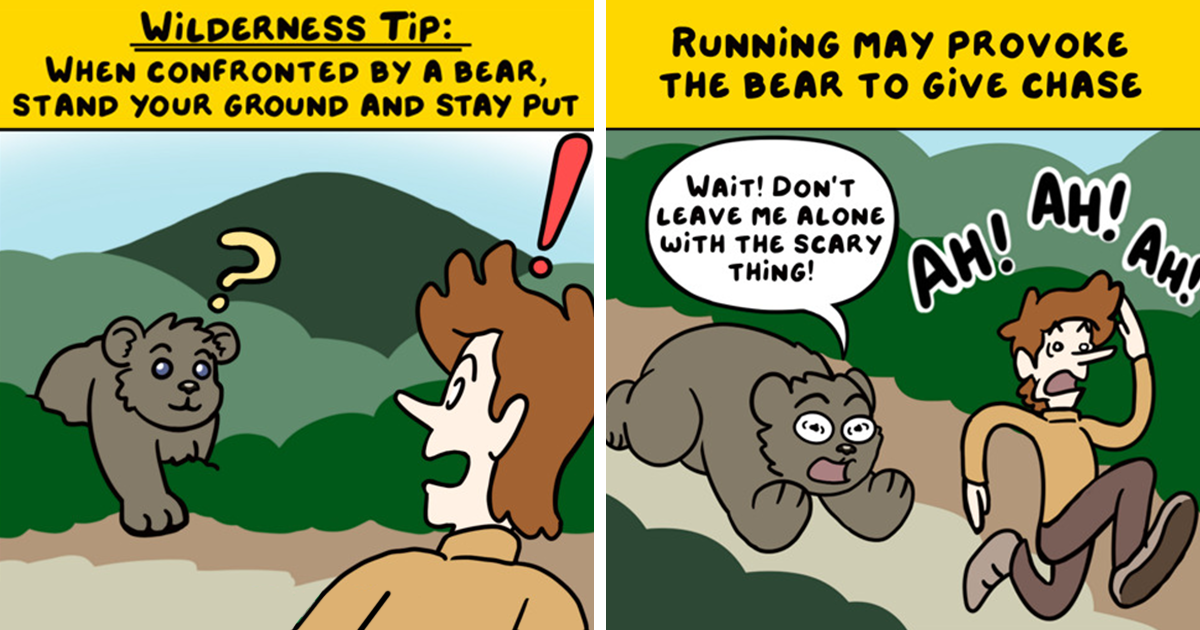
One comic begins with familiar wilderness guidance: when confronted by a bear, do not run. The joke changes perspective and imagines how that behavior might look to the bear. Instead of appearing brave, the motionless human becomes a mysterious and possibly horrifying object. When the person finally runs, the bear follows because it does not want to be left alone with whatever frightening thing caused the panic.
The humor works because the original instruction is sensible, but the comic refuses to accept the usual human-centered viewpoint. Sandoval asks what the animal thinks, and suddenly an educational poster becomes an emotionally complicated chase scene.
2. Horror Monsters Have Domestic Problems Too
Another strip introduces a terrifying spirit accompanied by ominous noises. The human initially assumes that the supernatural figure caused them. The ghost then explains that the plumbing has been deteriorating for years and the entire system may need to be replaced.
That reveal transforms supernatural terror into homeowner terror, which is arguably worse because an exorcist may leave after an hour, while a plumber might return with an estimate containing four commas.
Sandoval frequently uses this form of comic misdirection. He establishes one genre, encourages the reader to anticipate its conventional conclusion, and then replaces it with an embarrassingly practical concern. The haunted house is still frightening, but now the ghost is worried about water pressure.
3. Modern Social Behavior Is Treated Like Ancient Nonsense
A comic about the invention of the wheel makes fun of the difference between creating something useful and successfully marketing it. One inventor presents a circular device with an awkward name. The crowd rejects it. Another inventor introduces essentially the same object with a catchier presentation, and suddenly everyone believes civilization has arrived.
The setting is prehistoric, but the joke feels painfully current. People do not always choose the clearest idea, the best product, or the most practical solution. Sometimes they choose the option with the better slogan, smoother presentation, or founder who confidently announces that rocks have been “disrupted.”
4. Financial Anxiety Follows People Into the Afterlife
One of the darker comics features a ghost unable to complete his unfinished business. The phrase initially suggests revenge, justice, or a hidden family secret. Instead, the spirit remains trapped by financial obligations connected to medical treatment.
The absurd supernatural premise creates distance from a serious real-world frustration. Readers can laugh at the impossible image while recognizing the underlying fear: paperwork, debt, and bureaucratic systems have become so persistent that escaping them may require more than death.
This is a strong example of dark humor that aims upward at institutions rather than downward at vulnerable people. The ghost is not the target. The system that has turned haunting into an accounting appointment is.
5. Pop Culture Gets Punched Before the Boxer Does
Sandoval also plays with celebrity boxing, internet personalities, manufactured rivalries, and the strange economics of public spectacle. A character may begin by wanting an obnoxious celebrity to be punched, only to discover that the celebrity has found a way to charge admission, sell the humiliation, and schedule another profitable beating next month.
The joke recognizes a modern paradox: public criticism can become free marketing. Outrage attracts attention, attention attracts money, and eventually the audience realizes it has financed the exact person it claimed to dislike.
The Comic Techniques That Make the Ridiculous Situations Work
A Clear Setup That Looks Almost Normal
Successful comic strips give readers just enough information to form an expectation. A person hears a noise in a dark house. Someone introduces an invention. A ghost announces unfinished business. A character sees a troubling social interaction.
The setup must remain understandable because the final twist depends on the reader predicting something else. Confusion is not the same as surprise. If the reader cannot follow the first half, the punchline lands like a package delivered to the wrong apartment.
A Final Panel That Changes the Meaning of Everything
Many But a Jape comics use a classic reversal. The final panel does not simply add another joke; it forces the reader to reconsider the earlier panels.
The bear is not necessarily chasing prey. The monster did not produce the frightening noise. The inventor did not fail because the idea was useless. The ghost’s unfinished business is not mystical. Each conclusion rewrites the setup while remaining connected to it.
Cartoon humor often depends on this combination of recognition and incongruity. The reader recognizes the situation, detects the unexpected contradiction, and mentally resolves the two ideas. Discussions of cartoon construction have similarly emphasized surprise, visual pacing, social context, and the relationship between images and captions.
Visual Styles That Support the Subject
Sandoval has experimented with different formats and drawing styles, sometimes matching the artwork to the subject being parodied. An anime-related joke can borrow anime visual language, while fantasy strips may resemble adventure games or role-playing illustrations.
In more recent work, he has described relying on a smaller group of dependable styles rather than redesigning the visual approach for every individual gag. The lines have also become cleaner and the details more consistent as the production schedule has changed.
This consistency helps readers process the storytelling quickly. Faces remain expressive, poses are readable, and backgrounds contain enough information to support the scene without competing with the joke.
Characters Who Are More Than Punchline Delivery Systems
Recurring characters create an extra layer of comedy because readers know their habits. Beary’s friendliness and nervousness make each misunderstanding more effective. Feitr’s heroic reputation becomes funny because his violent instincts conflict with the society that celebrates him.
Sandoval’s fantasy work expands this approach by asking what a game-inspired universe would look like if supposedly unimportant non-player characters had real lives. Heroes may view an adventure as an opportunity to gain experience points, while civilians see the same event as another armed stranger entering town, breaking furniture, opening private containers, and demanding a quest.
The idea began as a parody of familiar fantasy and gaming clichés but gradually developed into a larger fictional society with its own relationships and moral problems.
Everyday Life Is the Perfect Fuel for Absurd Humor
Comic strips have long used domestic problems, public behavior, work, family life, technology, and social change as sources of comedy. The format allows artists to compress a recognizable experience into a few carefully arranged images. Historical collections maintained by the Library of Congress show how comic artists have used words and pictures to entertain readers, comment on society, and make difficult or mundane experiences easier to examine.
Webcomics continue that tradition while removing many old limitations. Artists can publish directly, experiment with unusual lengths, change styles, develop niche characters, and immediately see which jokes connect with readers.
Sandoval has admitted that predicting which comic will be most effective is difficult. Some strips are short and sharp, while others need more panels to develop their ideas. Audience reactions can be surprising, because a joke the artist considers straightforward may become a favorite while an ambitious one receives the digital equivalent of three polite coughs.
That uncertainty is part of comedy’s charm. Humor is not a factory where a creator inserts one setup, tightens two punchline bolts, and receives exactly 600 laughs. Context, timing, personal experience, cultural knowledge, and the reader’s mood all influence the response.
Why Readers Need Funny Comics About Ridiculous Situations
A four-panel comic cannot repair the healthcare system, defeat online hypocrisy, lower the cost of plumbing, or persuade fictional heroes to stop entering strangers’ homes and taking every visible potion. It can, however, change the emotional weight of those frustrations for a moment.
Humor gives readers permission to look directly at an annoyance without treating it as a personal failure. A bill becomes a ghost story. A social contradiction becomes a visual argument. A bad day becomes evidence that reality may be managed by writers who submitted the first draft accidentally.
Health organizations have noted that laughter may help reduce stress, support relaxation, and strengthen social connection. Humor is not a substitute for treatment or practical action, but it can provide a valuable pause from tension and help people share difficult experiences.
Online comics are particularly suited to this role. They require little time, can be shared easily, and often communicate feelings that would otherwise demand an uncomfortable five-minute voice message. Sending a comic can mean, “This made me think of you,” “We both do this,” or “Our workplace is clearly haunted by an accountant.”
A Reader’s Experience: Learning to See Daily Life Like a Comic Artist
Reading a large collection of everyday-life comics changes the way you notice ordinary events. At first, you simply enjoy the punchlines. After several strips, however, the mind begins searching for setups everywhere.
A self-checkout machine unexpectedly announces that an employee is coming to help. That is not merely a technical delay anymore. It is the beginning of a comic in which the machine has reported you for placing an emotionally suspicious avocado in the bagging area.
A meeting that could have been an email becomes a fantasy council where twelve exhausted villagers gather to hear a wizard slowly read an email aloud. The wizard then schedules a second council to discuss whether everyone understood the first council.
A person says, “I’m fine,” while carrying five grocery bags, a laptop, an umbrella, and the remains of their dignity. In comic logic, the bags would ask whether the person needs assistance. The person would refuse. The umbrella would quietly call a therapist.
This way of observing life is surprisingly useful. It encourages attention to contradiction. What do people say, and what do their actions reveal? Which rules are presented as logical but produce absurd results? What happens when a familiar situation is viewed from the perspective of the animal, machine, ghost, background character, or tired employee?
Consider customer-service conversations. A representative may say, “I completely understand your frustration,” immediately before transferring you to another department that has never heard of you, your problem, or apparently the company. A cartoonist sees two realities operating at once: the polite script and the chaotic system beneath it.
Public signs offer similar opportunities. A notice may prohibit an activity so oddly specific that it creates an entire unseen story. “Do not place live poultry in the elevator” raises several questions, none of which should be answered before lunch.
Technology is perhaps the richest source of accidental comedy. Software is designed to simplify life, but it regularly asks users to prove they are human by identifying blurry motorcycles while behaving like a suspicious robot itself. Password systems demand a capital letter, a symbol, a number, an ancient rune, and the name of a childhood pet you have spent years trying to forget.
The best everyday comics do not invent absurdity from nothing. They recognize that absurdity already exists inside familiar routines. The artist’s job is to isolate it, exaggerate it, and present it in a form that lets everyone else finally see the joke.
Trying this perspective can even soften minor frustrations. When the coffee machine fails, there is still no coffee, which remains a serious constitutional issue. Yet imagining the machine as a dramatic character protesting unsafe working conditions can turn irritation into a story.
That does not mean every inconvenience must become forced positivity. Some situations are genuinely painful, unfair, or exhausting. Dark and satirical comics work precisely because they do not pretend everything is wonderful. Instead, they say, “Yes, this is terribleand also, look at how bizarre it is.”
Sandoval’s comics often occupy that productive space. They acknowledge annoyance, fear, hypocrisy, and disappointment while allowing ridiculous characters to expose the hidden logic. A ghost complains about bills. A bear misreads safety advice. A heroic warrior reveals the frightening assumptions built into adventure stories.
After reading the collection, one may not become a cartoonist, but daily life starts looking more editable. The awkward pause becomes a panel break. The unnecessary explanation becomes a speech bubble. The unexpected consequence becomes the final frame.
And somewhere, probably just outside the scene, an anxious bear is waiting for everyone to stop screaming.
Conclusion: A Colorful Reminder That Normal Life Is Not Normal
The 25 new But a Jape comics succeed because they combine recognizable problems with unpredictable interpretations. James Sandoval does not depend on one subject, character, or format. He can move from fantasy parody to social satire, from horror to healthcare, and from ancient inventions to internet celebrities while maintaining a clear comic voice.
His strongest jokes invite readers to form an assumption and then overturn it. The surprise is funny, but the recognition beneath it creates the lasting appeal. We laugh because the situation is ridiculousand because, with only a minor adjustment, it resembles something we have experienced ourselves.
These funny comics about everyday life offer more than quick entertainment. They remind us that perspective changes everything. A terrifying monster may be worried about plumbing. A heroic adventurer may be someone else’s public-safety emergency. A groundbreaking invention may need nothing more than a better name.
Reality remains inconvenient, expensive, and frequently confusing. Fortunately, it is also providing comic artists with excellent material.
Note: This article is an original critical overview based on publicly available creator interviews, official comic profiles, established comic-history resources, and reputable discussions of humor and laughter. It does not reproduce the original comics or their artwork.