Turning a beloved TV comedy into a movie sounds easy, at least in the way microwaving leftover pizza sounds easy. You already have the characters. You already have the catchphrases. You already have fans who will show up out of loyalty, curiosity, or a dangerous combination of both. What could possibly go wrong?
As Hollywood has demonstrated again and again, plenty. A sitcom is often built on rhythm: twenty-two minutes, a familiar set, a handful of running jokes, and characters who feel like old friends because they drop by every week. A movie needs something different. It needs escalation, visual momentum, a bigger story, and enough freshness to justify asking audiences to leave the couch, buy a ticket, and pretend theater popcorn is a balanced dinner.
Some TV comedy movies have made the jump beautifully. Others arrived wearing a fake mustache and carrying a suitcase full of nostalgia. This list looks at 13 TV comedies that probably shouldn’t have been made into movies, not because the original shows were bad, but because the film versions struggled to understand what made the shows work in the first place.
Why TV Comedy Adaptations Often Go Wrong
The biggest issue with TV-to-movie comedy adaptations is scale. A small joke can feel charming on television and weirdly undercooked on the big screen. A character who is hilarious in weekly doses can become exhausting when stretched across 90 minutes. Even worse, a film adaptation may try to “modernize” the material so aggressively that it sandblasts away the original charm.
Another problem is audience mismatch. Fans want the old magic. New viewers want a real movie. Studio executives want both groups, plus international box office, merchandise potential, and maybe a fast-food tie-in shaped like a dinosaur. That is a lot of weight to put on one innocent sitcom.
13 TV Comedies That Probably Shouldn’t Have Been Made into Movies
1. The Beverly Hillbillies (1993)
The original Beverly Hillbillies sitcom had a simple comic engine: the Clampetts became rich but remained proudly rural, creating a culture clash with Beverly Hills high society. The 1993 movie had a talented cast and plenty of recognizable bits, but it often felt like a long tribute act rather than a living comedy.
The film’s problem was not that the premise was impossible. The premise is actually sturdy. The problem was that the movie leaned heavily on broad exaggeration without fully updating the social satire. By the 1990s, “country folks meet rich snobs” needed more bite, more surprise, or at least a sharper reason to exist. Instead, the movie mostly reminded viewers that the TV version had already milked the oil well dry.
2. Car 54, Where Are You? (1994)
The original Car 54, Where Are You? was a black-and-white police sitcom with a specific New York energy and a quick, loose sense of comic chaos. The 1994 film adaptation arrived decades later, long after the show’s original cultural moment had passed.
What made the series work was its compact absurdity. It did not need a big cinematic plot. It needed oddball cops, neighborhood texture, and fast timing. The movie tried to turn a vintage sitcom into a broader comedy vehicle, but the result felt disconnected from both the source material and the audience of the moment. It is one of those adaptations that makes you ask, “Who exactly demanded this?” And the answer appears to be: possibly a filing cabinet.
3. Sgt. Bilko (1996)
Based on The Phil Silvers Show, Sgt. Bilko had a promising lead in Steve Martin, one of the great American comic performers. Unfortunately, even a great comedian can struggle when asked to step into a role so closely associated with another performer’s rhythm.
The original Bilko was slippery, fast-talking, and perfectly suited to television’s episodic setup. The movie gave the character a bigger plot but not necessarily a bigger comic purpose. It was polished, busy, and professionally made, yet it never escaped the shadow of the earlier series. Sometimes a character is not a franchise. Sometimes he is a weekly con artist who should remain exactly where he was: causing trouble in half-hour installments.
4. McHale’s Navy (1997)
McHale’s Navy began as a military sitcom about lovable schemers and misfit sailors. The 1997 movie attempted to revive that spirit with action-comedy energy, but the result was a reminder that not every old sitcom becomes funnier with explosions.
The film had a cast willing to play big, but the comedy often felt more frantic than clever. The original show worked because of ensemble banter and a relaxed sense of troublemaking. The movie pushed for bigger stakes, louder gags, and broader villainy. Bigger, in this case, did not mean better. It meant the joke had to salute too hard.
5. Leave It to Beaver (1997)
The original Leave It to Beaver captured an idealized version of midcentury family life. Its comedy was gentle, moral, and built around childhood mistakes that felt enormous to a kid and adorable to adults. Translating that tone into a 1997 movie was always going to be tricky.
The film was sweet-natured, but sweetness alone is not enough to power a feature film. Its nostalgia felt more like a museum display than a fresh family comedy. The movie wanted to honor the show’s innocence, but by the late 1990s, audiences had seen many sharper, stranger, and more self-aware family stories. Beaver did not need a cinematic upgrade. He needed a bike, a life lesson, and twenty-two minutes.
6. My Favorite Martian (1999)
The 1960s sitcom My Favorite Martian had a charmingly simple premise: an ordinary human hides and helps a stranded alien. The 1999 movie added effects, celebrity casting, and a busier plot, but it never found a strong reason to bring the concept back.
Science-fiction comedy can be wonderful when the weirdness reveals something funny about people. Here, the movie too often treated the Martian angle as an excuse for noise, gadgets, and frantic incident. The original worked because the situation was funny before the special effects arrived. The film sometimes seemed to believe the special effects were the joke. That is not comedy; that is a screensaver with dialogue.
7. Inspector Gadget (1999)
Inspector Gadget was based on an animated TV series with a wonderfully silly formula: a bumbling detective, a brilliant niece, a loyal dog, and endless mechanical nonsense. The live-action movie had a recognizable title and plenty of visual possibilities, but it struggled to capture the cartoon’s elegant stupidity.
The animated Gadget was funny because he was confidently clueless while Penny and Brain did the real work. The movie turned the concept into an origin story, added live-action mechanics, and gave viewers a version of the character that felt less like a walking punchline and more like a studio committee wearing roller skates. It had energy, but not the precise comic machinery that made the cartoon memorable.
8. Dudley Do-Right (1999)
Dudley Do-Right came from Jay Ward’s world of cheerfully ridiculous cartoon humor. The character was never meant to carry emotional realism, elaborate plotting, or a live-action romantic arc. He was a goofy Mountie in a universe made of puns, pratfalls, and cardboard villainy.
The movie had Brendan Fraser, who had already proved he could play cartoonish live-action comedy in George of the Jungle. But Dudley Do-Right did not have the same spark. The jokes were stretched thin, the pacing sagged, and the film seemed unsure whether to parody the cartoon or sincerely recreate it. The result landed somewhere between a tribute and a very expensive costume party.
9. The Adventures of Rocky & Bullwinkle (2000)
Rocky and Bullwinkle was one of television’s great smart-dumb comedies: silly enough for kids, sly enough for adults, and packed with wordplay that moved faster than a squirrel with a press pass. The 2000 film tried to honor that legacy by mixing animation with live action, but the chemistry was uneven.
The original cartoon’s cheapness was part of its charm. It knew it was flimsy and turned that limitation into a comic weapon. A feature film, however, needs more than affectionate self-awareness. The movie had moments that understood the old show’s meta humor, but it also felt padded and strangely heavy. Rocky and Bullwinkle were always best when they were light enough to float through nonsense. The movie handed them luggage.
10. The Flintstones in Viva Rock Vegas (2000)
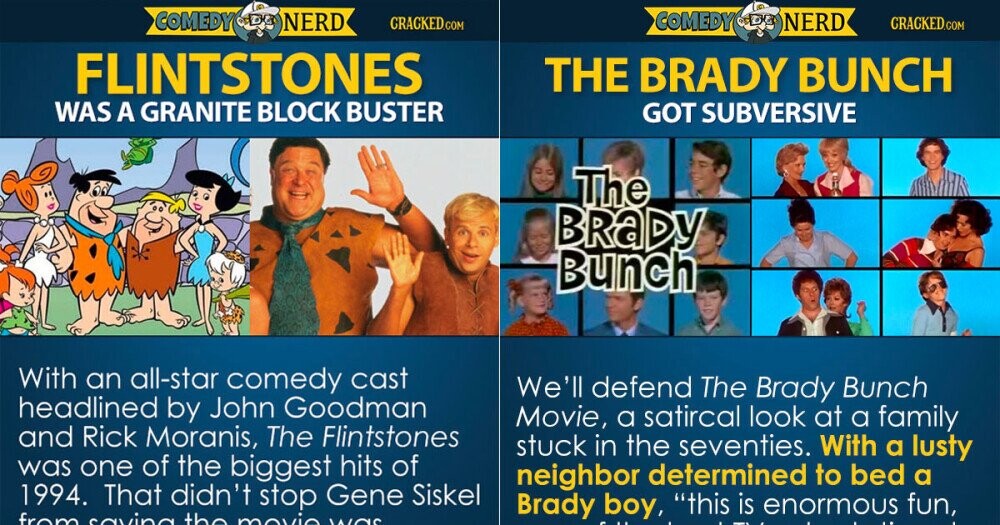
The first live-action Flintstones movie was not exactly a critical darling, but it had spectacle, stars, and curiosity value. The prequel, The Flintstones in Viva Rock Vegas, had a tougher job: convince audiences they needed an origin story for Fred and Barney’s romantic lives. That is a sentence only a studio meeting could love.
The movie leaned into colorful sets, Stone Age puns, and prehistoric Las Vegas jokes, but it lacked the star power and novelty of the earlier film. The original animated sitcom worked because it was basically a blue-collar family comedy wearing dinosaur slippers. The prequel became a loud swirl of costumes, gags, and brand extension. It was less “yabba-dabba-doo” and more “yabba-dabba-why.”
11. Fat Albert (2004)
Fat Albert and the Cosby Kids was an animated series with a clear moral structure and a warm neighborhood feel. The 2004 movie brought the cartoon characters into the real world, a concept that can work if the emotional logic is strong enough. Unfortunately, the film often felt caught between nostalgia, fish-out-of-water comedy, and after-school-special sincerity.
The movie was not mean-spirited. In fact, its kindness may be its most defensible quality. But kindness is not the same as sharp storytelling. The transition from animated television to live-action feature softened the characters into symbols instead of making them feel newly alive. The film seemed to know the original mattered, but it did not always know what to do with that affection.
12. Bewitched (2005)
Bewitched is one of the more interesting failures on this list because it did not simply remake the sitcom. Instead, it built a meta-comedy about actors making a new version of Bewitched, with Nicole Kidman playing a real witch cast as Samantha. On paper, that is clever. On screen, the spell flickered.
The original sitcom’s humor came from domestic tension, magical secrecy, and the impossible dream of being “normal.” The movie shifted the focus toward Hollywood vanity and behind-the-scenes reboot culture. That approach was bold, but it also moved the story away from the emotional engine that made the show popular. A clever concept can still fail if the audience spends the movie wishing it were watching the simpler version.
13. The Honeymooners (2005)
The original Honeymooners was a landmark sitcom built on working-class frustration, marital banter, and the explosive comic presence of Jackie Gleason. The 2005 movie reimagined the setup with a new cast and a modernized tone, but it faced a nearly impossible challenge: how do you update a classic without flattening the very pressure that made it funny?
The movie had performers with charm, including Cedric the Entertainer, Mike Epps, Gabrielle Union, and Regina Hall. Still, it often felt like a broad comedy borrowing famous character names rather than a true extension of the original. The series thrived on cramped apartments, big dreams, and emotional friction. The movie chased a lighter, more conventional plot. It was not enough to say “Ralph Kramden” and hope the old magic paid rent.
What These Failed TV Comedy Movies Have in Common
They Mistook Recognition for Story
A familiar title can open the door, but it cannot carry the furniture. Many of these films assumed that viewers would be satisfied just seeing old names, costumes, or catchphrases again. But nostalgia is seasoning, not the main course. Too much of it and the whole meal tastes like a rerun.
They Stretched Small-Screen Jokes Too Thin
Television comedy has a special compactness. A sitcom premise can reset every week. A movie cannot rely on the reset button. When a film stretches a one-joke premise across feature length, the audience starts to notice the elastic snapping.
They Modernized the Wrong Things
Updating an old comedy is not automatically a mistake. The mistake is updating the surface while ignoring the structure. Add visual effects, celebrity cameos, louder music, and modern slang if you must, but if the original’s emotional rhythm disappears, the adaptation becomes a wax figure with Wi-Fi.
They Forgot That Comedy Is Timing
Many classic TV comedies worked because of timing: pauses, reactions, entrances, exits, and the comfort of repetition. Movies often demand speed and scale. When filmmakers push too hard, the timing collapses. A joke that once danced now arrives dragging a parade float.
Personal Viewing Experiences: When Nostalgia Buys the Ticket and Regret Holds the Popcorn
Watching these TV comedy movies can be a strangely educational experience. You start with hope. Maybe the critics were too harsh. Maybe the old charm will sneak through. Maybe the film will be a hidden gem, the kind of movie people dismissed because they expected too much. Then, about twenty minutes in, you realize you are not watching a hidden gem. You are watching a brand-extension piñata, and someone forgot to put candy inside.
The funny thing is that many of these movies are not impossible to enjoy. A bad TV comedy adaptation can still have a great performer, a bizarre gag, a nostalgic costume, or one line that lives rent-free in your brain like a raccoon in an attic. Inspector Gadget has a certain late-1990s plastic-toy energy. My Favorite Martian has actors working harder than the script deserves. The Flintstones in Viva Rock Vegas looks so committed to its Stone Age nightclub universe that you almost admire the confidence. Almost.
The experience becomes even more interesting when you compare the movie to the show. Classic sitcoms often feel modest by design. The sets are small. The plots are simple. The performances carry the weight. When the movie version arrives with a bigger budget, it sometimes becomes less alive. The living room gets replaced by a chase scene. The recurring joke becomes an origin story. The warm familiarity becomes a marketing campaign wearing a party hat.
That is why some of these adaptations feel less like movies and more like long commercials for the idea of a movie. They remind you of something you liked without giving you a new reason to like it. They point at the past and say, “Remember this?” Then they keep pointing for 90 minutes. Eventually your arm gets tired for them.
Still, there is value in revisiting them. These films show how difficult comedy adaptation really is. They prove that a beloved title is not a magic spell, that casting matters, that tone matters, and that the big screen is not automatically an upgrade. Some stories are happier in their original format. Some characters belong in weekly chaos, not cinematic destiny. Some jokes need a laugh track, a couch, and a commercial break to breathe properly.
For writers, filmmakers, and comedy fans, these movies are caution signs covered in glitter. They say: respect the source, but do not embalm it. Update the idea, but do not erase its pulse. Give audiences a story, not just a souvenir. And above all, remember that comedy is not created by making everything bigger. Sometimes the funniest thing in the world is a small room, two actors with perfect timing, and a joke that knows exactly when to leave.
Conclusion
TV comedy movies fail most often when they forget why people loved the shows. A sitcom is not just a premise. It is rhythm, chemistry, repetition, personality, and comfort. The best adaptations find a cinematic way to preserve that spirit. The weaker ones simply inflate the brand until it floats away like a parade balloon with a slow leak.
The 13 movies above are not all equally bad, and some have defenders who love them sincerely. That is part of the fun. But each one demonstrates the danger of assuming that a familiar TV comedy automatically deserves a feature film. Sometimes the smartest move is not a reboot, remake, prequel, or nostalgia-powered theatrical event. Sometimes the smartest move is leaving the remote control right where it is.