Prehistoric battle sites are tricky little troublemakers. They do not come with banners, dated plaques, or a convenient sign reading, “Two angry groups clashed here on a Tuesday.” What archaeologists usually find instead are wounded skeletons, broken weapons, burned defenses, hurried burials, and the kind of unsettling patterns that suggest organized violence rather than bad luck. In other words, prehistory rarely gives us a movie scene. It gives us clues, and then dares us to connect them.
That is what makes these sites so fascinating. They show that conflict did not suddenly appear when kings started keeping records or when armies learned to wear matching outfits. Long before written history, people raided, defended settlements, fought over land and resources, and sometimes wiped out entire communities. Some of the places below are classic battlefields. Others are massacre pits, fortified settlements, or mass graves that preserve the aftermath of violent clashes. All of them matter because they push the story of warfare far deeper into the human past.
From the Nile Valley to East Africa, from Neolithic Europe to prehistoric Britain, these sites reveal that organized violence was never just a late invention of “civilized” societies. Humans were already doing very human things: defending territory, building alliances, panicking under pressure, and making terrible decisions with stone, wood, and bronze. Cheerful? Not exactly. Important? Absolutely.
How Archaeologists Recognize a Prehistoric Battle Site
Archaeologists do not label a place a prehistoric conflict site because one skeleton had a bad day. They look for patterns: multiple individuals with similar injuries, projectile points embedded in bone or found where soft tissue once was, fortifications that appear to have been attacked, evidence of hurried or abnormal burial, and demographic clues about who died. A pit full of men, women, and children may suggest a massacre or raid. A landscape scattered with the remains of fighting-age adults, weapons, and military gear may point to a battlefield. The more clues line up, the stronger the case.
With that in mind, here are ten of the most compelling prehistoric battle sites and conflict locations known today.
1. Jebel Sahaba, Sudan
If you want to start near the beginning, Jebel Sahaba is the heavyweight. This cemetery in the Nile Valley is at least 13,400 years old and remains one of the earliest known sites in the world showing repeated interpersonal violence. Earlier interpretations imagined a single dramatic massacre. More recent research paints a messier, and probably more realistic, picture: not one giant showdown, but recurring raids, ambushes, or skirmishes over time.
That distinction matters. Jebel Sahaba suggests prehistoric violence could be chronic rather than one-off. The cemetery includes men, women, and children, and many individuals show evidence of projectile injuries. Some people even display both healed and unhealed trauma, which means violence was not an isolated event but part of life. In plain English, this was not one unlucky afternoon. It was a rough era.
2. Nataruk, Kenya
Nataruk, near Lake Turkana in Kenya, is one of the most famous prehistoric conflict sites ever discovered. Dated to roughly 9,500 to 10,500 years ago, it preserves the remains of at least 27 people associated with an ancient hunter-gatherer landscape. The site gained worldwide attention because it offered strong evidence that mobile foragers, not just settled farmers or state-level societies, could carry out organized lethal attacks.
What makes Nataruk so haunting is the lack of ceremonial order. These were not carefully arranged burials in a formal cemetery. The remains seem to capture the aftermath of a violent episode near a lagoon, with signs that some victims were struck by projectiles or blunt-force weapons. Archaeologists have interpreted the scene as a raid or massacre, likely tied to competition over a rich and attractive environment. So much for the old fantasy that prehistoric hunter-gatherers all lived in perfect harmony while gently sharing berries.
3. Talheim Death Pit, Germany
Talheim is one of the best-known prehistoric massacre sites in Europe, and for good reason. Discovered in southern Germany, this Early Neolithic pit dates to around 5000 cal BC and contains the remains of 34 individuals associated with the Linearbandkeramik, or LBK, culture. These were some of Europe’s first farming communities, which means Talheim speaks directly to one of archaeology’s biggest questions: did farming make people more peaceful or more territorial?
Talheim is not exactly a great advertisement for the peaceful-farmer theory. The victims include men, women, and children, and the injuries strongly suggest violent death. Scholars have used the site to argue for organized group conflict among early farming villages. Talheim matters not only because of the body count, but because it helped shift academic opinion. It showed that early agricultural communities were fully capable of collective violence, likely involving disputes over land, resources, or social control.
4. Schletz/Asparn, Austria
Another grim LBK-era site, Schletz/Asparn in Austria offers evidence for large-scale violence at a fortified settlement. The remains of at least 67 people have been uncovered, and archaeologists believe the full ditch system may once have contained many more. Like Talheim, Schletz points to the destruction of a community rather than a tidy duel between evenly matched sides.
The site is especially important because it combines human remains with defensive architecture. This was not just a place where people died; it was a place where people seem to have expected danger. Fortified ditches, abnormal deposition of bodies, and demographic imbalances among the dead all support the interpretation of an attack with lasting consequences. If Talheim shows violence among early farmers, Schletz shows that some of those farmers were already thinking in defensive terms. When your village needs fortifications, neighborhood relations have probably taken a turn.
5. Schöneck-Kilianstädten, Germany
Schöneck-Kilianstädten, also tied to the LBK world, adds another layer to the story of Early Neolithic violence in central Europe. The site contained a mass grave with at least 26 individuals, including adults and children, dated to around 7,000 years ago. Researchers identified trauma patterns consistent with a deliberate and highly violent attack.
Why does this site stand out when Talheim and Schletz already made the point? Because repetition matters. One massacre could be dismissed as an anomaly. Three similar cases across the same cultural horizon begin to look like a pattern. Schöneck-Kilianstädten suggests that conflict among early farming groups was not rare background noise. It may have been a structural feature of the world they inhabited, tied to settlement, competition, and social fragmentation.
6. Potočani, Croatia
Potočani, a Copper Age site in eastern Croatia, contained a mass grave of 41 people dating to about 4200 BC. What makes it particularly important is what DNA analysis revealed: the victims were not mostly one close family group. Instead, they represented a broader community with mixed ages and both sexes present.
That shifts the interpretation in an important way. Rather than a family execution or a targeted elite purge, Potočani looks more like indiscriminate collective killing. Archaeologists still debate the exact motive, but the site shows that prehistoric violence could be community-wide and socially devastating. In other words, prehistoric conflict was capable of being both organized and indiscriminate, which is an unsettlingly modern combination.
7. San Juan ante Portam Latinam, Spain
San Juan ante Portam Latinam, usually shortened by specialists to something far less friendly-looking, is one of the most revealing Late Neolithic conflict sites in western Europe. Located in northern Spain and dated roughly to 3380–3000 cal BC, the site contains remains representing at least 338 individuals. That number alone makes it hard to ignore.
Recent reanalysis found a much broader pattern of trauma than earlier studies recognized, including both healed and unhealed injuries. The demographic picture is telling: adolescent and adult males were especially affected, and the evidence suggests repeated exposure to violence, raids, and battle. This matters because it hints at something more formalized than random village slaughter. San Juan ante Portam Latinam suggests that by the Late Neolithic, some communities in western Europe were already dealing with persistent, socially organized warfare.
8. Koszyce, Poland
The Koszyce mass grave in southern Poland is one of the most emotionally striking prehistoric conflict sites because it combines lethal violence with careful burial. Dated to about 5,000 years ago, the grave contained 15 people from a large extended family. Ancient DNA showed that the individuals were closely related, and their bodies appear to have been arranged with care, likely by surviving relatives who returned after the attack.
Koszyce is important because it reminds us that archaeology does not only recover violence; it also recovers grief. The site preserves the aftermath of conflict, but also the response of the living. The dead were not dumped casually. They were placed deliberately, with kinship visibly shaping the burial. So while Koszyce is a massacre site, it is also a prehistoric family story, which somehow makes it hit even harder than the numbers alone.
9. Crickley Hill, England
Crickley Hill in Gloucestershire is a little different from the mass-grave sites above. It is a long-lived hilltop site with evidence of repeated violence over many centuries, from the Neolithic into later prehistory. Archaeological work has shown that its early enclosure was attacked and eventually abandoned, and the hill later hosted an Iron Age hillfort that was also violently destroyed.
One of the most memorable clues is the concentration of more than 400 arrowheads near the entrance of the later fortification. That is the kind of detail archaeologists love because it suggests where attackers pressed hardest. Crickley Hill may not offer the same kind of burial evidence as Jebel Sahaba or Talheim, but it gives us something equally valuable: a fortified landscape that seems to have witnessed repeated prehistoric assaults. It is the sort of place where the ground itself starts looking suspicious.
10. Tollense Valley, Germany
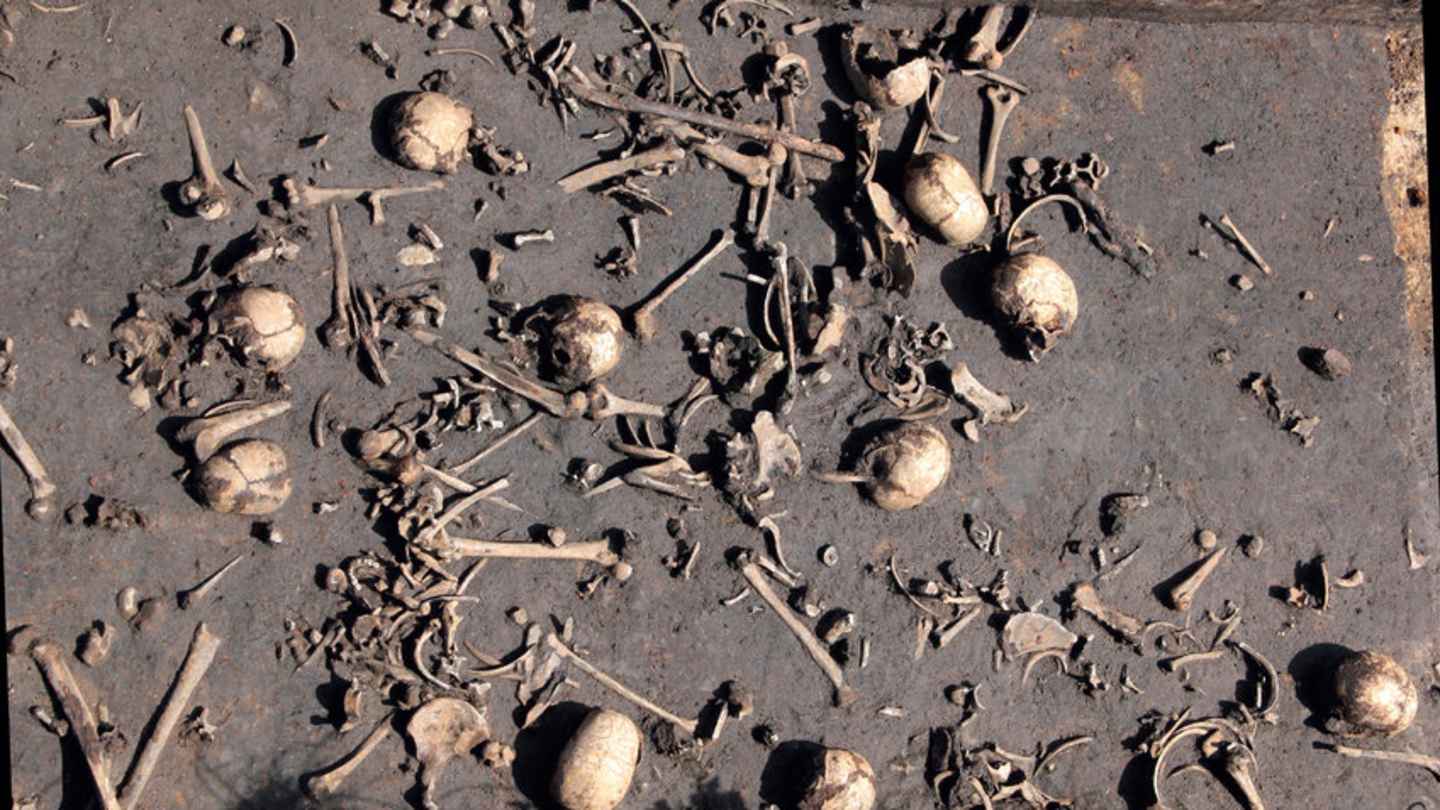
Tollense Valley is the blockbuster of prehistoric battle archaeology. Dating to about 1250 BC, this Bronze Age site in northeastern Germany is widely regarded as Europe’s oldest known battlefield of large scale. Archaeologists have found remains from more than 150 individuals, and estimates suggest that over 2,000 people may have been involved in the conflict.
Tollense stands apart from many earlier sites because it looks less like a village massacre and more like an actual battlefield in the classic sense: a landscape of movement, combat, and collapse. Weapons, horse remains, trauma patterns, and the scale of the dead all point to a major organized clash. Recent work on the arrowheads suggests that not all combatants were local, which means this was likely an interregional conflict. By the Bronze Age, war in Europe was not merely neighborhood drama with sharper tools. It was bigger, broader, and more coordinated.
What These Sites Tell Us About Prehistoric Warfare
Put these ten sites together and a pattern emerges. First, prehistoric violence was real, recurring, and often collective. Second, it took different forms: raids on communities, attacks on fortified places, battles between organized groups, and massacres that erased villages or families. Third, warfare did not begin only after states, kings, and written records. In some places, it appears deep in the hunter-gatherer past. In others, it intensified with farming, settlement, territoriality, and larger social networks.
The archaeological record also shows that “battle site” is sometimes a modern umbrella term. Some places were ambushes. Some were raids. Some were wiped-out settlements. Some were genuine open battlefields. Prehistory did not care about our categories. It just left evidence.
What It Feels Like to Encounter These Places Today
Reading about prehistoric battle sites is one thing. Standing in the landscapes where this violence unfolded is another. The strangest part is how ordinary many of these places look now. A river valley can seem peaceful enough to host a picnic. A hilltop can feel perfect for a morning walk. A dry basin can look almost empty, as if nothing memorable ever happened there. Then you learn what archaeologists pulled from the ground, and the whole landscape changes in your imagination.
That is the real experience of these sites: not horror movie spectacle, but quiet dissonance. Jebel Sahaba was once part of a Nile-world shaped by climate stress and repeated conflict. Nataruk was once a wet, resource-rich place where life should have looked promising. Tollense today can sound almost poetic, all river and meadow, until you remember that it preserves the remains of a Bronze Age clash on a shocking scale. Crickley Hill offers broad, beautiful views, which is exactly why it was useful and vulnerable. Prehistoric people loved good terrain for the same reason modern people do.
There is also something humbling about how fragmentary the evidence is. Archaeologists do not recover speeches, war aims, or dramatic final declarations. No one left us a heroic inscription saying who attacked whom, who won, or whether the whole thing started over cattle, grain, a water source, or an insult that got wildly out of hand. Instead, visitors and readers are left with traces: bones, stone points, burned gates, ditches, and the stubborn feeling that human conflict has always been tangled up with fear, scarcity, pride, and belonging.
The emotional experience can be surprisingly mixed. There is sadness, of course, especially at sites like Koszyce, where careful burial suggests survivors returned to honor their dead. But there is also awe at the skill of modern archaeology. Tiny lesions on bone, microscopic wear on artifacts, isotope signatures, ancient DNA, and radiocarbon dating can turn a mute grave into a social history. These places are not only about death. They are about how much information human beings can recover when they pay close attention.
And then there is the uncomfortable mirror effect. The farther back you go, the more you expect people to seem alien. Yet these sites do the opposite. They make prehistoric communities feel recognizable. People defended choke points. People built fortifications. People reacted to environmental pressure. People cared for relatives. People buried their dead with intention. People organized violence long before they wrote epics about it. The tools were different, but the emotional logic can feel eerily familiar.
In that sense, the experience of exploring prehistoric battle sites is not only archaeological. It is philosophical. These places ask a question that never really goes away: how ancient is our capacity for organized violence, and how ancient is our capacity to mourn it? The answer, judging from these landscapes, is very ancient indeed. Prehistory may be silent, but it is not peaceful. And once you understand that, the hills, valleys, and burial grounds of the ancient world stop looking empty. They start looking crowded with memory.
Conclusion
The ten sites above do not tell one simple story about the birth of war. They tell several. Some reveal repeated raiding among hunter-gatherers. Some show the destruction of early farming communities. Some preserve fortified settlements under attack. One, Tollense, looks strikingly like the kind of battlefield later history books would recognize immediately. Together, they show that prehistoric warfare was not a myth, not a rare fluke, and not just a side effect of literate civilization. It was part of the human past long before history had a pen.