“`
Some spoons are just spoons. They scoop yogurt, stir coffee, disappear into the office sink, and live a heroic but anonymous life between the dishwasher and the drawer. Then there is Yuichi Takemata’s ryo Spoon S, a small Japanese stainless-steel spoon with the quiet confidence of an object that knows it does not need to shout to be noticed.
The ryo Spoon S belongs to the world of refined Japanese flatware, where utility, craft, and subtle beauty meet over something as everyday as a bite of dessert or a spoonful of jam. It is linked to Yuichi Takemata, a Kanazawa-based metal artist known for handcrafted cutlery, jewelry, and household objects that age with grace. The ryo series itself is associated with a collaboration between Takemata, designer Osamu Saruyama, and metal manufacturer Tasan Kinzoku, blending design direction, industrial pressing, and hand finishing into one deceptively simple piece of tableware.
That is the charm of this spoon. It is small, functional, and easy to overlook at first glance. But once you understand the craft behind it, the spoon becomes less like a utensil and more like a tiny ambassador for Japanese design: disciplined, practical, beautiful, and politely allergic to unnecessary drama.
What Is Yuichi Takemata’s ryo Spoon S?
Yuichi Takemata’s ryo Spoon S is a small stainless-steel spoon connected to Takemata’s broader body of handcrafted Japanese cutlery. Product listings for Takemata’s Spoon S describe a compact utensil measuring about 10 cm long and 1.2 cm wide, weighing approximately 4 grams, and made in Japan from stainless steel. That makes it a petite piece, ideal for delicate servings rather than big, enthusiastic bowls of cereal.
Think of it as a spoon for careful moments: stirring espresso, serving a small condiment, pairing with a dessert plate, scooping salt, tasting sauce, or adding a finishing spoonful of something beautiful. It is not trying to replace a tablespoon. It is not trying to be a ladle. It knows its lane, and frankly, it drives in it with excellent posture.
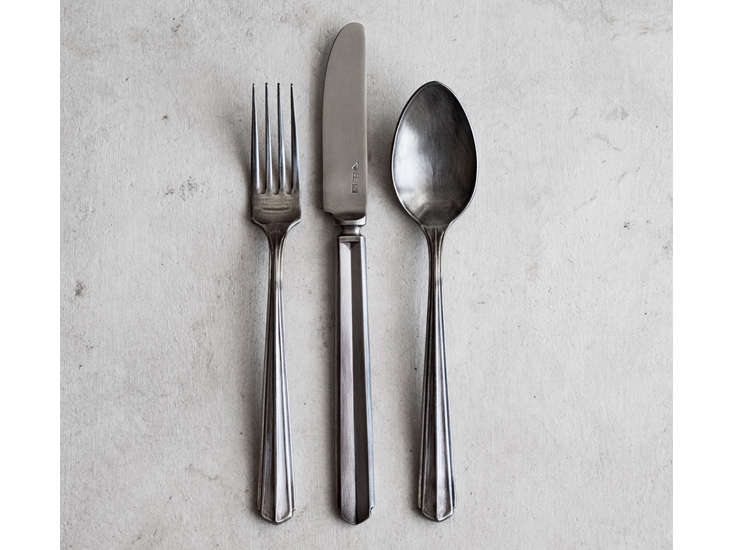
The word ryo in this context refers to a series of stainless flatware known for its understated shape, antique-like finish, and hand-worked surface. The collection includes various pieces such as forks, knives, serving spoons, salad spoons, bouillon spoons, and other table tools. The Spoon S sits naturally within this universe of refined Japanese cutlery: small in size, rich in character, and designed to feel at home beside ceramics, wood, glass, and linen.
The Artist Behind the Spoon: Yuichi Takemata
Yuichi Takemata was born in Kanazawa, Ishikawa Prefecture, Japan, in 1975. His creative background began with metal engraving and jewelry work, a detail that helps explain the sensitivity of his flatware. Jewelry trains the hand to care about millimeters. Cutlery asks the hand to care about use. Takemata’s work seems to live exactly where those two disciplines shake hands.
He began studying metal carving in the 1990s, worked in accessory making, became independent in the early 2000s, and opened his atelier shop KiKU in Kanazawa. Later, he expanded from custom jewelry into everyday tools and cutlery, eventually opening sayuu in the Higashiyama area of Kanazawa. This timeline matters because the ryo Spoon S is not a random product designed by committee and given a poetic name five minutes before launch. It comes from an artist whose practice is rooted in metal, surface, use, and time.
Kanazawa itself is also important. The city is known for craft traditions, including metalwork, lacquerware, ceramics, and gold leaf. In that environment, objects are not expected to be merely decorative. They are expected to carry cultural memory, discipline, and a certain quiet dignity. Takemata’s cutlery reflects that atmosphere without becoming stiff or museum-like. It is meant to be used, held, washed, and used again.
The ryo Series: Collaboration, Pressing, and Hand Finishing
The ryo series is especially interesting because it combines multiple forms of expertise. Osamu Saruyama is credited with the design, Tasan Kinzoku with the metal manufacturing and pressing, and Yuichi Takemata with direction and individual hand finishing. The result is a line of stainless-steel flatware that has the consistency of production and the soul of the hand.
This balance is not easy. Purely handmade objects can be wonderfully expressive but inconsistent. Purely industrial objects can be precise but emotionally flat. The ryo Spoon S occupies the middle ground: pressed metal shaped through manufacturing skill, then refined by an artist’s hand so each piece carries slight differences in finish, texture, and presence.
Some descriptions of the ryo series note that it uses molds connected to the early period when Western tableware was introduced to Japan. That historical echo gives the pieces a fascinating identity. They are neither purely Western nor traditionally Japanese in a rigid sense. They feel like objects that have traveled, adapted, and settled into a new language at the table.
Design Details That Make the ryo Spoon S Special
1. A Small Scale with Big Personality
The Spoon S is tiny, but it does not feel flimsy in concept. Its small scale encourages slower use. Instead of shoveling, it invites tasting. Instead of rushing, it asks you to notice. That may sound dramatic for a spoon, but anyone who has used thoughtfully made tableware understands that size and shape can change the rhythm of eating.
2. Stainless Steel with an Antique Mood
Stainless steel is often associated with shine, efficiency, and modern kitchens. The ryo series takes that practical material and gives it a warmer, more aged character. The hand-finished surface softens the industrial feeling and gives the spoon a lived-in elegance. It looks less like something fresh from a factory line and more like something that already has a story.
3. A Surface That Rewards Looking Closely
The surface of Takemata’s cutlery is part of the experience. Slight variations are not defects; they are part of the appeal. In a world where many products look suspiciously like they were designed by a spreadsheet wearing glasses, the ryo Spoon S offers evidence of human touch. Its finish catches light softly, pairs beautifully with handmade ceramics, and avoids the loud sparkle of overly polished flatware.
4. A Shape That Supports Everyday Use
Good design is not only about how an object looks in a photo. It is about how naturally it enters daily life. The ryo Spoon S is suited to small, precise tasks: sugar, jam, tea, coffee, condiments, tasting, desserts, and small shared dishes. It can sit beside a handmade cup or a small dish without overpowering the arrangement.
Why Japanese Craft Lovers Appreciate This Spoon
Yuichi Takemata’s ryo Spoon S appeals to people who enjoy Japanese craft, minimalist tableware, artisan flatware, and objects that improve daily rituals. Its beauty is not decorative in a flashy way. It is quiet, tactile, and practical. That makes it especially appealing to collectors of Japanese ceramics and handcrafted table settings.
The spoon also fits naturally with the idea of wabi-sabi, the Japanese appreciation of imperfection, impermanence, and understated beauty. A ryo spoon does not need to remain mirror-perfect forever. In fact, part of its appeal is the way it may develop more character through use. Tiny changes in tone, soft marks, and signs of handling can become part of the object’s life.
This is also where the spoon connects to the broader philosophy of beautiful everyday things. The best household objects do not sit around waiting for a special occasion. They work. They stir tea, scoop preserves, serve guests, and make breakfast feel slightly more intentional. The ryo Spoon S proves that even the smallest tool can lift an ordinary moment without turning the kitchen into a design lecture.
How to Use Yuichi Takemata’s ryo Spoon S at Home
Because of its small size, the ryo Spoon S works best when used with intention. It is excellent for coffee service, tea trays, dessert courses, tasting menus, and small dishes. Place it beside a ceramic sugar bowl, a dish of sea salt, a pot of honey, or a small jar of fruit preserves. It also works beautifully for serving yuzu kosho, mustard, miso paste, spice blends, or a tiny spoonful of chili crisp.
For dessert, the spoon can pair with custard, panna cotta, ice cream, mousse, or a small bowl of fruit. Its modest scale makes each bite feel considered. That is part of its charm. A giant spoon attacks dessert like a bulldozer. A small spoon negotiates politely and still wins.
It can also serve as a tasting spoon while cooking. Use it to sample sauces, check seasoning, or plate a small accent. Because it is stainless steel, it is practical, durable, and easy to clean when treated properly. Still, because this is artisan flatware with a hand-finished surface, gentle care is the smarter choice.
Care Tips for Stainless Artisan Flatware
Although stainless steel is durable, handcrafted flatware deserves a little kindness. Hand washing is generally the safest approach for preserving the finish of artisan pieces. Use mild dish soap, warm water, and a soft sponge. Avoid harsh abrasives, bleach, steel wool, or long soaking sessions in salty or acidic foods.
After washing, dry the spoon promptly with a soft cloth. This helps prevent water spots and protects the surface. If the spoon is used with acidic ingredients such as vinegar, citrus, tomato, or fermented condiments, rinse it soon after use. Stainless steel is tough, but it is not magic armor forged by kitchen elves.
Storage also matters. Keep the spoon where it will not be aggressively scratched by heavier utensils. A small divider, cloth wrap, or dedicated tray can help protect it. Of course, it is still a tool, not a priceless meteorite. The point is not to fear using it. The point is to let it age gracefully instead of sending it into battle against a drawer full of steak knives.
How It Compares with Ordinary Flatware
Ordinary flatware often prioritizes uniformity, affordability, and dishwasher convenience. There is nothing wrong with that. A busy household needs reliable forks and spoons that can survive weeknight pasta, school lunches, and mysterious sink situations. But artisan flatware like the ryo Spoon S offers something different: a closer relationship between hand, material, and daily ritual.
The difference is visible in the finish, but it is also felt in the way the object changes the table. A standard spoon completes a place setting. A Takemata spoon creates a small focal point. It suggests that someone thought about the meal, even if the meal is just coffee and toast. That is the power of a well-made object: it adds intention without requiring ceremony.
For collectors, the ryo Spoon S may also be appealing because it is part of a broader design language. It can be combined with other ryo pieces or mixed with handmade ceramics, linen napkins, wooden trays, and simple glassware. It does not demand a matching set. In fact, it may look better when placed among objects with different textures and histories.
Who Should Buy the ryo Spoon S?
The ryo Spoon S is a good fit for people who appreciate Japanese craft, small-scale design, and artisan tableware. It is especially suitable for those who already enjoy handmade ceramics, tea tools, coffee rituals, or carefully chosen kitchen objects. If your favorite phrase is “good enough, throw it in the drawer,” this spoon may feel a little too poetic. If you believe breakfast can be improved by the right cup, bowl, or spoon, welcome home.
It is also a thoughtful gift. Because it is small, functional, and beautiful, it can work as a gift for design lovers, home cooks, tea drinkers, coffee enthusiasts, or anyone building a more intentional kitchen. It is not loud or trendy, which is exactly why it has lasting appeal.
Why the ryo Spoon S Still Feels Relevant
Modern design trends come and go at alarming speed. One year everyone wants glossy minimalism; the next year every room must look like a monastery with Wi-Fi. The ryo Spoon S avoids that cycle because it is rooted in function, proportion, material, and craft. These qualities do not expire when a new color trend appears on social media.
Its relevance also comes from a growing interest in buying fewer but better things. A small handmade spoon will not solve the world’s problems, but it does represent a different way of thinking about consumption. Instead of treating household objects as disposable background noise, it asks us to notice what we use every day.
That is why Yuichi Takemata’s work resonates with design enthusiasts. His cutlery does not perform luxury in a loud way. It offers refinement through restraint. The ryo Spoon S is not trying to look expensive. It is trying to look honest, useful, and quietly beautiful. That is harder than it sounds.
Experience Notes: Living with a Spoon Like Yuichi Takemata’s ryo Spoon S
Using a small artisan spoon changes the mood of ordinary routines in ways that are surprisingly easy to notice. The first experience is visual. Place a spoon like the ryo Spoon S beside a handmade cup, a small ceramic plate, or a linen napkin, and the table immediately feels more composed. Not fancy, not stiff, not “please use the guest towels” formal. Just more thoughtful.
The second experience is tactile. A small spoon asks to be held differently. You do not grab it with the absent-minded energy of someone late for a Zoom call. You pick it up, feel the shape, and notice the weight. Because the Spoon S is compact, it creates a closer connection between hand and food. Stirring coffee becomes quieter. Scooping jam feels less like a chore and more like a tiny ceremony. Even adding salt to a dish can feel oddly satisfying, as if the spoon has convinced the seasoning to behave with dignity.
In a kitchen setting, a spoon like this performs best when given a clear role. Keep it near a coffee station for sugar or spices. Place it beside a honey jar so it becomes part of a morning ritual. Use it for tasting sauces while cooking, especially when preparing something that needs small adjustments: a miso dressing, a citrus glaze, a soup broth, or a pan sauce. The small bowl of the spoon encourages moderation, which is useful when the difference between “perfectly seasoned” and “accidentally seawater” is about half a gram of salt.
At the table, the experience becomes even more interesting. Guests often notice unusual flatware, but not always immediately. Someone may pick up the spoon, pause, and ask, “Where did you get this?” That is the moment artisan design does its quiet magic. The spoon creates conversation without begging for attention. It does not need gold plating, oversized branding, or a dramatic backstory printed on a napkin. Its surface and shape do the talking.
The ryo Spoon S also encourages slower collecting. Instead of buying a full matching set in one dramatic shopping-cart incident, you can build a table setting gradually. One spoon for coffee. A pair for dessert. A few companion pieces for serving. This approach feels more personal because each object earns its place. Over time, the drawer becomes less like storage and more like a small archive of daily pleasures.
The final experience is care. Washing a hand-finished spoon by hand may sound inconvenient, but it can become part of the object’s rhythm. Rinse, wash gently, dry with a cloth, return it to its place. The ritual takes less than a minute, yet it reinforces the idea that useful things deserve attention. In a world full of disposable everything, that small act feels refreshingly human.
Conclusion
Yuichi Takemata’s ryo Spoon S is a small object with a large design presence. Made from stainless steel and connected to the refined world of Japanese artisan flatware, it combines practical use with quiet beauty. Its appeal lies in proportion, texture, hand finishing, and the way it turns everyday moments into something more deliberate.
This is not a spoon for people who want every object to be invisible. It is for people who notice the curve of a cup, the surface of a ceramic bowl, the weight of a fork, and the pleasure of using something made with care. The ryo Spoon S proves that good design does not always need to be big. Sometimes it is ten centimeters long, quietly sitting beside your coffee, making the morning feel better without saying a word.