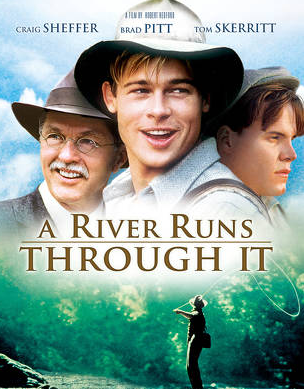
Some books teach writing by explaining point of view, plot structure, and the proper handling of semicolons. A River Runs Through It teaches writing by quietly walking infore you realize what it is doing.
Norman Maclean’s semi-autobiographical novella follows a family in which faith, fly fishing, discipline, and love are tangled together like fishing line in a windy tree. Based largely on Maclean’s experiences growing up in Montana, the story centers on the narrator, his Presbyterian minister father, and his gifted but troubled brother, Paul. It was published in 1976, after Maclean had retired from a long career teaching English at the University of Chicago. The collection became the first original work of fiction published by the University of Chicago Press. is celebrated for its descriptions of the Big Blackfoot River, but its real subject is more difficult to catch: how people can love one another deeply without fully understanding, controlling, or saving one another. For writers, that combination of precision and mystery offers a master class in narrative craft.
Why A River Runs Through It Still Teaches Writers
Maclean did not publish his famous story as a young literary prodigy. He had spent decades reading, teaching, and thinking about language before becoming a fiction author late in life. That long apprenticeship matters. His prose feels polished because it was produced by a writer who understood that beautiful sentences are not decorations. They are structural beams.
The novella combines family history, outdoor writing, tragedy, humor, spiritual reflection, and technical explanations of fly fishing. In less disciplined hands, that mixture could resemble a garage shelf after an earthquake. Maclean makes it coherent because every element serves the same emotional current.
1. Open With a Sentence That Contains the Story’s World
The opening sentence“In our family, there was no clear line between religion and fly fishing”is memorable because it does several jobs at once. It introduces the family, establishes the importance of fishing, reveals the father’s spiritual influence, and sets the story’s gently humorous tone.
Most weak openings provide information. Strong openings create a governing idea. Maclean’s first line tells readers how to interpret almost everything that follows. Fishing will not merely be a hobby. It will become ritual, moral education, artistic practice, family language, and a way of approaching the unknowable.
How to Apply This Lesson
Before writing your first paragraph, finish this sentence: “In this story, there is no clear line between ______ and ______.” The two subjects might be ambition and loneliness, cooking and family memory, technology and control, or gardening and grief.
You do not have to use that sentence in the final draft. Its purpose is to reveal the hidden relationship driving your material. Once you know that relationship, your opening can introduce more than a location or character. It can introduce the story’s entire emotional weather system.
2. Treat Setting as an Active Force
In many stories, setting is attractive wallpaper. The mountains are majestic, the town is sleepy, and the coffee shop smells reassuringly of cinnamon. Then the plot proceeds as though it could happen anywhere.
Maclean’s Montana cannot be replaced so easily. The river shapes the family’s routines, language, beliefs, and memories. Its currents affect physical action while also reflecting time, danger, beauty, and forces beyond human control. The natural world does not pause politely while the characters discuss their problems. It presses against them.
Maclean is also specific. He notices rocks, water, light, casting movements, heat, distance, and geological history. Those details create authority. More importantly, he selects details that reinforce the emotional situation. When the river becomes difficult to read, the people beside it are often difficult to read as well.
Make Place Change the Scene
Ask what your characters can do in this setting that they could not do elsewhere. Ask what the location demands from their bodies. Does it make conversation harder? Does it expose competence, fear, impatience, or vanity? A useful setting creates pressure.
Instead of writing, “The river was beautiful,” show what the current forces a person to do. Instead of announcing that a neighborhood feels oppressive, reveal its narrow driveways, watchful curtains, and lawns trimmed with military enthusiasm. Concrete details beat decorative adjectives almost every time.
3. Use a Specialized Activity to Reveal Character
Fly fishing supplies much of the novella’s visible action, but Maclean never treats it as technical filler. The way each person fishes reveals temperament. Discipline, grace, rebellion, patience, pride, and self-destruction become visible through movement.
This is one reason the story works for readers who have never held a fly rod. Readers do not need to master the equipment because the activity is emotionally legible. They understand that Paul’s brilliance on the water expresses something essential about himsomething beautiful, dangerous, and impossible to separate into tidy pieces.
A specialized activity can solve a common writing problem: characters who explain themselves too much. A person may lie during a conversation, but behavior often tells the truth. Let a character repair an engine, frost a cake, conduct an orchestra, negotiate a contract, or organize a cluttered desk. Competence and failure both reveal personality.
Research Enough to Earn the Metaphor
Technical detail becomes convincing when it is accurate and selective. Dumping every fact from your research folder into a scene is not expertise; it is a hostage situation.
Choose details that affect decisions. Explain only what readers need in order to understand the difficulty, risk, or elegance of an action. Maclean’s fishing passages succeed because physical technique and emotional meaning develop together.
4. Let Ritual Carry Emotional Weight
The Maclean family is not especially skilled at direct emotional confession. Fortunately, fiction does not require everyone to sit in a circle and announce a breakthrough. The family communicates through fishing trips, instruction, meals, work, and familiar arguments.
Ritual gives writers a way to dramatize relationships without summarizing them. A father correcting a casting motion may also be expressing love, authority, anxiety, and disappointment. A brother joining another brother on the river may be offering companionship without demanding an explanation.
Look for repeated actions in your own material. Sunday phone calls, holiday recipes, morning walks, shared jokes, and yearly trips can accumulate meaning. Repeat the ritual, but change one element each time. The difference will show readers how the relationship has evolved.
5. Write Love Without Pretending It Solves Everything
One of the novella’s hardest lessons is that love and understanding are not identical. The narrator loves Paul, yet he cannot fully comprehend or rescue him. The family recognizes danger but struggles to offer help that Paul can accept.
Less mature stories often make affection magically effective. A heartfelt speech arrives, the troubled character finally listens, and emotional plumbing is restored before dinner. Maclean rejects that comfort. Love remains valuable even when it is limited.
This gives the story its emotional honesty. Characters are not careless because they fail to save one another. They are human. They reach toward someone whose inner life remains partly inaccessible.
Preserve the Other Character’s Mystery
Writers naturally want to explain why characters behave badly. Motivation matters, but complete explanation can flatten a person. Real people are mixtures of history, impulse, pride, fear, habit, and contradiction. Paul remains compelling because no single diagnosis or moral label contains him.
Give readers enough evidence to form interpretations, but resist closing every case file. A character can be loving and destructive, graceful and reckless, loyal and unreachable. Contradiction is not a flaw in characterization. It is often the beginning of believable characterization.
6. Balance Lyrical Prose With Ruthless Compression
Maclean’s prose can become musical, philosophical, and expansive, yet it rarely feels uncontrolled. That balance may come partly from his early training. He recalled writing short compositions for his father, who repeatedly instructed him to shorten them. The young writer learned that revision often means discovering what can disappear. not mean every sentence should be stripped down until it resembles an emergency telegram. Compression creates room for lyricism. When ordinary transitions and explanations are concise, the writer can slow down at moments that deserve attention.
Expand Selectively
Notice where Maclean spends his descriptive energy: difficult casts, changing light, family rituals, moments of danger, and memories carrying emotional force. He does not describe every chair, sandwich, shoelace, and passing squirrel with equal enthusiasm.
During revision, mark the passages where the story slows down. Those moments should matter. If a paragraph receives elaborate imagery but contributes little to the narrative, the prose may be wearing a tuxedo to take out the trash.
7. Build Symbols Through Repetition
The river is symbolic, but Maclean does not introduce it with a flashing sign that says, “Attention: Metaphor Approaching.” Its meaning grows through repetition.
The river is first a real place where people fish. It becomes a family sanctuary, an artistic testing ground, a spiritual presence, a carrier of memory, and finally an image of time and loss. Because readers repeatedly experience it as something physical, its symbolic power feels earned.
Writers can use the same technique with an object, location, phrase, sound, or routine. Introduce it plainly. Bring it back under different emotional circumstances. Allow its associations to accumulate. By the final appearance, the image should carry more meaning than it did at the beginning.
8. Use Humor to Keep Sorrow Human
Although the novella moves toward tragedy, it is not humorless. Maclean’s narration can be dry, affectionate, and quietly mischievous. Family members tease, compete, misunderstand one another, and occasionally behave like people who should not be trusted with either fishing equipment or a serious plan.
Humor prevents the characters from becoming monuments to suffering. It also increases the force of the sadder scenes. Readers feel loss more deeply after seeing the ordinary comedy of a life.
The lesson is not to insert jokes during every funeral. It is to remember that emotional tone can vary. Grief exists beside embarrassment, irritation, hunger, vanity, and absurdity. A story becomes moving when it feels alive, not when every paragraph orders the reader to feel devastated.
9. Transform Memory Instead of Merely Reporting It
A River Runs Through It draws heavily from real people and events, but Maclean presented it as fiction. He altered certain details and shaped remembered experience into a deliberate narrative form. one is not structure. A writer must still select scenes, arrange revelations, compress time, build patterns, and decide where the story begins and ends. “This really happened” does not automatically make an episode interesting. Reality has never met a tangent it did not like.
When writing autobiographical material, identify the emotional truth rather than attempting to reproduce every event. Combine repetitive incidents when appropriate, protect private information, and acknowledge uncertainty. Then shape the material around a meaningful change, question, or discovery.
10. End With Resonance, Not a Full Explanation
Maclean’s ending returns to water, memory, and the people the narrator loved but never completely understood. The final image does not solve the family’s tragedy. It enlarges it.
A resonant ending connects the immediate story to something deeper while remaining rooted in concrete imagery. Maclean’s famous closing phrase, “haunted by waters,” works because water has been developing meaning throughout the novella. The ending feels surprising and inevitable at the same time.
To strengthen your conclusion, return to an earlier image, object, location, or line of thought. Let it appear changed by everything that has happened. Avoid explaining the theme as though you are checking the answer key. Trust the image you have spent the story building.
Practical Writing Exercises Inspired by Maclean
The Governing-Sentence Exercise
Write one sentence connecting two subjects that do not initially seem related. Use it to generate a 500-word scene. Do not explain the connection directly; let action reveal it.
The Skilled-Hands Exercise
Describe a character performing something difficult that they know well. Focus on physical choices, corrections, and rhythm. Remove any sentence that directly names the character’s personality. Let technique do the describing.
The Repeated-Ritual Exercise
Write the same family ritual at three different ages. Keep the basic activity unchanged but alter one detail in each version. That changing detail should reveal the movement of time.
The River-Image Exercise
Choose one physical image and place it near the beginning, middle, and end of a story. Each appearance must gain a new association. By the conclusion, the image should carry emotional meaning without requiring an explanation.
Putting the Lessons Into Practice: A Writer’s Experience
Imagine attempting to write a family story after reading A River Runs Through It. The first draft begins with background: where the family lived, what everyone did for work, and which relative could turn a five-minute disagreement into a three-day festival. The information is accurate, but the story refuses to breathe.
Then the writer remembers Maclean’s method and looks for a shared ritual. The answer is not fly fishing. It is Saturday breakfast.
For years, the family gathered in a narrow kitchen where the father made pancakes. He never used a recipe. He judged the batter by the way it fell from a spoon and tested the pan with a drop of water. His children could tell his mood from the size of the first pancake. A perfect circle meant calm. A torn pancake meant everyone should admire the newspaper and avoid major life announcements.
Suddenly, the story has a center. The kitchen becomes more than a room. The pancakes become more than breakfast. The father’s gestures reveal what he cannot comfortably say. A child waiting beside the stove can study him without understanding him completely.
The writer deletes three paragraphs of family history and begins with the pan. That revision feels alarming because the deleted information is true. It is also unnecessary. Maclean’s lesson about compression becomes practical: truth is not measured by the number of facts preserved.
In the next draft, the writer adds sensory detailthe hiss of batter, the metal edge of the spatula, the sweet smell that remained in the kitchen curtains. At first, too much description arrives. The butter glows like sunrise. The syrup resembles amber. The steam performs a small ballet. Breakfast is apparently auditioning for an epic poem.
The writer cuts again. Only details connected to character remain. The father scrapes burned edges before placing a pancake on a plate. He gives the best one to the child who has disappointed him. He never mentions the disappointment.
That action accomplishes what dialogue could not. It contains anger, restraint, duty, and affection. The specialized activity has become emotional language.
The writer then repeats the breakfast ritual years later. The father’s hands shake slightly. One child has moved away. Another arrives late. The first pancake tears, but no one pretends not to notice. The scene does not announce that the family has changed. The altered ritual shows it.
Finally, the story ends after the father is gone. The adult child stands in a different kitchen and tests a pan with a drop of water. The sound is ordinary, but it carries every earlier breakfast. No speech explains what has been inherited. The repeated image performs that work.
This exercise reveals why Maclean’s writing remains so useful. His lessons are not limited to rivers, Montana, or fishing. They apply wherever people struggle to express love through actions, wherever memory must be shaped into narrative, and wherever a physical place holds emotional history.
The experience also teaches patience. A meaningful story may already be present inside an ordinary routine, but the writer must remove the surrounding clutter before seeing it. The grand subject is often hiding in something small: a cast across water, a hand correcting another hand, a pancake placed silently on a plate.
Conclusion
The deepest writing lessons from A River Runs Through It are lessons in attention. Attend to the physical world. Attend to the gestures through which people communicate. Attend to contradictions instead of sanding them smooth. Most of all, attend to the limits of what one person can know about another.
Maclean shows that a writer can be precise without becoming cold, lyrical without becoming excessive, and emotional without manipulating the reader. He transforms fishing into character, landscape into structure, and memory into art.
Writers do not need a Montana river to follow his example. They need a meaningful place, a repeated ritual, an honest mystery, and the discipline to remove every sentence that keeps the real story from coming to the surface.
Note: This article presents original literary analysis and practical writing guidance without reproducing extended copyrighted passages from the novella.