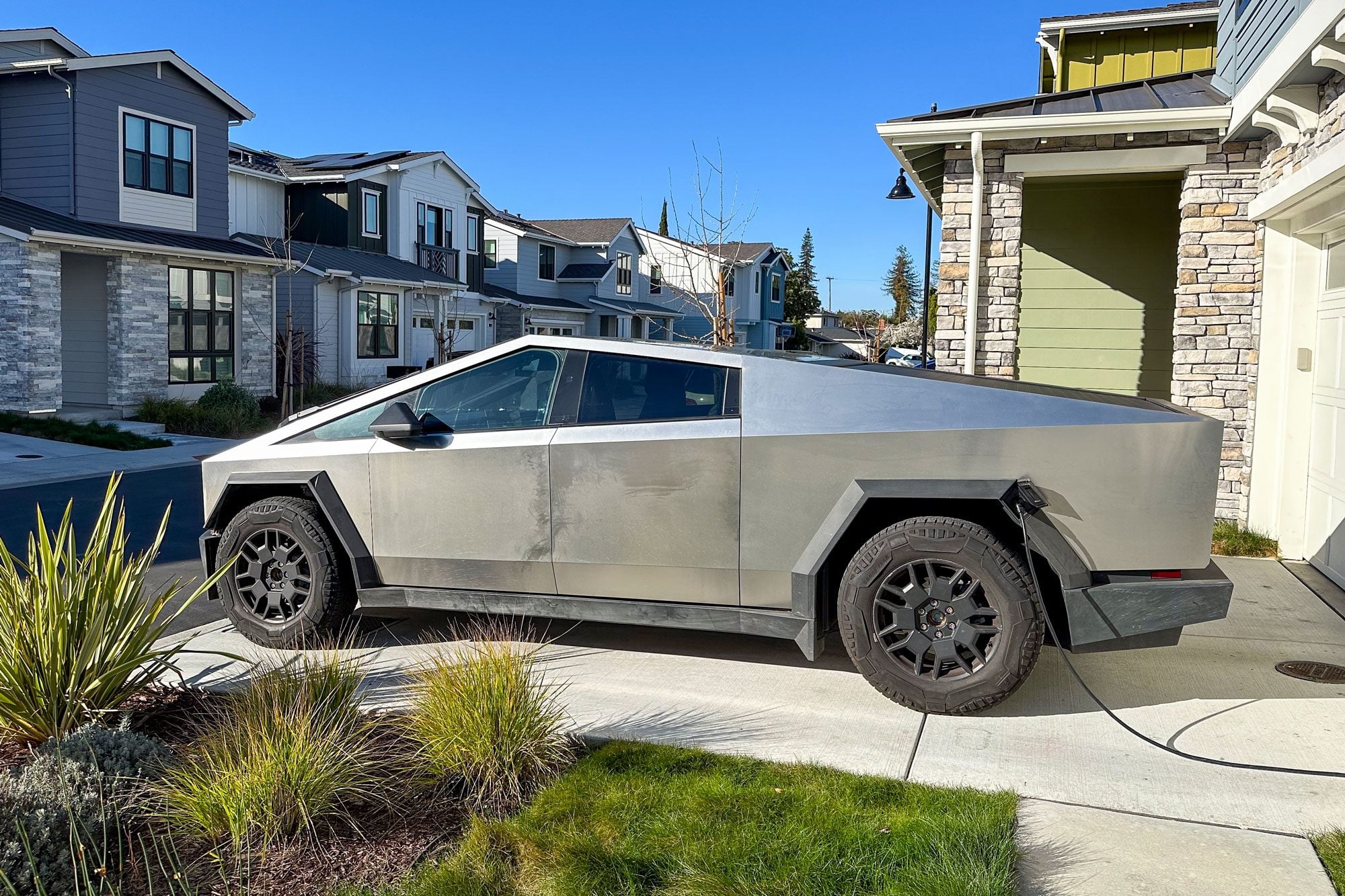
The Tesla Cybertruck looks as though a stainless-steel kitchen appliance escaped from a science-fiction movie and decided to become a contractor. That makes it excellent at attracting attention, starting arguments, and appearing in social media thumbnails. But a work truck has a less glamorous assignment: carry heavy equipment, tow trailers, power tools, survive dirty job sites, and report for duty again tomorrow morning.
On paper, the Cybertruck checks many of those boxes. Depending on the configuration, it offers serious towing capacity, a useful six-foot cargo bed, up to 2,500 pounds of payload capacity, all-wheel drive, adjustable suspension on higher trims, and enough onboard electrical power to operate demanding tools. It also has strong acceleration, a spacious crew cab, and access to Tesla’s extensive fast-charging network.
However, specifications do not tell the entire story. Electric range falls dramatically when towing, the wedge-shaped body creates visibility problems, repairs may require specialized service, and the truck’s unconventional controls can complicate an otherwise ordinary workday.
So, would the Tesla Cybertruck actually make a good work truck? The honest answer is yesfor the right type of work, operating radius, charging setup, and owner. For everyone else, it may be an extremely capable solution to a problem they do not have.
What Qualifies as a Good Work Truck?
A legitimate work truck must do more than win a drag race while carrying two bags of mulch. It needs to perform several jobs consistently:
- Carry workers, tools, materials, and equipment safely
- Tow an appropriately sized trailer without constant logistical drama
- Provide a useful, accessible cargo bed
- Operate reliably in heat, cold, rain, dust, and traffic
- Keep fueling or charging downtime under control
- Fit into the company’s operating budget
- Remain easy enough for multiple employees to drive
The importance of each category depends on the business. A local electrician covering 70 miles per day has different requirements from a landscaping crew towing a loaded equipment trailer across three counties. The Cybertruck can be excellent for the first driver and frustrating for the second.
Cybertruck Work-Truck Specifications
Tesla has changed Cybertruck configurations and prices several times, so buyers should confirm the current rating for the exact vehicle they are considering. As a general guide, current versions cover a fairly wide range of capability.
| Work-Truck Feature | Cybertruck Capability | Practical Meaning |
|---|---|---|
| Maximum towing capacity | Approximately 7,500 to 11,000 pounds, depending on trim | Enough for many utility, equipment, boat, and enclosed trailers |
| Maximum payload | Up to approximately 2,500 pounds on certain configurations | Competitive with many conventional half-ton pickups |
| Cargo bed | About 6 feet long and 4 feet wide | Can carry 4-by-8-foot sheets with the tailgate lowered |
| Unloaded driving range | Roughly 300 to 325 EPA-estimated miles on common versions | Comfortable for local and regional work when charged overnight |
| Onboard electrical power | 120-volt and 240-volt power capability, depending on configuration | Can operate tools, appliances, compressors, chargers, and jobsite equipment |
| Drivetrain | Dual- or tri-motor all-wheel drive on major configurations | Strong traction and immediate torque on pavement or loose surfaces |
The base all-wheel-drive model is rated lower for towing than the more expensive Premium AWD and Cyberbeast versions, while payload also varies with trim, tires, and equipment. Tesla advertises up to 2,500 pounds of payload and as much as 11,000 pounds of towing capacity on eligible models.
Where the Cybertruck Works Surprisingly Well
The Payload Rating Is Genuinely Useful
A payload capacity approaching 2,500 pounds is not decorative brochure glitter. It places properly configured Cybertrucks within the useful range of traditional half-ton pickups and ahead of several electric-truck competitors.
That capacity can cover a crew, toolboxes, ladders, cable, plumbing supplies, bags of concrete, landscaping materials, or other dense cargo. Remember that payload includes everything added to the truck: passengers, accessories, cargo, aftermarket equipment, and the trailer’s tongue weight. Four workers and a heavy trailer can consume the available payload faster than free doughnuts disappear at a morning safety meeting.
Owners should therefore check the certification label on the specific vehicle rather than assuming every Cybertruck can carry the advertised maximum.
The Cargo Bed Is More Practical Than the Styling Suggests
The Cybertruck’s cargo box is approximately six feet long and four feet wide. It is large enough for common construction materials, and 4-by-8-foot sheets can ride with the tailgate lowered. The powered tonneau cover provides weather-resistant storage and improves security when tools must remain in the vehicle.
The composite bed does not require a traditional drop-in liner. It includes tie-down locations and integrated power outlets, while additional storage areas provide room for smaller items. For contractors who routinely carry valuable battery tools, keeping the cargo area covered and difficult to access is a meaningful advantage.
The sloping sail panels are the main compromise. Reaching over the bed sides can be awkward, especially near the cab. A conventional pickup with straight bed rails remains easier when workers frequently grab tools from the side rather than opening the tailgate.
Onboard Power May Be Its Best Work Feature
The Cybertruck can function as a large mobile power source. Tesla’s Powershare system can provide up to 11.5 kilowatts of continuous power in supported applications, drawing energy from the truck’s large battery. Integrated 120-volt and 240-volt capability can support many saws, compressors, chargers, pumps, lights, cooking equipment, and other electrical loads.
For electricians, mobile repair technicians, event crews, filmmakers, disaster-response teams, and remote contractors, this is more than a party trick. It may reduce the need to haul a separate generator, gasoline cans, extension equipment, and backup batteries.
Electric power is quiet, immediate, and free of generator exhaust at the point of use. That matters when working indoors, in residential neighborhoods, near schools, or at early hours when firing up a roaring gasoline generator would make the entire block learn your company’s name for the wrong reason.
It Is Extremely Maneuverable for Its Size
Rear-wheel steering and steer-by-wire give the Cybertruck a surprisingly tight, responsive feel. It can turn and reposition more easily than its exterior dimensions suggest, which helps on crowded construction sites, in parking garages, and along narrow residential streets.
The adjustable air suspension available on higher trims can also raise the truck for rough access roads or lower it for loading. Immediate electric torque makes climbing grades and moving heavy loads feel effortless.
Independent road testing has consistently found the Cybertruck unusually agile for such a large, heavy pickup. Testers have also reported a firm but controlled ride, although some drivers find the variable steering response overly quick at low speeds.
Daily Energy Costs Can Be Attractive
A business that charges overnight at its shop may spend less on electricity than it previously spent on gasoline or diesel. Electric motors also eliminate oil changes, spark plugs, exhaust systems, and many traditional powertrain service items.
The savings depend heavily on local utility rates, annual mileage, public-charging use, insurance premiums, financing costs, tire consumption, and downtime. The best financial case usually belongs to a truck that drives a predictable local route and returns to the same charging location every evening.
Where the Cybertruck Struggles as a Work Truck
Towing Range Is the Biggest Problem
The Cybertruck may be able to pull an 11,000-pound trailer, but the important question is how far it can pull that trailer before the driver needs a charger.
Towing hurts every vehicle’s efficiency because the truck must overcome additional weight, rolling resistance, and aerodynamic drag. Electric pickups make that penalty more visible because the dashboard immediately displays the resulting loss of range.
An unloaded Cybertruck may cover roughly 300 miles or more under favorable conditions. Consumer Reports recorded 334 miles during a 70-mph highway test of an all-wheel-drive model, while Car and Driver obtained about 250 miles in a different 75-mph highway test. Variations in trim, tires, speed, temperature, and testing conditions explain much of the gap.
Add a large enclosed trailer, cold weather, hills, and highway speeds, and usable range can fall by half or even more. In one independent cold-weather demonstration at the maximum 11,000-pound load, a Cybertruck covered only about 90 miles before reaching a very low state of charge. That was an extreme scenario, not a universal result, but it illustrates the risk of planning around the unloaded EPA estimate.
A local contractor towing 40 miles to a job and returning to a private charger may be perfectly satisfied. A crew traveling 250 miles with a trailer may spend too much of the day locating pull-through chargers, disconnecting the trailer, and explaining to the customer that electrons are currently holding the schedule hostage.
Public Charging With a Trailer Can Be Awkward
Tesla’s Supercharger network is a major advantage, but many charging stalls were designed for vehicles without trailers. A long truck-and-trailer combination may block traffic or require the trailer to be disconnected before charging.
Newer pull-through charging sites improve the situation, but they are not available everywhere. Businesses should map the routes they actually drive, identify trailer-friendly stations, and create a backup plan before buying an electric tow vehicle.
Visibility Is Poor
The Cybertruck’s long dashboard, thick windshield pillars, unusual roofline, and high body create major blind spots. When the powered tonneau cover is closed, the conventional rear view is obstructed, requiring greater reliance on cameras.
Camera assistance works well most of the time, but job sites are not controlled laboratory environments. Mud, rain, snow, dust, concrete residue, or a badly placed glove can cover a camera. Consumer Reports described the Cybertruck’s outward visibility as especially weak despite praising its maneuverability and braking performance.
Drivers working around pedestrians, equipment, open trenches, and low obstacles will need time to become comfortable with the truck’s dimensions and camera-dependent layout.
The Controls Require an Adjustment Period
Most truck drivers expect turn-signal stalks, physical mirror controls, familiar door handles, and obvious buttons for frequently used functions. The Cybertruck prefers steering-wheel controls and touchscreen menus.
An owner-driver may adapt quickly. A fleet employee who switches among several vehicles may not. Training matters because even a minor delay finding the wiper control becomes irritating when a storm arrives while the driver is merging with a loaded trailer.
Repairs and Downtime Deserve Serious Attention
The stainless-steel exterior resists ordinary paint scratches because there is no conventional painted finish to damage. It also provides a distinctive, durable outer surface for messy environments.
However, stainless panels do not make the vehicle immune to collision damage. Replacing or repairing unusual body panels can require specialized parts, equipment, and expertise. Before purchasing several trucks, a business should ask its insurer about premiums, identify an approved collision center, and determine how quickly local Tesla service can handle commercial downtime.
The Cybertruck has also experienced multiple safety recalls since production began, involving both software-remedied issues and components requiring physical service. At the same time, the 2026 Cybertruck earned an IIHS Top Safety Pick+ award, with strong crashworthiness and crash-avoidance results for qualifying vehicles. In other words, a recall history and good crash-test performance can exist at the same time.
The Purchase Price Is Only One Cost
Cybertruck prices have changed repeatedly, and the difference between configurations is substantial. A business must compare total operating cost rather than simply comparing monthly payments.
Important expenses include:
- Home or commercial charging installation
- Insurance and collision coverage
- Commercial registration and taxes
- Replacement tires for a heavy, powerful vehicle
- Accessories such as racks, storage systems, wraps, and trailer equipment
- Lost revenue during charging or service downtime
- Depreciation and eventual resale value
A Cybertruck that replaces both a pickup and a generator may create real savings. One that spends every afternoon at an expensive public charger may not.
Which Businesses Could Benefit Most?
Strong Cybertruck Use Cases
The Cybertruck is most convincing for businesses with predictable mileage, overnight charging, limited heavy towing, and a genuine need for mobile electricity. Good candidates include electricians, HVAC technicians, audiovisual crews, mobile repair services, property managers, solar installers, event companies, photographers, inspectors, and local construction supervisors.
It may also serve as a rolling advertisement. Few vehicles attract more attention, which could help a design studio, technology company, custom builder, or premium service business generate local recognition. Of course, attention is not always positive. A company should consider whether the styling and public associations fit its brand before applying a twelve-foot logo to the doors.
Weak Cybertruck Use Cases
The Cybertruck is less persuasive for operators who tow near the maximum rating over long distances, work in regions with weak charging infrastructure, require fast field repairs, or depend on standardized fleet controls.
Landscaping crews, agricultural operators, hotshot drivers, highway contractors, remote oil-field workers, and businesses that cannot install overnight charging may be better served by a gasoline, diesel, hybrid, or longer-range electric pickup.
A Realistic Workweek With a Cybertruck: Experience-Based Scenarios
The following scenarios are illustrative composites based on published specifications, independent vehicle tests, and common contractor workflows. They are not presented as personal firsthand ownership experiences.
Monday: The Local Electrical Contractor
The truck begins the week at 90 percent charge after spending the night connected to a Level 2 charger at the company shop. The driver loads conduit, cable, hand tools, two ladders, and several battery packs. There is no trailer today, and the route includes three residential jobs within a 35-mile radius.
This is close to the Cybertruck’s ideal workday. Acceleration makes highway merging effortless, rear-wheel steering helps when reversing into narrow driveways, and the covered cargo bed keeps expensive tools out of sight. At the final project, the crew uses the truck’s outlets to operate a vacuum and recharge equipment without unloading a generator.
The truck returns with plenty of energy remaining and quietly recharges overnight. In this role, it feels less like an experiment and more like an unusually fast mobile workshop.
Tuesday: Materials and Urban Deliveries
The next assignment involves picking up plywood, boxed fixtures, and several bags of construction material. The six-foot bed handles ordinary supplies, while sheet goods fit with the tailgate lowered and proper securement.
The driver appreciates the tight turning behavior at the supplier’s crowded loading area but quickly discovers the disadvantage of the sloped bed sides. Reaching an item near the front of the cargo box is less convenient than it would be in a conventional pickup.
Downtown parking is another mixed experience. The truck turns tightly, but its poor sightlines encourage constant camera checking. Pedestrians stop to photograph it, which is amusing for the first three minutes and less amusing when the driver is already late.
Wednesday: The Equipment-Trailer Test
A compact equipment trailer is connected for a regional project. The electric motors pull away smoothly, and the truck feels stable with a properly balanced load. There is no engine noise, gear hunting, or obvious strain. The Cybertruck’s performance is not the problem; energy consumption is.
As speed and aerodynamic drag increase, the predicted arrival percentage begins dropping. The driver slows down and confirms the location of a charging stop. The truck reaches the destination comfortably, but the return trip requires charging.
The available station does not have a convenient pull-through stall, so the trailer must be disconnected. What should have been a simple break becomes a small parking-lot construction project involving wheel chocks, trailer locks, and several annoyed motorists.
This experience demonstrates the central Cybertruck towing paradox: it can pull a heavy trailer extremely well, yet the infrastructure surrounding the trip may be less capable than the truck.
Thursday: A Remote Jobsite Power Source
The crew spends the day at a partially completed property without permanent electrical service. This is where the Cybertruck earns back some goodwill.
Lights, chargers, a saw, and other equipment run from the vehicle without generator noise or exhaust. Workers can communicate normally, nearby residents are not subjected to hours of engine drone, and nobody must make an emergency trip for a red gasoline can.
The crew monitors battery consumption and preserves enough energy for the drive home. For businesses that repeatedly need quiet mobile electricity, this capability could justify the truck more convincingly than its acceleration or stainless-steel body.
Friday: Weather, Dirt, and Fleet Reality
Rain turns the jobsite into mud. Cameras require cleaning, the stainless exterior collects fingerprints and grime, and the driver becomes more aware of the limited direct visibility. The truck still handles the slippery access road confidently, but workers must avoid treating its technology as a substitute for careful spotting.
Back at the shop, the manager reviews the week. Local driving was inexpensive and convenient. Mobile power reduced generator use. The cargo area was secure, and the crew enjoyed the spacious cabin. Towing created the only major scheduling problem.
The conclusion is not that the Cybertruck failed as a work truck. It succeeded during the tasks that matched its strengths and became inconvenient when the company pushed into long-distance towing. That distinction should guide any buying decision.
Final Verdict: Is the Cybertruck a Good Work Truck?
The Tesla Cybertruck is a real truck, not merely a stainless-steel fashion statement. It can carry substantial payloads, tow serious trailers, transport a crew, handle rough access roads, secure tools beneath a powered cover, and supply enough electricity to transform how some teams operate in the field.
Its strongest work-truck advantages are onboard power, local operating efficiency, maneuverability, cargo security, and impressive unloaded performance. Its biggest weaknesses are towing range, trailer-unfriendly charging layouts, poor outward visibility, unfamiliar controls, uncertain repair downtime, and a purchase decision complicated by frequently changing configurations.
For a contractor who drives predictable local routes, charges at the shop, occasionally tows, and regularly needs mobile power, the Cybertruck could be one of the most useful electric work vehicles available. For a business that pulls heavy trailers hundreds of miles, works far from charging stations, or needs a standardized truck that any employee can immediately understand, a conventional pickup remains the safer tool.
The Cybertruck can absolutely work for a living. The key is to buy it for the job it performs wellnot because it looks prepared to install drywall on Mars.
Note: Cybertruck pricing, trim availability, range estimates, towing ratings, software, and standard equipment may change. Buyers should verify the specifications of the exact vehicle and obtain commercial insurance, charging-installation, and repair estimates before purchase.