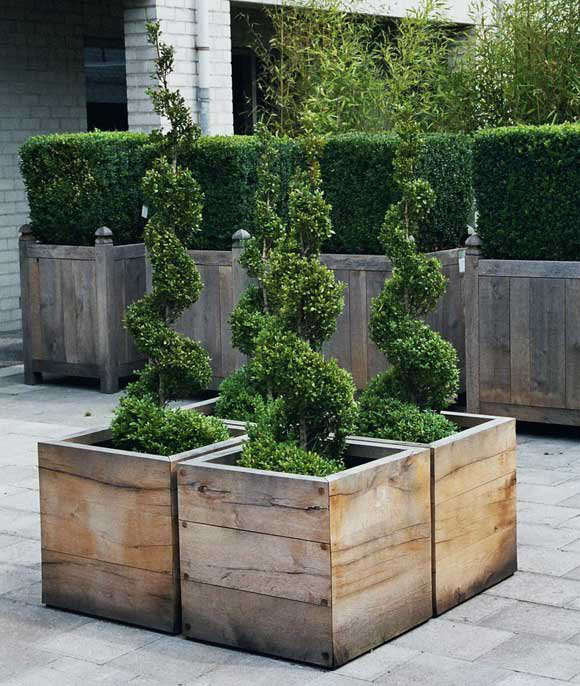
Some garden planters quietly hold a fern. Others stand in the landscape like small pieces of architecture, commanding attention without shouting, waving, or arriving in a suspiciously bright shade of plastic orange. Belgium’s finest handmade wooden planters belong firmly in the second category.
The designs associated with Belgian workshop Out-Standing transform oak and other durable hardwoods into monumental garden containers with clean proportions, substantial frames, and surfaces designed to grow more attractive outdoors. They are functional enough to support trees and shrubs, yet sculptural enough to look complete before anyone has added so much as a sprig of thyme.
Calling anything the “world’s most beautiful” is naturally subjective. Gardeners have argued over less important matters, including the proper pronunciation of “clematis.” Still, these Belgian garden planters make a persuasive case through craftsmanship, restraint, natural materials, and the rare ability to complement both traditional estates and modern urban terraces.
The Belgian Workshop Behind the Famous Wooden Planters
Based in Zandhoven, Belgium, Out-Standing is a woodworking company specializing in handcrafted outdoor pieces. Its portfolio extends beyond luxury garden planters to include tables, gates, garden structures, and other architectural woodwork. The common thread is a respect for natural material combined with disciplined European design.
The company was established in 2005, with production intentionally kept in its own Belgian workshop. Modern equipment is used to prepare and size the timber, but the assembly and finishing remain labor-intensive, hands-on processes. That combination matters. Machines can produce accurate components; experienced joiners give the finished object its personality.
Collections and individual designs have appeared under names such as Fenne, Vasari, and Velvet. Some are square and formal, while others soften the geometry with curved walls or more organic silhouettes. Custom fabrication also allows dimensions and details to be adapted for specific landscapes, terraces, commercial entrances, and architectural projects.
Not Just Another Wooden Box
At first glance, describing one of these objects as a wooden planter box feels technically correct but emotionally inadequate. It is a little like calling a grand piano “furniture with strings.”
The construction is substantial, the proportions are deliberate, and the visual weight is carefully controlled. Thick corner posts, framed panels, broad rims, and occasional metal details give the planters a permanent architectural quality. They can define the edge of a patio, frame a doorway, divide an outdoor dining space, or establish a focal point at the end of a garden path.
Because the designs avoid fussy decoration, they work with many architectural styles. A weathered oak container can look entirely at home beside an old brick farmhouse, a limestone townhouse, a glass-walled modern residence, or a restaurant terrace where the rosemary is expected to behave like an employee.
Why Belgian Garden Design Looks So Distinctive
Belgian gardens often balance several European traditions. French influence appears in geometry, clipped hedges, and symmetry. English naturalism contributes softer planting and seasonal change. Flemish visual culture adds deep greens, weathered surfaces, dark architectural accents, and an almost painterly awareness of light.
The result is formal without feeling stiff and rustic without looking accidental. Belgian garden designers frequently rely on structure, texture, and repeated forms rather than a nonstop parade of colorful flowers. Dense green hedges may become the backdrop, while a small number of carefully chosen objects provide contrast.
A large oak planter fits perfectly into that vocabulary. It supplies geometry, warmth, height, and texture while allowing the plant to remain the principal performer. The container and foliage support each other instead of competing for attention.
Restraint Is the Secret Ingredient
Many outdoor spaces become visually noisy because every pot has a different shape, color, height, and personality. One is pretending to be an ancient Greek urn. Another is shiny enough to communicate with satellites. Three small plastic pots are hiding behind a chair because nobody knows what to do with them.
Belgian-style landscaping usually takes the opposite approach: fewer objects, stronger forms, and a limited palette. Two matching planters beside an entrance can create more impact than a dozen unrelated containers. A single oversized planter containing a sculptural tree can anchor an entire courtyard.
This principle is especially valuable in compact gardens. Reducing the number of competing elements makes a small patio feel calmer and more spacious. The planter becomes part of the architecture rather than another decorative accessory squeezed into the available square footage.
The Beauty of Oak, Patina, and Honest Materials
Rustic oak is closely associated with the planters that first attracted international design attention to Out-Standing. The workshop also works with sustainably sourced hardwoods such as padouk, iroko, and afrormosia, selecting the species according to the desired appearance and technical requirements.
These woods are valued for more than their strength. Their grain, knots, tonal variation, and natural movement give each planter a slightly different character. Hand finishing preserves those individual qualities rather than erasing them beneath a perfectly uniform manufactured surface.
Outdoors, untreated or naturally finished hardwood gradually responds to sunlight and rain. Warm brown tones mellow into a silvery-gray patina. For many owners, that change is not damage; it is the point. The planter begins to relate more naturally to stone, gravel, weathered metal, mature tree bark, and the muted greens of the garden.
Weathering Is a Feature, Not a Manufacturing Error
Wood expands and contracts as moisture and temperature change. Small checks, tonal shifts, and surface variations may develop over time. In a finely made outdoor planter, these changes contribute to an authentic aged appearance.
That does not mean wooden planters are indestructible. Even durable hardwood lasts longer when good design limits standing water, allows airflow, and keeps vulnerable surfaces from remaining constantly saturated. A properly fitted liner, open drainage routes, and feet that lift the base slightly above the paving can all help protect the structure.
Owners who prefer a more controlled appearance may choose a painted finish, including custom RAL colors. Charcoal, black, deep green, and soft gray work particularly well because they intensify the surrounding foliage without turning the planter into a billboard.
Wooden Planters Versus Belgian Clay Planters
Belgium’s reputation for exceptional garden containers is not limited to wood. Atelier Vierkant, another internationally recognized Belgian company, creates large handmade clay vessels with minimal forms and deeply textured surfaces. Its frost-resistant planters have become favorites among prominent architects and landscape designers.
The two traditions share a design philosophy even though their materials differ. Both emphasize scale, craftsmanship, restrained color, and a close relationship between container, plant, architecture, and landscape.
Clay feels mineral and sculptural. Oak feels warm and structural. A large ceramic vessel may resemble an abstract artwork, while a framed wooden planter can feel like a movable piece of garden architecture. Either can be beautiful, but wooden models are particularly effective where nearby doors, pergolas, furniture, or siding already introduce timber into the design.
How to Use Belgian Planters in a Landscape
Frame a Front Entrance
Place a matching pair of tall planters on either side of a doorway, gate, or set of exterior steps. Repetition creates order, while the height makes the entrance feel more important. Clipped evergreens, multi-stem shrubs, or small trees provide year-round structure.
Measure carefully before ordering. The planters should feel generous without narrowing the walking route or colliding with an opening door. Nobody wants a beautiful entrance that requires guests to arrive sideways.
Create a Terrace Boundary
Rectangular planters can divide dining and lounging areas without constructing a permanent wall. Filled with ornamental grasses, upright shrubs, or small trees, they provide privacy while preserving airflow and filtered views.
This technique is useful on roof terraces and urban patios where planting directly in the ground is impossible. A coordinated row of large containers can make the space feel intentional rather than temporarily furnished.
Anchor a Garden View
A single substantial planter can terminate a sightline at the end of a path, beside a bench, or against a clipped hedge. The strongest compositions often use simple planting: one sculptural specimen surrounded by a restrained ground layer.
Consider a cloud-pruned evergreen, Japanese maple, multi-stem serviceberry, olive tree in a suitable climate, or an architectural grass. The plant should have enough visual strength to match the scale of the container.
Repeat Forms for Rhythm
Using the same planter design at intervals can connect different parts of a landscape. Repetition is especially effective along a long terrace, around a pool, or across a large commercial courtyard. The containers become visual punctuation markscommas, not exclamation points.
Choosing Plants for a Large Luxury Planter
A magnificent planter cannot compensate for a plant that hates its location. Begin with the practical conditions: sunlight, winter temperature, wind exposure, irrigation, and the mature dimensions of the plant.
For a formal Belgian-inspired look, choose evergreen structure and a restrained color scheme. Boxwood alternatives, yew, holly, compact conifers, bay laurel in mild climates, or clipped privet can create strong silhouettes. Where local pests or diseases make a traditional species unreliable, select a regionally appropriate substitute rather than fighting an expensive horticultural battle every weekend.
For a softer contemporary display, combine an upright focal plant with mounding foliage and a trailing edge. This is often described as the thriller, filler, and spiller method. The formula is useful, but it should not become a commandment. A single tree in a beautifully proportioned container may look more sophisticated than a crowded botanical variety show.
Keep the Plant Palette Cohesive
All plants sharing a container should have compatible light and moisture requirements. Lavender will not enjoy living with a moisture-loving fern, no matter how charming their relationship looked at the nursery.
Foliage often provides longer-lasting value than flowers. Pair broad leaves with fine grasses, matte leaves with glossy evergreens, or dark foliage with silvery stems. Seasonal bulbs can be tucked between permanent plants for a spring display without dismantling the overall composition.
Drainage, Soil, and Watering: The Unromantic Essentials
Beautiful container gardening still depends on several practical details, beginning with drainage. Excess water must be able to leave the planter. Waterlogged potting mix pushes oxygen from the root zone and can lead to declining plants, root disease, and the awkward experience of explaining why a very expensive tree now resembles a coat rack.
Drainage openings should remain clear, and water must have somewhere safe to flow. On balconies or roof terraces, confirm that runoff will not stain surfaces, enter the building, or surprise people below.
Use a high-quality container mix rather than dense garden soil. Potting media should hold moisture while remaining aerated and free draining. Filling the bottom with gravel does not replace proper drainage holes and may reduce the useful rooting depth.
Large containers dry more slowly than tiny pots, but mature plants can still use substantial amounts of water during hot or windy weather. Check moisture below the surface instead of relying on appearances. Automated drip irrigation can simplify care, provided emitters are monitored and the system is adjusted seasonally.
Repeated watering gradually carries nutrients from the potting mix, so container plants usually require periodic fertilization. Follow plant-specific recommendations and product directions. More fertilizer is not more love; sometimes it is simply more salt around the roots.
What to Consider Before Buying a Belgian Garden Planter
Handmade European planters represent a significant investment, particularly when shipping, custom dimensions, liners, and professional installation are involved. Before ordering, examine the entire project rather than choosing from a photograph alone.
- Scale: Mark the proposed footprint on the ground with tape or cardboard. Large planters often appear smaller in photographs than they do beside an actual door.
- Weight: Calculate the combined weight of the container, wet potting mix, plant, liner, and drainage materials. Confirm that decks and roof terraces can support the load.
- Access: Determine how the planter will reach its final location. Measure gates, elevators, stairs, and narrow side yards before delivery day becomes an outdoor furniture puzzle.
- Drainage: Decide where water will exit and whether a saucer, drainage connection, or protective surface is required.
- Irrigation: Install tubing or water access before the container is full. Moving a planted hardwood box later is rarely anyone’s idea of recreational exercise.
- Maintenance: Ask how the selected wood and finish will weather and whether routine cleaning, oiling, painting, or hardware inspection is recommended.
- Availability: Handmade and custom products may require longer lead times, and dealer relationships can change. Confirm current specifications directly with the manufacturer or authorized supplier.
Why These Planters Remain Relevant
Garden trends move quickly. One year every patio wants a vertical succulent wall; the next year everyone quietly discovers that vertical succulent walls require maintenance. Belgian planters endure because their appeal is rooted in proportion, material, and workmanship rather than novelty.
They also support a broader movement toward treating outdoor areas as genuine living spaces. A well-designed planter can connect a building to its landscape, soften hard paving, direct movement, create privacy, and provide a permanent framework for seasonal planting.
Most importantly, these containers improve with age. New wood looks handsome, but silvered wood surrounded by mature foliage looks as though it has always belonged there. That quality is difficult to imitate with mass-produced décor.
The Ownership Experience: Living With a Belgian-Style Planter
The experience of owning a large handmade planter begins well before planting day. The first surprise is usually its physical presence. A square marked on a landscape plan may seem modest, but a deeply framed oak container standing three feet tall behaves more like a piece of furnitureor a very polite garden building.
Placement therefore becomes the first important lesson. A planter pushed too close to a wall can look cramped and may restrict airflow. Positioned too far into a walkway, it becomes an elegant obstacle course. The most successful location usually gives the object enough room to be appreciated from several angles while connecting it visually to a doorway, window, hedge, or seating area.
Then comes the planting. Filling the entire container with heavy soil is unnecessary and can create drainage problems. A professionally planned interior, suitable liner, drainage layer where specified, and high-quality potting mix make the job easier. Irrigation tubing should be installed before the final planting because reaching through the branches of a newly positioned shrub is an excellent way to lose both patience and a sleeve button.
During the first growing season, owners often notice that the planter changes almost as much as the plant. Fresh wood begins to mellow. Rain darkens the grain temporarily, sun lightens exposed surfaces, and subtle silver tones appear. This transition can feel alarming to anyone expecting the planter to remain showroom brown forever. Once the weathering becomes more even, however, the container typically looks more integrated with the landscape.
Watering also requires adjustment. A large container may retain moisture longer near its center while drying faster around exposed edges. Wind can increase water loss dramatically, especially on roof terraces. Checking the potting mix by touch is more reliable than following a rigid calendar. Irrigation systems help, but clogged emitters and disconnected tubes have ended many vacations with an unpleasant horticultural plot twist.
Seasonal editing becomes one of the pleasures of ownership. Spring bulbs can appear beneath a permanent shrub, summer annuals can soften the rim, and autumn grasses or evergreen cuttings can refresh the display. Because the planter itself already has visual authority, the planting does not need to be complicated. A simple composition often looks richer and is easier to maintain.
Over several years, the relationship between object and garden becomes increasingly convincing. Small marks stop feeling like flaws. Moss may settle into shaded joints. The wood tones begin echoing nearby stone and bark. The plant develops a mature canopy that finally matches the generous scale of the container.
That gradual evolution is the real luxury. The planter is not merely purchased, displayed, and replaced when fashion changes. It participates in the aging of the garden. It records seasons, weather, pruning decisions, successful experiments, and the occasional plant that absolutely refused to cooperate. In a world full of disposable outdoor accessories, a handcrafted Belgian planter offers something refreshingly different: permanence with permission to change.
Conclusion
The world’s most beautiful garden planter may be impossible to determine scientifically, unless researchers develop an internationally recognized unit of patio elegance. Even so, Belgium’s handcrafted wooden planters deserve their reputation.
Out-Standing combines sustainable hardwoods, skilled joinery, architectural proportions, and natural weathering to create containers that function as part of the landscape rather than temporary decoration. Their beauty comes from restraint: fewer lines, better materials, careful scale, and enough confidence to let wood and plants do the talking.
Whether used to frame an entrance, organize a terrace, support a sculptural tree, or add structure to a small urban garden, a Belgian planter can deliver impact without visual clutter. Choose the correct size, provide reliable drainage, use compatible plants, and allow the surface to age naturally. The result will not simply hold a garden. It may become one of the reasons the garden feels complete.
Note: This original article synthesizes established information from the Belgian manufacturers’ published materials and reputable U.S. design, forestry, landscaping, and university horticultural resources. Product specifications, finishes, distribution, and availability should be confirmed before purchase.