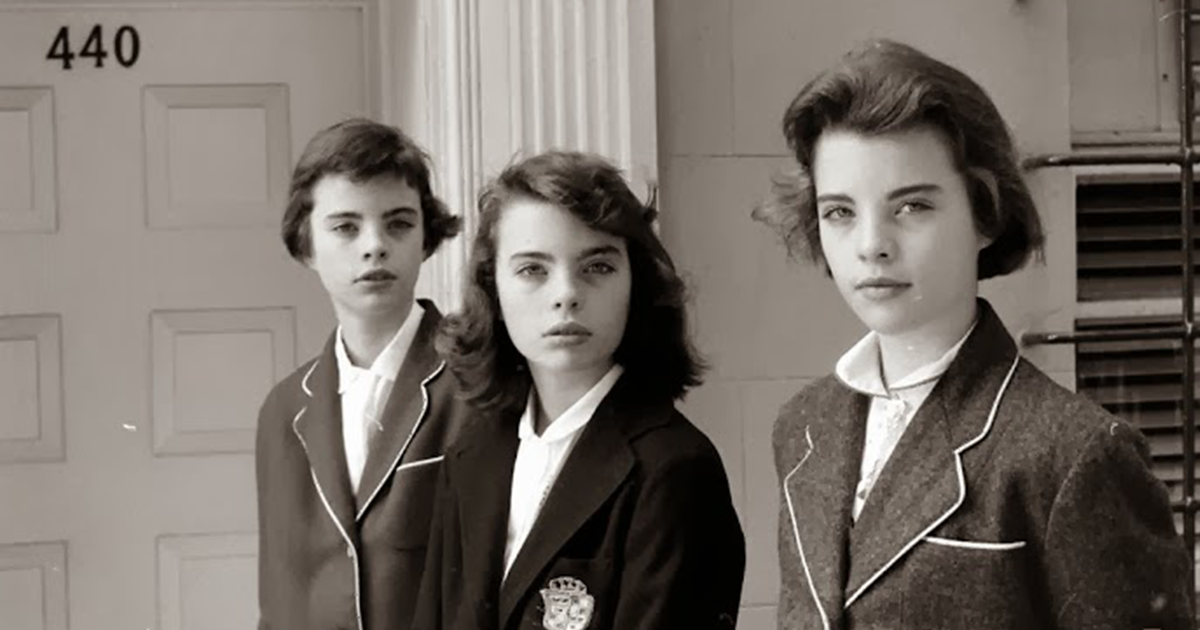
At first glance, Nina Leen’s black-and-white photographs of women from the 1940s and 1950s look like elegant time capsules: polished shoes, waved hair, slim gloves, crowded dressing rooms, school dances, office desks, and living rooms arranged with military precision. Look longer, however, and the pictures become less tidy. A woman smiles while calculating how she is being seen. A teenage girl performs confidence for her friends. A homemaker manages a household that appears effortless only because much of her labor remains outside the frame.
That tension makes Leen’s work compelling. She did not merely photograph “vintage women.” She photographed women negotiating expectations during two decades of enormous change. Her camera caught the gap between the official instructionbe attractive, capable, cheerful, and appropriately feminineand the complicated human being trying to live inside it.
Who Was Nina Leen?
Nina Leen was born in Russia, grew up in several European countries, studied painting in Berlin, and moved to the United States in 1939. She taught herself photography with a Rolleiflex. Her first pictures published by LIFE were an unlikely series about tortoises at the Bronx Zoo in 1940, beginning a relationship with the magazine that lasted more than three decades. Although often called a staff photographer, Leen actually worked on contract. Even so, she produced more than 50 covers and a vast number of photo essays before LIFE ended its original weekly run in 1972.
As an immigrant, Leen viewed American culture from both inside and outside. That distance helped her make ordinary rituals look familiar, strange, amusing, and faintly theatrical. A room full of women applying lipstick could resemble backstage preparation for a national performance called “being presentable.”
Women Between Wartime Independence and Postwar Domesticity
The women in Leen’s photographs lived through a dramatic social reversal. During World War II, labor shortages drew millions of American women into factories, government offices, transportation, and jobs previously associated with men. By 1945, women made up about 37 percent of the civilian workforce. Clothing changed too: shorter skirts, stronger shoulders, simpler lines, and practical garments suited wartime work and material restrictions.
After the war, popular culture renewed its enthusiasm for marriage, motherhood, suburban comfort, and domestic expertise. Yet women did not disappear from paid employment. In the 1950s, they continued working as teachers, nurses, librarians, secretaries, flight attendants, and factory employees, even while advancement remained sharply limited. The cheerful housewife and the working woman were often the same person at different hours, carrying a handbag in one hand and an invisible second shift in the other.
Leen showed this contradiction without needing a slogan. Whether her subjects were shopping, typing, studying, caring for children, or preparing for a social event, they were expected to appear composed while performing substantial physical and emotional labor. Apparently, exhaustion was acceptable as long as it had good posture.
The “American Woman’s Dilemma” in 1947
One of Leen’s most revealing assignments examined what LIFE called the “American Woman’s Dilemma.” Published in 1947, the story explored pressures surrounding employment, homemaking, marriage, children, education, and ambition. The questions sound surprisingly modern: Should a woman work full-time or part-time? How should housework be divided? What happens to a career after children arrive? Why must every choice be treated as a public referendum on womanhood?
The feature acknowledged the economic value of unpaid domestic work while still framing women’s lives as a difficult balance between home and employment. Leen photographed people inside that debate rather than reducing them to statistics. Some unpublished frames also depicted single working women, reminding modern viewers that the magazine’s final edit represented only part of what her camera recorded.
The series offers no simple heroine. The homemaker is not automatically fulfilled, the professional woman is not automatically liberated, and the fashionable woman is not automatically frivolous. Leen’s subjects appear to be thinking, adapting, and occasionally enduring advice from a society that had no shortage of opinions about them.
Teenage Girls and the Birth of Youth Culture
Leen was unusually skilled at photographing teenagers. Her 1944 LIFE essay on teenage girls in Missouri helped document the emergence of the modern American teenager as a distinct social category with its own clothes, language, friendships, spending habits, romantic codes, and rituals. The girls study, gather in bedrooms, talk on telephones, attend social events, and observe one another with the intensity of amateur anthropologists.
These photographs are funny because adolescence is funny, although rarely to the adolescent experiencing it. A group of girls can turn a sofa into a parliament, a mirror into a courtroom, and a telephone call into an international crisis. Leen did not mock them. She treated their emotions as real while preserving the small absurdities of their world.
More importantly, she photographed friendship, self-invention, boredom, embarrassment, and social intelligencenot merely future wives or fashion consumers. Hair, posture, clothes, and conversation become tools for entering adult society, but also for creating a private culture adults do not fully understand.
Fashion as a Social Language
Leen was one of LIFE’s most accomplished fashion photographers. She covered Paris fashion and photographed American style with a cool, graphic eye. In her pictures, clothing communicates age, class, occasion, respectability, aspiration, and sometimes rebellion.
From Wartime Utility to Postwar Elegance
Wartime restrictions encouraged economical silhouettes and practical dressing, while the postwar period revived luxurious fabrics, fuller shapes, polished accessories, and highly structured presentation. For a 1950 feature on American elegance, Leen photographed mink-trimmed satin coats, tweed suits, rhinestone details, and other designs intended to prove that American fashion could rival European sophistication.
Even leisurewear carried rules. Her 1950 beach-fashion images featured strapless and halter-top swimsuits, “pirate pants,” dramatic straw hats, and one-piece suits that generally outpaced two-piece designs. Going to the beach, it seems, required enough strategic planning to launch a small naval operation.
Clothes, Gesture, and Performance
Leen’s best fashion photographs do more than display garments. They use bodies, spacing, mirrors, architecture, and repetition to create psychological scenes. A row of models becomes a chorus. A dressing room becomes a laboratory of self-construction. A hat may technically be an accessory, but in Leen’s compositions it behaves like punctuationan exclamation point, a question mark, or occasionally a complete alibi.
Public Life, Shopping, and Female Social Worlds
Leen repeatedly entered spaces where women gathered beyond the immediate family. She photographed Macy’s shoppers in 1948, fashion at horse races, members of Manhattan’s Pamper House using dedicated makeup nooks in 1952, and women and girls in a convertible being served by a female carhop during a 1945 California story.
Together, these photographs complicate the stereotype of the isolated homemaker. Women exchange information, compare styles, build alliances, compete, relax, spend money, and occupy public space. Consumer culture shapes the scenes, but the women are not passive mannequins. Their gestures suggest judgment, humor, skepticism, pleasure, and calculation. Leen understood that every group contains subplots: who leans toward whom, who controls the center, and who looks ready to escape through the nearest service entrance.
Why Black-and-White Makes the Images Feel Modern
Black-and-white removes fashion’s most obvious attractioncolorand forces attention onto structure. Viewers notice the geometry of a skirt, the shine of a shoe, the pale arc of a glove, the dark block of a suit, the repetition of carefully arranged hair, and the expressions that interrupt visual perfection.
It also resists easy nostalgia. Color can make the past feel decorative, like a box of vintage candy. Black-and-white is less cooperative. It emphasizes contrast, shadow, texture, and ambiguity. Domestic interiors may feel claustrophobic; social gatherings may look ritualistic; fashion images may become surreal. Critics have noted the tension and mystery in Leen’s seemingly ordinary scenes, which helps explain why her work appears more psychologically complicated than a conventional magazine assignment.
What the Photographs Showand What They Leave Out
Leen’s best-known pictures are not a complete record of American womanhood. Much of the celebrated material centers on white, middle-class subjects and on worlds most visible to a major national magazine. Her famous 1944 teenage-girl essay, for example, focused on white, middle-class girls in Missouri. Race, poverty, rural labor, immigrant communities, queer lives, and many other experiences were often underrepresented or filtered through the editorial priorities of the period.
That limitation makes the photographs documents to be read in two directions. They show the people in front of the camera, but they also reveal what editors believed a mass audience wanted to see. A photograph may be honest about a moment while the publication remains selective about whose moments count.
Recent exhibitions devoted to LIFE’s pioneering women photographers have placed Leen beside Margaret Bourke-White, Marie Hansen, Martha Holmes, Lisa Larsen, and Hansel Mieth. The exhibitions underline a crucial point: women were not merely subjects during the picture-magazine era; they were image-makers helping define how modern life looked.
Nina Leen’s Lasting Legacy
Leen died in 1995, leaving fashion work, social observation, portraits, animal studies, and numerous books. Her gift was the ability to find drama in ordinary behavior. A school gathering, shopping trip, beauty routine, or family room could become a study of identity.
Her pictures remain relevant because their questions remain unresolved. How much of femininity is chosen, and how much is rehearsed? Who performs the labor that makes elegance look effortless? Can a woman pursue work, family, independence, beauty, pleasure, and rest without being asked to defend the arrangement? Leen answered not with manifestos, but with faces, rooms, clothes, hands, mirrors, and perfectly timed glances.
An Extended Viewing Experience: How to Look at Nina Leen’s Women
The most rewarding way to experience Nina Leen’s photographs is to resist the urge to scroll quickly. Vintage imagery is often consumed as instant atmosphere: “Nice dress, excellent hat, next photo.” Leen’s work deserves a slower approach. Begin with the whole frame, then examine its social map. Notice where the woman is positioned. Is she centered, crowded, reflected, watched, or partly hidden? Does the room support her, or does it seem to press inward?
Next, look at the hands. Faces know when a camera is present; hands are less disciplined. A hand grips a handbag, adjusts a collar, rests protectively on a chair, touches a friend, holds a cigarette, or pauses during work. These gestures may reveal more than the official expression. A smile can announce, “Everything is lovely,” while the knuckles quietly file a minority report.
Clothing should be read as behavior rather than costume. A tailored suit may communicate professional authority, but it may also show how carefully a woman had to package that authority. Gloves suggest polish and restraint. A swimsuit represents leisure while exposing the body to public judgment. A teenage sweater may look simple, yet within a peer group it can carry an entire code of belonging. The viewing experience becomes richer when the question changes from “What is she wearing?” to “What did this outfit allow her to do, and what did it require her to prove?”
Mirrors are especially important in Leen’s world. When women apply cosmetics or prepare for an event, the mirror introduces a second audience. The subject is observed by the photographer, by nearby women, by the imagined public, and by herself. Beauty becomes less a fixed quality than an activity assembled through practice, comparison, and correction. Anyone who has redone one eyebrow six times before deciding the first version was fine will recognize the emotional stakes.
Group scenes add another layer. Instead of searching immediately for the most glamorous figure, look at the quiet person near the edge. She may be watching rather than performing, and her expression can change the meaning of the photograph. Trace the lines of attention: one woman looks at another, a third watches the first, and someone in the background appears to have reached an entirely different conclusion. Leen’s group photographs behave like short stories in which every character has a private subplot.
Finally, compare the image with the historical narrative around it. A cheerful domestic photograph may belong to an era that praised homemaking while undervaluing unpaid labor. A stylish office portrait may conceal restricted advancement and unequal pay. A carefree teenage scene may represent only a narrow slice of American youth. This does not require rejecting beauty or humor. It means allowing pleasure and criticism to exist together.
That double vision is Leen’s deepest gift. Her photographs can be enjoyed for composition, fashion, expression, and period detail, but they also invite viewers to question the systems surrounding the frame. The women are neither flat symbols of oppression nor perfect icons of vintage glamour. They are individuals adapting, performing, resisting, enjoying themselves, and occasionally looking as though they have already heard enough advice for one century.
Conclusion
Women in 1940s and 1950s black-and-white photos by Nina Leen appear poised between tradition and change. Through teenagers, workers, homemakers, shoppers, models, mothers, and friends, she captured the choreography of femininity during a transformative era. Her photographs preserve beautiful clothes and vanished customs, but their real power comes from something less decorative: the tension between social expectation and private identity.
Note: This article interprets Leen’s photographs within their historical and editorial context. Her widely circulated LIFE images illuminate important aspects of mid-century American culture, but they should not be treated as a complete representation of every woman’s experience.