It sounds like summer camp wandered into your kitchen, but placing a pool noodle inside a drawer is one of those delightfully odd home hacks that makes immediate sense once you try it. A short piece of foam can stop a loose silverware organizer from sliding backward, rattling, and rearranging itself every time someone reaches for a fork with unnecessary enthusiasm.
The idea popularized by Family Handyman is wonderfully simple: measure the empty space behind the organizer, cut a pool noodle to fit, and wedge the foam into the gap. The noodle acts as a soft, removable bumper. No drilling, no permanent adhesive, no custom carpentry, and no need to negotiate with a drawer that apparently wants to become a percussion instrument.
Why Drawer Organizers Slide Around
Most utensil trays are designed to fit a range of standard drawer sizes rather than one exact cabinet. That flexibility is useful when shopping, but it often leaves a few inches of unused space behind or beside the organizer. Each time the drawer opens, momentum carries the tray forward. When the drawer closes, the tray slides backward again.
That movement creates more than an irritating clatter. It can push utensils into awkward piles, allow small objects to slip behind the tray, and make an otherwise organized drawer feel messy. A lightweight plastic organizer may move especially easily when it rests on a smooth painted, laminated, or finished wood surface.
Commercial solutions include nonslip drawer liners, adhesive dots, museum putty, expandable trays, spring-loaded dividers, and organizers with rubber feet. These can all work. The pool noodle drawer hack simply solves the same problem with a cheap, compressible object that may already be sitting in the garage wearing a faded tropical pattern.
How the Pool Noodle Drawer Hack Works
The foam does not need to cover the entire drawer. It only needs to fill enough of the empty gap to prevent the organizer from gaining momentum. Because a pool noodle compresses slightly, it can create gentle pressure between the tray and the back wall of the drawer.
The Basic Principle
Think of the noodle as a removable spacer. A rigid block must be cut very accurately, while foam is more forgiving. If the piece is slightly oversized, it can compress. If it is slightly undersized, you can cut another thin section and add it beside the first.
Why Foam Is Useful
A soft bumper absorbs some of the vibration produced when the drawer opens and closes. It also avoids the sharp knocking sound that can occur when a hard organizer repeatedly hits the back of a wooden drawer. The result is not glamorous, but neither is listening to forks perform an unsolicited drum solo before breakfast.
What You Need
- One clean pool noodle
- A tape measure or ruler
- A marker
- A sharp utility knife, serrated knife, or sturdy scissors
- A cutting board or protected work surface
- The drawer organizer you want to stabilize
You will probably use only a small portion of the noodle. Save the remaining foam for other household projects, such as protecting sharp garage edges, padding hangers, filling awkward storage gaps, or preventing small objects from falling between appliances.
Step-by-Step: Use a Pool Noodle Inside a Drawer
1. Empty and Clean the Drawer
Remove the utensils and lift out the organizer. Vacuum crumbs, wipe the drawer interior, and allow it to dry. This is also a good opportunity to remove duplicate tools, broken gadgets, mystery keys, and the tiny packet of soy sauce that has apparently held permanent residency since 2019.
2. Return the Organizer to Its Preferred Position
Place the tray where you actually want it to remain. In most silverware drawers, that means positioning it near the front so the compartments are easy to reach when the drawer is only partially open.
3. Measure the Empty Gap
Measure the distance between the back edge of the organizer and the inside back wall of the drawer. Also measure the available width and height. A full round noodle may be too tall for a shallow drawer, so check that the drawer can close without the foam rubbing against the cabinet frame.
4. Mark and Cut the Foam
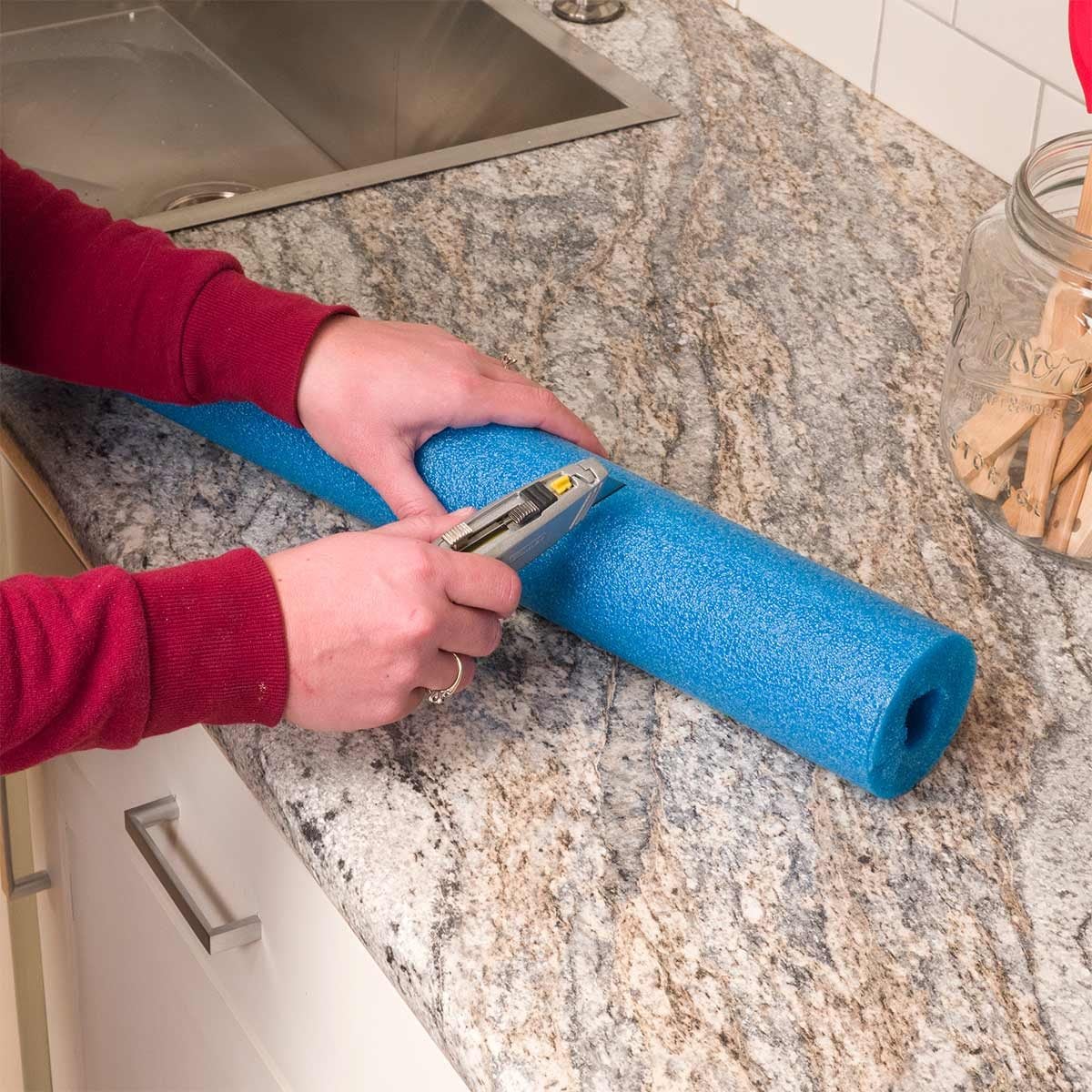
Transfer the measurement to the pool noodle. Cut on a stable surface, keeping your free hand away from the blade. Begin with a piece slightly longer than the measured gap. You can always trim it; teaching foam to grow back is considerably more difficult.
5. Adjust the Shape if Necessary
For a shallow drawer, cut the round noodle lengthwise to create a half-cylinder. You can also cut a thick strip from one side. The goal is not to preserve the noodle’s elegant aquatic silhouette. The goal is to produce a spacer that fits below the top edge of the drawer.
6. Wedge the Piece Behind the Organizer
Place the cut foam between the organizer and the back of the drawer. It should fit snugly without bowing the tray, stressing the drawer sides, or preventing the drawer from closing. Trim the foam in small increments until the fit feels secure.
7. Reload and Test
Return the utensils to their compartments. Open and close the drawer several times at normal speed. Then repeat the test with the slightly dramatic force used by whoever in your household believes every drawer is a fire station emergency. If the organizer stays put, the hack is working.
How to Get the Fit Right
The best pool noodle drawer spacer is firm enough to stop movement but not so tight that it creates pressure on the cabinet. Foam should function as a bumper, not a structural support beam.
If the Noodle Is Too Thick
Slice it lengthwise, remove a narrow strip, or use only half of the cylinder. Check the drawer’s top clearance before reloading it. A piece that sits too high may catch on the cabinet frame or make the drawer difficult to close.
If the Noodle Is Too Loose
Cut a longer section or add a thin foam slice beside it. Another option is to position the noodle horizontally across most of the drawer width. Wider contact can provide better stability for a large utensil tray.
If the Organizer Moves Sideways
A rear bumper primarily controls front-to-back motion. For sideways sliding, add short foam pieces along one or both sides. Keep the arrangement simple enough that you can remove everything for cleaning without assembling a three-dimensional foam puzzle.
Where Else This Drawer Organization Hack Works
The same method can stabilize many lightweight containers, provided the foam does not interfere with drawer hardware or come into contact with exposed sharp edges.
Bathroom Drawers
Use a small foam spacer behind bins holding combs, cotton swabs, cosmetics, or dental supplies. Grouping similar products into separate containers makes the drawer easier to maintain and prevents small objects from migrating into dark corners.
Office and Craft Drawers
Pool noodle pieces can steady trays containing pens, clips, sewing notions, stamps, or art supplies. This is particularly helpful when several small modular containers slide apart whenever the drawer opens.
Workshop Storage
A foam bumper may help stabilize lightweight bins used for fasteners, measuring tools, or non-sharp accessories. Keep it away from hot equipment, exposed blades, drill bits, saw teeth, and anything likely to slice or puncture the foam.
Bedroom Dressers
Use the technique behind fabric bins or adjustable compartments for socks, belts, and accessories. A small rear spacer can keep a flexible organizer pushed toward the front where its contents remain visible.
Important Safety and Cleaning Considerations
Protect Your Hands While Cutting
Cut the noodle on a stable board rather than holding it in midair. Use controlled pressure and direct the blade away from your body. Replace a dull utility blade instead of forcing it through the foam.
Keep Knives in a Proper Insert
Do not use loose foam as a substitute for a knife block, blade guard, or purpose-built knife organizer. Sharp knives should be secured so their edges are covered and your hands do not encounter an unexpected blade while searching through the drawer.
Inspect the Foam Occasionally
Remove the spacer during routine drawer cleaning. Replace it if it becomes dirty, compressed, torn, sticky, or crumbly. The hack is inexpensive enough that there is no prize for keeping one battered piece of foam in service for the next decade.
Avoid Overcomplicating the System
A good organization method should be easy to reset after unloading the dishwasher. If the drawer requires a diagram, three labels, and an introductory seminar, the system may be too elaborate for everyday life.
Pool Noodle vs. Other Ways to Stop a Drawer Organizer From Sliding
Nonslip Drawer Liner
A grippy liner covers the drawer bottom and can reduce movement across the entire surface. It is useful when several small containers are involved. However, liners need to be cut to size and may shift, curl, or collect crumbs beneath them.
Adhesive Dots or Removable Putty
Small adhesive products take up almost no space and work well beneath individual bins. They may leave residue, lose grip after repeated cleaning, or make the organizer less convenient to remove.
Expandable Organizers
An expandable tray can use more of the drawer width and provide additional compartments. This is a polished solution, although it costs more than repurposing a leftover pool noodle.
Spring-Loaded Dividers
Adjustable dividers are excellent for separating cooking utensils, towels, lids, or pantry items. Models with padded ends can remain firmly in place without damaging drawer walls. They are better suited to creating compartments than merely filling a small gap behind an existing tray.
Custom Wood Dividers
Wooden dividers offer a built-in appearance and can be tailored to the drawer’s exact dimensions. They also require more measuring, tools, time, and commitment. The pool noodle solution is ideal for renters, temporary setups, oddly sized drawers, and anyone whose home-improvement philosophy is “effective before elegant.”
Organize the Drawer Before You Stabilize It
Preventing movement will not rescue a tray overloaded with twenty-seven gadgets. Before installing the foam spacer, group similar objects and remove anything that does not belong.
Keep daily flatware together. Store larger cooking utensils in a separate divided drawer when possible. Move rarely used specialty tools to a secondary location. Protect knives in a dedicated insert, and keep frequently used objects where they can be reached without opening the drawer fully.
Measure the organizer as well as the drawer before buying new storage products. An organizer that looks perfect online can become an expensive plastic monument to optimism when it is half an inch too wide.
Finally, build the system around real household habits. Labels, dividers, and beautiful matching bins are helpful only when everyone can understand where things belong and return them without performing advanced spatial reasoning.
A 500-Word Practical Experience: What a Typical Weekend Test Reveals
Consider a common household test case: a standard kitchen drawer, a plastic silverware tray, and a gap of roughly three inches behind it. Before the pool noodle is added, opening the drawer pulls the tray toward the front. Closing it sends the tray backward with a clack. After a few days, teaspoons lean into the fork compartment, measuring spoons escape along the side, and one chopstick disappears behind the organizer like it has entered a witness-protection program.
The first attempt usually teaches the most important lesson: measure the drawer’s height, not only the gap behind the tray. A full-size noodle section may fit beautifully from front to back but sit too tall for the drawer to close. Cutting the foam into a half-cylinder solves the problem. The flat side rests against the drawer bottom, while the curved side presses gently against the organizer.
During installation, an intentionally oversized piece tends to work better than a loose one, but only by a small margin. When the foam is much too long, it pushes the organizer forward and may cause the tray to bow. Trimming approximately a quarter inch at a time provides better control than making one heroic cut and hoping the laws of geometry feel generous.
Once the fit is correct, the difference is immediate. The organizer remains near the front, the utensils make less noise, and the drawer feels more solid. The improvement is especially noticeable early in the morning, when a rattling silverware tray seems capable of waking people in neighboring counties.
The next observation appears during cleaning. Because the foam is not glued down, the organizer and spacer can be removed in seconds. Crumbs can be vacuumed, the drawer wiped, and the components returned without scraping away adhesive. This removable design is one of the hack’s strongest advantages.
A week of ordinary use may reveal minor adjustments. If the tray still shifts sideways, two narrow pieces along the sides can help. If the foam rotates or rides upward, cutting a flatter section creates more contact with the drawer bottom. If the noodle smells strongly, sheds particles, or appears degraded, replacing it with a clean piece is wiser than attempting to make the original one a family heirloom.
The experience also demonstrates that the hack works best as part of a simple organization system. When excess gadgets are removed and each utensil has a logical home, the stationary organizer remains neat. When the tray is overfilled, the foam can stop the organizer from moving, but it cannot prevent a potato masher from declaring war on everything around it.
Most importantly, the project delivers a satisfying result without permanent changes. Renters can use it without modifying cabinetry. Homeowners can test the arrangement before investing in custom dividers. Families can resize the foam whenever they replace the organizer. The finished drawer will not appear in a luxury kitchen catalog, because the noodle is hidden. That is part of its charm: the solution quietly does its job without demanding applause, counter space, or a rechargeable battery.
Frequently Asked Questions
Does the pool noodle need to span the entire drawer?
No. It only needs enough contact to prevent the organizer from sliding. A short central piece may work for a small tray, while a wide organizer may benefit from a longer section.
Can I use the hack in a shallow drawer?
Yes. Cut the noodle lengthwise or remove a strip so the foam sits below the drawer’s upper edge. Always test the drawer before replacing the contents.
Will the foam damage the drawer?
A clean, lightly compressed piece should function as a removable bumper. Do not force an excessively large section into place, and inspect both the foam and drawer finish during cleaning.
Can I use pipe insulation instead?
Foam pipe insulation can serve a similar purpose and is often available in narrower diameters. Choose a clean piece that fits the space without stressing the organizer or cabinet.
What should I do with the leftover pool noodle?
Save it for future spacers, hanger padding, garage-edge guards, appliance-gap blockers, craft projects, or protective packing. Labeling the leftover piece may also prevent someone from returning it to the swimming pool in its newly shortened condition.
Conclusion
Using a pool noodle inside a drawer is a classic example of practical home improvement: inexpensive, reversible, slightly ridiculous, and surprisingly effective. A carefully measured piece of foam can stop a loose utensil organizer from sliding, reduce rattling, and make the drawer easier to use.
The key is to measure all three dimensions, cut safely, avoid excessive pressure, and keep the foam below the drawer’s closing clearance. Combine the bumper with sensible decluttering and clearly defined compartments, and an unruly silverware drawer can become quieter and more organized in minutes.
No renovation is required. No specialized hardware is involved. The only casualty is a small section of pool noodle that probably believed it had a long career in aquatic recreation ahead of it.