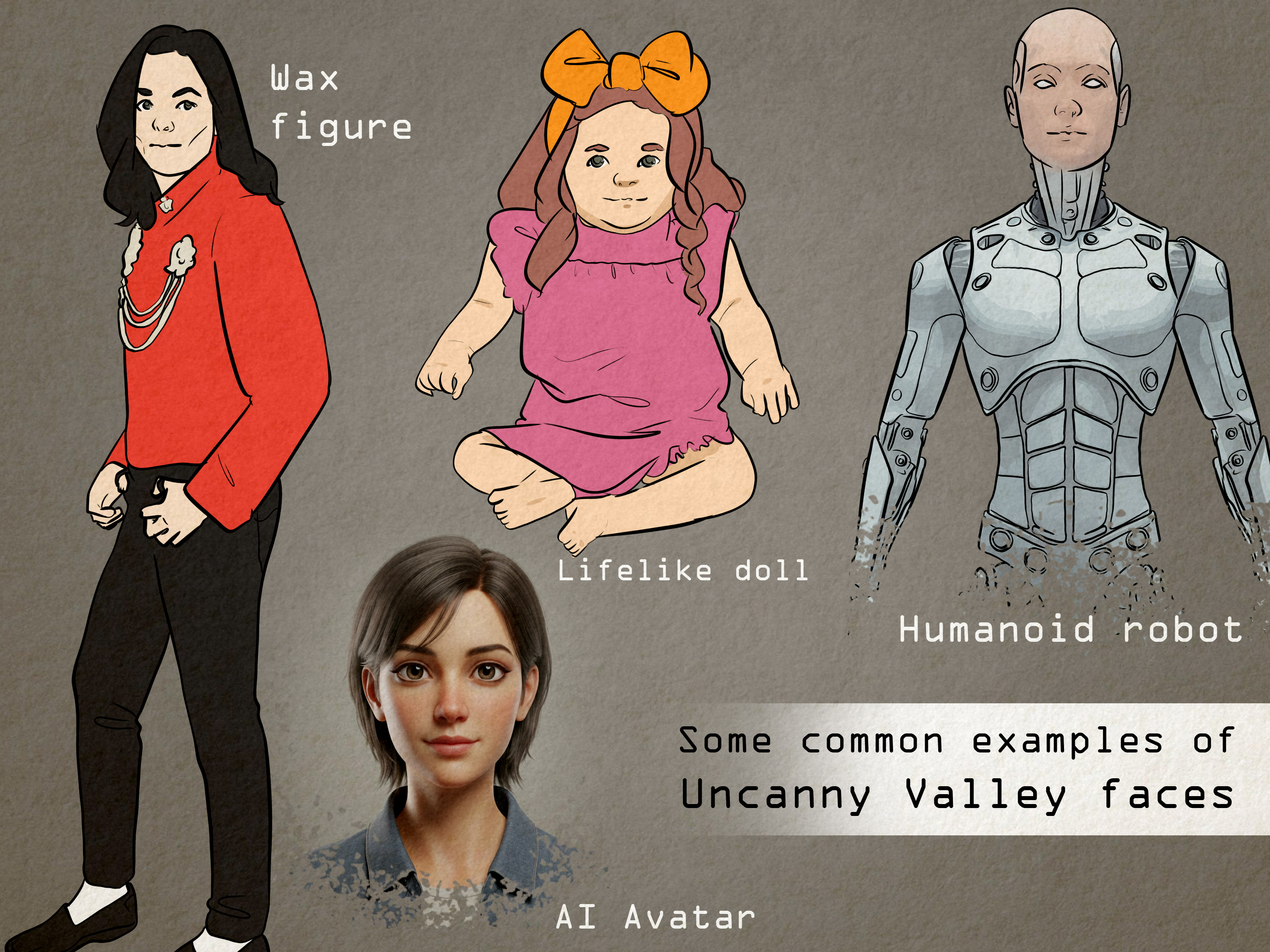
Have you ever looked at a robot, video game character, wax figure, AI selfie filter, or hyper-realistic animated face and felt your brain quietly whisper, “Nope”? That strange little shiver is not just you being dramatic. It may be the uncanny valley face effect: the uneasy feeling people get when a face looks almost human, but not quite human enough.
The creepy part is that the face does not have to be monstrous. In fact, the more human it tries to look, the more disturbing it can become when something is slightly off. A blank stare, waxy skin, stiff mouth movement, too-perfect symmetry, glassy eyes, or a smile that arrives half a second late can turn “realistic” into “please remove this from my screen immediately.”
The uncanny valley matters more than ever because we now meet human-like faces everywhere: AI-generated influencers, customer service avatars, video game characters, animated movie humans, deepfake-style media, virtual assistants, humanoid robots, and beauty filters that sandpaper every pore into oblivion. Understanding why these faces feel creepy helps us understand design, psychology, technology, and our own very picky brains.
What Is the Uncanny Valley Face?
An uncanny valley face is a human-like face that appears realistic enough to trigger our expectations for a real person, but artificial enough to violate those expectations. The result is discomfort, eeriness, distrust, or a sense that something is “off.”
The term “uncanny valley” was introduced by Japanese roboticist Masahiro Mori in 1970. He suggested that as robots become more human-like, people generally feel more comfortable with themup to a point. Then, when the robot becomes almost human but still imperfect, emotional comfort drops sharply. That drop is the “valley.” If the design becomes truly indistinguishable from a real person, comfort may rise again.
Faces are especially vulnerable to this effect because humans are face-reading machines. We recognize tiny changes in eyes, mouths, skin texture, emotion, timing, and movement. Your brain can spot a weird smile faster than you can explain why it is weird. Congratulations: your face-detection system is both impressive and extremely judgmental.
Why Does the Uncanny Valley Feel So Creepy?
The uncanny valley is not caused by one single thing. Researchers and designers usually discuss several overlapping explanations. The short version: your brain expects a human face to behave like a human face, and when it does not, your mental alarm system starts tapping the glass.
1. The Face Creates Category Confusion
People like to sort things quickly: human, animal, cartoon, object, robot, statue, doll, mannequin. A cartoon character is not creepy because it clearly belongs in the “not real” category. A real person is not creepy because they clearly belong in the “human” category. The uncanny valley happens in the awkward middle, where the brain cannot settle on a category.
An almost-human face may make you think, “Is this a person, a simulation, a doll, a filter, or a haunted customer service chatbot?” That uncertainty can feel uncomfortable because the brain prefers fast, confident judgments, especially when dealing with faces.
2. Human Realism Raises Human Expectations
The more realistic a face looks, the more we expect it to behave realistically. If a cartoon character blinks strangely, we forgive it. If a hyper-realistic digital person blinks strangely, we start planning our escape route.
Realistic skin should have pores, tiny color variations, natural softness, and subtle imperfections. Real eyes should track movement with purpose. Real smiles should involve the cheeks and eyes, not just the mouth. When a face looks nearly real but misses these details, the mistake becomes louder. It is like hearing one wrong note in an otherwise polished piano performance.
3. Appearance and Motion Do Not Match
One of the biggest uncanny triggers is mismatch. A face may look human, but its movement may feel robotic. The lips may not sync perfectly with speech. The smile may rise too slowly. The eyes may stare without micro-movements. The head may move like a mannequin on a lazy Susan. Not ideal for trust-building.
Research on human-like robots and virtual characters suggests that people react strongly when appearance and motion do not line up. If something looks biological, we expect biological motion. When the body says “person” but the movement says “software update pending,” the result can feel unsettling.
4. Facial Expressions Feel Incomplete
Human expressions are complex. A genuine smile is not only a mouth curve. It involves the eyes, cheeks, timing, posture, and context. A fearful expression is not just wide eyes. A surprised face is not just raised eyebrows. When digital characters or robots show emotion only in part of the face, people may read the expression as fake, lifeless, or suspicious.
This is why some uncanny faces seem emotionally “empty.” They may be technically smiling, but the smile does not reach the eyes. They may be speaking warmly, but the face remains too still. The result feels less like a friendly person and more like a refrigerator trying theater for the first time.
5. The Brain May Treat “Almost Human” as a Warning Signal
Some theories suggest that uncanny faces may trigger old survival systems. A face that looks human but appears stiff, pale, lifeless, sick, or abnormal can activate discomfort because humans are sensitive to signs of illness, danger, or death. This does not mean every uncanny face looks diseased; it means our brains may react defensively to faces that violate normal human expectations.
In other words, the uncanny valley may be partly your brain saying, “This resembles a person, but something is wrong, so please pay attention.” Helpful? Sometimes. Overdramatic? Absolutely.
Common Features of an Uncanny Valley Face
Not every creepy digital face has the same problem, but many uncanny faces share a few recognizable traits:
- Glassy or unfocused eyes: The eyes look present but not mentally “there.”
- Too-smooth skin: Skin texture looks plastic, waxy, airbrushed, or strangely poreless.
- Stiff facial movement: The face moves in limited or mechanical ways.
- Odd blinking: Blinks are too slow, too rare, too frequent, or poorly timed.
- Unnatural smiles: The mouth smiles while the eyes remain emotionally unemployed.
- Perfect symmetry: Real faces are slightly uneven; extreme symmetry can feel artificial.
- Voice mismatch: A human-like face paired with a voice that does not fit can increase discomfort.
- Lighting inconsistency: Shadows, reflections, or skin highlights do not match the environment.
Uncanny Valley Examples in Pop Culture and Technology
The uncanny valley is easiest to understand through examples. Many viewers have described early photorealistic animation, certain CGI movie characters, humanoid robots, and AI-generated faces as unsettling because they approach realism without fully arriving there.
Animated Movies and CGI Humans
Some animated films and visual effects projects have been criticized for making human characters look too realistic to be cartoons but too artificial to feel alive. Early photorealistic CGI humans often struggled with eyes, skin texture, and facial motion. The technology was impressive, but the emotional result could be chilly, like watching a wax museum learn choreography.
Modern animation often avoids this by choosing stylization over realism. Pixar-style, anime-style, comic-style, and exaggerated designs work because they do not promise to be real humans. They create their own visual rules, and audiences accept them quickly.
Humanoid Robots
Humanoid robots can be charming, useful, or fascinating, but the more closely they copy human faces, the higher the design risk. A clearly mechanical robot can feel friendly because expectations are modest. A highly realistic android face creates expectations for human warmth, eye contact, timing, and emotional responsiveness. If those expectations are not met, the robot may feel eerie instead of impressive.
AI-Generated Faces and Avatars
AI-generated faces can look incredibly realistic at first glance. But the uncanny effect often appears after a longer look. Maybe the teeth form a strange pattern. Maybe the eyes do not focus in the same direction. Maybe the skin looks like it was polished by a luxury car detailer. Maybe the expression feels emotionally vague, as if the person is smiling, apologizing, and buffering at the same time.
AI video can intensify the effect because motion adds another layer of expectation. A still image may pass as realistic, but once the face talks, blinks, breathes, or turns, tiny flaws become more visible. This is why AI avatars can feel convincing for two seconds and deeply weird by second five.
Why Faces Are More Uncanny Than Objects
A slightly inaccurate chair does not bother most people. A slightly inaccurate human face can bother people immediately. That is because faces carry social information: identity, attention, emotion, trust, health, intention, and mood. Humans evolved to read faces quickly because faces tell us whether someone is friendly, angry, confused, tired, interested, or about to say, “We need to talk.”
Because the face is so socially important, the brain has low tolerance for mistakes. Small errors in the eyes, mouth, or timing can create a big emotional reaction. The face may be 95 percent realistic, but the missing 5 percent is exactly where the creepiness lives. The uncanny valley is basically the brain’s version of “close, but no thank you.”
Is the Uncanny Valley Always Bad?
Not always. In horror games, sci-fi films, surreal art, and psychological thrillers, the uncanny valley can be useful. Creators may intentionally design almost-human faces to make audiences feel uneasy. A character that looks familiar but wrong can create tension without needing jump scares, gore, or a villain monologue delivered in a thunderstorm.
However, the uncanny valley becomes a problem when the goal is comfort, trust, or emotional connection. A healthcare avatar, educational assistant, customer support bot, or companion robot should not make users feel like they are being greeted by a polite mannequin with Wi-Fi. In these cases, designers usually try to reduce uncanniness.
How Designers Avoid the Uncanny Valley
Designers have two main strategies: stay clearly stylized or achieve extremely high realism. The danger zone is the middle, where the design looks nearly human but not fully convincing.
Use Stylization Instead of Fake Realism
Stylized characters often avoid the uncanny valley because they do not pretend to be real. Big eyes, simplified skin, expressive shapes, and clear cartoon proportions tell the viewer, “Relax, I am not trying to replace your neighbor.” This is why many successful avatars, mascots, and game characters are deliberately less realistic.
Match the Face, Voice, and Movement
If a character looks simple, its voice and motion can be simple. If it looks realistic, its behavior must be realistic too. Designers need to align the level of realism across appearance, speech, gestures, facial expression, and emotional response. A realistic face with stiff animation is a one-way ticket to Creepy Town, population: your avatar.
Add Natural Imperfections
Real faces are imperfect. Skin has pores, tiny shadows, asymmetry, small muscle movements, and subtle changes in color. Adding controlled imperfection can make a digital face feel warmer and more believable. Ironically, making a face less perfect can make it feel more real.
Be Transparent About Artificiality
People often react better when they know they are interacting with an avatar, AI character, or robot. Transparency reduces the mental guessing game. If the design clearly communicates what it is, users do not have to waste energy deciding whether the face is human, fake, or a suspiciously smooth intern named Brian.
Uncanny Valley Face vs. Just Bad Design
Not every creepy face belongs to the uncanny valley. Sometimes a face is unsettling because the lighting is bad, the model is low quality, the proportions are strange, or the animation is simply awkward. The uncanny valley specifically involves near-human realism. A poorly drawn cartoon may look bad, but it usually does not trigger the same eerie feeling as a nearly realistic artificial person.
The difference is expectation. Bad design disappoints you. Uncanny design confuses your social instincts. Bad design says, “This could be improved.” Uncanny design says, “Why does this person look like they were assembled from memory by a committee of confused printers?”
Why the Uncanny Valley Matters in the Age of AI
The uncanny valley used to be mostly a robotics and animation topic. Now it belongs to everyone online. AI profile pictures, virtual influencers, synthetic video presenters, face filters, digital customer agents, and generated ads are becoming common. Many of them use human faces because faces attract attention and build trust. But if the face feels wrong, it can do the opposite.
For brands, the lesson is simple: a realistic AI face is not automatically more persuasive. Users may trust a stylized mascot more than a hyper-realistic digital spokesperson with frozen cheeks and a smile that looks like it was approved by legal. In marketing, education, gaming, and product design, emotional believability matters more than raw realism.
Real-Life Experiences With Uncanny Valley Faces
Most people first notice the uncanny valley in entertainment. You are watching an animated movie, a game cutscene, or a glossy commercial, and suddenly a face appears that is technically impressive but emotionally suspicious. The character has skin, eyes, teeth, and hair in all the correct locations, yet the whole face feels like a person-shaped error message. You may not pause the video and announce, “Ah yes, predictive coding mismatch.” You just feel uncomfortable.
A common experience happens with beauty filters. At first, the filter looks flattering. It smooths skin, brightens eyes, sharpens the jawline, lifts shadows, and removes blemishes. Then it goes too far. The face becomes so polished that it loses the small details that make a person look alive. The cheeks stop looking like skin and start looking like expensive fondant. The eyes sparkle, but not in a “healthy glow” waymore in a “limited-edition porcelain doll watching you from a shelf” way.
Another everyday example is the AI-generated profile photo. The person looks professional, symmetrical, and well-lit. But after a few seconds, you notice something odd: the earrings do not match, the hair blends into the background, the teeth are too uniform, or the eyes seem focused on two separate business opportunities. The face is close enough to human to invite trust, but strange enough to make you hesitate.
Video calls and virtual avatars can create the same reaction. Some avatars track facial movement well, but others lag behind. A person smiles, and the avatar smiles a fraction too late. The mouth moves, but the cheeks stay still. The eyes blink on a schedule known only to the software. The result is not terrifying, but it is distracting. Instead of listening to the message, you start studying the face like a detective in a very low-stakes mystery.
Humanoid robots can create an even stronger reaction because they exist in physical space. A robot face on a screen is one thing; a robot face turning toward you in a room is another. If the robot has realistic skin, a human voice, and slow blinking eyes, people may feel fascinated and uncomfortable at the same time. That mixed reaction is the uncanny valley doing its weird little tap dance.
These experiences show why the uncanny valley is not only a theory for scientists and designers. It is part of modern digital life. Every time technology tries to copy the human face, it also copies our expectations for warmth, emotion, timing, and authenticity. When the copy gets close but misses the soul of the expression, we notice. The good news is that uncanny faces can be fixed. Designers can choose clearer stylization, better motion, more natural expression, and honest presentation. The goal is not always perfect realism. Sometimes the friendliest face is the one that admits it is not human.
Conclusion
The uncanny valley face is creepy because it sits in the uncomfortable space between human and artificial. It looks familiar enough to trigger our social instincts, but strange enough to violate them. The eyes may be too glassy, the skin too smooth, the smile too stiff, or the movement too mechanical. Your brain sees “almost human” and starts searching for the missing piece.
As AI, robotics, animation, and virtual avatars become more advanced, the uncanny valley will remain an important design challenge. Realism is powerful, but realism without emotional accuracy can backfire. The best human-like faces are not just detailed; they are coherent, expressive, transparent, and believable. Until then, we will continue meeting digital faces that make us squint at the screen and ask the most human question of all: “Why does this feel weird?”
SEO Tags
Note: This article is written for educational and editorial publication, synthesized from established research and reputable explanations in psychology, robotics, animation, AI, and user-experience design.