Before airplanes became sleek metal arrows slicing through the sky, they were awkward, imaginative, and occasionally hilarious contraptions that looked as if someone had challenged a barn, a bicycle, a bird, and a teapot to collaborate. The story of early flying machines is not just a tale of triumph; it is also a parade of magnificent oddballs. Some hopped. Some flapped. Some floated. Some crashed with the confidence of a piano dropped from a balcony. Yet each strange experiment pushed aviation forward.
The top 10 quirkiest early flying machines reveal how inventors slowly learned the rules of lift, drag, thrust, weight, balance, structure, and control. These machines may look ridiculous today, but they were built by people brave enough to ask, “What if this actually works?” Sometimes it did. Sometimes it absolutely did not. Either way, aviation history would be much duller without them.
This list focuses on real early aircraft, gliders, helicopters, and experimental flying machines that helped shape the path toward modern aviation. Buckle up, tighten your goggles, and prepare for a delightful tour through the age when flight was part science, part courage, and part “please don’t tell my insurance company.”
1. Leonardo da Vinci’s Ornithopter: The Flying Machine That Wanted to Be a Bird
Leonardo da Vinci’s ornithopter is one of the most famous early flying machine concepts, even though it never actually flew. Designed in the late 15th century, it was inspired by birds and bats, with large flapping wings that a human pilot was supposed to move using body power. The idea was bold, beautiful, and deeply impractical, like asking a person to pedal a church organ into the clouds.
What makes the ornithopter quirky is its faith in human muscle. Leonardo understood that wings mattered, but he did not have access to engines, lightweight materials, or modern aerodynamic testing. His sketches show a mind trying to decode nature with astonishing seriousness. He studied birds, airflow, and motion, creating drawings that looked futuristic for their time.
The ornithopter did not solve flight, but it helped frame the dream. It showed that flying machines could be engineered rather than merely imagined in mythology. Today, it remains a symbol of creative curiosity: not a failure, but a brilliant question drawn in ink.
2. Sir George Cayley’s Glider: The Coachman’s Unwanted Promotion
Sir George Cayley is often called one of the fathers of aeronautics because he identified the key forces of flight: lift, weight, thrust, and drag. That may sound ordinary now, but in the early 1800s it was revolutionary. Cayley understood that a flying machine needed fixed wings for lift, a separate system for propulsion, and control surfaces for stability.
His most colorful achievement came with a man-carrying glider in the 1850s. Aviation lore says that Cayley’s coachman became one of the first adult passengers in a heavier-than-air flying machine. The glider reportedly crossed a small valley, and the coachman was not exactly thrilled. According to legend, he complained that he had been hired to drive, not fly. Honestly, fair point.
Cayley’s glider was quirky because it looked more like a fragile airborne cart than a modern aircraft. Yet its design logic was surprisingly advanced. It treated flight as an engineering problem, not a magical trick. If Leonardo represented the dream of flying like a bird, Cayley represented the moment humans started thinking like aircraft designers.
3. Henson and Stringfellow’s Aerial Steam Carriage: The Victorian Airliner That Never Was
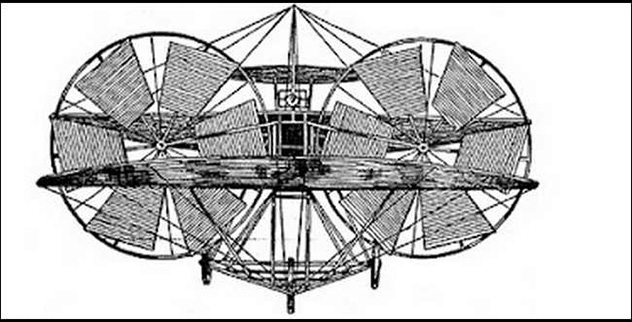
In the 1840s, William Samuel Henson and John Stringfellow proposed the Aerial Steam Carriage, also called the Ariel. It was advertised in dramatic illustrations as a passenger-carrying aircraft soaring over London, looking almost like a flying bus with wings. The promotional imagination was spectacular. The performance, unfortunately, was not.
The Ariel was intended to be powered by steam, which created an obvious problem: steam engines were heavy. Early aircraft needed power without too much weight, and the Ariel’s technology was not ready for the job. Models struggled, and the full dream of a practical steam-powered passenger plane remained grounded.
Still, the Ariel deserves a place among the quirkiest early flying machines because it predicted the idea of commercial air travel decades before powered flight became practical. It was not just a machine; it was a business plan with wings. Henson and Stringfellow imagined people traveling through the sky long before airports, boarding passes, or tiny bags of pretzels existed.
4. Clément Ader’s Éole: The Bat-Winged Steam Mystery
Clément Ader’s Éole was one of the strangest and most visually unforgettable early powered aircraft. Completed in the late 19th century, it had deeply curved, bat-like wings and a lightweight steam engine driving a propeller. If most early flying machines looked like kites or bicycles, Éole looked like something that had escaped from a Gothic novel.
In 1890, Éole reportedly made a short powered hop. Whether that counted as true controlled flight is still debated, because control is the difference between flying and being briefly bullied by physics. The aircraft had limited ability to steer, and its lift-off was more of an intriguing leap than a reliable flight.
Even so, Éole was important because it proved inventors were closing in on powered heavier-than-air flight. Ader’s use of a steam engine was ambitious, and his bat-wing design showed how closely many pioneers still looked to animals for inspiration. The result was dramatic, strange, and historically irresistible.
5. Hiram Maxim’s Flying Machine: The Giant That Tried to Escape Its Rails
Sir Hiram Maxim, best known for inventing the Maxim gun, also built one of the most enormous early flying machines of the 1890s. His aircraft was a huge steam-powered biplane that ran along a rail track. It had powerful engines, large wings, and enough confidence to alarm anyone standing nearby.
Maxim’s machine was not designed for graceful takeoff from an open field. It was tested on rails, with restraining structures intended to keep it from rising too freely. During trials, the aircraft generated enough lift to break parts of the track system. That is both a failure and a flex. Imagine building a machine so determined to fly that it tears up its own leash.
Its quirkiness comes from its scale and method. Maxim had power, but he did not solve control or practical operation. His flying machine was like a locomotive having an identity crisis. It demonstrated that lift and power could be achieved, but it also proved that aviation needed more than brute force. A machine must not only rise; it must be guided, balanced, and safely returned to earth.
6. The Langley Aerodrome: The Houseboat-Launched Heartbreaker
Samuel Pierpont Langley, secretary of the Smithsonian Institution, built a series of Aerodromes in the late 19th and early 20th centuries. His smaller unmanned models showed promise, but the full-size, piloted Aerodrome A became famous for all the wrong reasons.
Langley’s machine was launched from a catapult mounted on a houseboat in the Potomac River. That sentence alone earns it a place on this list. In 1903, just days before the Wright brothers succeeded at Kitty Hawk, Langley’s man-carrying Aerodrome failed twice and plunged into the river with pilot Charles Manly aboard. Manly survived, but the aircraft’s reputation sank almost as quickly as the machine.
The Aerodrome had a strong engine for its time, but it lacked the structural strength and control system needed for practical flight. Its biggest lesson was painfully clear: an aircraft is not a kite with an engine attached. The Wright brothers’ success later that same month showed the importance of control, testing, and pilot-centered design. Langley’s Aerodrome remains one of aviation’s most dramatic almost-successes.
7. Horatio Phillips’ Multiplane: The Venetian Blind of the Skies
Horatio Phillips took the idea of wings and asked, “Why stop at two?” His multiplane designs used stacks of many narrow wing surfaces, creating aircraft that looked like flying bookshelves or airborne window blinds. The result was bizarre, fascinating, and very difficult to ignore.
Phillips had serious aerodynamic insight. He experimented with curved airfoils and understood that wing shape affected lift. His 1890s and early 1900s multiplanes made short hops, including a powered attempt that briefly left the ground. However, they lacked practical control and stability, which meant they were better at proving ideas than becoming usable aircraft.
The multiplane is quirky because it exaggerated a real principle. If wings create lift, then many wings should create lots of lift, right? In theory, maybe. In practice, airflow interference, weight, drag, and control problems make the answer more complicated. Phillips’ machines remind us that good engineering is not just adding more of the thing that seems useful. Otherwise, modern jets would look like flying lasagna.
8. Santos-Dumont’s 14-bis: The Box-Kite Bird of Prey
Alberto Santos-Dumont’s 14-bis, also known as the “Bird of Prey,” was one of the most distinctive early airplanes. It looked like a box kite that had decided to become famous. In 1906, Santos-Dumont flew it publicly in France, making him a hero in early aviation and especially in Brazil, where he remains a national icon.
The 14-bis was quirky for several reasons. It had a canard layout, with control surfaces at the front. The pilot stood or sat in an exposed position, and some control movements were connected to the pilot’s body. Observers joked that Santos-Dumont seemed to dance as he flew, which may be the most stylish form of flight control ever attempted.
Its public flights mattered because they showed heavier-than-air powered flight before official witnesses and crowds. The Wright brothers had flown earlier in 1903, but their work was initially less public. Santos-Dumont’s achievement helped convince Europe that airplanes were real, not rumors from windy sand dunes. The 14-bis may look odd today, but in 1906 it was proof that the future had wings.
9. Paul Cornu’s Helicopter: The Flying Bicycle That Hovered Into History
Paul Cornu, a French bicycle maker and inventor, built an early helicopter in 1907. It had twin rotors, a lightweight frame, and a small engine. The machine looked less like a modern helicopter and more like a bicycle repair shop caught in a tornado.
Cornu’s helicopter reportedly rose briefly off the ground, making it one of the first rotary-wing aircraft to achieve manned free flight. The hop was short, low, and not especially controllable. Some later engineering analyses have questioned how successful the flight really was, but Cornu’s place in helicopter history remains significant.
Its quirkiness is obvious: open frame, exposed pilot, spinning rotors, and barely any control. Cornu was chasing vertical flight at a time when fixed-wing airplanes were still trying to prove they could stay up without frightening livestock. His helicopter did not lead directly to practical rotorcraft, but it showed that inventors were already imagining a future where machines could rise straight into the air.
10. Caproni Ca.60 Noviplano: The Nine-Wing Flying Boat With Big Vacation Energy
The Caproni Ca.60 Noviplano, built in Italy in 1921, may be the ultimate quirky early flying machine. It was a gigantic flying boat designed to carry passengers across the Atlantic. It had three sets of triple wings, making nine wings in total, plus eight engines. It looked like someone stacked three triplanes on a houseboat and said, “Perfect. Now add paying customers.”
The ambition was enormous. Giovanni Battista Caproni imagined large-scale air travel at a time when commercial aviation was still young. The Ca.60 was meant to be a luxurious airliner, a floating palace with wings. Unfortunately, reality arrived with a splash. After a brief test flight, the aircraft crashed into Lake Maggiore and was badly damaged.
Despite its failure, the Noviplano remains unforgettable. It represents the wild optimism of early aviation, when designers were willing to leap from fragile biplanes to transatlantic passenger monsters in one heroic bound. The Ca.60 was not practical, but it was visionary. Also, it may be the only aircraft in history that looked like it needed its own zip code.
Why These Odd Machines Matter
It is easy to laugh at early flying machines, and frankly, some of them invite it. But laughter should not hide their importance. Every strange aircraft on this list helped answer a question. Can humans imitate birds? Can fixed wings lift a person? Can steam power flight? Can many wings create more lift? Can a machine hover? Can passengers cross oceans by air?
The answers were not always successful, but failures in aviation often became data. A crash, a hop, a wobble, or a broken rail could teach engineers what not to do next time. Early aviation progressed through observation, courage, repeated testing, and a willingness to look ridiculous in public.
Modern aircraft are smooth, efficient, and heavily tested, but they owe a debt to these odd ancestors. Today’s airplanes use refined principles that pioneers struggled to discover: aerodynamic lift, lightweight structure, reliable propulsion, stable control, and pilot safety. The top 10 quirkiest early flying machines show that progress rarely begins polished. It begins with sketches, splinters, smoke, fabric, wire, and somebody saying, “I think this might fly.”
Experience Section: What These Early Flying Machines Teach Us Today
Spending time with the history of early flying machines feels a little like walking through a museum of brave mistakes. At first, the machines seem funny. A bat-winged steamer? A helicopter that looks like a bicycle frame? A passenger flying boat with nine wings? It is tempting to smile and move on. But the longer you look, the more impressive they become.
One of the strongest experiences these machines offer is a sense of scale. In photos, the Caproni Ca.60 looks strange; in imagination, it becomes almost unbelievable. Picture standing beside that enormous structure on the edge of a lake, hearing engines cough awake, smelling fuel and oil, and watching a nine-wing flying boat attempt to lift itself from the water. It must have felt like witnessing either the birth of the future or the beginning of a very expensive repair bill.
The same is true of Maxim’s rail-bound aircraft. Today, aviation testing is careful, computerized, and measured with sensors. Maxim’s method was more physical: build a huge machine, run it along rails, and see whether it tries to leave Earth. There is something thrilling about that directness. It reminds us that innovation often begins before the rules are fully understood. Early inventors were not reckless fools; many were skilled engineers working at the edge of available knowledge.
These machines also create empathy for pilots. Modern passengers complain about legroom, snacks, and boarding lines, but early aviators faced open cockpits, unreliable engines, weak structures, and controls that could feel more like polite suggestions than commands. Santos-Dumont dancing with the 14-bis controls sounds amusing, but it also shows how physically involved early flying could be. The pilot was not simply operating the aircraft; the pilot was part of the aircraft.
Another lasting experience is the reminder that design is a conversation with failure. Phillips’ multiplane asked whether more wings could solve lift. Langley’s Aerodrome asked whether a powerful engine and a catapult launch could beat the flying problem. Ader’s Éole asked whether a bat-like wing and steam engine could make powered flight practical. Each machine answered partly yes, partly no, and partly “please redesign everything.”
For students, makers, engineers, writers, and dreamers, these aircraft are encouraging. They prove that looking silly is not the opposite of being serious. Many world-changing ideas pass through an awkward stage. The first version of almost anything important is usually clumsy. Early flying machines make that truth visible in wood, canvas, wire, and smoke.
They also make aviation feel human. Modern jets are so advanced that they can seem inevitable, as if flight was always destined to become smooth and routine. But these quirky machines show that aviation was never inevitable. It was argued into existence, sketched into existence, crashed into existence, and occasionally dragged out of rivers into existence.
That is the real charm of the top 10 quirkiest early flying machines. They are not just odd artifacts. They are proof that progress has a sense of humor. The sky was not conquered by perfect machines on the first try. It was reached by people willing to build impossible-looking things and test them anyway.
Conclusion
The top 10 quirkiest early flying machines show the wonderfully messy path from imagination to aviation. Leonardo dreamed of flapping wings. Cayley clarified the science. Henson and Stringfellow imagined passenger flight. Ader, Maxim, Langley, Phillips, Santos-Dumont, Cornu, and Caproni each pushed the dream forward in strange and memorable ways.
Some machines flew. Some hopped. Some failed spectacularly. Yet every one of them belongs in the story of flight because each helped inventors understand what the sky required. Their designs may look comical now, but their courage was real. Without these quirky pioneers, modern aviation would have taken much longer to leave the ground.