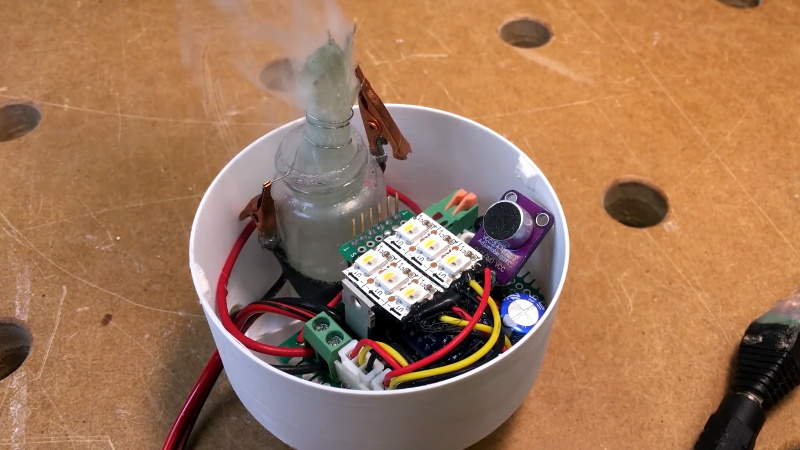
Most flameless candles follow a simple formula: hide a yellow LED inside a plastic shell, make it blink, and hope nobody looks too closely. This super realistic LED candle takes a far more theatrical approach. It glows through real wax, can be “lit” by bringing a match near the top, responds when someone blows on it, and ends the performance with a visible puff of scented smoke.
Created by maker Keith, known online as keith204, the project grew from a three-year effort to reproduce the little rituals ordinary LED candles miss. Inside are an Arduino Pro Mini, six addressable RGB LEDs, an infrared sensor, a microphone, and a separate heated smoke system. The result is less a decorative light and more a tiny interactive special effect disguised as a pillar candle.
What Makes This Realistic LED Candle So Convincing?
A real candle is not just a bright dot. It has depth, color variation, an uneven flicker, a familiar lighting ritual, and a smoky farewell when the flame disappears. Cheap battery candles usually imitate only the glow. Keith’s design imitates the sequence.
It Can Be Lit With a Match
An infrared sensor near the top detects a burning match brought close to the candle. The controller then starts the flame animation. That interaction is wonderfully persuasive because it follows a rule everyone already understands: approach the wick with fire and the candle comes alive.
The match itself remains a real flame, so this feature is theatrical rather than completely flameless. Still, it eliminates the awkward moment of turning a fake candle upside down and searching for a tiny switch while trying to maintain romantic dignity.
Real Wax Becomes the Light Diffuser
The candle body uses genuine wax to soften and spread the light. Wax hides the individual LEDs, produces a warm internal glow, and gives the object the texture and slight translucency of a traditional pillar candle. In daylight, it avoids the toy-like shine of molded plastic. In darkness, it blends several points of colored light into something that looks surprisingly organic.
You Can Blow It Out
A microphone listens for the short burst of sound and airflow created when someone blows toward the top. When the signal crosses the programmed threshold, the LEDs shut down. Because the user performs the same gesture used with a normal candle, the effect feels natural without requiring buttons, apps, voice assistants, or a minor negotiation with Bluetooth.
Inside the Smoking LED Candle
An Arduino Pro Mini Controls the Performance
The compact Arduino Pro Mini acts as the brain. It reads the sensors, tracks whether the candle is currently on or off, runs the flicker animation, and activates the smoke effect at the correct moment. The board’s small footprint and familiar ATmega328-based architecture make it a practical choice for an embedded project with limited room.
The software is best understood as a sequence of states. In the “off” state, the controller watches for a nearby match. In the “burning” state, it animates the LEDs and listens for a blow. After extinction, it briefly activates the smoke system before returning to standby. This state-based design prevents every sensor reading from triggering every feature at oncewhich would be less “cozy candle” and more “wax-covered panic machine.”
Six RGB LEDs Build a More Natural Flame
A short strip containing six WS2812B-style addressable RGB LEDs creates the glow. Since each pixel can be controlled separately, the program can vary color and brightness across the group rather than making the entire candle pulse together. Warm amber, yellow, orange, and dim red tones combine inside the wax to create depth.
The animation matters as much as the hardware. Real flames do not brighten and dim in a perfectly smooth loop. They make small, irregular changes. A convincing program therefore uses restrained randomness, avoiding both repetitive fading and frantic disco behavior. Adafruit’s NeoPixel guidance also emphasizes stable power, sensible brightness, and protective components because addressable LEDs require a microcontroller and can draw meaningful current.
Infrared Sensing Handles the Match Trick
Rather than using a camera, the candle relies on infrared sensing to recognize a nearby burning match. This keeps the system compact and gives it an immediate response. Calibration is critical: a threshold that is too low may react to sunlight or another heat source, while a threshold that is too high turns the graceful lighting ritual into frantic match waving.
A Microphone Recognizes the Blow
The microphone does not need to understand speech. It only needs to identify a brief, strong sound pattern near the top of the candle. Software can compare the incoming signal with a threshold and require a minimum duration, helping prevent accidental shutdowns caused by conversation, music, or somebody placing a mug on the table with unnecessary authority.
The Smoke Effect Is the Showstopper
The most unusual feature uses a heating coil made from 28-gauge wire wrapped around a wick associated with a tiki-torch-style setup. The wick carries a mixture based on vegetable glycerin and aromatic oil. After the candle is blown out, the controller switches the heater through a MOSFET, producing a brief light-gray plume with fragrance.
A MOSFET is important because the tiny output pin on a microcontroller should not directly power a high-current heating element. The transistor allows a low-power control signal to switch the larger load. The project documentation shows how lighting, sensing, and power electronics can work together, but it also makes the smoke system the part that demands the most caution.
Why the Illusion Works
The design succeeds because it engages more than the eyes. The user raises a match, sees warm light spread through wax, watches an unstable flicker, blows toward the wick, and then sees scented vapor curl upward. Each action receives the expected response.
This is a classic principle of theatrical and interactive design: behavior often matters more than perfect appearance. A moderately realistic object that reacts correctly can feel more believable than a visually flawless object that ignores the user. The candle does not merely resemble the real thing; it participates in the same ritual.
How It Compares With Commercial Flameless Candles
Premium flameless candles have improved considerably. Many use real wax shells, uneven melted rims, moving flame pieces, remote controls, timers, and warm LEDs. Product-testing publications frequently favor designs with wax construction and natural-looking movement, while premium brands promote moving-flame systems that create a convincing flicker without an exposed wick.
Store-bought models win on convenience, battery life, and repeatable safety. Keith’s candle wins on interaction. It recreates ignition, burning, extinction, and smokesomething a normal remote-controlled pillar cannot do. It is not really a fair comparison, because one is a household product and the other is an enthusiast prototype allowed to be gloriously complicated.
The Important Safety Catch
Ordinary LED candles are popular partly because they remove an open flame. That matters around children, pets, curtains, bedding, and holiday decorations. The National Fire Protection Association reports that U.S. fire departments respond to thousands of home candle fires in an average year, and current guidance stresses keeping combustibles away and never leaving a burning candle unattended.
The smoke-enabled prototype is different. Its coil becomes hot enough to aerosolize liquid, so it contains a real heat source and a relatively high-current electrical load. Proper insulation, secure wiring, current protection, stable mounting, temperature monitoring, ventilation, and automatic shutdown should be considered essential. Calling the main light flameless does not make the heater harmless.
The vapor also deserves respect. Vegetable glycerin is common in consumer products, but heating it creates inhalable aerosol, and ingredients considered safe to eat are not automatically proven safe to breathe repeatedly. CDC and NIOSH research notes that glycerin-based heated mixtures create particles that may be inhaled by users and bystanders, while inhalation data for many flavoring chemicals remain limited. Any effect should therefore be brief, well ventilated, and built only with materials evaluated for the intended use.
Where a Candle Like This Could Shine
Halloween and Escape-Room Props
The design belongs naturally in a haunted library, wizard’s desk, theatrical séance, or escape room. A match-triggered glow and breath-triggered smoke can make a close-up prop feel magical. Multiple units could even be synchronized with sound effects or hidden room controls.
Film, Photography, and Stage Work
A controllable electronic flame can repeat the same cue across multiple takes and can be tuned for camera exposure. The smoke system could create a precise extinguishing moment, although any production use would still require professional electrical, fire, and ventilation review.
Maker Education
The project combines addressable LEDs, sensor calibration, state-based programming, transistor switching, enclosure design, and power management in one memorable object. Builders can also stop at safer milestones: first the flicker, then wax diffusion, then blow detection, and only later more advanced features.
What Makers Can Learn From the Build
The main lesson is to study the behavior of the object being imitated. Keith divided the candle ritual into eventsunlit wick, ignition, flicker, blow, fade, and smokeand designed electronics for each one. That observation produces more realism than simply adding brighter LEDs.
The second lesson is to prototype in stages. A complex build is easier to debug when lighting, sensing, and power systems are tested separately. It also allows a maker to finish with a useful non-smoking version rather than feeling obligated to install every feature.
Finally, realism and practicality are not the same goal. A practical LED candle prioritizes cool operation, long battery life, timers, and simplicity. A realism experiment may intentionally add inconvenient features because they strengthen the illusion. Both approaches are valid, as long as a theatrical prototype is not mistaken for an ordinary consumer appliance.
The Experience: From First Spark to Final Puff
First Impressions
Based on the documented build and demonstration, the first surprise is how little the candle advertises its electronics. The real wax body does most of the visual work. There is no obvious display or plastic flame demanding attention. It resembles a plain pillar candle waiting for someone to perform the obvious ritual.
That restraint improves the reveal. Bring a match close, and the body begins to glow. The response connects action and result quickly enough to feel intuitive, yet softly enough to resemble a flame gathering strength. The rational mind knows LEDs are involved; the rest of the brain simply checks the box marked “candle.”
Watching the Flicker
The illusion is most persuasive from a normal seating distance. Up close, a determined observer may spot separate light sources or notice that the wick is not burning. A few feet away, the wax becomes excellent camouflage. The brightness appears to move within the candle rather than blink from a single point.
Subtlety makes the effect believable. Small irregular changes feel more natural than dramatic flashes. When the program avoids an obvious repeating loop, the viewer eventually stops examining the technology and starts enjoying the atmosphere. That is the moment the engineering disappearswhich is exactly what good effects engineering should do.
Blowing It Out
The blow-out interaction is the feature people understand immediately. Lean forward, blow toward the top, and the glow disappears. It produces the same tiny sense of completion as extinguishing a real candle because the familiar gesture receives the familiar result.
Then the candle delivers its second reveal. A pale plume rises from the top, bringing fragrance and completing the illusion. The timing adds humor: just as the viewer believes the trick is over, the project performs an encore. An actual candle may produce a messy ribbon of smoke; this one hits its cue like an actor who knows exactly where the spotlight is.
Living With the Full Effect
As a daily household object, the smoke-enabled version would require more attention than a commercial LED pillar. It needs power, liquid management, inspection of the heater area, and ventilation. The novelty would also tempt owners to demonstrate it repeatedly, which is precisely when a short theatrical puff could become unnecessary indoor aerosol.
The simpler features would have greater long-term appeal. Wax-diffused light, natural flicker, match sensing, and blow detection preserve much of the candle ritual without continuous combustion. Add an automatic timeout, a hidden service switch, temperature feedback, and a conservative power design, and the concept could become an elegant interactive display.
The experience is memorable because the project rebuilds a familiar object from completely different mechanisms. Nobody urgently needs a candle containing a microcontroller, six RGB pixels, sensors, a MOSFET, a heater, and scented liquid. Yet when it wakes up beside a match and exhales smoke after a breath, “need” becomes the least interesting question in the room.
Conclusion
This super realistic LED candle is a delightful example of overengineering with a clear purpose. Real wax softens the light. Individually controlled LEDs create depth. Infrared sensing makes a match meaningful. A microphone lets the user extinguish the glow naturally. The smoke system supplies a dramatic final detail that ordinary flameless candles cannot match.
It is not a straightforward replacement for a store-bought candle, and the heated aerosol system should be treated as an experimental effect requiring serious safeguards. As a maker project, however, it is clever, funny, and genuinely instructive. The light is cool, the engineering is hot, and the final puff of smoke is the perfect punch line.
Note: This article describes a documented experimental maker project, not a certified consumer product. Any heater, high-current circuit, match-triggered feature, or aerosol effect should be designed and operated only with appropriate electrical, fire, and ventilation protections.