Every couple has a moment when romance stops looking like candlelight and starts smelling like cumin, garlic, and the hard truth that two adults may define “normal dinner” very differently. That is exactly why the internet latched onto a viral relationship drama involving a man, his girlfriend, and Indian food cooked at home. On the surface, it sounded like a picky-eater problem. Underneath, it became a full-blown case study in cohabitation, cultural respect, boundaries, shared kitchens, and the tiny domestic habits that can quietly decide whether a couple is ready for marriage.
The story was simple enough to make people laugh and complicated enough to make them argue. A couple moved in together. The boyfriend discovered that his girlfriend cooked Indian food often. He did not like the smell, the spices, or the frequency. Instead of simply making his own meals or finding a compromise, he reportedly asked her not to cook Indian food in their shared home. The internet, naturally, put on its robe, grabbed the gavel, and transformed into Relationship Court.
One of the most repeated reactions was: “This is why you live together before you get married.” It was funny, yes, but also painfully practical. Dating can hide habits. Cohabitation reveals them. You may know someone’s favorite movie, childhood trauma, coffee order, and zodiac sign, yet still have no idea how they load a dishwasher, handle trash day, budget groceries, or react when the apartment smells like turmeric and onions after dinner.
Why This Indian Food Drama Hit a Nerve
The reason this story traveled so far online is not just because it involved food. It touched a nerve because food is rarely only food. In relationships, meals can represent comfort, culture, family, independence, tradition, health, money, labor, and sometimes plain old “I had a long day and want to eat what makes me happy.”
For many Indian and Indian-American households, dishes built around lentils, rice, spices, vegetables, breads, yogurt, pickles, chutneys, or richly seasoned meats are not “special occasion food.” They are everyday food. Asking someone to stop cooking the food they grew up with can feel less like a request about dinner and more like a request to shrink a part of themselves. That is why many commenters did not see the boyfriend as merely expressing a preference. They saw him trying to control the atmosphere of the home at the expense of his partner’s identity.
Of course, preferences are real too. Some people genuinely struggle with strong smells, spicy food, garlic, onions, certain textures, or lingering aromas in small apartments. Nobody is wrong for having a sensitive nose or a bland palate. The problem begins when personal discomfort turns into a command. “I don’t love this smell; can we talk about ventilation?” is one conversation. “Never cook that here again” is a different beast wearing bad shoes.
Cohabitation Is the Ultimate Compatibility Test
Living together before marriage does not magically guarantee a successful relationship. It is not a romantic cheat code. But it does reveal information that weekend dates and carefully planned sleepovers often miss. When two people share a home, the relationship moves from highlight reel to documentary.
Suddenly, compatibility is not just about chemistry. It is about grocery lists, cleaning standards, morning routines, thermostat wars, laundry timing, toothpaste caps, and whether one person thinks leftovers are a blessing while the other treats them like a haunted object in the fridge. Add food culture to the mix, and the stakes get even more personal.
In the Indian food drama, the couple learned something important before marriage: they did not simply disagree about dinner. They disagreed about what kind of home they were building. Was it a home where both people could bring their habits and culture into the kitchen? Or was it a home where one person’s comfort automatically outranked the other person’s daily life?
The Kitchen Is Where Theory Meets Reality
Before moving in, a couple can accidentally perform for each other. People cook “date food,” clean before visits, and pretend they always have matching towels. Once they live together, the performance fades. Real routines enter the room, often holding a frying pan.
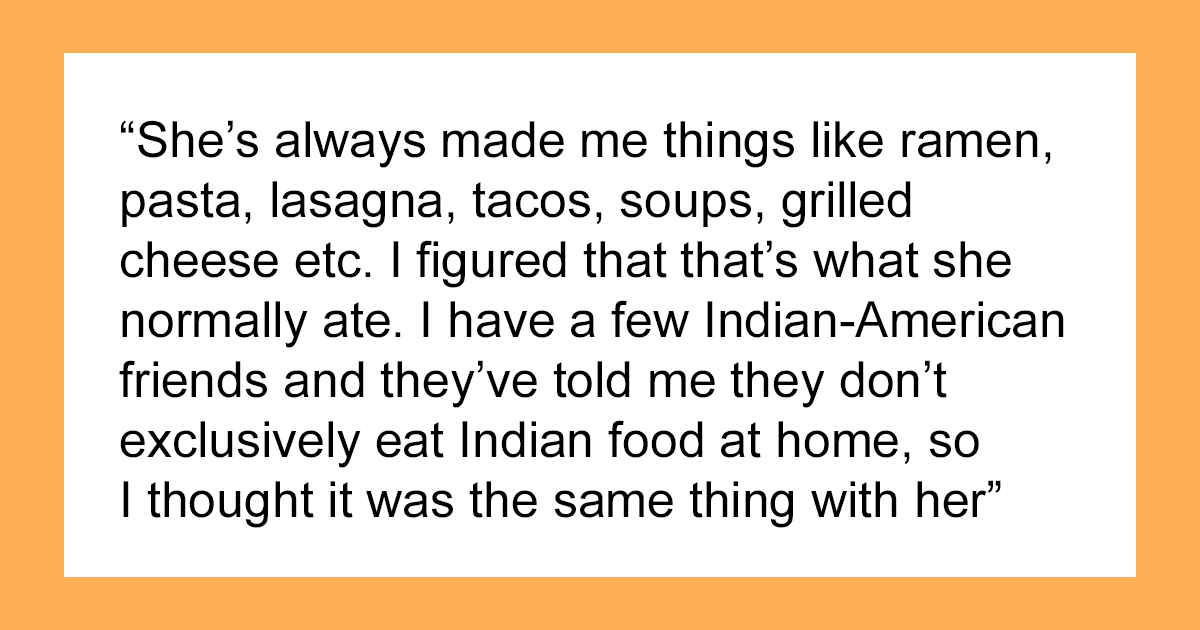
The girlfriend’s cooking was not a random surprise; it was part of her normal life. The boyfriend’s surprise may show that he had made assumptions based on limited evidence. Because she had cooked other types of food when they were dating, he assumed Indian food was occasional rather than central. That assumption is where many relationship conflicts begin: one person fills in the blanks without asking, then acts shocked when reality refuses to obey the imaginary script.
Food Preferences Can Become Relationship Power Struggles
Food choices in couples often become a negotiation between personal preference and shared life. One person loves spicy food; the other sweats near a jalapeño. One is vegetarian; the other thinks dinner without meat is a side quest. One believes garlic belongs in everything; the other believes garlic belongs in someone else’s kitchen.
These differences are normal. What matters is how couples handle them. Mature compromise might look like cooking separate meals sometimes, choosing certain nights for aromatic dishes, improving ventilation, storing spices properly, or agreeing on shared meals that both people enjoy. Immature conflict sounds more like, “Your food is gross,” “You’re too sensitive,” or “My preference is now the household law.”
The Indian food conflict became controversial because it appeared to move from preference into restriction. In a healthy relationship, a partner can say, “I struggle with the smell after cooking; can we find a solution?” But asking someone to give up a major part of their food routine in their own home sends a much louder message: your comfort belongs here only when it does not inconvenience me.
Why Indian Food Became the Center of the Debate
Indian cuisine is famously diverse, regional, and spice-forward. There is no single “Indian food” any more than there is one “American food.” A South Indian dosa, Punjabi chole, Gujarati dal, Goan fish curry, Hyderabadi biryani, and a simple home-cooked khichdi all carry different ingredients, aromas, and traditions. Yet many people reduce the entire cuisine to “curry smell,” which can come across as dismissive or culturally ignorant.
Spices like cumin, coriander, turmeric, mustard seed, cardamom, fenugreek, ginger, garlic, and chili are aromatic by design. They bloom in hot oil. They cling to memory. They make a kitchen feel alive. They can also linger in curtains, cabinets, and sweaters if a home has poor ventilation. Both things can be true: the food can be beautiful and the smell can be strong.
The respectful solution is not to shame the cuisine. It is to solve the practical issue. Open windows. Use an exhaust fan. Close bedroom doors. Clean surfaces after cooking. Store spices in sealed containers. Light a neutral candle after dinner if needed. Most domestic problems become easier when couples stop attacking identity and start troubleshooting logistics.
The Real Issue: Respect, Not Roti
What made people side strongly with the girlfriend was not simply that she liked Indian food. It was that the boyfriend’s request sounded one-sided. If he disliked her cooking, he had options: cook for himself, meal prep, order something, suggest shared dishes, or discuss a schedule. Instead, the alleged demand was that she should stop making the food she loved at home.
That is where the story becomes less about roti and more about respect. A shared home should not require one partner to disappear. If a person cannot tolerate the smell, sound, schedule, or cultural habits of the person they plan to marry, it is better to discover that before wedding deposits, joint pets, and a honeymoon fund are involved.
Compromise Should Not Mean One Person Always Shrinks
Real compromise has movement on both sides. For example, the girlfriend might agree not to cook the most aromatic dishes right before guests arrive or right before bedtime. The boyfriend might agree to stop insulting the food and take responsibility for his own meals. They could designate certain nights for separate dinners and certain nights for shared meals. They could experiment with milder dishes, better ventilation, or cooking larger batches less often.
But compromise is not “you stop doing what I dislike while I change nothing.” That is not compromise. That is a hostile takeover with a grocery receipt.
What Couples Should Discuss Before Moving In Together
This viral drama offers a surprisingly useful checklist for couples considering cohabitation. Before signing a lease, couples should talk about more than rent and furniture. They should discuss daily life in almost boring detail, because boring details become dramatic when ignored.
1. What Do You Actually Eat at Home?
Dating meals can be misleading. Restaurants, takeout, and weekend cooking do not always reflect weekday reality. Ask direct questions: What do you cook most often? Are there foods you cannot stand? Do you expect shared dinners every night? Are separate meals acceptable? Is the kitchen a shared creative space or a place one person dominates?
2. How Sensitive Are You to Smells?
Some people are deeply affected by food aromas, perfume, smoke, cleaning products, or pet odors. It is better to know this early. Smell sensitivity does not make someone bad, but it does require respectful problem-solving. If one partner loves aromatic cooking and the other gets overwhelmed by lingering smells, the couple needs a plan, not a courtroom.
3. What Does “Clean” Mean to You?
One person’s “clean kitchen” may mean spotless counters, dry sink, swept floor, and no dishes in sight. Another person may consider a pan soaking overnight to be a normal part of civilization. These differences can create resentment fast. Cooking strong-smelling food may feel more manageable when both partners trust that cleanup will happen promptly.
4. How Do You Handle Discomfort?
The strongest couples are not the ones who agree on everything. They are the ones who can say, “This bothers me,” without turning it into an attack. If someone responds to discomfort by issuing bans, mocking habits, or acting like their partner is unreasonable for existing normally, marriage will not fix that. It will put a ring on it and give it better lighting.
How the Boyfriend Could Have Handled It Better
The boyfriend in the story could have turned the entire situation around with a little humility. Instead of making his partner’s cooking the enemy, he could have said, “I did not realize how often you cook Indian food, and I am having trouble with the lingering smell. I know this food matters to you, so can we figure out a way to make the apartment comfortable for both of us?”
That sentence changes everything. It acknowledges his discomfort without insulting her culture. It recognizes that the food matters. It invites teamwork. It treats the problem as something outside the relationship rather than proof that one partner is wrong.
He also could have tried learning. Not every Indian dish is the same. Some are mild. Some are deeply aromatic. Some are quick and simple. Some are weekend projects. He might have discovered dishes he liked if he approached the kitchen with curiosity instead of dread. Even if he never became a fan, curiosity would still show respect.
How the Girlfriend Could Protect Her Boundaries
The girlfriend, meanwhile, would be reasonable to set a clear boundary: she should not have to erase her food culture to keep a relationship peaceful. A good boundary might sound like, “I am willing to discuss ventilation and timing, but I am not willing to agree that I can never cook Indian food in my own home.”
That kind of boundary is not stubborn. It is self-respect. Relationships require flexibility, but they should not require someone to audition for acceptance by abandoning the habits that make them feel at home.
Why the Internet’s Reaction Was So Strong
Online commenters often react intensely to domestic drama because the details are relatable. Most people have either lived with someone whose habits drove them mad or been the person whose habits drove someone else mad. The Indian food story gave people a tiny apartment-sized stage for bigger questions: What is fair in a shared home? When does a preference become controlling? How much should love adapt? How much should identity be protected?
The phrase “this is why you live together before you get married” became the perfect punchline because it captured the value of discovering incompatibilities early. It is better to learn before marriage that your partner cannot handle your cooking, your sleep schedule, your family calls, your cleaning style, or your emotional needs. Not because every mismatch is a dealbreaker, but because every mismatch deserves an honest conversation before lifelong promises are made.
The Bigger Lesson for Couples
The biggest lesson is not that every couple must live together before marriage. Some people choose not to for cultural, religious, financial, or personal reasons. The real lesson is that couples need realistic conversations before commitment. If you do not live together, talk like you might. Discuss food, chores, money, guests, privacy, sleep, pets, family visits, and how you argue. Romance is important, but so is knowing whether your future spouse expects the rice cooker to live permanently on the counter.
Marriage is not only a celebration of love. It is also a merger of systems. Two people bring two invisible operating manuals into one home. The trouble begins when each person assumes their manual is universal.
Conclusion: Love Is Grand, But Dinner Is Daily
The couple’s drama over Indian food is funny because it feels small. It is serious because it reveals something large. Food is daily. Home is intimate. Culture is personal. And shared living has a way of turning tiny preferences into giant neon signs that say, “Please discuss this before marriage.”
A partner does not have to love every dish, every smell, or every habit. But they do need to respect the person attached to them. The healthiest couples learn how to say, “This is hard for me,” without saying, “You need to become smaller for me.” If a relationship can survive cumin, coriander, and an honest conversation about the exhaust fan, it may be ready for bigger things. If it cannot, better to find out before the wedding cake enters the chat.
Real-Life Experiences: What This Food Fight Teaches Couples Before Marriage
Many couples do not discover their true compatibility during romantic dinners. They discover it on a Tuesday night when someone is hungry, tired, and emotionally one dirty pan away from becoming a documentary villain. Food is one of the fastest ways to reveal how two people handle difference because it shows up every day. You can avoid politics at dinner. You cannot avoid dinner itself.
Imagine a couple named Maya and Ryan. Maya grew up in a home where the kitchen was always active. Dinner smelled like toasted spices, simmering lentils, fried onions, and fresh cilantro. Ryan grew up eating grilled chicken, steamed vegetables, pasta, and the occasional taco night. Neither childhood was wrong. But when they moved in together, Ryan began making little comments: “Wow, that smell is intense,” “Are you cooking that again?” and “Can we just do normal food tonight?” At first, Maya laughed it off. Then she started cooking less. Then she started feeling like a guest in her own kitchen.
The turning point came when Ryan realized he was not just reacting to smell. He was treating his own habits as neutral and hers as unusual. Once he understood that, the conversation changed. They bought an air purifier, improved ventilation, agreed on cleanup routines, and created a weekly meal plan with both shared and separate dinners. Ryan did not magically become obsessed with dal, but he stopped acting like Maya’s food was a problem to be solved. That shift mattered more than the menu.
Another couple might face the opposite issue. One partner may be a picky eater who feels embarrassed by limited food preferences. The other may be an adventurous cook who feels rejected when meals are refused. In that case, the solution is not shaming the picky eater or forcing culinary bravery at every meal. The solution is honesty: “I want to share food with you, but I also need you to respect my limits.” A partner can try one bite without being pressured. The cook can offer options without becoming a personal restaurant. Both can treat food as connection rather than a loyalty test.
These experiences show why moving in together can be revealing. Shared living exposes the emotional meaning behind everyday habits. A messy stove may be about cleanliness. It may also be about feeling unappreciated. A complaint about smell may be about sensory discomfort. It may also be about cultural bias. A request for separate meals may be practical. It may also signal a deeper lack of interest in building a shared life.
The best couples learn to ask better questions. Instead of “Why are you always cooking that?” try “What does this food mean to you?” Instead of “Why are you so picky?” try “What foods feel comfortable for you, and where can we experiment gently?” Instead of turning dinner into a referendum on love, they turn it into a planning session with snacks.
In the end, the Indian food drama is memorable because it is not really about Indian food. It is about whether two people can make room for each other in the most ordinary parts of life. Anyone can look compatible in vacation photos. The real test is whether you can share a kitchen, respect a difference, open a window, and still choose kindness before the rice is done.