Disney animals have always behaved suspiciously like people. They fall in love, argue with parents, experience existential crises, and occasionally burst into perfectly choreographed musical numbers. The only thing missing is a human face.
Illustrator Isabelle Staub decided to fix that. In her widely shared digital art series, she transforms familiar animated animals into expressive human characters while preserving the personalities, colors, and visual clues that made the originals memorable.
The results are not simply attractive portraits wearing Disney-inspired colors. They are thoughtful exercises in character design. Dory still looks cheerfully distracted, Lady remains elegant and gentle, Nala carries unmistakable confidence, and Marie appears ready to correct your table manners before knocking a glass off the table.
Who Is Isabelle Staub?
Isabelle Staub is a US-based freelance illustrator known for vibrant digital portraits, polished character designs, and imaginative pop-culture reinterpretations. She studied illustration at Moore College of Art and Design in Philadelphia and later built a career combining personal artwork, commercial commissions, social media content, and art education.
Her professional portfolio has expanded to include work connected with major entertainment, toy, cosmetics, and lifestyle brands. However, many online viewers first encountered her through fan art. Her earlier portraits reimagined well-known animated heroines, including Ariel, Belle, Jasmine, Tiana, Pocahontas, Esmeralda, and Kida, in a more detailed version of her signature style.
Those illustrations demonstrated one of Staub’s greatest strengths: she can modernize a familiar design without erasing the features that make it recognizable. That talent became even more important when she began turning nonhuman characters into people.
An Unexpected Idea During a Creative Slump
The Disney animal series was not born from a detailed marketing calendar, a corporate pitch meeting, or a mysterious scroll delivered by a fairy godmother. Staub has explained that she was feeling creatively uninspired when the idea appeared while she was browsing images online.
She wondered what selected Disney animals might look like as humans. The question was simple, but the design problem was not. A successful transformation would need to remove fur, fins, paws, whiskers, and tails without removing the character’s identity.
When pandemic restrictions gave her more time to explore the concept in 2020, she continued developing the series. Each portrait reportedly required roughly seven to ten hours, depending on the complexity of the character and the amount of experimentation involved.
Why These Disney Animal Transformations Work
Turning an animal into a human is easy in the most literal sense. Draw a person, borrow the animal’s color palette, and add a vaguely related hairstyle. Done. Unfortunately, the result may resemble someone who accidentally coordinated an outfit with a cartoon fish.
Staub’s work succeeds because she treats each image as a character redesign rather than a costume change. She studies the original character’s emotional energy, recognizable shapes, facial expression, colors, and role in the story. She then translates those qualities into human features.
Personality Comes Before Decoration
Memorable character design begins with personality. Clothes, hair, and makeup can support a concept, but they cannot rescue a portrait that feels emotionally empty.
Animated characters communicate through large, readable expressions. Dory’s enthusiasm, Nala’s self-assurance, Lady’s sweetness, and Marie’s theatrical confidence are visible before they say a word. Staub preserves that emotional shorthand in the human versions.
Her characters do not merely wear the correct colors. Their eyes, eyebrows, mouths, and poses suggest how they would behave. Viewers can often identify the subject before reading the name, which is the visual equivalent of passing a difficult exam without remembering when you studied.
Color Becomes a Character’s Visual DNA
Color is one of the fastest ways to connect a redesigned portrait with its animated source. Staub frequently turns fur, scales, collars, bows, and markings into hair colors, clothing choices, accessories, makeup, or background accents.
This approach avoids overly literal gimmicks. A humanized fish does not need fins attached to her shoulders, just as a humanized cat does not need whiskers drawn across her face. Instead, carefully selected hues create an immediate association while allowing the portrait to function independently.
Shape Language Survives the Transformation
Professional character designers use shape language to communicate personality. Soft curves may suggest warmth or approachability, while sharp angles can imply speed, danger, sophistication, or intensity.
Staub translates the original animals’ silhouettes into human facial structures and hairstyles. Rounded cheeks, pointed features, wide eyes, flowing hair, or sharply defined brows become substitutes for muzzles, ears, and fins. The species changes, but the design rhythm remains familiar.
The Standout Characters in Isabelle Staub’s Series
Dory From Finding Nemo
Dory was the first transformation in the series and, according to Staub, one of the most difficult. Because the visual concept was still developing, the portrait required considerable experimentation.
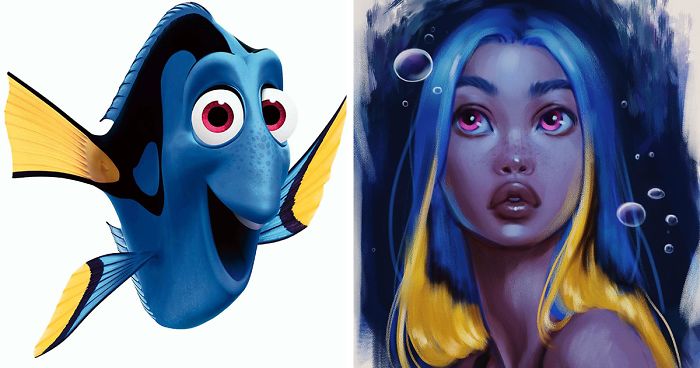
The finished human Dory uses the fish’s electric blue and yellow palette without resembling a walking aquarium decoration. Her large, curious eyes and open expression capture Dory’s optimism, friendliness, and slightly chaotic attention span.
That expression is essential. Dory is remembered not merely because she is blue, but because she approaches uncertainty with enthusiasm. Her human counterpart looks as though she has forgotten why she entered the room but is delighted to meet everyone inside it.
Lady From Lady and the Tramp
Lady’s transformation is built around warmth and refinement. Her long ears inspire flowing auburn hair, while her coloring and collar influence the clothing and accessories. The portrait feels polished without becoming stiff.
Most importantly, the human version retains Lady’s gentle temperament. She appears kind, sheltered, curious, and quietly intelligent. The design suggests someone who writes thank-you notes, owns an excellent cardigan collection, and has never once eaten spaghetti without proper lighting.
Nala From The Lion King
Nala presents a different challenge because much of her appeal comes from feline strength and physical confidence. Staub translates that energy through warm golden coloring, focused eyes, strong brows, and a calm, self-possessed expression.
The human Nala does not need a mane or lion ears to look powerful. Her authority comes from posture and gaze. She seems approachable, but she also looks fully prepared to explain why your plan for ruling the Pride Lands is terrible.
Marie From The Aristocats
Marie is sweet, pampered, and wonderfully convinced of her own importance. Her white fur, pink bow, and delicate features become a soft human portrait with pale coloring and playful pink accents.
The transformation preserves the contrast that makes Marie entertaining. She looks innocent, yet her expression contains just enough confidence to suggest she has already blamed her brothers for whatever happened to the curtains.
Lola From Shark Tale
Staub also humanized Lola from Shark Tale, translating the character’s glamorous appearance into a dramatic human portrait. Lola’s bold coloring, long lashes, and seductive screen presence become high-fashion styling and a knowingly confident expression.
The portrait fits naturally beside the Disney-inspired pieces because it uses the same translation method: personality first, recognizable visual signals second, and literal animal anatomy nowhere in sight.
Digital Painting Gives the Portraits Their Polished Finish
Staub’s artwork blends illustration, portrait painting, and animation-inspired design. Her figures have stylized proportions, but their skin, hair, eyes, and lighting contain enough detail to create depth and realism.
In interviews about her broader workflow, she has described combining digital painting software with Photoshop for final lighting, color adjustments, and print preparation. She has also taught digital illustration and shared process videos that reveal how an image develops from rough construction to polished rendering.
That progression matters because the finished portraits can look deceptively effortless. Viewers see luminous skin, dramatic eyes, and perfectly arranged hair. They do not see the hours spent testing proportions, repainting features, balancing colors, and asking why one eyebrow has suddenly declared independence.
Rendering Supports the Design Instead of Replacing It
Highly rendered digital art can become visually impressive but emotionally generic. Staub avoids that problem by resolving the character concept before polishing every strand of hair.
Lighting directs attention toward the face. Texture gives the portraits dimension. Fine details make them appealing at close range. Yet the identity of each character still depends on the underlying expression, palette, and shape language.
Why the Series Became So Popular Online
The Disney animals as humans series gained traction on Instagram and TikTok, where process videos allowed viewers to watch each transformation unfold. Staub has said that one close-up video showing her drawing Dory accumulated millions of views, and the project eventually received national media attention.
Its popularity can be explained by the combination of three powerful ingredients: nostalgia, surprise, and participation.
Nostalgia Creates an Immediate Connection
Many viewers have known these characters since childhood. They do not need an introduction to Dory’s forgetfulness or Nala’s confidence. That emotional familiarity allows the audience to evaluate each redesign instantly.
The portraits feel new, but they also activate old memories. It is the artistic equivalent of opening a childhood toy box and discovering that everyone inside has acquired excellent hair.
The Transformations Invite Debate
Humanized character art naturally encourages conversation. Viewers compare the redesign with the version in their imagination. They discuss facial features, clothing, ethnicity, hairstyles, ages, and which visual details best represent the original.
This does not necessarily mean there is one correct answer. Fan art is interpretation, not forensic reconstruction. Two artists can humanize the same lion or dog in entirely different ways and still produce convincing designs.
Process Videos Turn Art Into a Story
A completed portrait provides a satisfying reveal, but a time-lapse video adds suspense. The audience sees a rough sketch become a recognizable face, followed by color, shadows, highlights, and final details.
That format makes digital painting more accessible. It reminds viewers that a polished illustration did not materialize from a magical tablet. It was built through decisions, corrections, and patient repetition.
What Aspiring Artists Can Learn From the Project
Staub’s Disney transformations are entertaining, but they also offer practical lessons for illustrators and character designers.
Study the Character, Not Just the Screenshot
Before redesigning an existing character, identify the traits that remain consistent throughout the story. Is the character playful, cautious, vain, loyal, impulsive, or commanding? What emotional quality must survive the transformation?
Choose a Small Group of Recognizable Clues
A strong redesign does not transfer every detail. Select the most useful signals: a dominant color, a distinctive eye shape, a repeated accessory, an iconic expression, or a memorable silhouette.
Explore Several Versions Before Rendering
Testing multiple thumbnail sketches is faster than repainting a nearly finished portrait. Experiment with hairstyles, face shapes, clothing, and poses while the drawing is still loose. The delete button is much less emotionally dramatic at this stage.
Preserve Your Own Artistic Voice
The goal is not to imitate the original studio perfectly. Staub’s portraits work because viewers can recognize both the animated character and the illustrator behind the redesign.
Successful fan art creates a conversation between two visual identities. Too much imitation feels redundant. Too little connection makes the reference meaningless. The interesting work happens in the middle.
A Close-Viewing Experience: Seeing Familiar Characters Differently
Browsing the series for the first time creates a curious sequence of reactions. The initial response is usually recognition: the colors, eyes, or expression reveal the character almost immediately. A second later, the viewer begins checking the design more carefully. Which animal feature became the hairstyle? Did the original collar inspire the neckline? Why does this completely human face still feel unmistakably feline?
That slow inspection is one of the most enjoyable parts of the experience. The portraits function almost like visual puzzles, except the reward is not discovering that the butler committed the crime. It is understanding how a pair of floppy ears became flowing hair or how a fish’s color pattern became a stylish outfit.
Dory often produces the quickest emotional connection. Her portrait communicates openness before the blue and yellow details are fully processed. The wide eyes and relaxed expression suggest someone friendly, curious, and cheerfully unprepared for whatever is happening. The experience demonstrates that personality can be more recognizable than anatomy.
Lady invites a slower response. Her design feels elegant, but the elegance is softened by warmth. The human portrait does not look like a generic aristocrat. It retains the protected sweetness of a beloved household pet discovering a larger world beyond the front gate.
Nala’s portrait changes the mood again. Her confidence is communicated through restraint rather than exaggerated toughness. A steady gaze and controlled expression carry more authority than obvious lion references would. The viewer recognizes that strength does not always require armor, claws, or an inspirational soundtrack echoing across the savanna.
Marie provides the comic relief. Her portrait balances innocence with unmistakable self-importance, encouraging viewers to imagine the human character speaking with the same polished certainty as the kitten. It becomes easy to invent an entire personality around the image: charming, dramatic, impeccably dressed, and absolutely convinced that rules apply mainly to her brothers.
The experience also encourages viewers to imagine additional transformations. What would Daisy Duck look like as a fashion editor? Could Minnie Mouse become a vintage-inspired designer? Would Sebastian from The Little Mermaid appear as a nervous orchestra conductor who has not enjoyed a peaceful afternoon in years?
This imaginative participation explains why reinterpretation art remains so shareable. The artwork does not close the conversation after presenting an answer. It opens dozens of new questions. Every portrait becomes an invitation to compare, speculate, and create another version mentally.
For practicing artists, studying the series can become a useful exercise. Cover the character’s name and identify the visual clues. Separate the palette from the facial expression. Notice which original details were preserved, which were transformed, and which were discarded. Then attempt the same process with another animated animal.
The most valuable lesson is that recognizable design depends on selection. Copying everything is not necessary. A few carefully chosen features, supported by a clear personality, can carry an entire character across species. That realization makes the series more than a collection of polished portraits. It becomes a practical demonstration of visual storytelling.
Conclusion
Isabelle Staub’s humanized Disney animals succeed because they preserve the emotional core of the original characters. Her portraits are not literal conversions or novelty makeovers. They are carefully designed interpretations built from personality, color, shape, expression, and storytelling.
The project also shows how a personal experiment can grow into a career-defining creative moment. An idea discovered during an uninspired afternoon became a viral series, reached millions of viewers, attracted major media attention, and introduced new audiences to Staub’s broader work.
Most of all, the illustrations remind us why character design is so fascinating. Remove the paws, fins, fur, and whiskers, and a strong personality can still remain completely recognizable. Apparently, the true essence of a Disney character was never the species. It was the attitude.