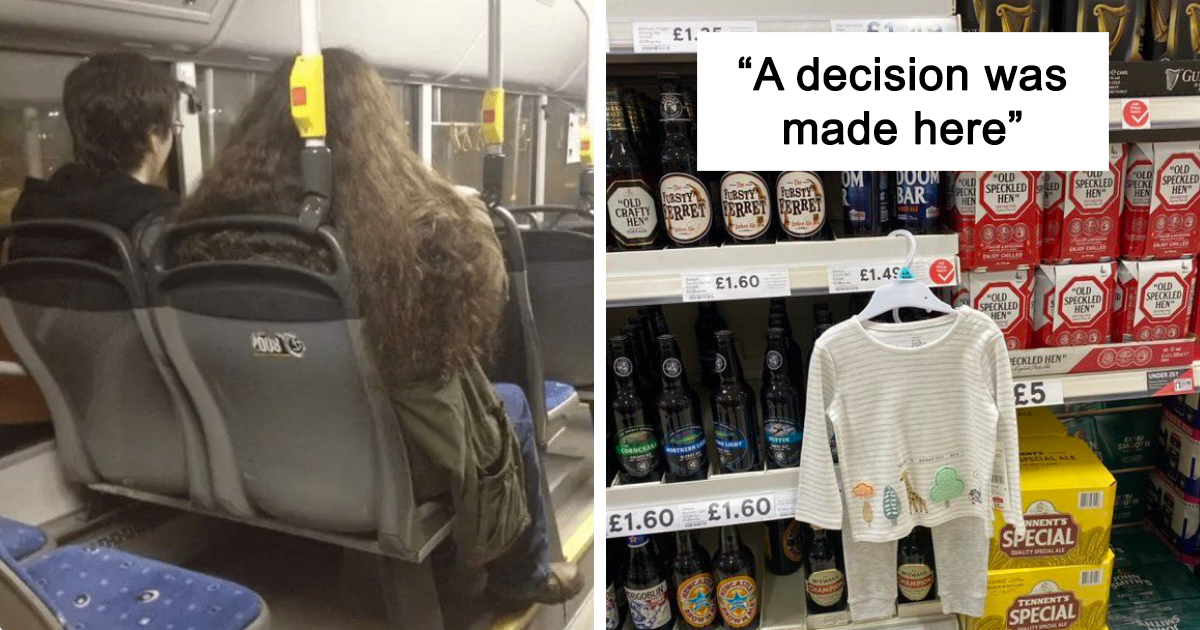
Britain has given the world Shakespeare, the steam engine, afternoon tea, and the unnerving confidence to place a handwritten sign reading “DO NOT FEED THE HORSE SAUSAGES” beside an otherwise normal sidewalk. One of those achievements is harder to explain than the others.
That unexplained territory is where No Context Brits thrives. The social media account collects photographs, screenshots, public mishaps, strange notices, questionable meals, local news moments, and everyday scenes that feel unmistakably British even when no caption explains what is happening. A traffic cone may be wearing formal clothes, a garden chair may be serving as municipal infrastructure, and someone has almost certainly brought tea to an emergency.
These 50 new pictures are more than random internet oddities. Together, they create an affectionate portrait of a country whose greatest comic resource may be its ability to remain calm while everything nearby becomes faintly ridiculous.
A Social Media Account Built on Magnificent Confusion
No Context Brits appeared online in 2021 with a simple promise: celebrate British life without explaining it. Early coverage documented its rapid growth from a new account into a major humor page. Its profile later embraced a description from The Washington Post, which called it a “mordant celebration of British mediocrity.”
That description sounds harsher than the account usually feels. The joke is not that Britain is boring. It is that Britain becomes fascinating when nobody is trying to make it impressive. A crooked village noticeboard, a rain-soaked seaside attraction, or a badly repaired fence may reveal more personality than a polished tourism campaign filled with castles and green hills.
The format is almost aggressively simple: here is a picture, there is little explanation, and viewers must decide whether civilization is progressing as planned.
What Appears in 50 New No-Context British Pictures?
Every collection offers different surprises, but a few themes return because British public life keeps producing them with admirable consistency.
Signs With an Invisible Backstory
British signs are often masterpieces of accidental literature. A store may announce a shortage with the emotional restraint of a wartime telegram. A handwritten warning may begin politely, become increasingly specific, and end by revealing that a neighborhood dispute has reached its seventh season.
A notice saying “Please stop putting gravy in the soap dispenser” is funny because it confirms that someone did exactly that, possibly more than once. Missing context forces viewers to imagine the decisions that made the sign necessary.
Food That Photographs Like Evidence
Britain has excellent regional dishes, strong baking traditions, ambitious restaurants, and enough cheese to make a dairy cow request union representation. No-context photography, however, rarely arrives when dinner looks elegant.
Instead, the camera finds a beige plate containing beans, toast, potatoes, sausages, and one object apparently recovered during an archaeological dig. The meal may taste comforting. It simply looks as though it has survived something.
Queues, Buses, Trains, and Public Resignation
Transportation supplies endless material. A bus stop may be relocated to a place where no bus could physically stop. A train sign may deliver bad news so calmly that passengers wonder whether a four-hour delay is a mindfulness exercise.
Queues become funniest when orderly behavior encounters nonsense: people waiting behind a traffic cone, a dog taking its place with suspicious professionalism, or a line bending around an obstacle nobody has considered moving.
Weather Treated as a Personal Betrayal
Rain is not merely weather in Britain. It is a recurring character with excellent comic timing. Barbecues continue beneath umbrellas, outdoor celebrations proceed under gray skies, and families sit on beaches wearing coats because the calendar says summer and the calendar will not be allowed to win.
A person eating ice cream during horizontal rain needs no caption. Posture alone delivers the entire joke.
Pubs, Football, Animals, and Improvised Engineering
Other pictures capture institutions that hold daily life together: the pub, the football ground, the corner shop, and the neighborhood group where somebody is furious about bins. A chalkboard may advertise “live music, probably,” while a homemade football banner turns spelling into abstract art.
Animals add another layer. Seagulls steal lunches with the confidence of organized crime. Sheep appear in places suggesting a daring escape or a planning-permission error. Dogs sit outside pubs looking as though they know who has been barred and why.
Then there are improvised repairs: tape, rope, traffic cones, patio furniture, and a national belief that “it should hold” qualifies as an engineering certificate.
Why Removing Context Makes Everything Funnier
Comedy often depends on incongruity: something breaks an expectation without becoming genuinely threatening. Humor researchers describe related ideas through theories of surprise, unexpected contrast, and “benign violations.” A wheelbarrow being used as restaurant seating is wrong enough to surprise us and harmless enough to enjoy.
No-context accounts intensify that effect by refusing to resolve the puzzle. A traditional joke guides the audience toward a punchline. These pictures present a contradiction and walk away, leaving the mind to invent explanations that grow more ridiculous by the second.
The strongest images also have an obvious focal point. Research on image-meme virality suggests that recognizable subjects, emotional cues, and easily processed compositions help visual jokes spread, while cluttered images with no clear focus often travel less successfully. One baffling sign or one calm person doing the wrong thing is ideal internet material.
The Distinctive Flavor of British Humor
British comedy is too diverse for one formula, but self-deprecation, irony, understatement, awkwardness, and suspicion of grandiosity appear frequently. Ricky Gervais has contrasted American optimism with a British comfort around underdogs, failure, sarcasm, and the possibility that things may go badly. The Atlantic has likewise noted British comedy’s willingness to embrace “life’s losers” and pull authority down a peg.
No Context Brits translates that worldview into images. Dignity is temporary, official systems are fallible, and nobody should become too pleased with themselves while wearing shorts in six inches of rainwater.
This is why “mediocrity” can be celebrated affectionately. A shabby arcade, an overambitious cake, or a village festival attended by nine people may look unimpressive from outside. To someone who recognizes the setting, it can carry nostalgia, familiarity, and warmth. Healthy self-deprecating humor can create perspective and social connection without becoming genuine self-attack.
A Crowdsourced Record of Everyday Britain
Viewed individually, these photographs are quick jokes. Viewed together, they become informal documentary photography. They preserve supermarket displays, improvised repairs, pub chalkboards, regional slang, neighborhood notices, low-budget celebrations, and strange public-transport moments that official archives might overlook.
The Britain shown here is not a museum of palaces, telephone boxes, and ceremonial guards. It is a living place full of discount stores, apartment blocks, old brickwork, new technology, multicultural neighborhoods, football shirts, and people solving inconvenient problems with whatever happens to be nearby.
The best posts celebrate recognizable details without pretending one picture defines an entire country. Britain is not one uniform identity, and England, Scotland, Wales, and Northern Ireland contain distinct histories, accents, customs, and rivalries. The account works best as a playful collage rather than a national census conducted by seagulls.
Why the Pictures Work Beyond Britain
International viewers do not need every reference. Partial understanding may improve the joke. A British viewer might recognize the supermarket, dialect, or emotional meaning of a wet holiday weekend. An American viewer may simply see a man transporting a sofa on a mobility scooter. Both laugh, but at different layers.
Visual humor travels quickly because it asks less of the audience than a long story. Research on humorous image-caption data highlights the role of emotional and semantic contrast, while social platforms reward material that can be understood, reinterpreted, and shared within seconds.
Shared laughter also creates belonging. Research summarized by UC Berkeley’s Greater Good Science Center suggests that laughing together can increase feelings of similarity and connection. That helps explain why comment sections become communities of recognition: “My town has one of those,” “My dad would do this,” or the strongest British endorsement available, “Fair enough.”
How to Enjoy a No-Context Photo Collection
Do not scroll too quickly. The obvious joke is rarely the only joke. Read every sign, inspect the background, notice what people are holding, and look for the person making an extraordinary effort to remain emotionally neutral.
Resist demanding an explanation immediately. Context may solve the mystery, but it can shrink the comedy. Learning that a cone was placed on a statue for charity is useful. Believing the statue put it there after a difficult evening is more entertaining.
The Experience of Scrolling Through 50 New British Pictures Without Context
The experience begins with confidence. The first picture seems understandable: perhaps a badly worded shop sign or a person waiting at a bus stop beside an unusually large object. You smile, identify the apparent joke, and continue. By the fifth image, that confidence has weakened. By the tenth, you are examining a bathtub in a front garden and wondering whether it is furniture, livestock equipment, public art, or all three.
This gradual surrender is part of the pleasure. A good no-context collection turns the viewer into an investigator. You begin studying clues. The weather suggests northern England. The shopping bag suggests a discount supermarket. The handwritten notice suggests an argument involving parking, recycling, or a hedge that has crossed a legal and emotional boundary.
Then recognition arrives. Even viewers who have never lived in Britain understand the behavior beneath the regional details. Every country has improvised repairs, confusing rules, territorial neighbors, eccentric pets, and projects completed with the phrase “that will probably hold.” The British version may involve more tea, older brickwork, and a stronger commitment to acting as though nothing unusual has happened.
The gallery develops a rhythm between absurdity and tenderness. One image may show a sign so aggressively polite that it becomes threatening. The next may feature an older couple eating lunch in folding chairs beside their car, apparently enjoying a beautiful view outside the frame. Another may show strangers solving a ridiculous problem with rope, optimism, and no visible expert supervision.
Those quieter scenes keep the collection from becoming a parade of stereotypes. The people photographed are usually not performing. They are shopping, traveling, gardening, watching football, caring for animals, or trying to get through a rainy afternoon. Humor appears because ordinary life already contains visual punchlines when nobody arranges the scene.
The double take is especially satisfying. You scroll past, stop, return, and find the real joke in a corner: a mannequin watching from a window, a dog sitting in a child’s stroller, or a formal warning attached to an object that cannot read. The image rewards attention without demanding seriousness.
These pictures are also naturally conversational. They seem designed to be sent with messages such as “This is you,” “Explain your country,” or simply “Why?” The recipient may provide context, but more often answers with another image. Soon the exchange becomes a private museum of ordinary chaos.
After 50 pictures, the strongest impression is not that Britain is uniquely strange. It is that Britain has developed an unusually fluent way of presenting strangeness without fanfare. The joke is rarely “Look how wild this is.” It is closer to “Well, this has happened. Put the kettle on.” Emotional restraint turns minor disorder into comedy and makes the gallery culturally specific yet universally recognizable.
You may leave more alert to humor in your own surroundings. A misspelled notice, an improvised roof repair, or a pigeon standing somewhere inappropriate suddenly looks less like background and more like material. That may be the account’s real achievement: it teaches viewers that everyday life is constantly writing jokes, usually in permanent marker on cardboard.
Conclusion: Britain Needs No Caption
No Context Brits succeeds because explanation is useful, but mystery is often funnier. Across 50 new pictures, viewers encounter determined picnics, baffling signs, public-transport drama, ambitious cooking, fearless animals, and heroic calm in situations that do not deserve it.
The collection is silly but observant. It celebrates details that make a place feel lived in rather than advertised. Britain may have castles, royal ceremonies, and centuries of history, yet its most persuasive online ambassador may still be a wet plastic chair beside a handwritten notice nobody can explain.
Note: This original commentary was developed from public reporting on No Context Brits and related U.S.-based coverage and research on British humor, visual comedy, social media, meme sharing, nostalgia, and laughter. Sources consulted included The Washington Post, TIME, The Atlantic, Smithsonian, Pew Research Center, MIT News, the American Psychological Association, Scientific American, Harvard Gazette, UC Berkeley’s Greater Good Science Center, arXiv-hosted research, Vogue, and Wired.