Some clocks whisper the time. Others shout it with LEDs, chimes, flip digits, glowing tubes, or enough exposed gears to make a Victorian engineer spill his tea. A laser cut retrograde clock belongs to that delightful second group. It is not content to let hands go politely around in circles like every wall clock at the dentist’s office. Instead, its hands sweep across an arc, reach the end, and snap back to the beginning like tiny mechanical performers taking a bow.
The best part? Despite the word “retrograde,” there is nothing truly backwards about it. The clock is still moving forward through time, unfortunately for anyone hoping to reverse Monday morning. What changes is the display. A retrograde clock uses a hand that travels along a limited scale rather than completing a full 360-degree rotation. A biretrograde clock doubles the fun by using two retrograde indicators, often one for hours and one for minutes.
In the maker world, this concept becomes especially charming when built from laser cut plywood. The warm edges, layered mechanisms, pivoting arms, cams, and visible movement turn a simple timekeeper into kinetic wall art. It is part clock, part sculpture, and part “please come look at this thing I made before I explain it to you for 45 minutes.”
What Is a Retrograde Clock?
A standard analog clock uses hands that rotate continuously around a central point. The minute hand completes a full circle every hour, and the hour hand completes a full circle every 12 hours. It is familiar, readable, and very good at looking serious in train stations.
A retrograde clock takes a more theatrical route. Instead of spinning completely around, the hand moves across an arc marked with numbers. When it reaches the end of that scale, it quickly returns to the starting point and begins again. That return motion is the “retrograde” action. It resembles the way a meter needle moves across a gauge, then resets.
In horology, retrograde displays are often found in watches showing the date, day, power reserve, minutes, or seconds. They are admired because they require clever mechanical control. The hand cannot simply rotate forever. It must advance smoothly, hold useful alignment with the scale, and then reset cleanly without throwing the whole mechanism into a tiny tantrum.
Why “Biretrograde” Sounds Fancy but Makes Sense
The term “biretrograde” simply means the clock has two retrograde displays. In a laser cut biretrograde clock, one hand may show the hour while another shows the minute. Each travels along its own arc and resets at the end of its cycle.
This is where the design gets visually satisfying. The minute hand climbs steadily toward 60, then drops back to zero. The hour hand advances more slowly across its own range. Together, the two displays make time feel physical. You can see the clock building toward a reset, which gives the object a sense of suspense. It is the opposite of a digital clock, which changes numbers with the emotional warmth of a calculator.
For makers, the biretrograde layout also creates a wonderful design challenge. The builder has to translate continuous rotation from a clock mechanism into limited back-and-forth motion. That is where cams, arms, pivots, gears, and carefully cut plywood pieces come in.
How a Laser Cut Retrograde Clock Works
The cleverness of this design is that it can use a common clock movement as the driving source. Rather than building a fully electronic clock with an Arduino, real-time clock module, stepper motors, and custom code, the mechanical version borrows the dependable rotation of a clock mechanism and reshapes it into retrograde motion.
Cams Turn Rotation Into Drama
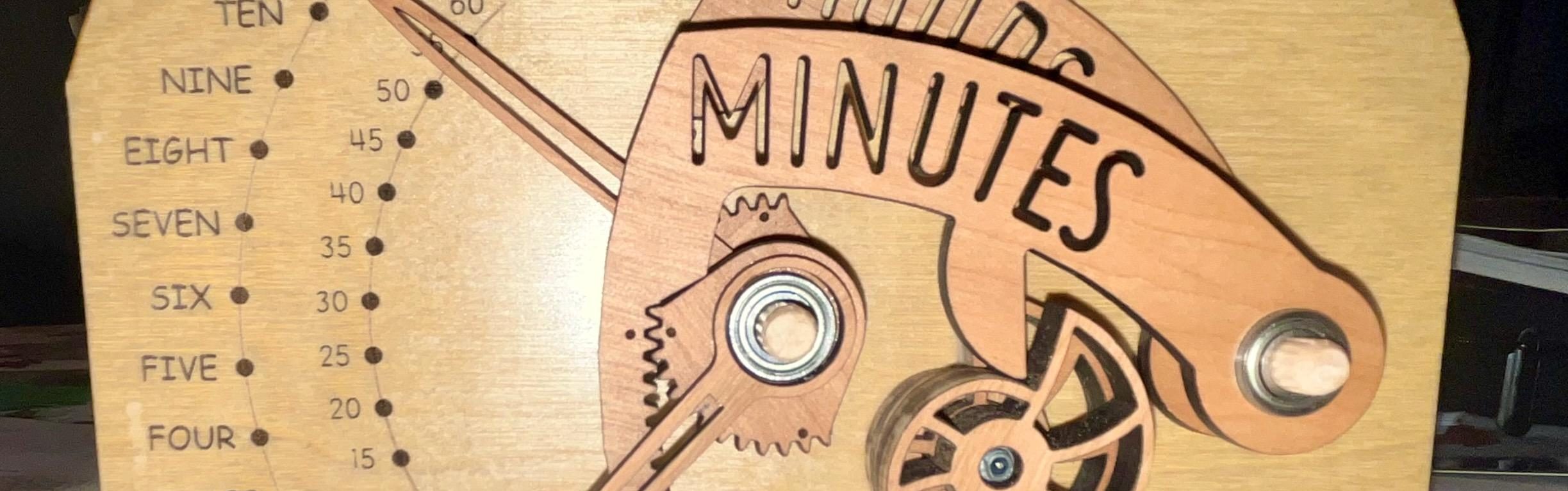
A cam is a shaped rotating part that pushes another part as it turns. In a retrograde clock, cams mounted to the hour and minute shafts can lift arms gradually. As the cam rotates, the follower arm rides along its profile. When the cam reaches the drop-off point, the arm falls back. That fall creates the reset motion.
This is beautifully old-school. The cam does not need firmware updates, Wi-Fi, or a password containing one capital letter, one number, and one regrettable symbol. Its “program” is cut into its shape. The geometry is the code.
Pivots and Linkages Make the Hands Readable
A simple cam-driven arm could point directly to a scale, but a refined laser cut clock often adds pivoting hands driven by linkages or gear segments. This extra mechanical layer improves readability and gives the front of the clock a more polished appearance. The hands can move gracefully across the face while the cam work happens behind the scenes.
The result is a timepiece that looks complex but remains understandable. Viewers can follow the motion with their eyes: shaft turns, cam rises, arm moves, hand sweeps, reset happens. It is a miniature lesson in mechanical design, disguised as home decor.
Why Laser Cutting Is Perfect for This Kind of Clock
Laser cutting and clockmaking are a natural match, assuming your idea of a good afternoon includes the smell of scorched plywood and the phrase “just one more test cut.” A laser cutter can create precise, repeatable parts from wood, acrylic, cardboard, or other sheet materials. For a retrograde clock, that precision matters.
The clock face needs clean markings. The gears or linkages need consistent shapes. Pivot holes must align. Decorative layers should stack neatly. A hand-cut version is possible, but it requires patience, skill, and probably a blood sacrifice to the sanding gods. Laser cutting makes the project more accessible while preserving the handmade charm.
Kerf: The Tiny Detail That Can Ruin Your Day
One important laser cutting concept is kerf, the small amount of material removed by the laser beam. If you cut a hole and expect a shaft to fit perfectly, kerf can decide whether the fit is snug, sloppy, or so tight that you begin questioning your life choices.
Good makers compensate for kerf by testing their material, measuring real cut results, and adjusting the design files. Plywood thickness can vary, and laser settings change depending on power, speed, focus, and material quality. A clock with moving parts does not forgive sloppy tolerances. The parts must move freely without wobbling like a shopping cart wheel.
Plywood Adds Warmth and Personality
Plywood is popular for laser cut clocks because it is affordable, stable, lightweight, and attractive when finished well. The laser leaves dark edges that can create a pleasant contrast against the pale face of the wood. With sanding, sealing, and careful assembly, the final clock can look far more premium than its humble sheet-material origins suggest.
That said, plywood also has opinions. It can warp, char, splinter, or contain glue pockets that cut unevenly. The best builds usually come from choosing quality plywood, running test cuts, masking surfaces when needed, and keeping the laser optics clean. In other words, the clock may be retrograde, but the workflow should not be chaotic.
Mechanical Clock Movement vs. Arduino Control
Many unusual clocks use microcontrollers. An Arduino Nano, a DS3231 real-time clock module, and stepper motors can produce accurate and flexible timekeeping. This approach is powerful because software can correct drift, control motion profiles, trigger lights, play sounds, and do all the other things that make makers say, “This will only take a weekend,” immediately before vanishing for three months.
But a mechanical retrograde clock driven by a standard clock movement has a different appeal. It reduces electronic complexity. There is less wiring, less code, and fewer chances for a loose jumper cable to turn your elegant timepiece into abstract sculpture. For builders who prefer wood, cams, gears, and linkages, the mechanical route feels refreshingly direct.
Neither approach is “better” in every situation. Arduino control is excellent for programmable displays, illuminated clocks, synchronized time, or experimental motion. A cam-driven mechanical design is excellent for simplicity, beauty, and the satisfaction of watching geometry do the work. One is a tiny robot. The other is a tiny wooden machine with manners.
The Charm of Visible Mechanisms
One reason maker clocks remain popular is that they reveal process. A phone can tell time more accurately than almost any handmade clock, but nobody gathers around a phone lock screen and says, “Look at the cam profile on that beauty.” A laser cut retrograde clock invites curiosity because the timekeeping is visible.
Visible mechanisms make an object feel alive. When a hand sweeps upward and snaps back, the viewer understands that something physical has happened. Energy moved. A shape pushed another shape. A pivot rotated. A spring or gravity-assisted return completed the cycle. It is simple enough to understand and complex enough to admire.
This is why exposed gears, skeleton watches, marble machines, and wooden automata have such staying power. They give motion a personality. A retrograde clock does not merely report the time; it performs it.
Design Lessons From a Laser Cut Retrograde Clock
A project like this teaches more than how to build a clock. It teaches design thinking. Every part has a job, and every job affects another job.
1. Motion Must Be Planned Before Decoration
It is tempting to begin with a beautiful face design, ornate numbers, and decorative cutouts. That is the fun part. But the real clock begins with motion. How far must the hand travel? Where does it reset? What angle gives the best readability? How does the cam convert rotation into that motion?
Once the mechanical path works, decoration can follow. This is the difference between a clock and a wall ornament that occasionally lies about the time.
2. Readability Still Matters
Novel clocks sometimes become so clever that reading them feels like solving a tax form in a wind tunnel. A good retrograde clock should be unusual but still usable. Clear scales, contrasting hands, sensible numbering, and smooth motion help the viewer understand the display quickly.
The best design balance is simple: make people smile first, then let them read the time without needing a tutorial longer than the warranty card.
3. Reset Motion Needs Control
The snap-back action is the star of the show, but it should not be violent. If the return is too harsh, parts may wear quickly, hands may bounce, and the clock may sound like a squirrel trapped in a toolbox. Smooth pivots, proper clearances, light hands, and well-shaped cams all help the mechanism reset reliably.
Where This Clock Fits in the Maker Movement
The laser cut retrograde clock sits at a sweet intersection of digital fabrication and traditional mechanism design. It uses modern tools to create an object that feels delightfully analog. That combination is a major reason laser cutters, 3D printers, CNC routers, and desktop fabrication tools have become so beloved in maker communities.
Digital files make the design shareable. A builder can publish SVG or DXF files, and another maker can cut the parts, modify the face, change the materials, or adapt the mechanism. This turns one clock into a platform for experimentation.
Someone might build a walnut veneer version for a living room. Another person might make a bright acrylic version for a classroom. A third might add LEDs, because makers are legally required to add LEDs to at least one project per year. The design invites iteration.
Practical Tips for Building a Laser Cut Retrograde Clock
If you want to build a similar clock, start with the mechanism before chasing fancy details. Print or cut test pieces for the cam, follower, and hand linkage. Move them by hand. Watch where friction appears. Look for binding at the reset point. Confirm the hour and minute scales match the actual motion.
Use lightweight hands. Heavy hands create extra load, especially during reset. Choose clean pivot hardware, such as small screws, brass tubing, washers, or bushings. Wood-on-wood pivots can work, but they may wear or swell with humidity. A little mechanical sympathy goes a long way.
Finish the wood before final assembly when possible. Sanding around delicate linkages after everything is installed is like trying to groom a cat with a leaf blower. Apply a clear coat, wax, or suitable finish lightly so it does not gum up moving parts. Keep friction surfaces clean and avoid over-tightening pivots.
Finally, accept that version one may not be perfect. This is not failure. This is prototyping, which is failure wearing a lab coat and carrying a clipboard.
Why This Clock Feels So Satisfying
A laser cut retrograde clock is satisfying because it solves a familiar problem in an unfamiliar way. Everyone knows what a clock does. Not everyone expects time to climb an arc and leap back to the beginning. That surprise makes the object memorable.
It also brings together several satisfying maker ingredients: precision cutting, mechanical motion, visible cause and effect, useful function, and artistic presentation. It is not just a gadget. It is a conversation piece with a job.
And unlike many novelty clocks, it does not need to be intentionally confusing. The retrograde display can be intuitive once the viewer understands the arc. In fact, the motion may make time feel more obvious. Minutes visibly accumulate. The reset marks a new cycle. The clock turns the passage of time into a small mechanical ritual.
Experience Notes: Living With and Building Around a Retrograde Clock
The first experience related to a laser cut retrograde clock is usually disbelief. You look at it and think, “That cannot be how a clock works.” Then the hand reaches the end of its scale, snaps back, and suddenly the whole idea clicks. It is like watching a magic trick after someone lets you peek under the table. The magic remains, but now it has gears.
For a builder, the experience is even better because every movement has a memory attached to it. That clean sweep across the minute scale? It probably came after three test cams, one slightly oval pivot hole, and a mysterious clicking sound that disappeared only after you loosened a screw by one-quarter turn. The finished clock becomes a record of tiny decisions. No one else may notice them, but you will. You will know which part was redesigned at midnight. You will know which spacer saved the reset motion. You will know which decorative flourish exists mainly to cover a mounting point. That is the secret joy of making things.
There is also a different relationship with time when the display is mechanical and visible. A digital clock makes minutes vanish silently. A retrograde clock lets them gather. You can see the minute hand approaching the top of the arc, building toward the reset. It gives the hour a rhythm. When the hand drops back, the clock seems to inhale and begin again. That may sound dramatic for a plywood object, but anyone who has stared at a well-tuned mechanism knows the feeling.
In a home workshop, the project teaches humility in the friendliest possible way. Laser cutting feels precise, but real materials keep you honest. Plywood thickness varies. Kerf changes. A hole that looked perfect in CAD may behave differently after cutting. Two parts that moved freely on the bench may bind after the front plate is tightened. The clock encourages patient problem-solving. Instead of forcing parts together, you learn to observe. Where is the rub? Which angle changes during reset? Is the hand too heavy? Is the cam profile too abrupt? The project rewards calm attention.
As a display piece, it also has unusual social power. Guests may ignore a regular clock completely, but a retrograde clock gets questions. “Does it go backwards?” “Why did it jump?” “Did you make that?” This is the maker’s favorite trapdoor. One innocent question opens into a tour of cams, laser kerf, pivot friction, and why clocks are secretly more interesting than most people remember. Use this power responsibly. Not everyone came over for a lecture on mechanical linkages, even if they clearly needed one.
The greatest experience, though, is the moment the clock runs on its own. After all the measuring, cutting, sanding, aligning, and adjusting, the hands move without your help. The mechanism stops being a pile of parts and becomes a machine. It keeps time in its own charming, slightly theatrical language. That is why there is nothing backwards about this laser cut retrograde clock. It points forward: toward better builds, smarter design, and the simple pleasure of making time visible again.
Conclusion
There’s Nothing Backwards About This Laser Cut Retrograde Clock because its brilliance lies in moving time forward through an unexpected display. By using cams, pivots, laser cut layers, and carefully shaped mechanical parts, it transforms ordinary clock rotation into sweeping retrograde motion. The result is practical enough to read, artistic enough to admire, and clever enough to make even non-makers pause for a closer look.
Whether built from plywood, acrylic, or a mix of materials, a retrograde clock proves that timekeeping does not have to be boring. It can be tactile, visible, humorous, and surprisingly elegant. In a world where every device already tells time, the real value of a handmade clock is not just accuracy. It is wonder. And this little machine has plenty of that.
Note: This HTML body is written as original publish-ready content synthesized from real maker, horology, laser cutting, and clock mechanism information.