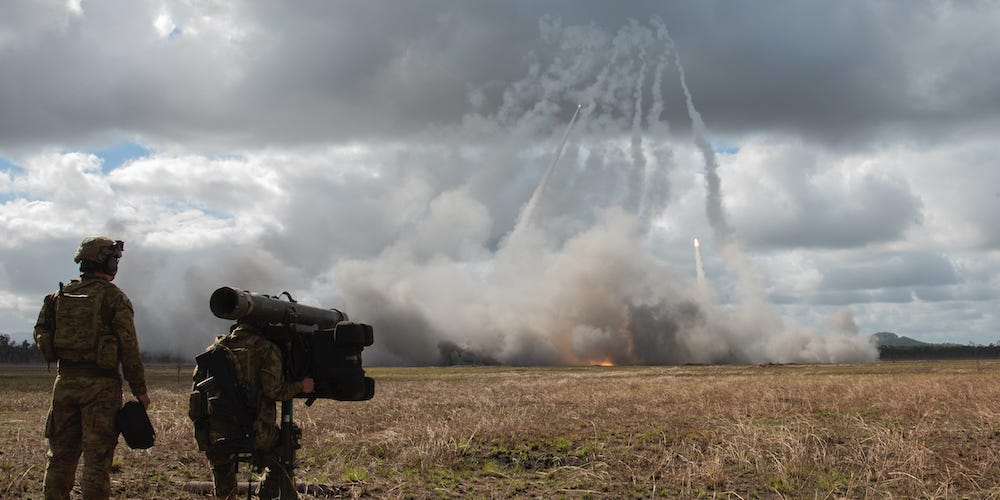
When people first heard that the United States was sending HIMARS rocket trucks to Ukraine, the name sounded like it belonged in a video game, a heavy-metal album, or a particularly aggressive brand of lawn equipment. In reality, HIMARS became one of the most talked-about weapons systems of the war because it gave Ukraine a combination military planners love: mobility, precision, and the ability to make distant supply depots suddenly feel very nervous.
The High Mobility Artillery Rocket System, better known as HIMARS, is a truck-mounted rocket launcher built for fast movement and precision strikes. In 2022, the United States began supplying the system to Ukraine as Russian forces relied heavily on ammunition depots, command posts, bridges, rail networks, and logistics hubs behind the front lines. The additional launchers did not magically rewrite the war overnight. Wars are stubborn, messy, and annoyingly resistant to simple plot twists. But HIMARS changed the math for both sides.
More launchers meant more opportunities for Ukraine to strike military targets beyond the reach of many traditional artillery systems. Just as important, the arrival of HIMARS forced Russia to adjust how it stored ammunition, moved supplies, protected headquarters, and deployed air-defense systems. In modern warfare, making the other side spend more time hiding, relocating, and worrying is often a victory in itself.
What Is HIMARS, Exactly?
HIMARS stands for High Mobility Artillery Rocket System. It is a wheeled launcher mounted on a military truck chassis, giving it far greater road mobility than older tracked rocket systems. The launcher can fire a range of guided rockets and missiles from the broader Multiple Launch Rocket System family of munitions.
A standard HIMARS launcher can carry a pod of guided rockets or a larger tactical missile, depending on the ammunition loaded. In Ukraine’s case, the system became especially associated with Guided Multiple Launch Rocket System, or GMLRS, munitions. These guided rockets gave Ukrainian forces the ability to strike targets at significant distances with far more accuracy than conventional unguided artillery rockets.
The important part is not just that HIMARS can shoot far. Plenty of weapons can shoot far. The real advantage comes from how quickly the launcher can move before and after firing. A HIMARS crew can relocate after launching rockets, reducing the chance of counterfire. In military shorthand, this is often called “shoot and scoot.” It sounds like something a toddler says after stealing a cookie, but in combat it is a major survivability feature.
Why Mobility Matters on a Modern Battlefield
Static artillery is vulnerable artillery. Once an opponent identifies a firing position, it can respond with rockets, drones, artillery, aircraft, or electronic surveillance. A mobile rocket launcher complicates that response. Instead of targeting one predictable location, the enemy must find a truck that may already be several miles away, hidden under camouflage, moving along a wooded road, or parked in a location that looks uninteresting from above.
That mobility also helps Ukraine use limited resources more efficiently. A launcher does not need to remain near the front line to be useful. It can strike deeper targets while operating from positions that are harder to reach. This matters because the war in Ukraine has involved a vast front, contested airspace, dense drone surveillance, and an endless contest between locating targets and avoiding being located.
Why the United States Sent More HIMARS to Ukraine
The U.S. decision to send additional HIMARS launchers was tied to Ukraine’s changing battlefield needs in 2022. Russia’s initial attempt to seize Kyiv had failed, but fighting in eastern and southern Ukraine shifted into a punishing artillery war. Russian forces possessed large stocks of artillery ammunition and relied on supply routes to move shells, fuel, spare parts, and reinforcements toward the front.
Ukraine needed a way to disrupt those systems without relying entirely on air power. That was difficult because Russia retained substantial air-defense capabilities. HIMARS offered an alternative: a precision-guided rocket artillery system that could reach important targets behind the immediate combat zone.
The initial U.S. delivery included four HIMARS launchers. More systems followed, including a July 2022 package that added four more launchers and raised the U.S.-provided total at that stage to 16. Over time, U.S. support expanded further, including additional ammunition, maintenance support, training, and related capabilities. Later U.S. security-cooperation material described more than 40 HIMARS launchers and associated ammunition as part of American support for Ukraine.
This pattern matters because HIMARS was never intended to operate as a stand-alone superhero truck. The launcher needed ammunition, trained crews, targeting information, maintenance, spare parts, communications equipment, and a broader military network. A rocket truck without rockets is just a very expensive way to transport regret.
How HIMARS Changed the Battlefield
The early use of HIMARS in Ukraine drew attention because Ukrainian forces reportedly struck ammunition depots, command posts, fuel facilities, logistics hubs, and key infrastructure used by Russian forces. The system’s precision created a new challenge for Russia: rear areas that had once seemed relatively safe were no longer reliably safe.
That effect went beyond the physical destruction of any single target. A logistics system depends on predictability. Ammunition must be stored somewhere. Vehicles need fuel. Officers need command posts. Rail lines and bridges need to stay functional. When those systems are threatened, commanders may disperse supplies, move headquarters farther from the front, use smaller depots, alter routes, and invest more heavily in air defense and electronic warfare.
All of those changes consume time and resources. If a commander must move a depot farther away from the battlefield, trucks travel longer distances. If supplies are dispersed, deliveries become more complicated. If air-defense systems are reassigned to protect logistics sites, they may be unavailable somewhere else. Military strategy is often a game of forcing the opponent to make uncomfortable choices, and HIMARS gave Ukraine another way to do that.
Precision Is More Than a Buzzword
Precision-guided rockets are valuable because they can focus effects on a specific military target rather than relying on large numbers of less accurate rounds. That does not remove the tragedy or danger of war, and it does not make every strike simple or risk-free. Intelligence can be incomplete, targets can move, and military systems exist in a chaotic environment where civilians remain vulnerable.
Still, precision can reduce the need for broad-area bombardment when commanders have reliable targeting information. For Ukraine, the appeal was obvious: a smaller number of accurate strikes could have an outsized effect on supply chains and command networks. For the United States, HIMARS also represented a way to provide meaningful military assistance without placing American personnel into direct combat.
HIMARS Was Powerful, but It Was Not a Magic Wand
It is tempting to treat any successful weapon system as a miracle machine. That is especially true online, where every new military capability is quickly given a nickname, a montage, and at least three comments claiming it has “changed warfare forever.” Reality is more complicated.
HIMARS improved Ukraine’s ability to strike important targets, but it did not eliminate Russia’s larger advantages in manpower, artillery volume, missiles, drones, and industrial capacity. Russia adapted by moving some ammunition dumps farther from the front, improving camouflage, using decoys, dispersing logistics sites, and increasing efforts to locate Ukrainian launchers. As the war evolved, electronic warfare, drones, glide bombs, air defense, and long-range strike systems all became part of the same increasingly crowded battlefield puzzle.
In other words, HIMARS was highly effective because it was part of a broader system of intelligence, planning, mobility, and logistics. Its value depended on the people using it, the ammunition available, and the ability to identify worthwhile targets. A launcher alone cannot win a war any more than a chef’s knife can cook dinner without a kitchen, ingredients, and someone who knows not to put the spatula in the dishwasher.
The Importance of GMLRS Ammunition
When people discuss HIMARS, they often focus on the launcher because it is visually distinctive. The truck is the celebrity. The rockets are the working band behind the scenes. Yet ammunition availability may be even more important than the number of launchers.
Guided Multiple Launch Rocket System ammunition allows HIMARS crews to conduct precision strikes against military targets at ranges beyond conventional tube artillery. A launcher can be replaced eventually. Ammunition shortages are harder to solve quickly because manufacturing guided rockets requires specialized components, production capacity, testing, transportation, and coordination across defense supply chains.
This is why military aid packages frequently included not only HIMARS launchers but also additional GMLRS rockets, artillery ammunition, spare parts, training, maintenance support, and vehicles. A modern weapons system is not a one-time purchase. It is an ongoing relationship with fuel, mechanics, software, logistics officers, warehouse workers, factory lines, and a great many people whose job titles do not fit neatly into an action movie.
Launchers, Rockets, Training, and Maintenance
Ukraine’s HIMARS capability depended on more than receiving equipment. Crews needed training on launching procedures, vehicle operation, communications, safety protocols, target coordination, and maintenance. Technicians needed access to parts and diagnostic tools. Commanders needed to integrate the system into artillery planning and intelligence workflows.
This is one reason why military assistance often arrives in stages. Sending more launchers can be useful, but sending equipment faster than a partner can train, sustain, and protect it may create bottlenecks. Effective support requires a balance between urgency and practicality. The goal is not simply to deliver hardware. The goal is to create a capability that can remain useful under battlefield pressure.
What More HIMARS Meant for Russian Logistics
Russian military logistics became a major focus of Ukrainian strike planning because artillery-heavy warfare burns through enormous quantities of ammunition and fuel. A force can have tanks, troops, and artillery pieces, but if shells do not arrive, the battlefield plan becomes much less impressive.
HIMARS gave Ukraine an option for targeting supply nodes that supported Russian operations. Striking an ammunition depot could reduce the volume of artillery fire in a sector. Hitting a command post could disrupt coordination. Damaging a bridge or rail facility could slow the movement of equipment. None of these actions guarantees a breakthrough, but together they can make offensive operations more difficult and defensive operations more expensive.
That is why the system’s strategic value often exceeded the number of launchers involved. A limited fleet of precision rocket systems can influence behavior across a much wider area. The threat of being targeted can force an adversary to change where it stores supplies, how it moves vehicles, and how it organizes leadership. Sometimes the most valuable strike is the one that makes the other side change its plans before a rocket is even launched.
What HIMARS Revealed About the Future of War
The HIMARS story reinforced several lessons about modern conflict. First, long-range precision fires matter. Second, mobility matters just as much as range. Third, logistics is not boring background work; it is often the main character wearing a reflective vest. Finally, a weapon system’s battlefield value depends on the network around it.
Ukraine demonstrated that a smaller force can use precision, speed, and intelligence to pressure a larger opponent. Russia demonstrated that even highly effective systems can be countered through adaptation, dispersion, electronic warfare, air defense, and repeated attacks on supply chains. Both sides showed that the battlefield is increasingly shaped by drones, sensors, satellite information, digital communications, and the constant race to find the enemy before the enemy finds you.
For the United States and its allies, HIMARS also became a reminder that production capacity is a strategic asset. Countries cannot assume that guided rockets, artillery shells, air-defense interceptors, and spare parts will be available in unlimited quantities during a prolonged conflict. The ability to manufacture, transport, and sustain weapons may matter as much as the technology itself.
Experiences and Lessons From the HIMARS Moment
The most useful way to understand the HIMARS experience is not as a story about a single weapon, but as a story about how modern armies learn under pressure. Ukraine’s use of precision rocket artillery illustrated that effectiveness comes from combining several elements: accurate intelligence, trained crews, secure communications, disciplined planning, maintenance support, and the ability to move quickly after firing. Remove any one of those pieces, and the whole system becomes less impressive.
One major lesson is that mobility can be a form of protection. In earlier wars, a large artillery battery might remain in a prepared position for long periods. In Ukraine, the threat of drones, counterbattery fire, satellite observation, and electronic surveillance made that approach increasingly dangerous. Launchers that could fire and relocate quickly had a better chance of surviving. This did not make them invisible, but it made the opponent’s job much harder.
Another lesson involves target selection. A precision weapon is most valuable when used against targets that create broader operational consequences. A strike against a warehouse may matter not because of the building itself, but because it affects ammunition delivery to an entire sector. A strike against a command post may matter because it interrupts decisions during a critical period. This is why long-range fires are often less about dramatic explosions and more about quietly making an opponent’s system less efficient.
The HIMARS experience also showed why ammunition stocks matter. The launcher attracts attention because it is visible, mobile, and photogenic in the way only a military truck covered in dust can be. But the guided rockets are what give the launcher practical value. Without a steady supply of ammunition, even the most advanced platform becomes limited. That reality has influenced defense planning across the United States and Europe, where governments have placed greater emphasis on expanding production of artillery shells, guided rockets, air-defense missiles, and other high-demand munitions.
There is also a lesson about adaptation. Russia did not simply accept the early impact of HIMARS strikes. Russian forces reportedly adjusted by dispersing supplies, moving some depots farther from the front, strengthening air defenses, using decoys, and relying more heavily on electronic warfare. Ukraine, in turn, continued to adapt its own methods of reconnaissance, targeting, concealment, and movement. Modern warfare is rarely a stable contest. Every successful tactic produces a countertactic, which produces another adjustment.
For ordinary observers, the HIMARS story is a reminder to be skeptical of claims that any single weapon will decide a war. Military systems are important, but wars are shaped by far more than hardware. Political leadership, industrial capacity, troop morale, training, intelligence, alliances, terrain, weather, economics, and public support all matter. A rocket launcher can be powerful, but it cannot negotiate peace, rebuild a city, or replace the human cost of conflict.
Still, HIMARS became an important symbol because it represented a shift in Ukraine’s ability to strike military targets beyond the front line. It showed how a relatively small number of precise, mobile launchers could complicate the plans of a much larger military force. It also showed that in a war defined by drones, sensors, and logistics, the side that can move, communicate, and resupply more effectively may gain advantages that are difficult to measure but impossible to ignore.
The lasting experience is not that HIMARS made warfare simple. It did the opposite. It exposed how complicated warfare has become. A truck, a rocket pod, a satellite signal, a map, a maintenance crew, a warehouse, a training program, and a few minutes of accurate information can all combine to change what happens hundreds of miles away. That is not magic. It is modern military logistics, precision technology, and a lot of very serious people trying to make sure one very expensive truck is in the right place at the right time.