Before fake news became a grim phrase people argued about at Thanksgiving, The Onion was already perfecting the art of fake news that told the truth. Its headlines looked like newspaper headlines. Its tone sounded like a wire-service dispatch written by a tired editor with a coffee stain on his tie. And somehow, behind all that nonsense, the jokes landed with the force of actual journalism.
Founded in Madison, Wisconsin, in 1988, The Onion grew from a student-area print weekly into one of the most influential satire brands in American media. Its self-declared title, America’s Finest News Source, is both a joke and, annoyingly for actual news outlets, sometimes a little too accurate. When The Onion is at its best, it does not simply say, “Here is a funny thing.” It says, “Here is the absurd engine under public life, and yes, it is leaking oil on the carpet.”
Below are five behind-the-scenes stories that help explain why The Onion became so durable, so imitated, and so beloved by readers who enjoy being lied to honestly.
1. The Onion Began as a Campus Paper With a Monster in the Lake
The Onion did not emerge from a Manhattan comedy laboratory or a Silicon Valley content-growth pod. Its roots are humbler and much better: Madison, Wisconsin, where University of Wisconsin students Tim Keck and Christopher Johnson launched the paper in 1988. The first issue reportedly amused students with a fake story about a monster in Lake Mendota. That is a very Wisconsin origin story: local geography, student mischief, and a creature that probably would have had strong opinions about cheese curds.
Its early genius was not just that it invented fake stories. College towns already had plenty of fake confidence, fake IDs, and fake bands with real tambourines. The Onion’s breakthrough was tone. The paper copied the calm, factual style of mainstream journalism and used it to report ludicrous events as if they were ordinary. That deadpan voice became the brand’s secret weapon.
Many comedy outlets wink at readers. The Onion rarely winked. It stared straight ahead, adjusted its imaginary press badge, and announced disaster, stupidity, romance, politics, despair, and grocery-store awkwardness in the same official voice. The result was instantly recognizable: serious language applied to ridiculous situations, or ridiculous language applied to serious truths.
2. The Name Became Part of the Myth
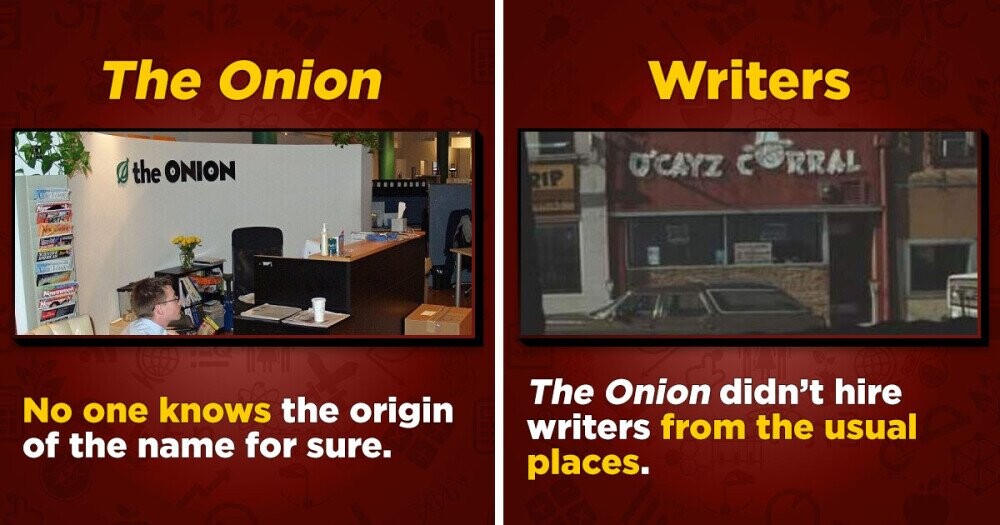
One of the most repeated stories about The Onion’s name is that its founders were so short on cash that they ate onion sandwiches while brainstorming the paper. Whether treated as strict origin history or comedy folklore, the story fits perfectly because it sounds like an Onion headline that escaped into reality: Cash-Strapped Satirists Nourished by Single Vegetable, American Dream.
The name also works because an onion has layers. That is a convenient metaphor, yes, but in this case the metaphor has earned its parking space. Onion satire often starts with a simple joke, then reveals a second layer about media, a third about politics, a fourth about human insecurity, and a fifth about the terrifying fact that everyone is improvising adulthood.
Take the classic “Area Man” style of Onion humor. The joke is not merely that an ordinary person is being covered like a national event. The deeper joke is that modern media often treats the trivial as monumental and the monumental as content. By giving small human frustrations the grammar of breaking news, The Onion exposes how silly news language can sound when removed from its usual costume.
3. The Writers’ Room Runs on Brutal Editing and Headline Darwinism
Behind the effortless feel of an Onion headline is a highly disciplined comedy process. Former and current staffers have often described the work as headline-heavy, collaborative, and ruthless in the best possible way. A good Onion joke usually begins as a headline, not as a finished article. The headline must contain the premise, the angle, the rhythm, and the tiny explosion of recognition.
That is why The Onion’s style is difficult to copy. A weak parody headline tells you it is joking. A strong Onion-style headline behaves like it has never heard of jokes. The sentence has to be clean enough to pass as news, strange enough to be funny, and sharp enough to reveal something real.
The editing culture is part of the magic. Dozens of ideas may be pitched, argued over, reshaped, or tossed aside before one survives. The discard pile is probably funnier than most websites’ homepages. But that pressure creates the unmistakable Onion polish: no wasted words, no nervous explanation, no “please clap” energy.
Why The Onion’s Voice Feels So Real
The Onion borrows the structure of journalism: headlines, subheads, quotes, datelines, expert commentary, public reactions, and institutional language. Then it fills that structure with absurdity. This is why the parody works. The design says “trust us,” while the content says “please do not trust anyone this much.”
Its writers also understand that specificity is funnier than vagueness. A headline about “society being weird” is forgettable. A headline about a local man, a particular sandwich, or a corporate spokesperson making a wildly empty statement feels alive. The details create the illusion of reporting, and the illusion makes the satire sharper.
4. The 9/11 Issue Proved Satire Could Return Before Everyone Was Ready
One of the most important behind-the-scenes moments in The Onion’s history came after the September 11 attacks. For many comedians and television shows, the question was whether humor could continue at all. The Onion staff faced the same question, but with a sharper blade: could a satirical newspaper publish jokes about a national trauma without sounding cruel?
The answer became one of the most discussed issues in the publication’s history. The staff returned with an issue that did not mock the victims. Instead, it mocked confusion, rage, media hysteria, political vagueness, and the desperate human need to do something, anything, when reality becomes unbearable.
Headlines such as “U.S. Vows To Defeat Whoever It Is We’re At War With” captured a national mood more precisely than many sober editorials. Another story about a woman baking an American-flag cake found comedy not in tragedy, but in helplessness. That distinction matters. The Onion was not laughing at suffering. It was laughing at the strange, fragile rituals people use to stand near suffering without being swallowed by it.
The issue was risky. Some staff members reportedly worried that readers were not ready. Yet the response was overwhelmingly positive, and the issue became a defining example of satire as emotional pressure valve. It showed that comedy can be respectful without becoming toothless, and that a joke can hold grief in one hand and absurdity in the other.
5. The Onion Left Print, Then Returned Like a Newspaper Zombie With Better Jokes
For years, The Onion was a physical paper passed around campuses, coffee shops, bars, and apartments where at least one roommate owned a milk crate instead of furniture. Then the internet changed everything. The Onion moved online early, grew nationally, built video projects, expanded its pop-cultural footprint through related brands, and eventually stopped its print edition in 2013.
At the time, ending print seemed logical. Newspapers were shrinking, ad dollars were moving, and digital traffic looked like the future. The Onion, being The Onion, had spent years mocking the death of print, only to be dragged into the same economic comedy sketch as everyone else.
Then came the twist: in 2024, under new ownership by Global Tetrahedron, The Onion brought print back as a subscription product. That decision sounded like a joke written by The Onion about The Onion: Digital Media Company Saves Future by Becoming Newspaper Again. But there was a real strategy behind the punchline.
Print gives satire something social media often destroys: context. Online, a single headline can be ripped away from the surrounding jokes, misread by angry strangers, or flattened by an algorithm that thinks outrage and delight are the same snack. In print, the reader sees a curated mix: politics beside fake ads, entertainment beside sports, small jokes beside big cultural swings. The whole page becomes part of the joke.
The return to print also reinforced something readers already felt: The Onion is not just a website. It is a comic institution with a specific rhythm, tradition, and physical memory. A printed Onion issue says, “Here is a fake newspaper you can hold while the real world continues behaving irresponsibly.”
Bonus Behind-the-Scenes Twist: The Onion Went to the Supreme Court
In 2022, The Onion filed a real amicus brief in a Supreme Court-related parody case involving Anthony Novak, who had created a spoof Facebook page of an Ohio police department. The case raised serious questions about parody and the First Amendment. Naturally, The Onion responded with a legal brief that made a serious argument while refusing to stop being The Onion.
The brief defended the principle that parody often works by maintaining a straight face. If every joke must announce itself as a joke, parody loses its power. A satirist forced to label satire is like a magician forced to explain the trick while wearing a sandwich board that says, “The rabbit is in the sleeve.” Technically informative, spiritually disastrous.
This episode revealed an important truth about The Onion’s role in American media. It is not merely a joke factory. It is also a defender of a comic tradition that depends on ambiguity, mimicry, and public intelligence. The Onion has been misunderstood many times, but misunderstanding is partly the point. Satire tests whether readers can recognize the difference between surface and meaning.
The InfoWars Saga: When Reality Tried to Out-Onion The Onion
The Onion’s more recent ownership story added another surreal chapter. In 2024, the publication was sold by G/O Media to Global Tetrahedron, a name longtime readers recognized as a fictional evil corporation from Onion lore. In other words, a fake corporation became real in order to buy a fake newspaper that tells the truth through lies. Media history rarely gets this tidy.
Then came the proposed takeover of Alex Jones’s InfoWars. The Onion’s parent company pursued the conspiracy platform after legal judgments connected to Jones’s false claims about Sandy Hook. The deal faced court obstacles, but the larger idea was unmistakably Onion-esque: turn one of America’s loudest misinformation brands into an object of parody.
That effort shows why The Onion still matters. It does not simply make jokes near the news. Sometimes it walks directly into the machinery of modern media and paints a mustache on the gears. The target is not only politicians or celebrities. It is the entire ecosystem of panic, branding, monetized outrage, and institutional nonsense.
Why The Onion’s Satire Still Works
The Onion survives because it understands that absurdity is not the opposite of truth. Often, absurdity is how truth introduces itself when polite language fails.
A traditional article may explain that corporations use empty empathy during crises. The Onion can invent a corporate statement so hollow it echoes. A pundit may argue that politics has become theatrical. The Onion can write a headline that makes the theater visible in five seconds. A columnist may spend 1,200 words explaining social anxiety. The Onion can turn one man’s minor grocery-store decision into an epic of American dread.
The publication’s best work has three qualities: precision, restraint, and emotional intelligence. Precision keeps the joke sharp. Restraint keeps it from becoming a lecture. Emotional intelligence keeps it from punching blindly. That combination is rare, which is why so many “Onion-style” jokes online feel like photocopies of a thunderstorm.
Experiences and Lessons From America’s Finest News Source
Reading The Onion over time creates a strange experience: you begin to notice how much of real news already sounds satirical. A mayor announces a task force to study a committee. A company apologizes for “falling short of expectations” without naming the thing it did. A politician says the important thing is to have a conversation, preferably one that delays action until everyone forgets why they were angry. Suddenly, The Onion does not seem exaggerated. It seems underfunded by reality.
For writers, marketers, journalists, and comedy fans, The Onion offers a practical lesson in voice. The publication proves that style is not decoration. Style is the machine. Its neutral, reportorial tone allows wild ideas to feel plausible long enough for the joke to detonate. That is useful beyond comedy. Any strong piece of writing needs a controlled voice, a clear angle, and the confidence not to overexplain itself.
Another lesson is the value of compression. The Onion headline is one of the hardest comedy formats because it has no room for warm-up. It must arrive dressed as information and leave as revelation. This is why great Onion headlines feel inevitable after you read them. You think, “Of course. That is exactly how humans are terrible.”
There is also a lesson in courage. The 9/11 issue, the Supreme Court brief, and the InfoWars pursuit all show a willingness to operate where humor is risky. Safe jokes can be pleasant, but satire needs friction. It needs something solid to scrape against. The Onion’s best work does not chase controversy for cheap attention; it finds the comic pressure point inside serious subjects.
As a reader, the best way to experience The Onion is to let the joke breathe for one extra second. The first laugh often comes from the absurd premise. The second comes from recognition. The third, if the piece is especially good, comes with a tiny wince because the joke has located something embarrassing and accurate about public life or private behavior.
That is the hidden beauty of America’s Finest News Source. It tells fake stories that help readers survive real ones. It gives language to the ridiculousness people feel but cannot always articulate. And in an age when headlines are engineered to frighten, flatter, or bait us, The Onion’s fake headlines remain oddly cleansing. They are lies that admit they are lies, which makes them feel more honest than plenty of things wearing a serious suit.
Conclusion
The Onion’s behind-the-scenes history is more than a collection of funny office stories. It is the story of a small Wisconsin paper that mastered journalistic form, built a legendary comedy voice, survived the internet, returned to print, defended parody in legal culture, and kept finding new ways to mock power without losing its deadpan soul.
Its greatest trick is not pretending fake events are real. Its greatest trick is showing that real events are often structured like jokes nobody agreed to be in. That is why The Onion remains essential: not because it escapes reality, but because it notices reality’s ridiculous posture and writes it down before reality can deny it.