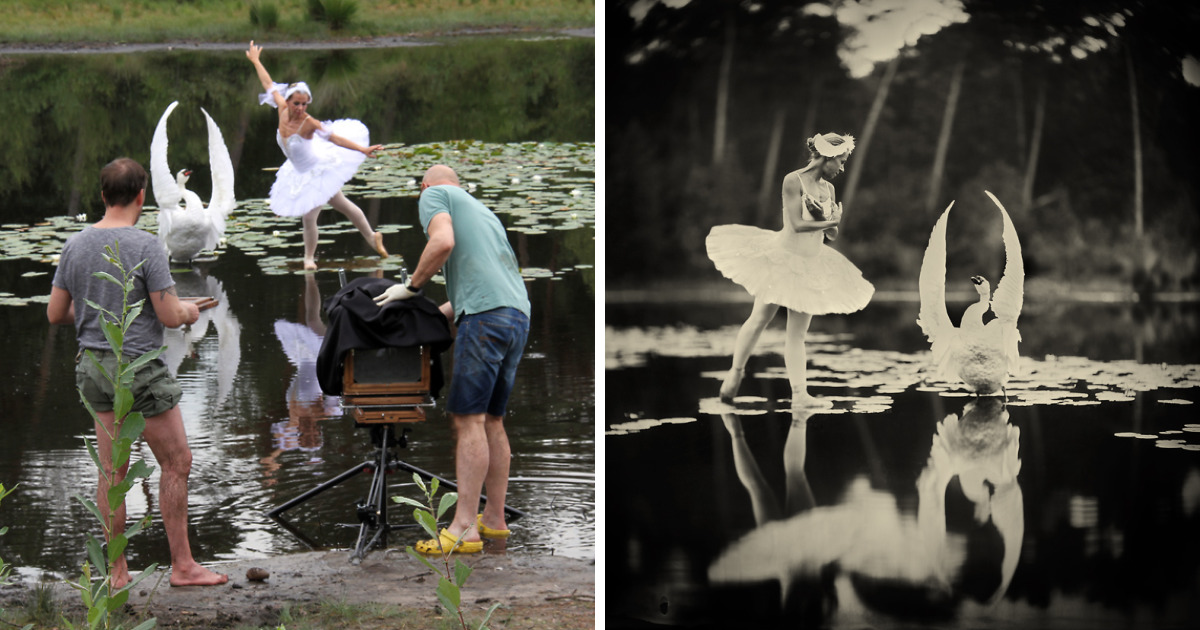
Some photographs are taken. Others are negotiated into existence with chemistry, weather, mud, nerves, and the kind of optimism usually reserved for people assembling furniture without reading the manual. “Swan Lake,” a wet plate collodion photo by Alex Timmermans, belongs firmly in the second category. It is not just an image of a ballerina, a swan, and a shallow pond. It is a small theatrical production, a science experiment, a timing puzzle, and a reminder that old photographic processes have absolutely no interest in making life easy.
At first glance, the picture feels like a scene from a forgotten fairy tale. A dancer appears to hover on the surface of the water, poised between grace and mystery. A white swan seems to share the stage. The tones are deep, silvery, and dramatic, the way only wet plate collodion can be: not perfectly clean, not digitally polished, but alive with texture. The image feels old and new at the same time, like Tchaikovsky accidentally wandered into a 19th-century darkroom and decided to stay for the atmosphere.
The story behind the photo is just as compelling as the final plate. It involved months of planning, a difficult location search, a hidden platform, cloudy weather, careful exposure, and hours of work for one successful tintype. That is the peculiar magic of wet plate photography: the final result may last for generations, but getting there can feel like trying to bake a cake during a thunderstorm while wearing gloves.
What Is Wet Plate Collodion Photography?
Wet plate collodion is one of photography’s great high-maintenance inventions. Introduced in 1851 by Frederick Scott Archer, the process changed the history of photography because it produced sharp, detailed images more quickly and affordably than earlier methods. It helped make ambrotypes, tintypes, and glass negatives popular during the 19th century, especially in portrait studios and documentary work.
The basic idea sounds simple until you try to do it. A glass or metal plate is coated with collodion, sensitized in a silver nitrate bath, exposed in a camera, developed, fixed, washed, and varnished. The catch is right there in the name: wet. The plate must be exposed and developed while the chemistry is still wet. Wait too long and the plate loses sensitivity. Work too fast and you spill chemistry, miss focus, or develop a new appreciation for modern memory cards.
Unlike digital photography, where a photographer can shoot hundreds of frames and choose later, wet plate collodion demands commitment. Each plate is prepared by hand. Each exposure matters. Every dust speck, pour mark, chemical streak, and edge artifact becomes part of the image’s personality. In a world trained to delete imperfections with one click, wet plate photography politely refuses to behave.
The Inspiration Behind “Swan Lake”
“Swan Lake” is a perfect subject for wet plate collodion because both the ballet and the process thrive on transformation. Tchaikovsky’s famous ballet tells a story of enchantment, duality, beauty, and tragedy. The white swan is graceful but cursed. The lake is romantic but dangerous. The surface is calm, yet everything underneath is complicated. Wet plate collodion has the same emotional vocabulary: elegance on top, chaos underneath.
For the photograph, the challenge was to translate the atmosphere of the ballet into a still image. The goal was not simply to photograph a dancer near water. That would be pleasant, but not magical. The image needed the illusion of suspension: the dancer and the swan appearing to float on the lake as if the water had agreed, just for a second, to become a stage.
This is where planning became everything. The idea reportedly lived in Timmermans’ mind for months before the shoot happened. The location had to be shallow enough to hide supports, calm enough to reflect the mood, and practical enough for a wet plate setup. In ordinary photography, a difficult location means bringing extra batteries. In wet plate photography, it can mean bringing a portable darkroom, chemistry, glass or metal plates, and the emotional resilience of a lighthouse keeper.
Building a Stage on the Water
The central illusion in “Swan Lake” depends on a hidden platform. The ballerina needed to stand securely while appearing to dance on the water. The swan also needed to appear naturally placed on the surface. That meant the team had to build adjustable supports beneath the scene.
According to the documented making-of notes, umbrella stands and wooden sticks were used to create adjustable platforms. Several stands supported the dancer’s platform, while another helped position the swan. This was not glamorous set design in the Hollywood sense. It was practical, clever, and wonderfully handmade. Great art sometimes begins with a vision. Sometimes it begins with a hardware-store solution and a quiet prayer that nobody falls into the pond.
The supports had to be stable, hidden, and adjustable in height. Too low, and the dancer would appear to sink. Too high, and the illusion would collapse. The same applied to the swan. The final composition depended on the delicate relationship between waterline, posture, reflection, and camera angle. One inch could make the difference between mythological elegance and “local ballet dancer trapped in suspicious pond equipment.”
Why Cloudy Weather Was Essential
Light is one of the strangest parts of wet plate collodion photography. The process is especially sensitive to ultraviolet and blue light, which means colors do not behave the way modern photographers expect. Warm tones can appear darker. Blues and whites can become surprisingly bright. Skin, fabric, water, and sky all translate through the chemistry in ways that require experience and testing.
For “Swan Lake,” both the dancer’s dress and the swan were white. Bright sun could have easily blown out the highlights and destroyed the fine detail. Cloudy weather gave the photographer more control. Soft light lowered contrast, preserved the whites, and helped create the moody, dreamlike atmosphere that makes the final plate so convincing.
Of course, cloudy weather is not a magic button. It simply changes the problems. Exposure still had to be nailed. The documented final plate used a Dallmeyer 5D Petzval lens at f/7 with an exposure time of about one second. That may sound short, but for a dancer holding a pose on a concealed platform in water, one second is long enough for balance, wind, and nerves to join the creative committee.
The Camera, Lens, and Plate
The final “Swan Lake” image was made as a 26.5 x 26.5 cm tintype. A tintype is a direct positive image made on a dark metal plate. It has a physical presence that digital images cannot imitate. You do not scroll past a tintype; you encounter it. The plate is an object, not just a file. It carries the evidence of its own making.
The Dallmeyer Petzval lens added another layer of character. Petzval lenses are loved for their distinctive rendering, central sharpness, and atmospheric falloff. In a scene like “Swan Lake,” that optical personality matters. The viewer’s attention goes to the dancer, while the edges can drift into mood and mystery. The lens helps the image feel less like documentation and more like memory.
Because wet plate collodion is unforgiving, the composition had to be prepared before the plate was sensitized. Focus, framing, platform height, pose, swan placement, and exposure decisions all had to come together quickly. Once the plate was ready, the clock started ticking. There is no leisurely pause for “just one more adjustment.” The chemistry is wet, the light is changing, and the image is either made or lost.
The Darkroom Dance Behind the Ballet
The most poetic part of wet plate photography is also the most stressful: the darkroom process. A plate is cleaned, coated with collodion, sensitized in silver nitrate, loaded into a holder, exposed, developed, fixed, washed, and eventually varnished. Every step affects the final image.
Development is especially dramatic. The image appears gradually, almost like a ghost deciding whether to become visible. In the case of a carefully staged scene like “Swan Lake,” that moment must have been intense. After hours of setup, the photographer watches the plate reveal whether the exposure worked, whether the whites held detail, whether the dancer remained sharp, and whether the entire illusion survived chemistry’s judgment.
This is part of why wet plate collodion remains beloved by contemporary artists. It slows the photographer down. It asks for intention. It leaves room for accident, but not laziness. The process rewards patience and punishes assumptions. Digital photography says, “Take another.” Wet plate says, “Are you sure?”
Why the Final Plate Works
The success of “Swan Lake” comes from the way all its elements cooperate. The ballet reference gives the image emotional structure. The pond provides reflection and atmosphere. The hidden platform creates illusion. The cloudy light protects the whites. The collodion process adds depth, imperfection, and antique drama. The dancer’s pose suggests balance and vulnerability. The swan, even if staged, becomes a symbolic partner in the scene.
Most importantly, the photograph does not feel over-explained. It invites the viewer to believe in it before asking how it was made. That is a sign of strong visual storytelling. The technical difficulty is impressive, but it does not shout louder than the image itself. The viewer sees grace first and engineering second, which is exactly how the trick should work.
The Beauty of Imperfection
Wet plate collodion has a reputation for flaws: streaks, halos, edge marks, uneven pours, dust, chemical blooms, and tonal surprises. But in the right hands, those so-called flaws become atmosphere. They remind us that photography is not always a clean window. Sometimes it is a handmade mirror, slightly tarnished and more interesting because of it.
In “Swan Lake,” the collodion aesthetic helps the image escape the slickness of modern fantasy photography. A digital version might have looked polished but predictable. The wet plate version feels fragile, haunted, and physical. It looks as if it has been pulled from a dream rather than exported from software.
That texture matters. The ballet itself is about transformation, longing, and the tension between beauty and doom. A perfectly smooth image might have missed that emotional complexity. The collodion plate, with its silver tones and handmade surface, gives the subject the right amount of uncertainty. It lets the lake feel enchanted, but not safe.
Safety, Patience, and Respect for the Process
Wet plate collodion is romantic, but it is not a toy. The process involves chemicals that require knowledge, ventilation, protective equipment, and careful handling. Silver nitrate can stain skin and harm eyes. Historical wet plate processes sometimes used highly dangerous fixers. Collodion itself involves volatile solvents. Anyone learning the process should study with experienced practitioners, follow safety data sheets, and treat the darkroom like a studio, not a snack bar.
This practical seriousness is part of the medium’s identity. Wet plate photography is not just “old-timey filters before Instagram.” It is a craft built on chemistry, timing, discipline, and respect. The finished image may look effortless, but behind it is a workflow where every shortcut can become a mistake. Or worse, a very memorable safety lesson.
What Photographers Can Learn from “Swan Lake”
One lesson is that concept matters. The image works because the idea is strong before the camera enters the story. A ballerina on water, paired with a swan, made through a 19th-century process: that is a clear visual promise. The technique supports the idea rather than distracting from it.
Another lesson is that preparation is creative. Building platforms, choosing cloudy weather, selecting the lens, controlling exposure, and coordinating the team were not boring logistics. They were part of the artwork. In difficult photography, planning is not the enemy of spontaneity. It is what makes the magical accident possible.
A third lesson is that limitation can be powerful. Wet plate collodion limits the number of attempts, the speed of shooting, and the flexibility of correction. Those restrictions can feel inconvenient, but they also sharpen attention. They make the photographer ask better questions before pressing the shutter, or in this case, before removing the lens cap.
Why Wet Plate Collodion Still Feels Modern
It may seem strange that a 19th-century process feels fresh in the 21st century, but that is exactly why artists keep returning to it. In an age of instant images, wet plate collodion offers resistance. It forces slowness. It makes photography physical again. It gives the subject, the photographer, and the viewer a sense that something actually happened.
“Swan Lake” feels modern because it is not nostalgic for nostalgia’s sake. It uses an antique process to create a contemporary artwork. The result is not a costume party for old cameras. It is a carefully imagined photograph that uses historical technique as a storytelling language.
Experience Notes: What Making a Photo Like “Swan Lake” Teaches You
Making a wet plate collodion image inspired by “Swan Lake” teaches you very quickly that art has muscles. Not metaphorical muscles. Actual ones. You carry equipment. You bend over trays. You level platforms. You walk back and forth between camera and darkroom. You hold your breath during exposure. Then you do it again because the first plate had a flaw, the second plate was too thin, and the third plate somehow developed a mysterious mark that looks like a tiny comet with bad manners.
The first experience is humility. Wet plate photography does not care how confident you felt when you packed the car. The process has its own rhythm, and you either learn to move with it or spend the day muttering at chemistry. A scene involving water adds another layer of comedy. Water reflects light, shifts with wind, hides supports, and makes every step feel slightly less secure than it looked in the planning notes.
The second experience is teamwork. A photograph like “Swan Lake” is not a solo performance, even if one person signs the final plate. The model must hold a difficult pose. Assistants help with equipment, safety, timing, and adjustments. Someone watches the dress. Someone checks the platform. Someone notices that the swan needs to be raised half an inch. Someone says, “That looks perfect,” and someone else says, “It looked perfect ten minutes ago before the clouds moved.” This is not chaos; it is collaboration wearing muddy shoes.
The third experience is learning to see in collodion. You stop thinking like a digital photographer. You begin asking how white fabric will render, how skin will separate from background, whether the sky will help or ruin the image, and how much contrast the plate can tolerate. You become aware of color in a new way because the final image will not translate color literally. The world becomes a set of tonal possibilities.
The fourth experience is patience with imperfection. At some point, a plate will almost work. The pose will be lovely, but the exposure will be slightly off. The composition will sing, but the chemistry will leave a mark. The focus will be right, but the mood will be wrong. Wet plate photography trains you to distinguish between a fatal flaw and a beautiful accident. That skill is useful far beyond the darkroom.
The final experience is gratitude. When the image appears in the fixer and everything comes togetherthe dancer, the water, the swan, the silver tones, the strange antique glowyou feel the reward of making something the hard way. Not because difficulty automatically makes art better, but because attention does. “Swan Lake” is memorable because it carries that attention in every inch of the plate. It is graceful because so much ungraceful work happened first.
Conclusion
The making of “Swan Lake” shows why wet plate collodion remains one of photography’s most fascinating processes. It combines science and theater, precision and accident, patience and panic. The final tintype is beautiful not only because of what it shows, but because of what it required: an idea held for months, a difficult location, handmade supports, careful weather choices, a skilled team, and the discipline to keep working until the plate finally said yes.
In the end, “Swan Lake” is more than a wet plate collodion photo. It is a reminder that some images deserve to be slow. Some stories need chemistry. Some magic requires umbrella stands hidden under water. And sometimes, after five hours of effort, the final plate really is the one.