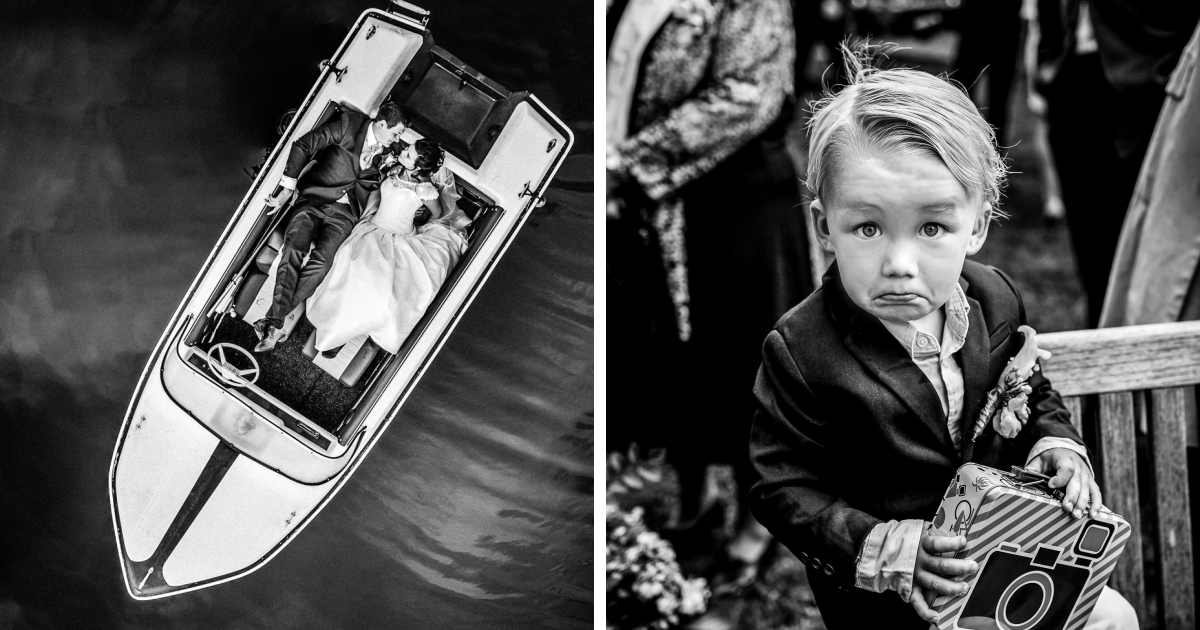
Some wedding photographs politely preserve a memory. Others kick down the door, rearrange the furniture, and make you feel as though you were standing beside the couple when the shutter clicked. The Impeccable Portrait, a collection honoring 50 standout wedding portraits created between 2010 and 2020, belongs firmly in the second category.
Selected from thousands of entries, the gallery brings together photographers who treat a wedding portrait as more than proof that two well-dressed people occupied the same location. The featured work includes bold environmental compositions, intimate black-and-white frames, reflections, long exposures, aerial viewpoints, dramatic architecture, playful group scenes, and portraits that look effortless even when they clearly required a small miracle involving timing, light, weather, and cooperative relatives.
What makes these images memorable is not one editing preset, one expensive lens, or one universally flattering instruction to “turn your chin slightly.” It is the combination of emotional truth and visual control. The best wedding portraits of the decade show that technical polish matters, but personality is what makes a photograph stay alive.
What “Impeccable” Really Means in Wedding Photography
The word impeccable may suggest perfection: spotless clothing, synchronized smiles, and not a single uncle blinking in the back row. Yet the strongest portraits in this collection are not sterile. They often include movement, mystery, asymmetry, weather, shadow, laughter, or a little visual chaos. Their perfection comes from intention.
The contest gallery features work by photographers and studios including Callaway Gable, Victor Lax, Two Mann Studios, Jerry Ghionis, Jen Huang, Matthew Sowa, Charmi Peña, Chrisman Studios, Peter van der Lingen, and Jacki Bruniquel. Several photographers appear more than once, which says something important: a recognizable point of view is not a lucky accident. It is a repeatable way of seeing.
A Portrait Can Be Posed Without Feeling Fake
Wedding photography is often described through opposing styles: traditional versus documentary, editorial versus candid, or film versus digital. In practice, the most persuasive work borrows intelligently from several traditions. A photographer may place a couple in strong light, refine the angle of their bodies, and then wait for the unscripted laugh that happens between instructions.
This hybrid approach preserves both visual elegance and emotional credibility. Couples receive the formal photographs their families expect without sacrificing the spontaneous frames that reveal what the celebration actually felt like.
Ten Qualities Shared by the 50 Best Wedding Portraits
1. Emotion Arrives Before Decoration
A magnificent venue can help, but it cannot manufacture connection. The portraits that linger longest are often anchored by a glance, a laugh, a protective gesture, or the quiet exhale after a hectic ceremony. The couple is not merely placed in a beautiful scene; the scene becomes meaningful because of what is happening between them.
2. Light Becomes Part of the Story
Soft window light can make a bridal portrait feel private. Hard sunlight can create graphic shadows. Flash can transform an ordinary corridor into a cinematic set. Blue hour adds a cool, dreamlike atmosphere, while backlighting turns veils, rain, dust, and mist into luminous textures.
Great photographers do not simply find “good light.” They decide what emotional job the light needs to perform. Romantic portraits may call for softness, while a theatrical composition may need sharp contrast and deep shadows.
3. Composition Gives the Eye Somewhere to Travel
Leading lines, doorways, arches, staircases, mirrors, pools, and repeating patterns appear throughout award-winning wedding work because they organize complexity. A couple may occupy only a small part of the frame, yet architecture or landscape pulls the viewer toward them. The photograph becomes a journey instead of a passport picture with better flowers.
4. Scale Creates Drama
Several celebrated wedding portraits use enormous landscapes, towering buildings, or broad skies to make the couple appear small. That choice does not diminish them. It emphasizes adventure, vulnerability, and the extraordinary feeling of beginning a life together in a very large world.
5. Black and White Removes Distractions
Color can carry cultural detail and atmosphere, but monochrome remains powerful when gesture, expression, shape, or contrast deserves complete attention. Black-and-white wedding photography can turn a fleeting expression into something sculptural. Without competing hues, the viewer notices hands, posture, wrinkles, fabric, and the geometry of light.
6. Movement Keeps the Portrait Alive
Walking, dancing, spinning, running, windblown fabric, and deliberate motion blur prevent a portrait from feeling embalmed. Even a formally arranged image benefits from a physical prompt: lean in, step together, look back, or whisper something ridiculous.
Movement gives people something to do, which is usually more useful than asking them to “act natural” while a large camera points directly at their faces.
7. The Environment Is Treated as a Character
An infinity-pool reflection, a horse beside a bride, a long-exposure group scene, an aerial perspective, or a modern museum interior can contribute narrative information. These are not interchangeable backdrops. They reveal something about the wedding’s location, culture, energy, or the couple’s taste.
8. Cultural Details Are Photographed With Purpose
Clothing, ceremonies, jewelry, family arrangements, and community traditions should not be reduced to decorative props. The best wedding portrait photography lets these elements remain specific. A strong image can be globally admired while still belonging unmistakably to the people and traditions represented within it.
9. Humor Is Allowed Into the Frame
Romance does not require everyone to look as though they are waiting for a royal proclamation. Playful group portraits, unexpected reactions, mischievous children, windy veils, and gloriously imperfect dance-floor moments add oxygen to a wedding gallery.
Humor makes the people recognizable, and recognizable people make photographs emotionally durable.
10. The Photographer Takes a Creative Risk
Some award-winning frames depend on unusual camera height, reflections, silhouettes, negative space, slow shutter speeds, off-camera flash, or a viewpoint that would make a cautious photographer quietly back away.
The lesson is not to use every trick at every wedding. It is to master reliable coverage so there is room to attempt one image that has never existed before.
A 50-Point Viewing Guide for the Portrait Collection
Rather than racing through the gallery like someone speed-scrolling during a lunch break, use these 50 details to study why the portraits work. Each point can also help couples and photographers evaluate wedding photography ideas.
- Notice where your eye lands first.
- Look for a genuine expression rather than a perfect smile.
- Study how the photographer uses empty space.
- Observe whether the couple fills the frame or becomes part of a landscape.
- Find the brightest area and ask why it is there.
- Trace leading lines toward the subjects.
- Look for reflections in glass, water, mirrors, or polished surfaces.
- See how doorways and windows create frames within the frame.
- Notice when symmetry creates calm.
- Notice when asymmetry creates tension.
- Study how hands communicate tenderness or nervousness.
- Watch for eye contact between the couple.
- Compare camera-facing portraits with moments when the couple ignores it.
- Look for movement in dresses, veils, hair, smoke, rain, or confetti.
- Identify moments captured just before or after the official pose.
- Notice how humor changes the emotional temperature.
- Study group spacing and layered arrangements.
- Look for family relationships expressed through body language.
- Observe how children create spontaneity.
- See whether the image feels directed, observed, or both.
- Compare soft natural light with dramatic artificial light.
- Look for silhouettes and rim light.
- Study the use of shadow as a design element.
- Notice whether color is vibrant, muted, or intentionally limited.
- Ask why certain frames work better in black and white.
- Look for texture in fabric, stone, skin, water, and foliage.
- Observe the relationship between wardrobe and background.
- Notice when architecture dominates the composition.
- Notice when the background nearly disappears.
- Look for wide-angle distortion used creatively.
- Study compressed perspectives created with longer lenses.
- Find low-angle views that make a scene feel monumental.
- Find high-angle or aerial views that reveal patterns.
- Look for deliberate blur rather than technical failure.
- Notice how long exposure records time in a still image.
- Study the balance between spectacle and intimacy.
- Ask what happened one second before the shutter clicked.
- Ask what probably happened one second afterward.
- Look for visual clues about place and culture.
- Notice whether traditions are documented respectfully and specifically.
- Study how attention remains on the couple in a crowded scene.
- Look for layers in the foreground, middle ground, and background.
- Observe how weather becomes an advantage.
- Notice how imperfect conditions create originality.
- Find images that would still work without an expensive venue.
- Identify portraits that reveal personality immediately.
- Look for images that feel timeless rather than trend-dependent.
- Notice where technical precision serves emotion.
- Notice where emotion matters more than technical neatness.
- Choose the portrait you would remember without seeing it again.
What Couples Can Learn From Award-Winning Wedding Portraits
Choose a Photographer for Consistency, Not One Viral Image
A spectacular portfolio cover can be persuasive, but complete wedding galleries reveal more. Couples should examine indoor and outdoor work, daytime portraits, dark receptions, family groups, candid moments, and difficult weather.
They should also meet the photographer. Comfort and trust affect facial expressions as much as camera settings do. Major wedding publications consistently recommend evaluating both visual style and personal chemistry.
Plan Priorities, Not a Photo Dictatorship
A concise list of essential relatives and meaningful details is useful. A rigid catalog of 147 Pinterest recreations is less helpful, particularly when number 83 requires sunset, a white horse, and a staircase the venue does not possess.
Share the people, traditions, and relationships that matter most, and then allow the photographer enough freedom to observe what actually happens.
Build Portrait Time Into the Schedule
Remarkable photographs often look spontaneous, but spontaneity still needs breathing room. A few protected windowsperhaps after getting ready, following the ceremony, and near sunset or blue hourgive photographers options without turning the celebration into an all-day modeling audition.
Experience-Based Lessons: Turning Inspiration Into Real Wedding Portraits
The most useful experience to take from a collection like The Impeccable Portrait is not the desire to copy a particular frame. It is learning how strong photographs are made under real wedding-day pressure.
The day will run late. Someone will misplace a boutonniere. The breeze will graduate into a personal attack on the veil. A child will discover frosting before the family portrait. None of this automatically ruins the pictures.
Start With the Emotional Objective
Before discussing poses, identify how the portraits should feel. Elegant? Joyful? Quiet? Cinematic? Playful? A couple who wants intimate photographs needs a different atmosphere from one hoping for bold, fashion-inspired frames.
Clear emotional language helps the photographer choose locations, light, prompts, and pacing. “We want to look like ourselves on our happiest day” is surprisingly useful. “Make us look expensive” is also useful, although it may require a staircase and excellent posture.
Create Conditions for Natural Reactions
People rarely relax because they are ordered to relax. They relax when the photographer communicates clearly, keeps the session moving, offers simple actions, and avoids making every adjustment feel like an emergency.
Professional guidance frequently emphasizes the photographer’s energy. Calm direction produces calm portraits, while humor can bring genuine laughter into group photographs.
For couples, the practical move is to focus on each other instead of monitoring the camera. Walk together. Talk about the ceremony. Whisper a joke. Hold still for the formal frame, and then remain connected for two seconds afterward. Frequently, the transition contains the best expression.
Use the Location Instead of Merely Standing in It
When arriving at a portrait spot, look beyond the obvious scenic background. A narrow shaft of window light, a patterned wall, a reflection in a hotel lobby, or the geometry of a parking structure may produce a more original image than the famous garden where three other weddings are currently forming a queue.
Skilled wedding photographers prepare, scout, and think quickly because the event combines portraiture, documentary work, architecture, fashion, and crowd management in one rapidly changing assignment.
Protect the Safe Photograph, Then Attempt the Strange One
Creative risk works best when essential coverage is secure. Photograph the clean family group before experimenting with motion blur. Capture a sharp, flattering couple portrait before trying silhouettes through champagne glasses.
Record the first dance reliably, then slow the shutter and blend flash with ambient light for a frame filled with movement. Technical resources from Nikon, Adobe, Professional Photographers of America, and established photography publications repeatedly stress preparation, adaptable lighting, and confident direction because wedding moments do not offer convenient reshoots.
Judge Success by Memory, Not Trends
A fashionable edit may collect immediate attention, but a lasting wedding portrait should continue to communicate after the trend has retired to a folder labeled “What Were We Thinking?”
Timeless does not have to mean conservative. It means the image has a strong human center. Unusual color, flash, blur, aerial composition, or dramatic posing can age beautifully when those choices express the couple rather than imitate the current social media feed.
That is the enduring achievement of the 50 best wedding portraits of the decade. They demonstrate that wedding photography can be polished without becoming generic, artistic without losing affection, and ambitious without forgetting the two people at the center of the celebration.