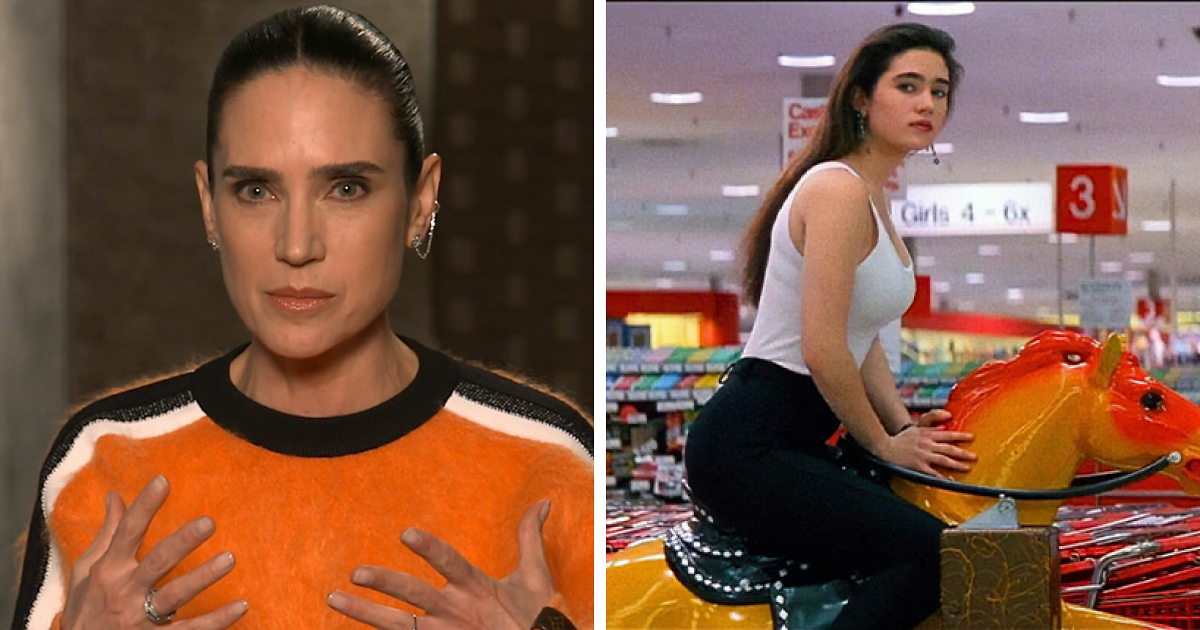
Jennifer Connelly has spent more than four decades building the kind of career most actors would happily trade a kidney, a vintage leather jacket, and at least three emotional support lattes to have. She has worked with major directors, crossed from cult fantasy to prestige drama, won an Oscar, and still appears in modern hits such as Top Gun: Maverick and Apple TV+’s Dark Matter. Yet every so often, the internet chooses chaos, dusts off a 1991 movie clip, and says: “Let’s talk about the horse again.”
The scene in question comes from Career Opportunities, the John Hughes-written romantic comedy starring Frank Whaley as Jim Dodge and Jennifer Connelly as Josie McClellan. In the film, the two characters are locked inside a Target store overnight, a premise that sounds like a teenage dream until armed robbers enter the chat. One moment, Josie rides a coin-operated mechanical horse inside the store. It became the film’s most remembered scene, partly because of the image itself and partly because the studio’s marketing leaned into it with all the subtlety of a marching band in a library.
Decades later, a resurfaced quote about Connelly’s discomfort with the scene and its promotional campaign reignited debate online. Some fans joked, “the horse has no regrets.” Others argued the scene helped make her famous. Many defended Connelly, pointing out that an actor can participate in a scene and still dislike how it is packaged, circulated, and used to define them afterward. That difference is the heart of the debate.
What Actually Happened With the Career Opportunities Horse Scene?
Career Opportunities was released in March 1991 by Universal Pictures. Written and co-produced by John Hughes and directed by Bryan Gordon, the film followed Jim Dodge, a smooth-talking young man stuck in a dead-end job, and Josie McClellan, a wealthy but unhappy young woman trying to escape her own gilded cage. The settinga mostly empty Target store after closinggave the movie a fantasy playground quality. Imagine being locked in a department store overnight, except instead of shopping carts and snacks, you also get family trauma, romance, and criminals with terrible timing.
The mechanical horse scene occurs when Josie uses her presence and confidence to distract the intruders. In context, it is a plot move. In marketing, however, it became something else. Promotional materials reportedly emphasized Connelly on the mechanical horse and paired the image with suggestive copy about Jim having “the ride of his life.” That is where the discomfort comes in.
Connelly later recalled learning from a college professor that a life-size promotional display of her on the mechanical horse had been used to advertise the movie. She had not seen it herself before hearing about it, and the situation made her uncomfortable. The awkwardness was not merely that a clip existed. It was that a private professional choice had been turned into a public sales gimmick, then followed her into an academic environment where she was trying to be a student, not a cardboard standee with a punchline.
Why the Quote Went Viral Again
The quote resurfaced online years later and quickly became a flashpoint because it sits at the intersection of nostalgia, celebrity culture, and changing attitudes about how young actresses were marketed in the 1980s and 1990s. The internet loves rediscovering old scenes, especially when they have meme potential. But the same internet is also more willing than before to question whether a famous image was fair to the person inside it.
For longtime fans, the scene is a pop-culture artifact. For Connelly, it represented a moment when her image was used in a way she did not feel comfortable with. Both things can be true. A scene can become iconic, and the actor can still have complicated feelings about it. Fame is not a receipt that says, “No returns, no complaints, no human emotions.”
The Career Debate: Did the Scene Help or Hurt Jennifer Connelly?
The online argument usually splits into two camps. The first says the horse scene helped Connelly become more recognizable. The second says that even if it increased visibility, it also reduced a serious young actress to a single provocative image. The truth is more interesting than either side’s bumper sticker version.
Career Opportunities did not become a massive box office hit. Its domestic gross was modest, and reviews were lukewarm to negative. John Hughes himself was reportedly unhappy with the finished film, and the movie never achieved the cultural standing of The Breakfast Club, Ferris Bueller’s Day Off, or Home Alone. Yet the horse scene survived. That is the strange math of pop culture: sometimes the movie fades, but one GIF puts on a tiny crown and refuses to leave.
Did it make Connelly famous? Not exactly. She was already known from Once Upon a Time in America, Labyrinth, The Hot Spot, and The Rocketeer. But did it become part of her public image? Absolutely. That is why the debate matters. Recognition is not always the same as respect. A scene can bring attention while also narrowing how audiences talk about a performer.
Visibility Is Not the Same as Agency
One of the weaker arguments online is the idea that if a scene helped an actor’s career, the actor is not allowed to regret it. That is like saying someone cannot dislike an old yearbook photo because it helped classmates remember them. Success does not erase discomfort. It only makes the discomfort more public.
Agency matters. Connelly’s later roles in Requiem for a Dream, House of Sand and Fog, Little Children, and Blood Diamond often involved difficult, emotionally demanding material. The difference is that those projects positioned her as a dramatic performer making mature artistic choices. The Career Opportunities marketing, by contrast, leaned heavily on her body and youth. That distinction is not small; it is the whole horse, saddle included.
Jennifer Connelly’s Career Proves She Was Never Defined by One Scene
The idea that the horse scene “made” Jennifer Connelly ignores the rest of her filmography, which is not exactly hiding under a couch cushion. She began working young, first as a child model and then as an actress. Her early screen roles included Sergio Leone’s Once Upon a Time in America and Jim Henson’s Labyrinth, where she starred opposite David Bowie. Labyrinth did not dominate the box office on release, but it later became a cult classic, giving Connelly a permanent place in fantasy cinema history.
In 2000, she delivered one of her most intense performances in Darren Aronofsky’s Requiem for a Dream, a film that pushed its cast into emotionally brutal territory. That role helped reshape how critics viewed her. She was no longer just a former teen star or a face from nostalgia. She was a serious actor capable of vulnerability, restraint, and devastation.
Then came A Beautiful Mind. Playing Alicia Nash opposite Russell Crowe, Connelly won the Academy Award, Golden Globe, and BAFTA for Best Supporting Actress. That awards sweep was not a footnote; it was a career-defining achievement. It confirmed what her best performances had already suggested: Jennifer Connelly was not a pop-culture accident. She was a disciplined actor with range.
Her later work continued that pattern. She moved through drama, science fiction, action, and television with roles in Hulk, Dark Water, Noah, Alita: Battle Angel, Snowpiercer, Top Gun: Maverick, and Dark Matter. That is not the résumé of someone trapped by one 1991 scene. It is the résumé of someone who kept choosing work, growing, and outlasting the industry’s limited imagination.
Why Audiences Are Split
The debate around the horse scene reveals a generational shift. Some viewers see the clip through a nostalgic lens: early-90s lighting, mall culture, John Hughes energy, and a department store fantasy that feels like a fossil from the pre-smartphone age. To them, the scene is harmless, campy, and memorable.
Other viewers see the scene through the lens of industry power dynamics. Connelly was very young when the movie was filmed. She was trying to move from child performer to adult roles, a transition Hollywood has historically handled with the grace of a raccoon in a crystal shop. Young actresses were often marketed less as artists and more as images. The point is not that audiences in 1991 were uniquely villainous. The point is that the system was comfortable turning a young woman’s image into a sales pitch, even if she later felt embarrassed or objectified by it.
There is also a third group: people who think regret must be all-or-nothing. They ask, “How can she regret that but not regret later intense roles?” The answer is simple. Context. Consent. Control. A mature actor choosing a dark dramatic role is not the same as a young actor discovering that a promotional display has converted her scene into a joke she has to discuss with a professor. One is performance. The other is packaging.
The Bigger Hollywood Lesson
The Connelly debate is not only about one movie scene. It is about how Hollywood images travel after the work is done. Actors perform a scene for a specific story. Studios then cut trailers, design posters, choose taglines, and decide what image will sell tickets. Sometimes that image becomes bigger than the story. Sometimes it becomes bigger than the actor wants it to be.
That is why old interviews can feel newly relevant. We now have better language for things that once got waved away as “just marketing.” Today, audiences are more likely to ask who controlled the image, who benefited from it, and whether the person being promoted had meaningful power in the process. That does not mean every old movie must be put on trial. It means viewers can enjoy a piece of pop culture while also understanding why the person inside it might not enjoy being reduced to it forever.
Why the Scene Still Has Cultural Staying Power
The horse scene endures because it is visually simple, instantly recognizable, and easy to detach from the film around it. Many people know the clip without remembering the plot, the director, or even the title. That is meme culture before memes had a name: a single image escapes its original context and gallops freely into the public imagination. Yes, “gallops” was unavoidable. The horse demanded it.
But staying power does not equal fairness. The scene’s longevity tells us more about audience memory than artistic value. Career Opportunities may be an uneven movie, but its most famous moment became a cultural shortcut for early Jennifer Connelly. That shortcut is precisely what makes the regret understandable. An actor can spend decades building serious work and still have the internet repeatedly yell, “Remember the horse?” That would test anyone’s patience. Even the horse might file a polite complaint with HR.
Experiences and Reflections: What the Jennifer Connelly Debate Teaches Us
There is a familiar human experience hiding inside this celebrity story: the discomfort of being remembered for something you have outgrown. Most people do not have a life-size promotional display following them around, thankfully. But many people know what it feels like to be reduced to an old version of themselves. Maybe it is a teenage photo, a workplace mistake, an old social media post, or a moment from college that friends keep bringing up at dinner even though everyone is now old enough to own air fryers and discuss mortgage rates.
That is why the Jennifer Connelly horse scene debate connects beyond Hollywood. It asks a relatable question: do people have the right to reinterpret their own past? The answer should be yes. Growth often means looking back and saying, “I understand why that happened, but I would not choose it the same way now.” That is not hypocrisy. That is adulthood with better lighting.
In creative work, this issue appears constantly. A writer may dislike an old article that once brought them attention. A musician may cringe at the song that first made them popular. An actor may feel grateful for early exposure while still wishing the exposure had not come wrapped in objectification. These feelings are not contradictions. They are layers. Careers are built from layers: ambition, compromise, opportunity, regret, luck, and the occasional mechanical horse that refuses to retire.
For young performers, Connelly’s experience is also a warning about the long life of promotional images. A scene ends when filming wraps. Marketing can last forever. Posters, trailers, clips, thumbnails, and GIFs can reshape the meaning of a performance. That is why modern conversations around consent, intimacy coordination, and actor participation in publicity are so important. The question is not only, “Was the actor willing to perform the scene?” It is also, “How will this scene be used, sold, repeated, and attached to their identity?”
For audiences, the experience offers a lesson in generosity. We can enjoy old movies without demanding that actors share our nostalgia. A viewer’s favorite scene may be an actor’s uncomfortable memory. That does not ruin the movie. It simply makes the conversation more honest. Pop culture becomes richer when we stop treating performers like museum exhibits and start treating them like people who are allowed to change their minds.
For anyone building a public careerartist, creator, entrepreneur, journalist, influencer, or office employee who once sang karaoke at the holiday partythere is another takeaway: early attention is powerful, but it can be sticky. The first thing people remember about you may not be the thing you most value about yourself. Over time, the challenge is to keep creating work that broadens the picture. Jennifer Connelly did exactly that. She moved from early image-making into serious dramatic roles, awards recognition, and long-term respect. The horse scene still resurfaces, but it no longer controls the story. It is one strange chapter in a much larger book.
In that sense, the “horse has no regrets” joke is funny, but incomplete. The horse is not the one who had to carry the public image. Connelly did. And her career shows that regret does not have to be a dead end. Sometimes it becomes a lens: a way to understand how an industry worked, how audiences have changed, and how an actor managed to keep moving forward with grace, intelligence, and more than enough talent to outrun one stubborn meme.
Conclusion
Jennifer Connelly’s regret over the Career Opportunities horse scene is not a simple story about embarrassment, fame, or internet jokes. It is a story about context. The scene became iconic because it was memorable, but the marketing around it helped turn a young actress into an image she did not fully control. That is why the resurfaced quote still sparks debate decades later.
What makes Connelly’s career remarkable is not that she escaped the scene entirely; the internet has clearly tied a rope to it and refuses to let go. What makes her career remarkable is that she built far beyond it. From Labyrinth to Requiem for a Dream, from A Beautiful Mind to Top Gun: Maverick and Dark Matter, she has proven that one viral image cannot define a serious artist unless everyone agrees to stop paying attention to the rest of the work. Luckily, the rest of the work is too strong to ignore.
Note: This article is based on publicly available entertainment reporting, film records, award databases, and interviews, written without direct source links for clean web publication.