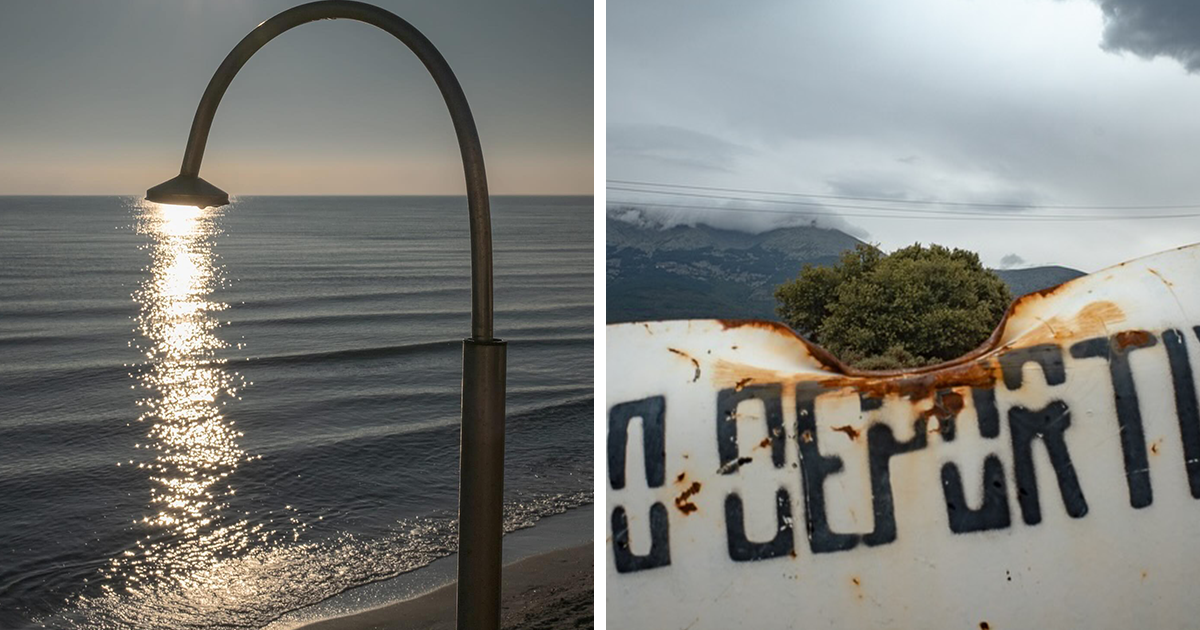
Most of us walk through the world on autopilot. We notice the traffic light turning red, the coffee getting cold, and the suspiciously large pothole that appears to have been promoted to neighborhood landmark. But photographer Denis Cherim looks at ordinary streets differently. A shadow becomes a doorway. A cloud becomes a hat. A streetlamp suddenly appears to conduct sunlight like it is leading an orchestra that nobody else was invited to hear.
The Coincidence Project is built around these blink-and-you-miss-it visual collisions. In the recent collection of 34 images, Cherim captures scenes in which nature, architecture, light, perspective, and chance briefly cooperate to create something amusing, strange, elegant, or all three at once. The result is not just a set of clever photographs. It is a reminder that the everyday world is considerably weirderand more poeticthan it first appears.
What Is The Coincidence Project?
Denis Cherim’s Coincidence Project is an ongoing photography series developed in late 2012. Its central idea is simple but powerful: unrelated objects can appear connected when a photographer notices the right angle, waits for the right light, and frames the scene with unusual patience. A building edge might appear to slice through a cloud. A metal fence may seem to hold the sky in place. A burst of light on water can suddenly look like it belongs to a nearby object.
Cherim’s work often places urban structures and natural elements in the same visual sentence. Concrete, trees, street signs, balconies, shadows, electrical towers, fences, and clouds become accidental co-stars. They do not know they are performing, which may be the secret to their charm. Nobody in these images is posing. The sun did not receive a call sheet. The cloud did not sign a release form. Yet somehow, everything shows up on time.
The project reportedly grew from a long-form visual diary and has remained a central part of Cherim’s practice for years. Rather than chasing grand spectacles, he seeks the surprising relationships hidden inside familiar places. That commitment turns ordinary surroundings into a moving puzzle of form, scale, and perception.
Why These 34 Images Make Viewers Look Twice
The appeal of these visual coincidences is not merely that they are funny or perfectly timed. They interrupt our assumptions. We think we know what we are seeing, then the image quietly changes the rules. A line becomes a horizon. A reflection becomes an object. A patch of sunlight becomes a beam with a job to do.
In the 34-photo selection, the most memorable images tend to work because they offer a small visual surprise without explaining themselves too quickly. At first glance, the image may appear straightforward. Then the eye catches an unexpected relationship between two elements that should not logically belong together. Suddenly, the scene feels less like a record of reality and more like reality briefly doing improv.
Perspective Turns Ordinary Objects Into Optical Jokes
Perspective is one of Cherim’s favorite tools. By carefully choosing where to stand, he can make objects that are physically far apart appear close enough to interact. A foreground structure may seem to touch a distant building. A tiny point of light can look enormous when it aligns with the right shape. A strip of sidewalk can become a runway for the sun.
This visual strategy resembles forced perspective, a photography technique that plays with perceived size, distance, and proportion. However, Cherim’s photographs usually feel less like staged tourist snapshots and more like found surrealism. He does not need someone pretending to hold the Eiffel Tower in their hand. He simply lets the city accidentally hold itself together in strange ways.
Light And Shadow Become Active Characters
In many Denis Cherim photographs, shadows do more than create mood. They participate. A shadow may extend the shape of a tree, complete an architectural line, or make a plain wall look as though it has developed a secret second identity. The sun becomes an enthusiastic collaborator, especially when it falls at a sharp angle and starts drawing geometry across sidewalks, walls, and stairways.
That is why the series feels playful without becoming random. Cherim pays close attention to where light lands, how lines meet, and when a shadow becomes visually stronger than the object casting it. Photography is often described as writing with light, but in this project light sometimes behaves more like a mischievous graphic designer with access to an entire city.
Nature And Architecture Meet Without A Formal Introduction
The strongest combinations in The Coincidence Project often come from the collision between natural and constructed forms. A tree can appear to grow from a building. A cloud may seem to rest on a fence. Vines can turn an industrial structure into a temporary sculpture. These moments are amusing because they make the built environment look less rigid and the natural environment look unexpectedly strategic.
One published image description highlights sunlight reflecting across the sea in a way that visually connects with a nearby showerhead-like form, while other examples show clouds, fences, apartment blocks, and urban lines creating unlikely harmony. The photographs do not alter reality so much as reveal how strange reality can already be when viewed from exactly the right place.
The Hidden Skill Behind A “Lucky” Photograph
Calling Cherim’s images lucky would be like calling a great chef lucky because the pasta did not burn. Chance matters, of course. A cloud must drift into position. A particular shadow must appear at the right hour. A passing person, bird, or ray of light may complete the frame. But luck only becomes a photograph when someone notices it before it disappears.
The Coincidence Project depends on visual awareness. Cherim has to slow down, scan his surroundings, test different angles, and recognize when several unrelated elements are about to form a temporary whole. That can involve moving a few steps left, waiting ten minutes, returning at another time of day, or simply refusing to believe that a boring sidewalk is actually boring.
His photographs also show the value of restraint. The scenes feel spontaneous because they are not overloaded with props, dramatic editing, or visual clutter. The comedy often comes from a single clean alignment: a curve meeting a straight line, a small object appearing to support something huge, or a shadow transforming an ordinary surface into a new image.
Published profiles have repeatedly described Cherim’s compositions as carefully framed relationships among shadows, objects, lines, foregrounds, and backgrounds. That combination of observation and composition is what gives the work its surreal energy.
Why The Coincidence Project Feels So Refreshing
We live in a visual culture that constantly asks for bigger, louder, faster, shinier. Every image seems to need a drone, a mountain, a celebrity, or a smoothie bowl balanced on a paddleboard at sunset. Cherim goes in the opposite direction. He finds wonder in corners, railings, blank walls, shadows, empty lots, and quiet streets.
That choice matters. It suggests that beauty does not always need to be imported from an exotic destination or rented by the hour. Sometimes it is already sitting outside the grocery store, waiting for the sun to hit a parking barrier at 4:37 p.m. The visual reward comes from attention, not extravagance.
The project also gives viewers permission to be curious. It asks us to question the first version of a scene. Is that really a building, or does it now look like a giant piece of folded paper? Is that cloud floating freely, or has a fence temporarily adopted it? Is the world becoming surreal, or are we simply noticing it properly for once?
What Denis Cherim’s Photography Teaches Us About Seeing
The best lesson from The Coincidence Project is that creative seeing is a habit. You do not need a famous landmark, a complicated camera bag, or a budget that requires a spreadsheet and emotional support. You need curiosity and a willingness to look at familiar places longer than usual.
Look For Lines Before Looking For Subjects
Instead of searching for something “important” to photograph, start by noticing lines. Look at the edge of a building, the curve of a lamppost, the pattern of a fence, or the path of a shadow. These visual structures can guide your eye toward unexpected connections. A scene that appears dull from one position may become remarkable after you move three steps sideways.
Watch The Light Change
Light is never fixed. Morning light, noon light, rainy-day light, and late-afternoon light all reshape the same location. A wall that seems uninteresting at noon can become dramatic when a tree shadow stretches across it. Return to familiar places at different times, and they may start behaving like entirely new neighborhoods.
Let The World Finish The Joke
Do not force every photograph. The best visual coincidence often appears when you leave room for uncertainty. Wait for a person to enter the frame. Notice how a moving cloud changes the balance of a building. Let a bird, bicycle, reflection, or splash of sunlight become the missing piece. The world is constantly setting up jokes; the photographer’s job is to catch the punchline before it walks away.
A Celebration Of Everyday Surrealism
The Coincidence Project is proof that the most entertaining visual stories can come from the least dramatic places. Denis Cherim does not need to invent impossible worlds. He finds them already hiding in plain sight, wedged between a wall and a shadow, balanced on the edge of a cloud, or quietly waiting at the end of a sidewalk.
These 34 unexpected combinations remind us that daily life is not actually ordinary. It only looks ordinary when we rush past it. Slow down, look twice, and the world may reveal that a streetlamp has been practicing ballet, a fence has adopted a cloud, and the sun has been working overtime as an unpaid art director.
Field Notes: What It Feels Like To Hunt For Coincidences
Experiencing the world through the lens of The Coincidence Project begins with a small shift in pace. Imagine taking a walk without a destination, not because you are lost, although that can be artistically productive, but because you have decided to pay attention. At first, nothing seems unusual. Cars pass. Storefronts repeat. Pavement remains aggressively pavement-like. Then your eyes begin to adjust. A bent street sign resembles a question mark. A shadow on a wall seems to complete the outline of a nearby tree. You realize that the city has been making tiny visual jokes all day, and you have simply been too busy to laugh.
The experience can become strangely calming. Searching for coincidences requires patience, but it is not the kind of patience that feels like waiting in line at the DMV. It is active patience. You study the way light moves through an alley. You wait for a cloud to drift above a rooftop. You stand near a fence because its pattern suddenly seems capable of holding the horizon together. The activity makes you less interested in rushing toward the next task and more interested in what is already happening around you.
There is also a playful frustration to it. You may notice a perfect alignment just as a delivery truck blocks the view. A bird may land exactly where you need it, then immediately decide it has better plans. A patch of sunlight may disappear behind a cloud one second before you lift your phone or camera. These missed moments can be annoying, but they are part of the appeal. They remind you that visual coincidence cannot be fully controlled. You can prepare for it, but you cannot order it through an app with same-day delivery.
Over time, this way of seeing changes familiar places. A route you have walked a hundred times begins to offer new possibilities. The old apartment block becomes a collection of grids, colors, reflections, and shadows. A parking lot becomes a stage for perspective. A cracked wall becomes a landscape with its own accidental mountains. The world does not physically change, but your relationship with it does. You stop asking whether a place is beautiful and start asking what it might become when seen from another angle.
That may be the most satisfying experience behind Denis Cherim’s approach. It encourages a form of visual optimism. You do not have to travel far to encounter surprise. You do not need a dramatic event to find a story. You only need to become available to the strange and delightful connections already forming around you. A day that begins as a routine walk can end with a small revelation: ordinary things are not dull; they are merely waiting for the right light, the right distance, and the right observer.
Note: This is an original editorial interpretation of Denis Cherim’s work. It does not reproduce the 34 photographs or replace the artist’s original project. Background details were cross-checked against Cherim’s project statement and published photography profiles.