Before streaming queues and endless social feeds, there was a sacred daily ritual in American homes:
spreading out the newspaper and heading straight for the funny pages. Syndicated comic strips didn’t
just fill a corner of the paperthey shaped pop culture, taught kids big ideas in tiny panels, and
slipped sly social commentary into breakfast time.
This ranking of the greatest syndicated comic strips in American history tips its hat to the original
Listverse list while bringing in fresh context from comics historians, museums, and pop-culture writers.
We’ll look at why these series were so influential, what made them unique on the comics page, and how
they still echo through American culture today.
What Makes a “Great” Syndicated Comic Strip?
With more than a century of American newspaper comics to choose from, “greatest” has to mean more than
“cute characters” or “good gags.” For this list, three things matter:
- Cultural impact: Did the strip influence language, humor, politics, or other media?
- Artistic innovation: Did it push the boundaries of what a comic strip could look like or say?
- Longevity and legacy: Did it stay in the public imagination long after the ink dried?
With that in mind, let’s walk down memory laneand through a few panels of American pop-culture history.
#10 – Krazy Kat: The Critics’ Darling Before Its Time
George Herriman’s Krazy Kat (1913–1944) is the art-house favorite of newspaper comics. Set in a
surreal, shifting version of Arizona’s Coconino County, the strip follows a love triangle of sorts: Krazy,
who adores Ignatz Mouse; Ignatz, who expresses “affection” by throwing bricks at Krazy’s head; and Offissa
Pup, who repeatedly arrests Ignatz for the assault.
The premise sounds simple, but the execution was anything but. Herriman played with language, perspective,
and panel design in ways critics now compare to modernist literature and experimental film. Later giants
of animation and comics regularly cite Krazy Kat as foundational, even if it never captured
mass-market popularity during its run. Today, it’s the strip scholars name when they’re trying to impress
other scholarsand they’re not wrong.
#9 – Liberty Meadows: A Modern Throwback with Attitude
Frank Cho’s Liberty Meadows (syndicated from 1997 to 2001) is the wildcard on this list. Set in
an animal sanctuary that doubles as a rehab center for neurotic critters, the strip blends classic
slapstick with self-aware, sometimes racy humor. A cast of anthropomorphic animals, a nerdy vet named
Frank, and the glamorous Brandy gave it the energy of a 1940s screwball comedy with ’90s pop-culture
references layered on top.
Liberty Meadows constantly pushed against the limits of what newspaper syndicates considered
“family-friendly,” which ultimately led Cho to focus on comic-book and collected formats instead.
While its run in daily papers was brief, its lush artwork and sharp gags showcased how a syndicated
comic strip could look almost like a high-end illustrated book and still land punchlines in three panels.
#8 – Garfield: The Global King of Relatable Laziness
Jim Davis’s Garfield launched in 1978 and quickly became the world’s most widely syndicated comic
strip. The formula: a lazy, lasagna-obsessed cat; his hapless owner Jon Arbuckle; and sweet but dim
dog Odie. Simple? Yes. Effective? Absolutely.
In its early decades, Garfield experimented more with longer storylines and seasonal arcs, even
veering into surprisingly dark territory with the famous “abandoned house” Halloween week. Over time,
the strip streamlined into short, gag-based humor, but its influence is massive: merchandise, animated
specials, movies, and a sort of universal symbol for “I hate Mondays” and “I’d rather be eating.”
Critics sometimes knock it for being too safe; readers vote with their eyeballs and lunchboxes. If you
ever doodled a sleepy orange cat in the margins of your notebook, you already know why it belongs here.
#7 – Li’l Abner: Satire in Hillbilly Clothing
Al Capp’s Li’l Abner (1934–1977) is a satire disguised as a rural comedy. Set in the fictional
Dogpatch, the strip follows the towering, naive Abner Yokum, his formidable Mammy and Pappy, and a
sprawling cast of Southern caricatures and social climbers.
Beneath the “hillbilly” jokes, Capp skewered American politics, advertising, celebrity culture, and
media hype. He introduced “Sadie Hawkins Day,” a fictional holiday where women ask men to a dancea gag
that escaped the comics page and became a real-life tradition at schools across the United States.
The strip isn’t without dated stereotypes, and modern readers have to approach some elements critically.
But in terms of influence on comic-strip storytelling, satire, and even American vocabulary, Li’l
Abner is impossible to ignore.
#6 – Opus (and the Bloom County Universe): A Penguin with Big Feelings
Berkeley Breathed’s Opus (2003–2008) can’t be separated from its spiritual siblings
Bloom County and Outland. All three orbit Opus the Penguin: wide-eyed, anxious, and
endlessly endearing. Through this awkward bird and his equally odd friends, Breathed explored everything
from Cold War anxieties to TV evangelists to presidential campaigns.
What makes Opus and its related strips stand out is how they combined the absurd with the topical.
One day, you’d get a joke about hair metal; the next, a devastating swipe at political hypocrisy. Breathed
ended Opus on his own terms, giving the character a quietly emotional farewell that still hits
readers right in the nostalgic feels.
#5 – Doonesbury: Politics on the Funny Page
When Garry Trudeau’s Doonesbury hit newspapers in 1970, it brought something new to the comics
page: unapologetically political, character-driven storytelling that allowed time to pass and people to
age. Instead of a static world where every Monday looks like last Monday, Doonesbury followed
college students who became adults, parents, and professionals across decades of American history.
The strip has tackled Vietnam, Watergate, the AIDS crisis, the Iraq War, and countless elections. It was
also the first comic strip to win a Pulitzer Prize for editorial cartooning, underscoring just how
seriously it was taken beyond the comics section.
Love its politics or loathe them, Doonesbury proved that syndicated comic strips could operate
as long-form social commentary without losing their humoror their readership.
#4 – Peanuts: The Gentle Giant of the Funny Pages
Charles M. Schulz’s Peanuts (1950–2000) may be the most beloved syndicated comic strip in
American history. At its height, it ran in thousands of newspapers and reached hundreds of millions of
readers worldwide. Charlie Brown, Snoopy, Lucy, Linus, and the gang became not just comic-strip
characters but cultural icons.
Schulz’s genius was subtle. The minimalist linework and quiet punchlines disguised deep emotional themes:
anxiety, failure, unrequited love, faith, and resilience. Terms like “security blanket” and phrases like
“good grief” seeped into everyday English. Holiday specials such as A Charlie Brown Christmas
further cemented Peanuts as a year-round presence in American life.
Even decades after Schulz’s final strip ran, reruns, licensed art, and new adaptations keep Peanuts
alive for new generationsproof that small panels can carry enormous emotional weight.
#3 – Pogo: “We Have Met the Enemy and He Is Us”
Walt Kelly’s Pogo (1948–1975) took place in the Okefenokee Swamp, where a cast of animals
grappled with human problems. Pogo Possum is the gentle moral center of the strip, surrounded by blustery,
foolish, and occasionally menacing neighbors who function as stand-ins for political and cultural figures.
The strip’s most famous line“We have met the enemy and he is us”appeared in a 1970s Earth Day strip and
remains one of the sharpest one-sentence critiques of human behavior ever printed in a newspaper. Kelly
blended poetry, wordplay, and dialect with slapstick and philosophy, making Pogo a rare example of
a comic strip that rewards both children’s giggles and adults’ re-reading.
#2 – The Far Side: One Panel, Infinite Weirdness
Gary Larson’s The Far Side (1980–1995) broke almost every unwritten rule of the newspaper comic
strip. It wasn’t a multi-panel narrative, it rarely starred recurring “characters” in a traditional sense,
and it loved science jokes, dark humor, and surreal punchlines.
A single panel might feature cows discussing philosophy, scientists meeting absurd fates in labs, or a
prehistoric family naming the dinosaurs. Teachers, biologists, nerds of all stripes, and anyone who enjoys
a good oddball joke adopted the strip as their own. Collections of The Far Side still line office
bookshelves and coffee tables, proving that its strange little universe never really left the culture.
Where other strips tried to build familiar worlds, Larson specialized in one-shot ideas that readers could
instantly recognize, quote, and sharebefore “viral content” was a thing.
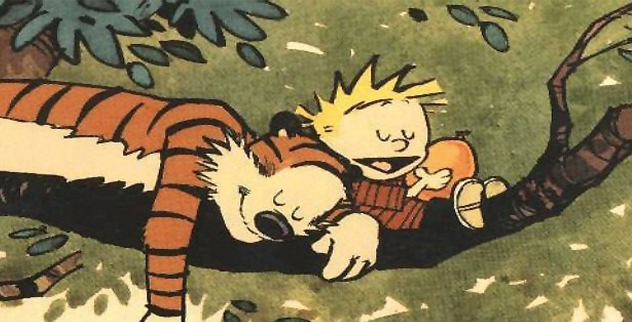
#1 – Calvin and Hobbes: The Last Great Newspaper Epic
Bill Watterson’s Calvin and Hobbes (1985–1995) is often called “the last great newspaper comic
strip,” and it’s hard to argue with that title. The series follows six-year-old Calvinhyperactive,
imaginative, frequently in troubleand his tiger Hobbes, who appears as a stuffed animal to everyone else
and as a fully alive companion to Calvin.
On the surface, it’s about snowball fights, school woes, and backyard adventures. Underneath, it wrestles
with philosophy, ethics, consumer culture, environmentalism, and the bittersweet experience of growing up.
Watterson also pushed the art form visually, fighting for larger Sunday formats and using dynamic layouts
and painterly color.
Perhaps the most remarkable choice Watterson made was refusing to license the characters for merchandising.
No official stuffed Hobbes, no Calvin bumper stickersjust the strip itself. When he ended the series at
its creative peak, it preserved Calvin and Hobbes as a complete, deeply personal work. The result:
a short run by newspaper standards, but a towering influence on cartoonists and readers alike.
Why These Comic Strips Still Matter
Syndicated comic strips were once the heartbeat of the American newspaper. They gave readers a familiar
rhythm: characters to check in on every morning, jokes to share aloud, and storylines to quietly obsess
over. As digital media reshapes how we read, these strips remain a blueprint for concise storytelling and
emotional connection.
From Krazy Kat’s experimental artistry to Calvin and Hobbes’ refusal to sell out, each
of these works shows a different way to be “great.” Some leaned into politics, some into absurdity, others
into quiet melancholy. Together, they chart a history of how Americans have laughed, argued, and reflected
on themselvesthree or four panels at a time.
Personal Experiences with the Greatest Comic Strips
Ask almost anyone who grew up with newspapers and they’ll tell you: the comic strips weren’t just filler,
they were a ritual. The paper might have been bought for the headlines, but the comics were why kids
volunteered to fetch it from the driveway.
For many readers, Peanuts was the first time they saw their own anxiety and awkwardness mirrored
back at them. Charlie Brown’s eternal almost-victoriesalmost kicking the football, almost winning the
baseball game, almost talking to the Little Red-Haired Girlfelt uncomfortably familiar. Yet the strip
never mocked him cruelly. It suggested that being imperfect and insecure didn’t make you unlovable; it
just made you human.
Readers who discovered Calvin and Hobbes as kids often say they came back to it years later and
realized they’d been reading a completely different comic as adults. As children, they saw snowmen
carnage, space adventures, and Spaceman Spiff’s sci-fi heroics. As grown-ups, they noticed the panels
where Calvin’s parents quietly worry about bills, or where Hobbes gently nudges Calvin toward kindness
and responsibility. The jokes didn’t changebut the readers did.
Others have memories tied to more offbeat strips. Someone might recall discovering The Far Side
in a teacher’s classroom, flipping through a dog-eared collection between assignments and laughing at cows
walking upright or scientists fleeing their own experiments. That may have been one of their first
encounters with humor that assumed they knew just enough science or history to get the joke.
Fans of Pogo and Doonesbury often describe a different kind of awakening. These strips
were where they first encountered politics in a way that felt accessible. Before watching televised
debates or scrolling through think pieces, they might have met a caricatured senator or a thinly veiled
stand-in for a real-world leader in the funny pages. The jokes made serious topics feel less intimidating,
and the recurring characters made complex issues easier to follow over time.
Even a strip like Garfield has its emotional footprint. For a lot of families, it was the one
comic everyone could agree onno matter their age. Kids loved the slapstick and the “I hate Mondays”
punchlines; adults recognized their own post-weekend energy levels. If you ever tore out a Garfield
strip and taped it to a refrigerator, you were participating in a quiet little tradition: turning a
three-panel joke into a shared household in-joke.
And then there are readers who rediscovered these comics later through collected editions, museum
exhibits, or online archives. Seeing original Krazy Kat or Pogo pages blown up on a wall
reveals just how much craftsmanship went into every line. Panels that once flashed by at breakfast suddenly
become artwork you can stand in front of, noticing brushstrokes and lettering choices.
In a digital world, the experience of syndicated comic strips has changed, but the core feeling remains.
Whether you scroll through them on a phone, revisit a childhood collection, or encounter them in a museum,
you’re tapping into the same thing readers felt decades ago: the joy of seeing tiny stories, perfectly
timed jokes, and surprisingly deep reflections squeezed into a handful of squares.
That’s why rankings like “The 10 Greatest Syndicated Comic Strips In American History” keep popping up
and why people still argue about them. These aren’t just nostalgic artifacts; they’re emotional landmarks.
Each strip on this list is tied to specific mornings, specific kitchen tables, specific laughs. In the end,
the “greatest” comic strip might simply be the one that made you feel seenwhether you were a nervous
kid, a stressed-out adult, or a daydreamer wishing your stuffed animals would talk back.