Some places look abandoned. Others look like they are still waiting for the orchestra to come back from intermission. The thermal baths of Băile Herculane, Romania, belong to the second category. Their halls, pools, corridors, and ceremonial rooms do not merely crumble; they perform. Even in decline, the Neptune Baths and neighboring historic bath buildings deliver a spectacle of faded grandeur: painted ceilings, arched windows, worn marble, plaster ornament, and that irresistible contrast between imperial elegance and modern neglect.
That contrast is what makes the interiors of Herculane so unforgettable. You are not looking at random ruins with a few cracked tiles and a sad pigeon in the corner. You are looking at a spa town with roots in Roman antiquity, a place once celebrated by emperors, where architecture, wellness, and mythology were stirred together like a very expensive mineral-water cocktail. And somehow, even after decades of decline, the rooms still know how to pose for the camera.
For architecture lovers, history nerds, photographers, and anyone who has ever whispered “wow” in a ruined building, Herculane is a fascinating case study. Its abandoned interiors are visually arresting, yes, but they also tell a larger story about thermal culture, 19th-century spa design, public memory, and the messy afterlife of once-glorious places.
Why Herculane Still Grabs the Internet by the Eyeballs
The appeal of Herculane’s abandoned baths is easy to understand the moment you see them. The spaces have scale. They have drama. They have texture. Long corridors rise beneath vaulted ceilings. Tall windows bring in soft mountain light. Decorative plasterwork clings on like a stubborn aristocrat refusing to leave the party. In some interiors, color still lingers on the walls in dusty pinks, pale blues, green washes, and warm earth tones. In others, ceramic details, red marble elements, grand stairways, or ornate fountains remind you this was once a serious center of healing and leisure, not just another pretty ruin for moody photographs.
And the setting does a lot of heavy lifting too. Băile Herculane sits in the Cerna Valley, hemmed in by mountains and the river, which gives the historic core a theatrical backdrop before you even step indoors. The old bath architecture does not feel random or generic. It feels site-specific, almost carved out of the valley’s mythology. Hercules gives the town its name, emperors gave it cachet, and thermal springs gave it purpose. That is a strong résumé for a place with peeling paint.
Online, the baths often circulate because they satisfy two different cravings at once: the desire to see beauty and the desire to witness loss. The images are gorgeous, but they are never purely decorative. They ask a quiet question: how did a place this beautiful end up in this condition?
A Spa Town With Ancient Credentials
From Roman Waters to Imperial Ritual
Băile Herculane is not a made-up “old world” destination cooked up by a marketing team with a fondness for sepia filters. It is one of Europe’s oldest spa towns, with documented references dating to the Roman period. The town’s identity has long been tied to its thermal-mineral waters, which were valued for their therapeutic qualities and helped establish the place as a center for treatment, leisure, and prestige.
That deep history matters because it explains why Herculane feels layered rather than merely old. This is not a single-era monument frozen in time. It is a place shaped by Roman heritage, later imperial development, and modern reinventions. Under the Austro-Hungarian period, the town expanded dramatically and became a fashionable destination for elite visitors. Emperor Franz Joseph famously praised Herculane as “the most beautiful resort on the continent,” which is either an extremely generous compliment or the 19th-century version of a five-star review.
The town also became associated with Empress Elisabeth, better known as Sisi, adding another layer of imperial glamour. So when you stand in front of the old baths, you are not simply looking at abandoned buildings. You are looking at spaces once embedded in a larger spa culture where medicine, recreation, status, and architecture blended into a single experience.
The Neptune Baths: The Crown Jewel of Decay
A Building Designed to Impress and Heal
The historic Neptune Baths are the star of the show for a reason. Built between 1883 and 1886 to plans by architect Alpár Ignat, the complex was conceived as a major treatment facility and a sophisticated architectural statement. The original program was ambitious: treatment tubs, stone baths, saunas, inhalation rooms, waiting spaces, and support rooms, all arranged to serve large numbers of bathers at once. In other words, it was not a sleepy little wellness annex. It was a carefully planned machine for restoration, ritual, and public display.
Architecturally, the building is eclectic in the best possible way. Its elongated form, central axis, projecting volumes, prominent dome, exposed brick, ornamented windows, balustrades, portico, and decorative rooflines give it a rich and layered character. Even from the outside, it announces itself with imperial confidence. Inside, the design becomes even more memorable. The proportions are generous. Circulation spaces feel ceremonial. Rooms that once served strictly practical functions still carry an air of theater.
That is why the interiors photograph so well. These are not utilitarian medical rooms wearing a fancy hat. They are environments designed to persuade visitors that treatment could also be elegant, modern, and uplifting. The architecture understood something many people still pay a lot of money to learn at luxury spas: mood matters.
What Makes the Interiors So Stunning
Color, Light, Ornament, and Beautiful Defiance
The abandoned interiors of Herculane stand out because they retain enough detail to suggest their former brilliance while revealing enough damage to make that brilliance feel fragile. That tension is everything. A perfect room can be impressive, but a damaged magnificent room can be haunting.
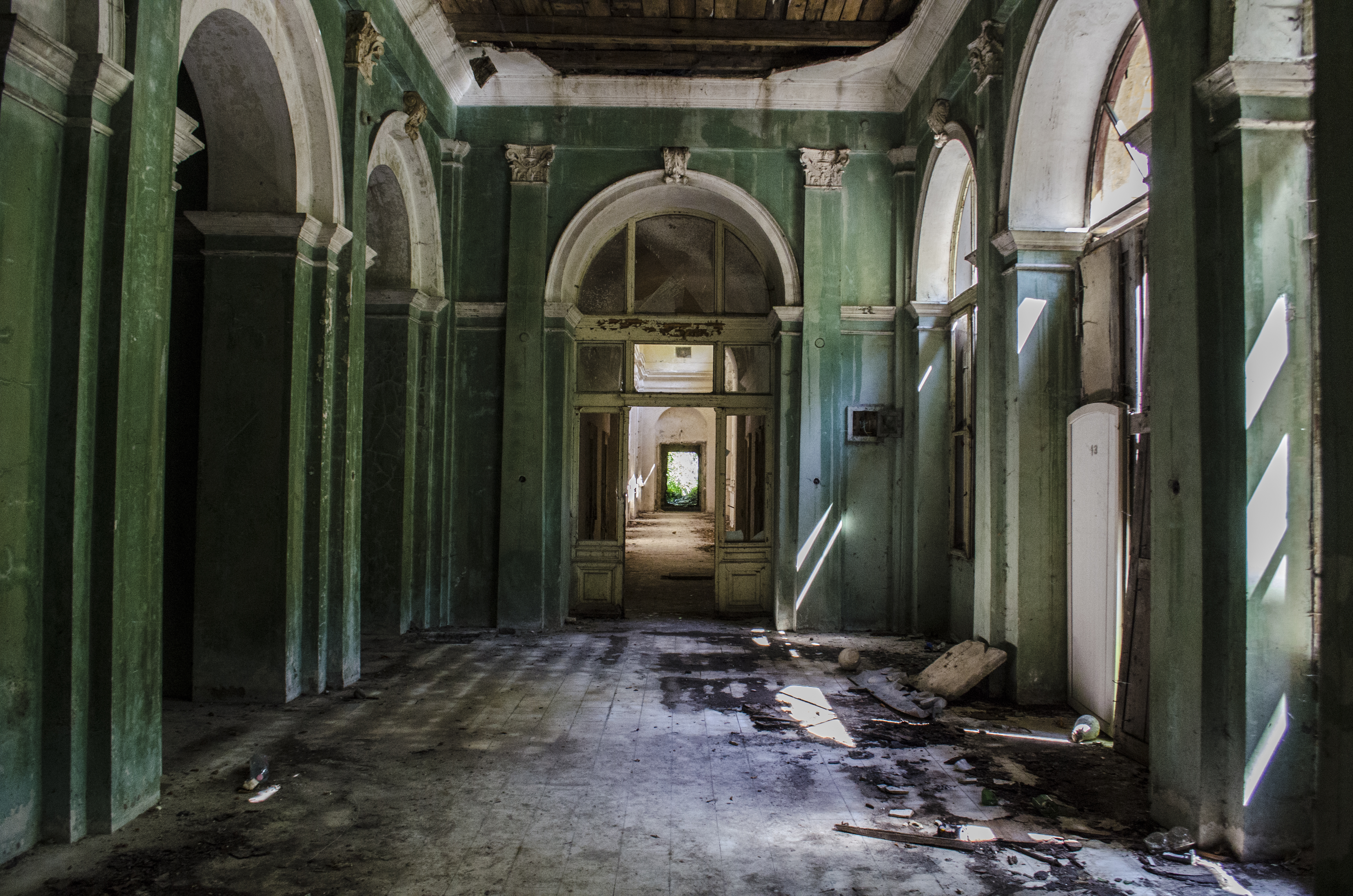
Start with the light. Arched windows and large openings wash many of the interiors with soft natural illumination, which turns cracked plaster into texture and dust into atmosphere. Then there is the color palette: faded blues, muted pinks, oxidized greens, warm ochres, and the reddish tones associated with marble and painted surfaces. These colors do not shout. They smolder.
Then come the details. Decorative ceilings. Painted panels. Moldings that still cling to the walls with admirable stubbornness. Doors aligned in rhythmic procession down long corridors. Empty pools sunk below tiled platforms. Grand halls where fountains and chandeliers once helped define the social heart of the building. Even when sections are scarred, stripped, or partially collapsed, the underlying design remains legible. The architecture is damaged, but it is not mute.
That legibility is what separates Herculane from generic ruin imagery. You can still read the space. You can still understand how people moved through it, where they waited, where they bathed, where they arrived dressed in social ambition and probably too many buttons. The interiors do not just look old. They still tell on themselves.
Why Beauty and Abandonment Coexist Here
The Long Afterlife of a Famous Resort
Like many historic resort towns in Eastern Europe, Băile Herculane did not simply move in a neat line from glory to preservation. It moved through political shifts, changing economic systems, modernization, neglect, and competing ideas about value. The town remained important into the modern era, and some thermal facilities still operate today. But parts of the historic fabric, including the most architecturally distinctive bath buildings, suffered from years of deterioration, underinvestment, and administrative complications.
That is part of what makes the abandoned interiors so emotionally potent. They do not feel abandoned because they were trivial. They feel abandoned because they were once central. The decorative richness that survives only highlights the scale of what has been lost: fractured marble, rusting infrastructure, damaged walls, weakened structural elements, and interrupted public use. The rooms still look noble, but they also look tired in the way only overworked old monuments can.
And yet Herculane is not just a story of failure. It is also a story of attention returning. Heritage organizations and local advocates have helped reframe the site not as a dead relic but as a monument with cultural, architectural, and community value. When the Neptune Baths were named to Europa Nostra’s 7 Most Endangered list in 2022, that recognition helped spotlight both the urgency of the situation and the importance of preservation.
More Than “Ruin Porn”
Why These Interiors Matter Beyond the Photo
It is easy to reduce abandoned grandeur to aesthetic entertainment. Scroll, gasp, save image, move on. But Herculane deserves better than the usual ruin fetish. These interiors matter because they sit at the intersection of thermal heritage, urban identity, and social memory. They are evidence of how earlier generations thought health, leisure, and architecture should work together. They also show how vulnerable that heritage becomes when preservation is delayed too long.
In Herculane, the baths are not isolated objects. They are part of a wider townscape, part of a valley, part of a local identity, and part of a still-living spa tradition. That makes their loss more significant and their survival more meaningful. Preserving such buildings is not about freezing them as dusty trophies. It is about keeping open the possibility that historic spaces can regain use, dignity, and relevance.
The work already undertaken by the Herculane Project helps make that point. Emergency interventions, maintenance work, studies of degradation, technical planning, and protective scaffolding may not sound as glamorous as chandeliers and red marble pools, but this is the real plot twist. Heritage is not saved by vibes alone. It is saved by drawings, fundraising, legal work, patient coordination, and people who are willing to care for a place after the photo trend fades.
What a Modern Reader Can Learn From Herculane
The Wellness World Did Not Invent Atmosphere
One of the most delightful lessons of Herculane is that the current obsession with wellness aesthetics is not new. Long before modern spa brands discovered beige robes, eucalyptus steam, and the marketing power of the phrase “immersive experience,” places like Herculane were already building environments where architecture shaped recovery. They understood that a bath was not just a procedure. It was an event.
That perspective still feels relevant. The most compelling interiors in Herculane are not merely decorative leftovers. They are reminders that public health spaces, therapeutic environments, and leisure architecture can be beautiful without becoming superficial. The best rooms in the old baths are persuasive because they marry function with grace. They suggest that healing spaces can have dignity, proportion, and even a little drama.
There is also a cautionary lesson here. A place can have history, beauty, fame, and loyal admirers and still drift toward ruin if no durable preservation structure supports it. Heritage does not survive on admiration alone. It needs maintenance, stewardship, and repeated acts of public will. Gorgeous plaster is not a self-defense system.
If You Care About Historic Interiors, Herculane Is a Case You Remember
For lovers of historic interiors, Herculane is especially moving because the surviving spaces feel unfinished rather than erased. They invite imagination. You can picture steam in the rooms, footsteps on the corridors, attendants preparing treatment spaces, elite guests arriving with impossible posture, and ordinary patients hoping the mineral waters might help them feel a little better. The buildings still hold enough memory to activate your own.
That may be the true source of their power. The interiors are stunning not only because they are ornate, rare, or photogenic, but because they still feel emotionally inhabited. The baths suggest use, ritual, rhythm, and pause. Even emptied out, they are full of echoes.
And that is why Herculane lingers in the mind. It offers more than decay and more than nostalgia. It offers a strange, beautiful in-between state where architecture refuses to stop speaking, even when the plaster flakes, the pipes rust, and the pools stand dry. The rooms still have posture. The town still has memory. The baths still know how to make an entrance.
Experiences Inspired by Herculane’s Abandoned Baths
What It Feels Like to Imagine the Rooms Alive Again
To think about Herculane only as a heritage story is to miss some of its emotional charge. The abandoned interiors also create an experience, even from photographs alone, that is difficult to shake. You do not just observe these spaces; you mentally enter them. You start to hear things. A door clicking shut. Water moving through hidden pipes. A low echo under a vaulted ceiling. The polite murmur of people pretending not to stare at one another while dressed for the bath. It all arrives in fragments, like the building is trying to remember itself out loud.
Imagine stepping from bright valley daylight into one of those long corridors. The temperature drops a little. The sound changes. Outside is river, mountain, sky. Inside is hush, dust, and the strange dignity of a room that has aged but not surrendered. Your eyes travel upward because the architecture insists on it. The ceiling rises. The arches repeat. The plaster peels in intricate patterns that almost look intentional, as if time itself took up decorative painting as a hobby.
Then there are the pools and treatment rooms, which may be the most affecting spaces of all. Empty baths have a particular sadness. They are built for presence: water, steam, bodies, routine, relief. Strip all that away, and what remains is an architecture of expectation. Steps lead down into basins that no longer hold anything but shadow. Tiled edges frame absence. Windows still cast soft light where water once reflected it back. It is beautiful, but it is also a little ghostly, like watching a stage after the actors have left and the set forgot to disappear.
What makes the experience so rich is the collision of moods. Herculane is grand, but not polished. Romantic, but not sweet. Historic, but not inert. There is elegance in the proportions and ornament, yet there is also grit in the broken surfaces and exposed wear. That mix keeps the interiors from feeling fake or over-curated. They have not been cleaned up for your approval. They simply persist.
For many viewers, the lasting impression is not even sadness. It is tension. You feel awe because the architecture is remarkable, frustration because the neglect is obvious, and hope because the place still seems recoverable in spirit, if not in every detail. The rooms do not read as empty shells. They read as paused spaces, waiting for the next chapter to catch up.
That is why Herculane inspires such a strong response. It offers the rare sensation of standing at the meeting point between loss and possibility. The baths remind you that buildings can hold memory in a physical way, and that interiors are never just decoration. They can record ambition, health culture, social ritual, beauty standards, and the values of an entire era. In Herculane, all of that lingers in the light on the walls, in the silence of the pools, and in the stubborn elegance of rooms that still refuse to look ordinary.
Final Thoughts
The stunning interiors of abandoned thermal baths in Herculane, Romania, are more than an internet sensation. They are a visual archive of spa culture, imperial taste, and civic neglect, but also of resilience, advocacy, and enduring beauty. The Neptune Baths, in particular, show how architecture can remain eloquent even in decline. Their cracked surfaces do not erase their grandeur. In a strange way, they reveal it.
Herculane endures because it offers a rare combination of myth, medicine, architecture, and atmosphere. It is ancient and theatrical, damaged and dignified, fragile and unforgettable. In a digital landscape crowded with disposable pretty pictures, that kind of place still stops people cold. And maybe that is a good sign. It means the baths are still doing what great interiors have always done: making people feel something the moment they enter the room.