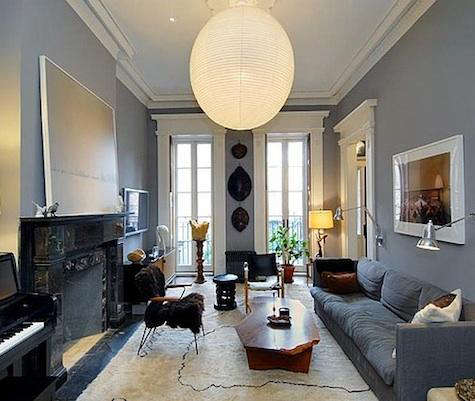
Celebrity homes often look as though no human has ever dropped a cracker, misplaced a remote, or owned a dog with muddy opinions. Julianne Moore’s West Village living room is different. It is sophisticated without behaving like a museum, modern without feeling chilly, and carefully collected without looking as though someone ordered “instant personality” from a catalog.
The room’s appeal comes from an intelligent mix of sculptural midcentury furniture, natural wood, relaxed linen, muted gray walls, soft lighting, and personal objects. The result is often described as organic modern design, but it has more soul than the average beige-on-beige interpretation of that trend. This is a room designed for reading, conversation, music, family life, and apparently proving that a turtle shell can be tasteful when placed with sufficient confidence.
Why Julianne Moore’s West Village Living Room Still Works
Moore’s home is a historic Manhattan townhouse renovated with architect Oliver Freundlich and the Brooklyn-based firm MADE. The property had previously been divided into apartments, so the renovation involved reconnecting its spaces while preserving the character of the house. Moore later rearranged major rooms to improve how her family actually used the home, including moving the kitchen toward the brighter parlor level.
That willingness to rethink convention explains much of the living room’s success. It does not appear to have been planned around an abstract idea of what a formal townhouse parlor should be. Instead, it reflects real activities: guests sitting together, children playing the piano, family members walking between rooms, and someone settling down with a book. Moore has described the space as a room for visitors, reading, music, and everyday traffic rather than a ceremonial area preserved for imaginary royalty.
The broader lesson is simple: a beautiful living room should support your life, not force your life to tiptoe around it. Before shopping for a single lamp, decide what the room must do. Does it need to host six friends? Accommodate a piano? Survive a Labrador? Hide an impressive population of charging cables? Function comes first, even when the coffee table has a design pedigree.
The Design Formula Behind the Look
1. Begin With a Quiet, Complex Wall Color
The original “Steal This Look” feature identified Benjamin Moore’s Pigeon Gray as a reference for the walls. It is the kind of subdued gray that allows warm wood, black leather, white linen, and sculptural objects to stand forward without visual shouting.
To reproduce the effect, avoid a gray that turns icy blue under artificial light. Look for a medium-light gray with slightly warm, green, or earthy undertones. Always paint large samples on at least two walls and observe them during the morning, afternoon, and evening. Tiny paint chips are charming little liars.
In a dark room, consider shifting one step lighter. In a bright south-facing room, a deeper gray can hold its own against strong daylight. Use a matte or eggshell finish on the walls for softness, with a slightly more durable finish on trim if the room gets heavy traffic.
2. Anchor the Room With Relaxed Linen
A generously proportioned sofa covered in neutral linen creates the room’s calm foundation. Remodelista suggested a Belgian-linen slipcovered sofa as a way to capture the original atmosphere. The important qualities are not the exact brand or price but the broad silhouette, natural texture, comfortable depth, and slightly relaxed tailoring.
Choose warm white, oatmeal, flax, pale mushroom, or soft stone instead of brilliant white. A warmer neutral feels more forgiving and harmonizes better with walnut. Slipcovers also make a formal sofa appear approachable, especially when the fabric has a visible weave.
Linen is strong and develops an attractive, casual texture, but it is not magically immune to stains, pets, sunlight, red wine, or children conducting unauthorized experiments with markers. Performance linen, linen blends, or washable covers may be better for active households. Traditional linen is durable, although prolonged sunlight and frequent staining can make maintenance more demanding.
3. Make Natural Wood the Main Character
One of the room’s defining pieces is a George Nakashima coffee table. Moore has called it one of her first major furniture purchases, and she has continued living with it rather than treating it like a guarded artifact. The table’s natural edge, expressive grain, and substantial presence introduce warmth and irregularity into an otherwise restrained interior.
Nakashima furniture is handcrafted and made to order, so an authentic piece is a serious investment. Fortunately, the design principle is widely accessible: choose a solid-wood table that celebrates the shape and grain of the material. A vintage slab table, locally made bench, reclaimed wood table, or simple walnut coffee table can create a similar grounding effect without requiring an auction-house paddle.
Avoid filling the room with six competing wood tones. Select one dominant familywalnut, dark oak, or medium brownand repeat it in two or three places. The woods do not need to match perfectly. In fact, exact matching can make a room resemble a furniture showroom that closes promptly at 8 p.m.
4. Add Sculptural Midcentury Seating
Moore’s interiors include collectible midcentury seating, including Martin Eisler Costela chairs with ribbed wooden frames, curved metal supports, and dark leather upholstery. These chairs contribute contrast because their structure is visually open while the sofa remains soft and substantial.
To capture the same rhythm, pair one upholstered sofa with one or two chairs that expose their frames. Look for leather sling chairs, campaign-inspired lounge chairs, woven-seat armchairs, or wood-framed vintage pieces. Black or dark brown upholstery introduces definition without adding another bright color.
The chairs should feel sculptural but still pass the basic human-sitting test. Some iconic chairs are excellent to admire from across the room and less excellent when your lower back files a formal complaint. Sit before buying whenever possible.
5. Use Lighting as Functional Sculpture
The room’s lighting is not limited to a single overhead fixture. Its design references include adjustable wall-mounted lamps, an unusual table lamp, and an oversized Noguchi Akari paper lantern. Together, these fixtures provide light at different heights while introducing shape and character.
Noguchi began developing Akari light sculptures in 1951, combining traditional Japanese lantern-making techniques with modern sculptural forms. Their paper surfaces soften illumination and make even a large fixture appear visually light.
Recreate the effect with three lighting layers:
- Ambient light: A paper pendant, globe, or shaded ceiling fixture for general illumination.
- Task light: A swing-arm sconce or floor lamp beside the sofa for reading.
- Accent light: A smaller lamp illuminating art, a shelf, or an architectural corner.
Layered lighting makes a living room adaptable and prevents the bleak atmosphere created by one extremely determined ceiling bulb. Lighting specialists commonly recommend combining ambient, task, and accent sources so a room can shift between conversation, reading, entertaining, and relaxation.
6. Include Small Furniture That Doubles as Art
Moore has used Eames walnut stools as stackable sculptural elements. Originally introduced in 1960, the turned-wood stools were designed to function as seats or small tables while adding a strong geometric profile.
This idea is especially useful in smaller living rooms. Instead of buying decorative objects that occupy space without doing anything, choose functional sculpture: a carved stool, pedestal table, wood block, ceramic garden seat, or low bench. It can support a drink, hold books, provide extra seating, or simply stand there looking important.
How to Recreate the Look Without Buying Exact Pieces
Invest in the Visual Anchor
Choose one item to carry the room. It might be a live-edge coffee table, an exceptional lounge chair, a large paper lantern, or a beautifully made sofa. Spend more on the item you will use and see every day, then allow secondary pieces to remain simple.
A room filled entirely with statement furniture becomes less of a statement and more of an argument. One or two memorable forms are enough.
Search Vintage Shops by Material, Not Designer
Searching exclusively for famous names can produce famous prices. Instead, use material and construction terms such as “walnut slab coffee table,” “black leather sling chair,” “turned wood stool,” “chrome swing-arm lamp,” or “linen slipcovered sofa.” These phrases identify the qualities that create the look without restricting the search to collectible originals.
Estate sales, architectural salvage stores, vintage marketplaces, local woodworkers, and consignment shops are particularly useful. Inspect joints, upholstery, odors, wood movement, and structural stability. A romantic vintage chair becomes less romantic when one arm detaches during Thanksgiving.
Balance Straight Lines With Organic Shapes
The room works because rigid and irregular forms coexist. The townhouse architecture, sofa, and wall-mounted lamps introduce order. The wood grain, paper lantern, hides, and collected objects soften that order.
For every strongly rectangular item, consider adding something curved, asymmetrical, handmade, or naturally shaped. A square sofa can be balanced by a round lantern. A straight console can support an irregular ceramic vessel. A precise grid of artwork can sit above a live-edge table.
Build a Neutral Palette Through Texture
Moore has spoken about preferring sculptural objects, restrained color, and abundant texture. Her favored palette has included black, gray, white, green, and purple, with natural materials supplying warmth.
A neutral living room becomes interesting when surfaces differ. Combine matte painted walls, woven linen, polished or worn leather, paper lighting, thick wool, smooth metal, and expressive wood. Designers often use layered textiles and architectural finishes to keep neutral rooms visually active rather than flat.
Color is still welcome, but it should appear deliberately. A dark green plant, plum-colored book, faded textile, or single piece of artwork can bring life without disrupting the quiet composition.
The Personal Objects Are More Important Than the Price Tags
Moore’s living room contains gifts, family pieces, art, books, a globe, and unusual objects collected through travel and friendships. She has emphasized that objects entering her home should feel authentic, human, and meaningful.
This may be the most affordable part of the design and the hardest to fake. A meaningful room cannot be completed in one shopping trip because meaning has an inconvenient habit of taking time.
Display fewer objects, but give each one enough room to register. Try a globe on a console, a handmade bowl on the coffee table, a framed photograph beside books, or a travel object on a pedestal. Group pieces by relationship rather than by color alone. An object from a friend can sit beside a book connected to that person. A found natural form can accompany a landscape photograph.
Avoid copying ethically questionable natural specimens merely because an old photograph included them. Contemporary alternatives can create the same sculptural interest: cast-resin forms, carved wood, ceramic shells, stone objects, botanical studies, or responsibly sourced vintage pieces with documented provenance.
A Practical Shopping List
- A warm gray, muted taupe-gray, or earthy neutral wall paint
- A deep sofa in oatmeal, flax, cream, or light stone upholstery
- A solid-wood coffee table with visible grain or a natural edge
- One or two open-frame lounge chairs in wood, leather, or canvas
- A large paper lantern or globe-shaped ambient light
- An adjustable reading lamp or wall-mounted swing-arm sconce
- A turned-wood stool, carved pedestal, or compact side table
- A wool rug or restrained natural-fiber floor covering
- Books, art, ceramics, and objects with genuine personal meaning
- A plant or leafy branch to introduce living green
Buy slowly. Start with the sofa, table, and lighting, then live with the room before adding accessories. Empty space is not a design emergency. It is breathing roomand it is considerably cheaper than buying the wrong decorative urn at 11:47 p.m.
Experience Notes: What It Is Like to Live With This Look
Rooms inspired by Julianne Moore’s West Village living room tend to look simple in photographs, but creating that simplicity requires restraint. The first challenge is learning when to stop. Once the sofa, wood table, pair of chairs, rug, and lantern are in place, the room may initially feel unfinished. The temptation is to fill every corner with baskets, pillows, side tables, decorative ladders, and at least one object described online as “artisanal.” Waiting for a few weeks usually produces a better result.
Natural materials also change with use. Linen wrinkles. Leather develops creases. Solid wood acquires small marks. Paper shades collect dust with astonishing professionalism. These changes are not necessarily flaws; they are part of the relaxed, lived-in character that makes the style appealing. Moore has discussed using important furniture in everyday life, including a Nakashima table bearing marks from a puppy. That attitude is useful: care for good furniture, but do not make your household emotionally subordinate to a coffee table.
The neutral palette can be surprisingly sensitive to lighting. A gray that looks elegant in a bright showroom may turn gloomy in a north-facing room. Cream upholstery can appear yellow beneath a warm bulb, while cool LEDs may make linen look slightly blue. Testing paint, fabric, wood, and light together prevents expensive surprises. Place samples beside one another and view them at the exact times when the room is used most.
Scale is another common lesson. A large paper lantern often looks enormous in a store and perfectly proportioned once suspended in a room with tall ceilings. Meanwhile, a coffee table that seems modest online can dominate a narrow seating area. Before ordering, mark dimensions on the floor with painter’s tape. Leave approximately 14 to 18 inches between the sofa and coffee table so people can move comfortably without performing a nightly obstacle course.
Open-frame chairs make a noticeable difference in smaller rooms. Because you can see through and around their structures, they provide seating without creating the visual heaviness of fully upholstered club chairs. They are especially effective opposite a substantial sofa. However, comfort varies widely, so test seat height, back support, and arm position rather than choosing solely from photographs.
Living with fewer accessories also changes cleaning routines. Large surfaces are easier to dust, and the room can be reset quickly after guests leave. The tradeoff is that every visible object receives more attention. A poorly placed cable, stack of mail, or neon plastic toy becomes the unexpected focal point. Closed storage nearby is therefore extremely helpful. A cabinet, built-in shelf, or lidded basket can preserve the calm appearance while quietly containing ordinary life.
The most rewarding part of this style is its flexibility. A restrained foundation can evolve without a full redesign. Changing one rug, adding a darker chair, rotating artwork, or replacing a lamp can shift the mood dramatically. Because the room is not tied to a loud trend or coordinated furniture set, it can absorb pieces acquired over many years.
Ultimately, the experience of recreating Julianne Moore’s living room is less about celebrity imitation and more about developing judgment. The strongest version will not contain an exact replica of every photographed item. It will combine useful furniture, honest materials, sculptural forms, comfortable lighting, and objects that reveal something about the people who live there. That is how a copied look becomes a personal room.
Conclusion
Julianne Moore’s West Village living room remains compelling because it combines serious design with ordinary life. A linen sofa relaxes the architecture. Natural wood provides warmth. Midcentury chairs add structure. Paper lighting softens the room, while books, gifts, art, and unusual objects prevent the composition from becoming anonymous.
To steal the look successfully, copy the principles rather than the receipts. Choose a quiet wall color, invest in one substantial natural-material piece, mix soft upholstery with open-frame seating, layer the lighting, and collect accessories slowly. The finished room should look considered but not staged, elevated but not precious, and comfortable enough that nobody needs written permission to sit down.