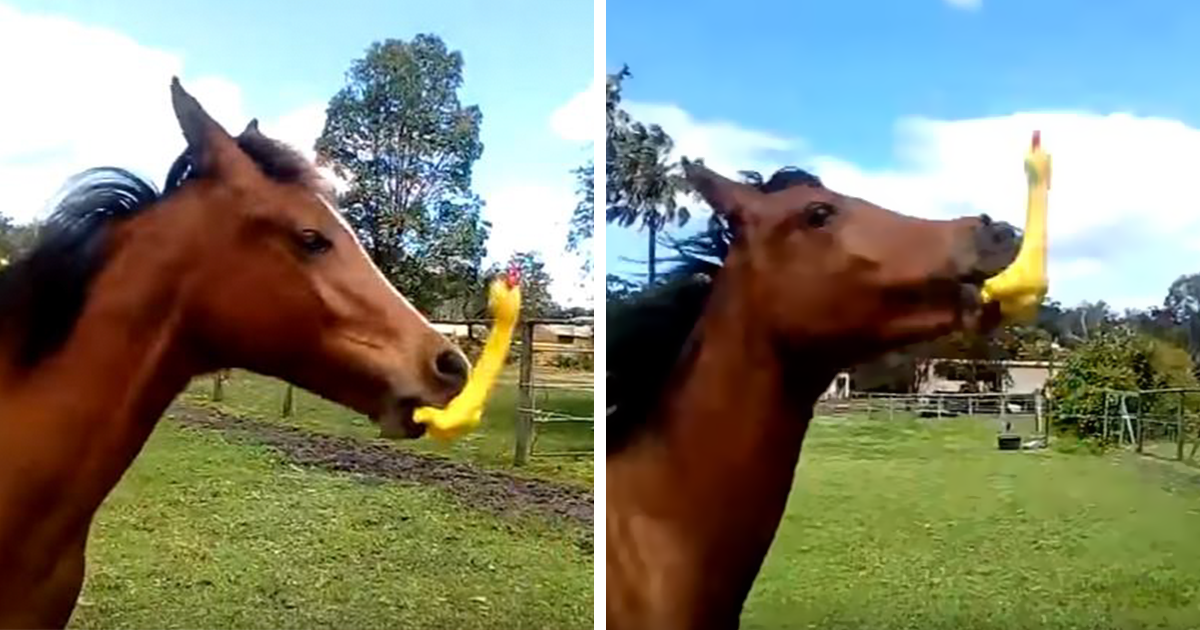
Most horses receive practical gifts: a fresh grooming brush, a comfortable blanket, perhaps a bucket that has not already been stepped on and reshaped into modern art. Kruzah, a playful young horse in Australia, received something far less sensiblea squeaky rubber chicken.
The result was not dignified. It was not elegant. It was, however, spectacularly funny.
Instead of cautiously inspecting the strange yellow bird and returning to important horse business, Kruzah grabbed it with his teeth and began squeezing. Each bite forced out a long, dramatic squawk. Kruzah appeared delighted by his new ability to create noise, while the rubber chicken sounded as though it deeply regretted every decision that had led it to the paddock.
A video of the performance spread rapidly online in 2017, turning an ordinary play session into a memorable viral horse video. Viewers were not merely watching a horse chew a toy. They were watching the birth of what sounded like an experimental barnyard orchestra with one musician, one instrument, and absolutely no rehearsal.
Meet Kruzah, the Horse Behind the Rubber Chicken Concert
Kruzah was reportedly a yearling when the famous footage was recorded. Debbie Barber shared the clip, and reports identified the horse’s owner as Janine Begini. The scene itself was beautifully uncomplicated: a curious young horse, a sunny outdoor space, and a novelty toy capable of producing a sound somewhere between a squeak, a scream, and a goose discovering unpaid parking tickets.
Kruzah picked up the rubber chicken, bit down, released it, and repeated the process with impressive enthusiasm. At times, he shook the toy around as if he were trying to improve its musical range. The chicken responded with the same distressed note every time. This did not discourage Kruzah. If anything, consistency seemed to be part of the appeal.
Why the Video Became So Funny So Quickly
The comedy came from contrast. Horses are commonly portrayed as graceful and majestic. They gallop across open fields, appear in historical paintings, and somehow make standing beside a fence look cinematic. Kruzah temporarily abandoned that noble image to become a four-legged child testing the loudest object in the house.
The sound also arrived with perfect timing. Each movement of Kruzah’s jaw produced another exaggerated squawk, creating a rhythm that felt almost intentional. Viewers could imagine him thinking, “I have discovered music,” while everyone else heard, “A chicken-shaped alarm system is malfunctioning.”
Online humor often depends on complicated references, but Kruzah’s routine needed no explanation. A horse was making a rubber chicken scream. The premise, performance, and punch line were all visible within seconds.
Why Would a Horse Love a Squeaky Rubber Chicken?
Kruzah’s reaction may look ridiculous, but the curiosity behind it is not unusual. Horses investigate their surroundings with their noses, lips, mouths, and feet. Younger horses can be especially interested in picking up objects, nudging them, tossing them, or testing whether they make an interesting sound.
A rubber chicken offers several forms of stimulation at once. It has an unusual shape, flexible texture, bright appearance, and immediate auditory feedback. Bite it once and nothing subtle happens. The toy loudly announces that the experiment worked.
The Power of Cause and Effect
Animals often repeat actions that produce interesting or rewarding results. For Kruzah, biting the chicken caused a noise. Releasing it allowed the toy to refill with air. Biting it again restarted the performance.
That simple cause-and-effect loop may help explain why he continued playing. He was not necessarily trying to entertain an audience or launch a career as an equine disc jockey. He had found an object that reacted every time he touched it.
Training and enrichment activities can similarly encourage animals to manipulate objects, solve basic problems, or explore safely. Veterinary guidance emphasizes that such activities should remain positive and should not create frustration or fear.
Horses Have Individual Preferences
Not every horse would respond like Kruzah. One might pick up the chicken immediately. Another might sniff it, decide it is suspicious, and leave the county emotionally. A third might ignore it because it contains neither hay nor snacks.
Equine enrichment is not one-size-fits-all. Some horses are fascinated by balls, traffic cones, hanging objects, scratching brushes, or treat dispensers. Others show little interest in toys unless food is involved. Age, temperament, previous experiences, housing, and the surrounding environment can all influence a horse’s response.
The Serious Side of a Very Silly Horse Video
Behind the laughter is a useful reminder: horses need opportunities to move, socialize, forage, investigate, and make choices. A novelty toy cannot replace pasture, appropriate exercise, companionship, or good management, but thoughtfully selected enrichment can add variety to a horse’s day.
Enrichment Can Help Break Up Monotony
Horses kept in stalls because of weather, injury, travel, or management schedules may have fewer opportunities to express natural behavior. Slow feeders, sturdy balls, safe mirrors, scratching surfaces, and treat-dispensing devices are among the options commonly suggested for suitable horses.
The ASPCA advises owners to provide socialization and enrichment when horses are stalled, along with daily turnout when possible. University of Minnesota Extension likewise recommends safe toys and other environmental adjustments for horses coping with stall rest.
These tools should be viewed as additions rather than substitutes. A rubber chicken may be entertaining, but it cannot provide the nutrition of forage, the movement of turnout, or the communication of another horse. Even the world’s most committed squeaky-toy enthusiast eventually needs dinner.
Play Can Reveal Personality
A horse’s interaction with a new object can reveal confidence, curiosity, caution, persistence, and preferred ways of exploring. Kruzah did not simply tolerate the chicken. He actively manipulated it and repeatedly returned to the behavior that created the sound.
Owners who pay attention to these choices can learn what motivates their horses. A mouthy horse may enjoy carrying or tossing a suitable object. A food-focused horse may prefer a rolling feeder. A horse that loves physical contact may spend more time using a securely mounted scratching brush than chasing a ball.
Observing body language remains essential. Relaxed exploration looks different from fear, defensive behavior, or escalating frustration. Ears, eyes, muzzle tension, posture, movement, and the horse’s willingness to approach or retreat all provide information about how the experience is being received.
Are Rubber Chickens Safe Toys for Horses?
A funny internet clip should not be interpreted as proof that every rubber chicken belongs in every paddock. Toys designed for dogs, children, or novelty stores may not withstand the strength of a horse’s teeth and jaws. Small pieces, squeakers, plugs, or torn material could create choking, ingestion, or injury risks.
Choose Toys With Horse-Sized Safety in Mind
Before introducing any object, owners should examine its size, material, construction, and condition. A suitable enrichment item should not have sharp edges, toxic components, loose cords, accessible hardware, or openings that could trap a hoof or jaw. Guidance on confinement-area enrichment similarly warns owners to avoid sharp edges and potentially toxic materials.
The environment matters too. An object that is reasonably safe in an open paddock may become hazardous in a cramped stall. Toys should be placed away from fencing, buckets, electrical equipment, gates, and other areas where a horse could become tangled or trapped.
Supervision Comes Before the Comedy
A new toy should initially be offered under supervision. Watch how the horse approaches it, whether the item remains intact, and whether play becomes overly excited or aggressive. Remove the object if the horse begins tearing pieces away, attempting to swallow it, striking dangerously, or chasing other animals with it.
Regular inspections are also important. A toy that was safe on Monday may be partially dismantled by Wednesday, especially if its owner has spent two days perfecting a rubber-chicken percussion solo.
When a horse has medical restrictions, dental problems, unusual eating behavior, or a history of ingesting foreign materials, the owner should consult an equine veterinarian before experimenting with new enrichment objects.
Why Animals Being Silly Captivate the Internet
Kruzah’s performance belongs to a beloved category of online entertainment: animals unexpectedly behaving like comedians. The humor feels spontaneous because the animal is not following a script. There is no visible attempt to deliver a joke, yet the timing can be better than anything carefully planned.
The clip also allows viewers to project a playful personality onto Kruzah. His repeated squeaking resembles the behavior of a child who discovers a noisy toy and decides everyone in the building should enjoy it. Anyone who has lived with a toddler, a puppy, or a smoke detector with a dying battery understands the basic situation.
The Video Works With or Without Words
Visual animal comedy travels easily across languages. Viewers do not need to understand a caption, recognize a celebrity, or know the background story. The horse bites. The chicken screams. Humanity briefly agrees that this is excellent.
That accessibility helped clips like Kruzah’s move across television reports, social platforms, humor websites, and animal-focused media. The video could be reposted with new captions, musical edits, or enthusiastic commentary while preserving its central joke.
Wholesome Humor Offers a Small Mental Vacation
Much of the internet asks people to worry, argue, purchase something, or remember a password containing one uppercase letter, two numbers, a symbol, and an ancient prophecy. A playful horse with a rubber chicken asks almost nothing.
For a few moments, viewers can simply laugh at an enormous animal enjoying an absurdly noisy object. That emotional simplicity is part of the appeal. The video delivers surprise, joy, and harmless chaos without requiring a complicated explanation.
Kruzah’s Story Was About More Than One Funny Moment
Reports surrounding the viral clip described Kruzah as having survived serious complications shortly after birth. Some coverage used the informal term “dummy foal,” historically applied to newborn foals showing signs associated with neonatal maladjustment syndrome. By the time of the rubber chicken video, however, Kruzah appeared energetic, curious, and remarkably committed to making noise.
That background gave viewers another reason to enjoy his enthusiasm. The scene was funny on its own, but it also showed a young horse actively engaging with his surroundings after a difficult beginning.
It is tempting to turn every animal story into an inspirational speech complete with piano music. Kruzah did not need that. His message was much more practical: sometimes recovery looks like standing in the sunshine and repeatedly squeezing a rubber chicken until everyone nearby loses composure.
What Horse Owners Can Learn From Kruzah
Let the Horse Help Choose the Activity
Owners may spend money on an elaborate toy only to discover that the horse prefers an empty feed tub. That is normal. Enrichment works best when it matches the individual animal’s interests rather than the human’s shopping enthusiasm.
Offer one new item at a time, observe the response, and avoid forcing interaction. Curiosity should be voluntary. A horse that walks away is communicating just as clearly as one that immediately begins composing the song of its people.
Rotate Activities Instead of Creating Clutter
Leaving every toy available every day can make them less novel and may create unnecessary obstacles. Rotating a few suitable items can renew interest while keeping the environment manageable.
Variety can include changes in feeding presentation, supervised groundwork, grooming, safe obstacles, scent exploration, scratching surfaces, and social turnout. Toys are only one part of a much larger enrichment plan.
Keep Expectations Realistic
A toy will not automatically solve cribbing, weaving, aggression, anxiety, or other concerning behaviors. Such problems can involve pain, stress, feeding schedules, social isolation, previous learning, or medical conditions. They deserve a thorough assessment rather than a novelty-store solution.
Research into equine enrichment has also shown that horses do not interact equally with every object, and individual toys may have limited effects on established repetitive behaviors. The goal should be to support overall welfarenot to assume one squeaky chicken can personally reorganize an entire management program.
Experiences Inspired by the Horse and Rubber Chicken Encounter
The funniest part of introducing a horse to a new toy is that the human rarely controls the outcome. You can arrange the scene, choose the object, and prepare your camera, but the horse remains the director.
Experience One: The Brave Investigator
Imagine placing a squeaky chicken in a paddock and watching a confident young gelding approach it immediately. He sniffs the feet, nudges the head, and finally picks it up by the middle. The first squawk freezes him for half a second. His ears move forward, then sideways, as though requesting technical assistance.
He tries again. The chicken screams. This time the gelding does not step back. He squeezes repeatedly, discovers that faster bites produce faster sounds, and begins walking around with his new instrument. Within minutes, he has transformed from cautious investigator into the least subtle parade marshal in equine history.
Experience Two: The Horse Who Wants Nothing to Do With It
A careful mare may offer a completely different review. She approaches slowly, stretches her neck, and snorts at the chicken from a safe distance. When the toy squeaks, she takes two brisk steps backward and stares at the human responsible.
Her expression appears to say, “You brought a loud, boneless bird into my home, and now you expect gratitude?”
After another inspection, she walks toward her hay and refuses further participation. This response is not a failure. Allowing a horse to investigate and retreat provides choice, and choice is an important part of thoughtful enrichment.
Experience Three: The Accidental Game of Fetch
Some horses enjoy tossing objects more than squeezing them. A playful horse may lift the chicken by one leg, swing it in a wide arc, and release it directly over the fence. The owner retrieves it. The horse throws it again.
Congratulations: the human is now playing fetch, while the horse supervises.
After several repetitions, it becomes obvious that the animal has trained the person to recover a yellow object on command. The horse receives entertainment, the human receives exercise, and the rubber chicken receives frequent opportunities to reconsider its career.
Experience Four: The Barn Audience
A noisy toy can attract attention from every horse nearby. Heads appear over stall doors. Ears turn toward the sound. One horse nickers, another begins pacing toward the gate, and an older gelding watches with the exhausted expression of a teacher supervising indoor recess.
This group response is a reminder to introduce noisy objects carefully. What entertains one horse may startle another. The best experience happens when handlers consider the entire environment rather than focusing only on the animal holding the toy.
Experience Five: The Human Cannot Stop Laughing
The final experience belongs to the person behind the camera. Horse owners spend plenty of time on serious responsibilities: carrying water, cleaning stalls, checking fences, scheduling veterinary visits, monitoring feed, and wondering how one animal managed to cover itself in mud immediately after being groomed.
Then a horse discovers a rubber chicken, and all seriousness collapses.
The laughter comes partly from surprise and partly from recognition. Beneath the size, strength, and elegance, horses can be deeply playful individuals. They form preferences, repeat amusing behaviors, investigate strange objects, and occasionally create moments that feel designed specifically to rescue an ordinary day.
Kruzah’s viral performance captured exactly that kind of moment. It was not polished or important in the traditional sense. It was a young horse enjoying a toy with complete commitment while a rubber chicken protested loudly enough for the internet to notice.