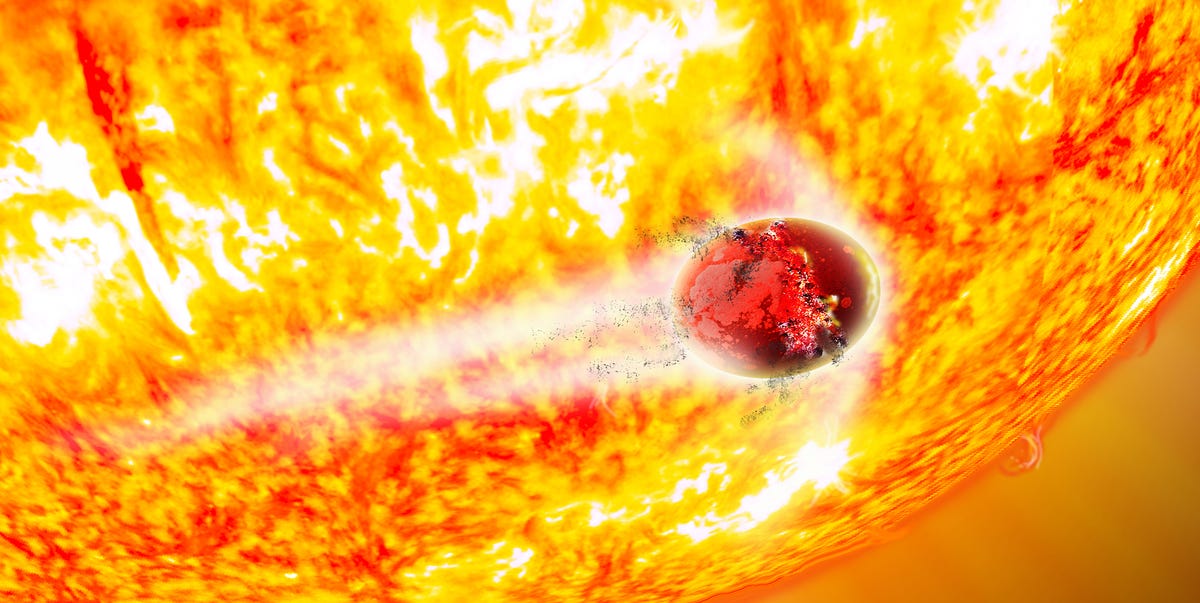
Some scientific discoveries arrive wearing a lab coat. Others kick open the door, scatter cosmic dust everywhere, and announce, “Good news, everyonewe found a dead star eating a planet.” That, more or less, is how astronomers met one of the strangest chapters in modern space science: the death of a solar system and the birth of a new field called necroplanetology.
The word sounds like something a goth astronomer would invent after too much coffee, but it is very real in spirit. Necroplanetology is the study of destroyed planets, planetary remains, and the violent ways dead stars can chew up the leftovers of their old solar systems. It is cosmic forensics: not just asking whether planets exist around other stars, but examining what happens after those planetary systems fall apart.
At the center of the story is a white dwarf known as WD 1145+017, a dense stellar corpse located hundreds of light-years away in the constellation Virgo. In 2015, astronomers studying data from NASA’s Kepler space telescope, during its K2 mission, noticed something odd. The star’s light kept dipping in messy, irregular patterns. These were not the clean, tidy signals astronomers expect when a healthy planet crosses in front of a star. These dips looked more like a cosmic crime scene.
The evidence pointed to one conclusion: astronomers were watching a dead star tear apart rocky planetary material in real time. A solar system was not merely old. It was being dismantled.
What Is a White Dwarf, and Why Is It So Dangerous?
A white dwarf is what remains after a star similar to the Sun runs out of usable nuclear fuel. First, the star swells into a red giant, shedding its outer layers into space. Then the hot, dense core is left behind. That core becomes a white dwarf: small, dim, incredibly dense, and gravitationally intense.
Imagine packing a large fraction of the Sun’s mass into an object roughly the size of Earth. That is the basic white dwarf situation. It is not a cozy retirement plan for a star. It is more like an astrophysical pressure cooker that has lost the recipe.
White dwarfs do not usually shine with the youthful fire of main-sequence stars, but they can still shape the fate of everything around them. Asteroids, moons, dwarf planets, and perhaps larger rocky bodies may survive the red giant phase only to have their orbits disturbed later. If those bodies wander too close, the white dwarf’s gravity can stretch, crack, and shred them. The process is called tidal disruption.
That shredded material can form rings, clouds, and dusty debris disks around the white dwarf. Some of it eventually falls onto the star’s surface. When astronomers detect elements like silicon, iron, magnesium, calcium, or nickel in a white dwarf’s atmosphere, they may be seeing the chemical fingerprints of destroyed rocky worlds.
The Strange Case of WD 1145+017
WD 1145+017 became famous because it offered something scientists had long suspected but had rarely caught in the act. Astronomers already knew that some white dwarfs were “polluted” with heavy elements. That pollution was suspicious because heavy elements should sink below the visible surface of a white dwarf relatively quickly. If astronomers could still see them, something had to be delivering fresh material.
The likely culprit? Planetary debris.
Then WD 1145+017 provided the smoking crater. Kepler data showed repeating dimming events every few hours. The dips were deep, uneven, and changeable. At times, the star’s brightness dropped dramatically, suggesting that material was passing in front of it. But the shapes of the dips did not resemble a solid planet with a neat circular outline. Instead, they looked like clouds of dust trailing from disintegrating bodies.
Think of a comet, but less “pretty object in the night sky” and more “rocky corpse being sandblasted by a stellar ghost.” The orbiting fragments appeared to be shedding dust as they circled the white dwarf in extremely short periods of roughly 4.5 to 5 hours. That means the doomed material was whipping around the star at close range, inside a gravitational danger zone where survival is not exactly encouraged.
Why This Discovery Was So Important
The discovery of disintegrating planetary material around WD 1145+017 helped connect several puzzle pieces in astronomy. Before this, scientists had strong evidence that white dwarfs could contain traces of rocky material. They also saw dusty disks around some white dwarfs. What they did not have was such a vivid example of the destruction process in progress.
WD 1145+017 showed that the chain of events could be real: a planetary body survives the death of its star, its orbit changes, it gets too close to the white dwarf, tidal forces rip it apart, debris forms a dusty cloud or disk, and pieces of that debris fall onto the star. The white dwarf then becomes, in effect, a laboratory for studying the chemistry of dead planets.
This is why necroplanetology matters. Regular exoplanet science often studies planets by measuring their size, mass, orbit, atmosphere, or effect on starlight. Necroplanetology studies planets after disaster. It asks what destroyed planetary systems can reveal about the original worlds: their density, structure, composition, and internal layers.
Necroplanetology: The Science of Planetary Afterlives
The term necroplanetology may sound dramatic, but the idea behind it is deeply practical. If a destroyed asteroid or dwarf planet leaves behind debris, that debris can tell scientists what the object was made of. If the light curve changes in certain ways, scientists can model how the object breaks apart. If different minerals appear in the white dwarf’s atmosphere, researchers can infer whether the original body was rocky, metallic, icy, or chemically unusual.
In other words, the destruction is terrible for the planet but very convenient for science. Space, as usual, has questionable manners.
Researchers have used computer simulations to explore how differentiated planetary bodies might break apart around WD 1145+017. A differentiated body is one that has separated into layers, such as a metal-rich core, rocky mantle, and lighter crust. Earth is differentiated. Large asteroids such as Vesta are also thought to have internal structure. If a similar body were torn apart by a white dwarf, the pattern of debris might reveal clues about its interior.
That is a remarkable idea. Astronomers cannot drill into exoplanets. They cannot scoop up a sample from a minor planet orbiting a dead star hundreds of light-years away. But by watching how the object falls apart, they can begin to reconstruct what it may have been like before it died.
How Scientists Read a Dead Solar System
Studying a dying planetary system requires several kinds of evidence. No single observation tells the whole story. Instead, scientists combine light curves, spectroscopy, infrared measurements, and computer modeling.
Light Curves Show the Shadows
A light curve records how a star’s brightness changes over time. When a planet passes in front of a star, the star dims slightly. In a typical exoplanet transit, that dimming is smooth and predictable. With WD 1145+017, the light curves were messy and shifting. That messiness was the clue. It suggested that astronomers were not seeing one clean planet, but unstable clouds, fragments, and dusty tails.
Spectroscopy Shows the Chemistry
Spectroscopy breaks starlight into its component wavelengths. Different elements leave different signatures, like chemical barcodes. When researchers detect heavy elements in a white dwarf atmosphere, they can compare those elements with materials found in rocky planets, asteroids, and icy bodies. This helps answer a thrilling question: what are planets outside our solar system actually made of?
Infrared Light Reveals Dust
Dust absorbs starlight and reradiates energy at infrared wavelengths. If a white dwarf has more infrared emission than expected, it may be surrounded by warm dust. That dust can be the ground-up remains of former planetary bodies. It is not glamorous, but neither is cleaning out a vacuum filterand both can reveal what has been sucked in.
Simulations Rebuild the Disaster
Computer models allow scientists to test different scenarios. What happens if the object is dense? What if it has a low-density crust? What if it is more like a rubble pile than a solid world? How quickly does it break apart? What kind of transit signal would that produce? By comparing simulations with observations, researchers can narrow down the possible nature of the doomed body.
What WD 1145+017 Teaches Us About Our Own Solar System
The story of WD 1145+017 feels distant, but it has an uncomfortable connection to home. Our Sun will not remain as it is forever. Billions of years from now, it will expand into a red giant. The inner solar system will be transformed, and Earth’s long-term outlook is not exactly spa-weekend material.
After the Sun sheds its outer layers, it will eventually become a white dwarf. By then, the solar system will be dramatically rearranged. Some objects may be swallowed. Others may survive but find their orbits disturbed. Asteroids, comets, and moons could be nudged inward toward the white dwarf Sun, where they might be shredded into debris.
That does not mean Earth will one day enjoy a starring role in a necroplanetology paper. Earth may be destroyed earlier during the Sun’s red giant phase. But the broader lesson still applies: planetary systems do not simply freeze in place after their stars die. They continue evolving. Sometimes they continue colliding, crumbling, and feeding their stellar remnants.
Solar systems have afterlives. Some are peaceful. Some are dusty. Some look like a celestial blender with a PhD.
Why Dead Planets Can Tell Us About Living Worlds
Necroplanetology is not just about endings. It is also about origins. When scientists study the debris around white dwarfs, they gain access to planetary building blocks from other star systems. That matters because planets are difficult to study directly, especially small rocky ones.
In many cases, a polluted white dwarf can reveal the bulk composition of rocky material with surprising detail. Researchers can compare the ratios of elements in the debris with those in Earth, Mars, asteroids, or meteorites. Some white dwarfs show evidence of rocky material similar to terrestrial planets. Others suggest water-rich bodies or chemically unusual fragments.
This makes white dwarfs valuable archives. They preserve evidence of planets that no longer exist in recognizable form. The original world may be gone, but its atoms remain readable. It is like finding a burnt cookbook and still figuring out the recipe.
The Birth of a New Field
Necroplanetology sits at the crossroads of astronomy, planetary science, geology, and computer modeling. It asks big questions with wonderfully grim wording. How do planets die? What survives after a star becomes a white dwarf? Can we identify the crust, mantle, or core of an extrasolar body from its debris? How common are destroyed planetary systems?
Future surveys and observatories are expected to find more systems like WD 1145+017. Each new discovery could become another case file in the growing archive of planetary afterlives. Some systems may show active transits from debris clouds. Others may show only chemical pollution. Still others may reveal disks, gas, dust, or strange variability that changes over years.
One exciting part of the field is its unpredictability. White-dwarf debris systems can change quickly. Transit features may appear, disappear, deepen, weaken, or shift in shape. That makes them frustrating to study, but also scientifically rich. A stable system tells one story. A chaotic system tells many.
Specific Examples of Cosmic Destruction
WD 1145+017 remains the celebrity case because it offered direct evidence of disintegrating material passing in front of a white dwarf. But it is not alone in showing that dead stars can host planetary wreckage. Other white dwarfs have been found with dusty disks, heavy-element pollution, and signs of accreting material. Some appear to have consumed rocky asteroids. Others may have accreted icy bodies with water-rich chemistry.
These examples suggest that planetary systems can survive stellar death in fragments. Not every world is instantly erased. Some objects remain in distant reservoirs until gravitational nudges send them inward. A surviving giant planet, passing star, or subtle orbital instability may disturb small bodies and send them toward the white dwarf. Once they cross the danger line, tidal forces do the rest.
That is one of the strange beauties of necroplanetology: destruction becomes data. The more violently a body is broken apart, the more exposed its ingredients may become. The process is tragic for the rock, excellent for the spreadsheet.
Why Readers Should Care About Necroplanetology
At first glance, the death of a solar system hundreds of light-years away may seem remote. But this research touches some of the biggest questions humans ask about the universe. Are planetary systems like ours common? Do rocky planets form with similar chemistry elsewhere? What happens when stars age? How permanent is a solar system?
Necroplanetology also reminds us that planets are not static decorations in space. They are part of long, evolving systems. They are born in disks of gas and dust. They grow through collisions. They settle into orbits. They may host oceans, atmospheres, or even life. Then, billions of years later, their stars change, and the architecture of the system can collapse.
In that sense, WD 1145+017 is not only a weird dead star. It is a preview of a universal truth: cosmic objects have life cycles. Even planets can have endings.
Experience-Based Reflections: Watching a Solar System Die From a Human Perspective
There is something oddly personal about reading the story of WD 1145+017. On paper, it is a technical subject filled with terms like “tidal disruption,” “metal pollution,” “transit depth,” and “differentiated asteroid.” But beneath the vocabulary is a scene almost anyone can understand: a once-organized system falling apart piece by piece.
For readers who have spent nights looking at the Moon or tracing constellations from a backyard, necroplanetology changes the emotional texture of the sky. Stars stop feeling like fixed lights pinned to a black ceiling. They become actors in long dramas. Some are young and loud. Some are stable and generous. Some are elderly, dense, and apparently not above eating the furniture.
The experience of learning about a dead solar system can also make our own solar system feel more precious. We live in a relatively calm era. The Sun rises, Earth orbits, Jupiter keeps its massive watch, and the asteroid belt mostly behaves itself. That stability is not guaranteed forever. It is a temporary chapter in a much longer story.
Necroplanetology encourages a different kind of wonder. It is not the soft wonder of a pretty nebula poster. It is the sharp wonder of realizing that even destruction has structure. A disintegrating asteroid can reveal its density. Dust around a white dwarf can reveal mineral chemistry. A polluted stellar atmosphere can preserve the memory of a vanished world. The universe does not waste evidence. It scatters it, heats it, pulverizes it, and then leaves scientists to assemble the clues.
For writers, educators, and science communicators, this topic is a gift. It has drama, mystery, and a name that practically writes its own headline. But it also requires care. The real science is more interesting than exaggeration. WD 1145+017 is not a Hollywood explosion. It is a slow, measurable, evolving process observed through light, dust, and chemistry. The drama is not that a planet went “boom.” The drama is that humans built tools precise enough to notice a dead star dimming as fragments of a former world passed in front of it.
That is the most astonishing part. Nobody flew a spacecraft there. Nobody filmed the event with a cosmic camcorder. Scientists watched tiny changes in brightness from an object far beyond human reach and reconstructed a planetary disaster. It is detective work performed with photons.
In daily life, we often think of endings as blank spaces. A thing is gone, and that is that. Necroplanetology says otherwise. Endings leave traces. Broken worlds leave chemistry. Dust leaves heat. Shadows leave patterns. Even a solar system’s death can become a beginning for knowledge.
So the next time someone says astronomy is just people naming stars and arguing about telescopes, hand them WD 1145+017. Here is a dead star surrounded by planetary wreckage, teaching us what distant worlds were made of before they were destroyed. If that does not earn at least one dramatic eyebrow raise, the eyebrow may need recalibration.
Conclusion
The death of a solar system sounds like the final page of a cosmic story, but WD 1145+017 proves it can also be the first page of a new scientific field. By watching planetary debris orbit, crumble, and fall onto a white dwarf, scientists have opened a strange and powerful window into the interiors of worlds we could never visit.
Necroplanetology transforms destruction into discovery. It shows that dead planets are not silent. Their dust, metals, and shadows still speak. They tell stories about formation, composition, orbital chaos, stellar aging, and the far future of systems like our own. The field may be young, but its subject is ancient: the long afterlife of planets once their stars have changed forever.
In the end, WD 1145+017 is more than a dead star with bad table manners. It is a reminder that the universe is both creative and destructive, often at the same time. Solar systems are born from dust, live in motion, and may one day return to dust around a stellar remnant. Somewhere in that dusty return, scientists found a new way to read the history of worlds.
Note: This article is original, publication-ready web content based on real astronomical research about white dwarfs, planetary debris, WD 1145+017, and necroplanetology. Source links are intentionally not inserted into the article body.