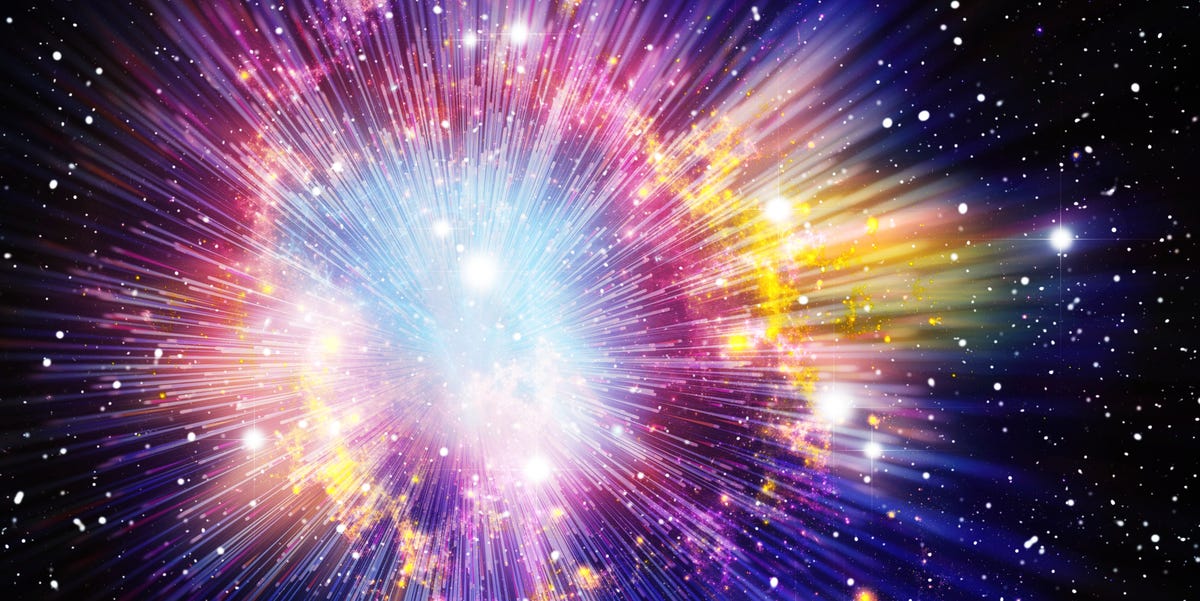
Black holes have a branding problem. They are famous for swallowing light, stretching time, and generally behaving like the universe’s least welcoming neighbors. So the idea that scientists could soon spot explosions from the first black holes sounds a little backwardlike saying a vacuum cleaner might suddenly become a confetti cannon. But in modern astrophysics, that wild headline is not just click-worthy. It is rooted in serious research.
The excitement comes from two related mysteries. First, astronomers are trying to understand how the universe built its earliest black holes so fast, only a few hundred million years after the Big Bang. Second, physicists are hunting for a very different class of ancient black holestiny primordial black holesthat may have formed in the infant universe and could end their lives in brief, violent bursts of radiation. If scientists detect one of those bursts, it would not just make for a spectacular astronomy headline. It could confirm Hawking radiation, reshape theories of dark matter, and rewrite part of the story of how the cosmos grew up.
In other words, this is not just another black hole story. It is a full-blown cosmic detective case, and several of humanity’s most powerful observatories are now on the job.
What Scientists Mean by “the First Black Holes”
When researchers talk about the first black holes, they are usually referring to one of two possibilities.
1. Primordial black holes from the baby universe
These are the weirdest suspects on the list. Primordial black holes are hypothetical black holes that may have formed extremely early, perhaps fractions of a second after the Big Bang, when dense patches of matter in the young universe collapsed under their own gravity. Unlike black holes formed from dying stars, primordial black holes would not need a star at all. They would be born straight from the chaos of the early cosmos.
If they existed, they could have come in many sizes. The very small ones are the most intriguing for today’s astronomers because they should gradually lose mass through Hawking radiation. As they shrink, they heat up. As they heat up, they radiate more. And in the final stage, they may end with a burst of high-energy particles and gamma rays. That is the “explosion” scientists hope to see.
2. Seed black holes from the first stars or direct collapse
The other version of the story begins a little later, during cosmic dawn. The universe’s first starsoften called Population III starswere likely enormous, short-lived, and made almost entirely of hydrogen and helium. When they died, many probably collapsed into black holes. Some theories also suggest that giant pristine gas clouds could have skipped the star phase altogether and collapsed directly into massive “seed” black holes.
These early seeds may have grown into the supermassive black holes that now anchor galaxies. That matters because telescopes such as the James Webb Space Telescope have found black holes in the young universe that seem absurdly massive for their age. In astronomy, “absurdly massive” is a technical term meaning, “Please send more grad students.”
Why This Topic Suddenly Feels Urgent
For decades, Hawking radiation remained one of the most famous predictions in theoretical physics that no one had directly observed. Stephen Hawking proposed in 1974 that black holes are not completely black. Quantum effects near the event horizon should allow them to emit radiation and slowly evaporate over time. For stellar-mass or supermassive black holes, the process is far too slow to notice. But tiny primordial black holes, if they exist, could be evaporating right now.
That possibility got a fresh jolt from recent work suggesting the odds of detection may be better than scientists once assumed. One attention-grabbing study argued that if black holes interact with a hidden “dark sector” of particles, the final bursts from evaporating primordial black holes could be more common than older models predicted. In that picture, astronomers might have a realistic chance of detecting one within the next decade rather than waiting for an absurdly rare event on geological timescales.
That does not mean the discovery is guaranteed. It means the search has moved from “interesting sci-fi-adjacent speculation” to “serious observational target.” And that is a big shift.
What Astronomers Are Already Seeing Near Cosmic Dawn
Even before anyone catches a black hole in its final evaporative fireworks, astronomers are already finding clues that the early universe was surprisingly efficient at making black holes.
The James Webb Space Telescope has transformed this field. It has identified extraordinarily distant galaxies and possible active black holes from a time when the universe was only a few hundred million years old. One standout example is GN-z11, a luminous galaxy seen when the universe was still in its infancy. Webb observations have also raised hopes that scientists may be getting closer to detecting Population III stars or at least their explosive deaths and the black hole remnants they leave behind.
Another striking object is UHZ1, an early galaxy whose X-ray emission points to a rapidly growing black hole when the universe was only about 3% of its current age. That kind of discovery matters because X-rays are a classic sign of a feeding black hole. The faster astronomers find these ancient objects, the harder it becomes to explain them with slow, ordinary growth models alone.
Then there are the so-called “little red dots” and other dusty, compact early-universe objects that may hide young black holes. Some researchers think these could be evidence that massive seeds formed quickly, perhaps from direct collapse rather than from ordinary stellar remnants. Others remain cautious, which is how science should work. But the trend is clear: early black holes are showing up faster, earlier, and in stranger forms than many astronomers expected.
How Scientists Could Actually Spot the Explosions
No, researchers are not waiting for someone to look up and shout, “Hey, a black hole just popped.” The hunt is far more technical, and it depends on several kinds of instruments working together.
Gamma-ray observatories
If a tiny primordial black hole reaches its final stage of evaporation, theory says it should produce a burst of high-energy particles, especially gamma rays. That makes gamma-ray instruments the main hunters. Existing facilities such as NASA’s Fermi Gamma-ray Space Telescope and ground-based observatories that monitor the sky for very high-energy events are crucial here.
The High-Altitude Water Cherenkov Observatory, or HAWC, has already set strong limits on how often primordial black hole bursts can happen nearby. In plain English, that means scientists have not seen one yet, but they have become much better at narrowing the possibilities. The search is not blind anymore. It is targeted, statistical, and improving.
X-ray and infrared telescopes
These instruments do a different job. Rather than catching the final flash of a tiny primordial black hole, they help identify where the earliest black hole growth was happening. Chandra sees the X-ray glow from hot matter falling into black holes. Webb sees the infrared light from the ancient universe, allowing astronomers to study galaxies and black hole candidates from cosmic dawn.
Together, Webb and Chandra are acting like the universe’s best forensic team: one finds the distant crime scene, the other checks whether a black hole was busy eating there.
Wide-field surveys
The Nancy Grace Roman Space Telescope and the Vera C. Rubin Observatory should expand the search in a different way. Roman will survey broad areas of sky and help pinpoint rare early objects for detailed follow-up, while Rubin’s wide, repeated scans of the sky will be excellent for catching transient eventsbrief flashes, odd outbursts, and anything else the universe throws across the room at 2 a.m.
Gravitational-wave detectors
There is also a non-light route to the truth. LIGO has already shown that black holes can be found by listening to spacetime itself. Future missions such as LISA are expected to probe massive black hole formation and mergers deep in cosmic history. If early black holes formed through direct collapse or other unusual channels, their merger signals may reveal the pattern.
That means scientists are not relying on just one type of evidence. They are building a multi-messenger case using gamma rays, infrared light, X-rays, and gravitational waves. It is less “one telescope to rule them all” and more “assemble the nerdiest superhero team in history.”
What an Explosion Would Proveand What It Would Not
If astronomers detect a convincing evaporating primordial black hole burst, the implications would be enormous.
First, it would provide the strongest direct evidence yet for Hawking radiation. That alone would be huge because Hawking radiation sits at the intersection of gravity, quantum mechanics, and thermodynamics. Observing it would push physics into territory where some of its biggest unresolved questions live.
Second, it would be strong evidence that primordial black holes really existed. Since no known process in the current universe naturally makes black holes that tiny, a burst today would point back to conditions in the early universe.
Third, the energy spectrum of the particles could hint at physics beyond the standard model. Some of the most exciting recent work suggests these bursts might reveal hidden particles or dark-sector physics. In other words, a black hole explosion might double as a particle accelerator built by the Big Bang.
But it would not instantly prove that all supermassive black holes grew from primordial ones. That question would still need broader evidence from galaxy surveys, black hole demographics, and merger histories. One discovery would open the door. It would not finish the entire argument.
Why the Earliest Black Holes Matter So Much
At first glance, this may sound like a niche story for people who use phrases like “radiation-dominated era” in casual conversation. But the first black holes matter because they help explain how structure formed in the universe.
Black holes are not just cosmic vacuum cleaners. They shape galaxies. They influence star formation. Their growth is tied to the evolution of the biggest structures in space. If scientists misunderstand the first black holes, they may also misunderstand how galaxies assembled, how quickly heavy elements spread, and how the early universe became the place where planets, chemistry, and eventually life could exist.
That is why this field has explodedfiguratively for now, literally if the data get lucky. The mystery of the first black holes is really a mystery about origins. Not just the origin of black holes, but the origin of the architecture of the universe itself.
The Biggest Obstacles
Of course, the cosmos is not handing over answers without a fight. Many astrophysical events can mimic parts of the signal scientists want: gamma-ray bursts, magnetar flares, active galactic nuclei, and other exotic outbursts can muddy the waters. Researchers need to separate a genuine primordial black hole signature from all the other flashy nonsense happening in the sky.
There is also a theory problem. Primordial black holes remain hypothetical. The “dark sector” models that raise the odds of detection are exciting, but they are still models. Nature has not signed the paperwork yet.
And on the cosmic dawn side, early black hole candidates are incredibly distant, faint, and difficult to interpret. Sometimes astronomers are not sure whether they are looking at a galaxy, a buried active nucleus, a burst of star formation, or some combination of all three. The early universe has a habit of refusing to color inside the lines.
Bottom Line
Scientists could soon spot explosions from the first black holesbut only if one of the universe’s oldest and smallest relics is still out there finishing its long evaporation today. At the same time, telescopes such as Webb and Chandra are revealing that black holes were already active, massive, and surprisingly common near cosmic dawn. Put together, those efforts are closing in on one of astronomy’s biggest questions: how did black holes get started, and how early did they begin shaping everything around them?
If the answer arrives as a burst of gamma rays from an evaporating primordial black hole, it will be one of the great scientific moments of the century. If it comes instead from a census of ancient quasars, direct-collapse seeds, and gravitational-wave mergers, that will still be revolutionary. Either way, the first black holes are not staying hidden forever.
And that may be the most delicious irony in all of astrophysics: the darkest objects in the universe could end up illuminating its earliest history.
The Experience of Chasing the Universe’s Oldest Fireworks
There is also a human side to this story, and it is worth talking about because science is not only equations, telescopes, and press releases with dramatic artwork. It is also the experience of waiting, checking, doubting, re-checking, and then realizing that a weird little signal may be the thing you have spent years hoping to find.
Imagine what it is like for a team hunting primordial black hole explosions. Most nights, nothing happens. Data arrive in streams, alert systems chirp, software flags candidates, and almost all of them turn out to be something ordinaryor at least ordinary by astronomy standards, which still includes exploding stars and galaxies powered by invisible monsters. The work is repetitive, technical, and often unglamorous. Researchers tune filters, compare timestamps, reject false positives, and argue about whether an unusual burst is really unusual or just instrument noise wearing a fancy hat.
Then one day a burst looks wrong in exactly the right way.
It is short. It is energetic. It does not line up neatly with the usual suspects. Gamma-ray teams check their logs. Other observatories are alerted. Someone pulls archival data. Someone else tries very hard not to get excited too early, which of course is the fastest route to getting excited. Slack channels and email threads suddenly move at the speed of panic. A theorist says, carefully, that the spectrum is “interesting,” which in scientist language can mean, “I may need to sit down.”
If the signal survives scrutiny, the experience would be extraordinary. It would not feel like a movie scene where everyone cheers instantly and dramatic music erupts on cue. Real discovery is messier. It feels like pressure, disbelief, and obsession. Teams would work through time zones. Independent groups would try to reproduce the result. Reviewers would ask hard questions. Rivals would become collaborators for five minutes, then rivals again. The atmosphere would be electric because everyone would understand the stakes: a real evaporating primordial black hole would touch cosmology, particle physics, gravity, and the origin story of the universe all at once.
There is a different but equally powerful experience on the observational side of cosmic dawn. Astronomers using telescopes like Webb and Chandra are not watching explosions in real time so much as reading ancient messages that took more than 13 billion years to arrive. The emotional texture of that work is different. It is quieter. You are not chasing a sudden flash; you are peeling back layers of time. A faint smudge in an image is not just a dot. It may be a galaxy from the era when the first stars were turning on. A strange spectrum may hint that a young black hole was already feeding when the universe was barely out of diapers.
For scientists, that experience can be surreal. You spend years mastering calibration pipelines, detector quirks, and statistical tools, and then one day you are staring at evidence from a period of cosmic history no human will ever visit and no experiment can ever recreate. It is both deeply technical and strangely emotional. The data are numbers, but the feeling is almost archaeological. You are excavating the first chapters of reality.
That is why this topic grabs people far beyond astrophysics departments. A confirmed explosion from a primordial black hole or a decisive view of the earliest black hole seeds would not just be a scientific result. It would feel like a new sensory organ for humanity. We would not merely know more facts. We would experience the early universe differently. And for a species living on a small rock around an average star, that is not a bad way to spend an afternoon.