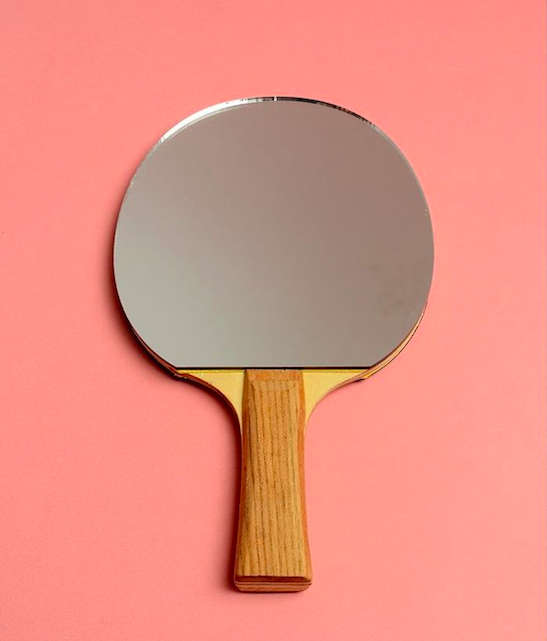
Some home objects politely sit in the corner and behave. Others walk into a room wearing a tiny cape, tap the microphone, and say, “Yes, I am a mirror shaped like a ping pong paddle. Please admire my range.” Sarah Illenger’s Ping Pong Mirror belongs proudly to the second group. More accurately, the object is associated with Berlin-based artist and designer Sarah Illenberger, whose surname is sometimes shortened or misspelled online as “Illenger.” Either way, the idea is instantly memorable: a handheld mirror that borrows the silhouette of a table tennis paddle and turns a familiar game object into a playful piece of functional design.
The Ping Pong Mirror is not simply a quirky accessory. It is a smart example of conceptual product design, where humor, craft, material choice, and everyday usefulness meet in one compact object. Made from wood and acrylic glass, measuring approximately 25 x 15 cm, and produced in Berlin, this handheld mirror proves that even the smallest decorative accessory can carry a big personality. It is the sort of design that makes people pause, smile, and then immediately check whether their hair is doing something illegal.
What Is Sarah Illenger’s Ping Pong Mirror?
At its core, Sarah Illenger’s Ping Pong Mirror is a handheld mirror shaped like a ping pong paddle. Instead of rubber and sponge, it uses reflective acrylic glass. Instead of sending a ball across a table, it sends your reflection directly back at you, hopefully with kinder lighting than your bathroom at 6:30 a.m.
The design plays with recognition. Most people know the look of a ping pong paddle: rounded head, short handle, athletic energy, a hint of basement tournament drama. By replacing the paddle surface with a mirror, the object shifts from sports equipment to design accessory without losing its original charm. It feels familiar and strange at the same time, which is exactly where memorable design often lives.
A Small Object With a Big Concept
The appeal of the Ping Pong Mirror is not based on ornament alone. It is based on transformation. A common object becomes something else. A paddle becomes a mirror. A tool for play becomes a tool for self-checking. A quick table tennis reference becomes a decorative conversation starter.
This kind of visual twist is deeply connected to Sarah Illenberger’s broader creative practice. Her work often gives everyday materials new meaning through careful handcraft, clever staging, and a sense of humor that feels intelligent rather than forced. Fruit, flowers, paper, wood, food, textiles, and ordinary household objects often become visual puns or poetic sculptures in her projects. The Ping Pong Mirror fits naturally into that world: simple, witty, tactile, and very hard to ignore.
Who Is Sarah Illenberger?
Sarah Illenberger is a German artist, illustrator, designer, and art director known for turning everyday objects into surprising visual statements. Based in Berlin, she works across photography, set design, sculpture, craft, installation, and editorial imagery. Her projects often look clean and playful at first glance, but they usually contain a precise idea underneath the surface.
Illenberger’s background in graphic design and handmade imagery helps explain why her objects feel so visually direct. The Ping Pong Mirror does not need a long instruction manual. You see it, understand the joke, and appreciate the craftsmanship almost instantly. That speed of communication is part of its success. Good design does not always need to shout. Sometimes it just needs to look like a ping pong paddle and quietly reflect your face back at you.
Design That Makes Everyday Life Feel Less Ordinary
What makes Illenberger’s work special is her ability to uncover the hidden comedy and poetry inside ordinary things. She does not treat everyday objects as boring. She treats them as raw material for imagination. A flower can become a graphic symbol. A piece of fruit can become a sculptural character. A paddle can become a mirror. In her creative universe, the ordinary is never finished; it is waiting for one more clever idea.
This approach gives the Ping Pong Mirror a strong emotional appeal. It is not luxurious in the traditional “gold-plated and guarded by velvet ropes” sense. Instead, it is luxurious because it makes daily life more delightful. You pick it up, and for a moment, checking your reflection becomes a tiny design event.
Materials and Craft: Wood Meets Acrylic Glass
The Ping Pong Mirror is made from wood and acrylic glass, a combination that gives it both warmth and lightness. Wood brings the familiar feel of a real paddle. Acrylic glass provides the reflective function while keeping the object practical and relatively lightweight. The result is an accessory that feels handmade, approachable, and contemporary.
Unlike a typical decorative mirror framed in brass, chrome, or resin, this piece speaks the language of sports equipment and studio craft. Its material story is part of its charm. The wooden handle reminds you that this object began as an idea rooted in touch and play. The acrylic mirror surface keeps the design functional without making it fragile or overly precious.
Why Acrylic Glass Works for This Design
Acrylic glass is often used when designers want a reflective or transparent surface that is lighter and less breakable than traditional glass. For a handheld object, that matters. A mirror shaped like a paddle should feel easy to pick up, wave around, hang, style on a shelf, or use near a vanity. If it were too heavy or too delicate, the playful concept would lose its ease.
The material also reinforces the object’s modern character. This is not an antique vanity mirror with carved roses and a tragic backstory. It is a crisp, contemporary design object with a mischievous grin.
Why the Ping Pong Shape Is So Clever
The ping pong paddle shape works because it already has a built-in human scale. It fits the hand. It has a handle. It has a rounded surface. In other words, it was practically waiting to become a hand mirror. Illenberger’s design does not fight the object’s original form; it reveals a second identity that was hiding in plain sight.
This is why the mirror feels so satisfying. The transformation is simple but not obvious until someone makes it. Once you see it, you think, “Of course a ping pong paddle can become a mirror.” That “of course” moment is the sweet spot of smart design.
Playfulness Without Gimmick
There is a fine line between playful design and novelty clutter. The Ping Pong Mirror stays on the right side of that line because it remains useful. It is not a joke object that becomes boring after three minutes. It still functions as a mirror. It still has a pleasing shape. It still brings texture, contrast, and personality to a room.
Its humor is not loud. It does not scream, “Look at me, I am funny!” It simply presents a familiar form in a new role. That restraint makes it suitable for modern interiors, creative studios, boutique retail displays, vanity tables, guest bathrooms, and design-focused shelves.
How Sarah Illenger’s Ping Pong Mirror Fits Modern Interior Design
Modern interior design has moved far beyond matching furniture sets and perfectly obedient accessories. Today, many of the most memorable rooms include at least one object that feels personal, odd, artistic, or gently rebellious. Sarah Illenger’s Ping Pong Mirror works beautifully in that role.
It can soften minimalist interiors by adding humor. It can sharpen eclectic rooms by adding graphic clarity. It can give a vanity area a designer touch without turning the space into a showroom where nobody is allowed to breathe. Its small size also makes it easy to style without overwhelming a room.
Where to Display It
On a vanity table, the Ping Pong Mirror becomes both tool and sculpture. On a bathroom shelf, it adds a gallery-like surprise. Hung near an entryway, it can function as a quick last-look mirror before you leave the house. Placed on a stack of art books, it becomes a visual wink for guests who notice details. In a boutique or eyewear store, it fits naturally because it invites interaction.
The design also works well in spaces that already include playful or sporty references. A game room, creative office, children’s design corner, or casual guest room can all benefit from an object that connects movement, reflection, and humor.
Decorative Mirror, Hand Mirror, or Art Object?
The best answer is: yes. Sarah Illenger’s Ping Pong Mirror sits comfortably in several categories at once. It is a decorative mirror because it adds visual interest. It is a hand mirror because it can be used practically. It is an art object because it transforms meaning through form. This category-blending quality is one reason design lovers find it so appealing.
Most mirrors are about reflection. This mirror is also about recognition. You recognize the paddle, then recognize the mirror, then recognize the joke. That layered experience gives the object more staying power than a generic accessory.
A Conversation Starter That Earns Its Place
Some conversation pieces are exhausting. They demand attention but do very little once they have it. The Ping Pong Mirror earns attention because it is visually economical. It uses one strong idea and executes it cleanly. There is no need for excessive decoration, glitter, slogans, or complicated mechanics. The concept does the work.
That makes it especially attractive for collectors of contemporary design, fans of handmade objects, and homeowners who prefer accessories with a story. It is the kind of item that lets you say, “Oh, that? It’s a ping pong paddle mirror by Sarah Illenberger,” and then enjoy the small silence while the other person processes that excellent sentence.
Why Designers Love Everyday Object Transformations
Design history is full of artists and designers who have reimagined ordinary things. The appeal is easy to understand: familiar objects carry cultural memory. We know how they feel, what they do, where they belong, and what they mean. When a designer shifts that meaning, the result can feel surprising, funny, elegant, or even philosophical.
The Ping Pong Mirror works because it respects the original object while changing its purpose. It does not erase the paddle. It keeps the paddle’s outline and hand-held identity. Then it changes the surface, and suddenly the object belongs to a different ritual. Instead of serving a fast-moving game, it serves the slower, more intimate act of looking at oneself.
From Game to Grooming Ritual
There is a delightful contrast between table tennis and mirror use. Ping pong is quick, social, competitive, and kinetic. Looking into a hand mirror is usually quiet, personal, and still. Combining those two associations gives the object energy. It makes grooming feel less stiff and design feel less serious.
And honestly, bathrooms could use the help. Many bathrooms are full of bottles, towels, toothpaste negotiations, and lighting that seems personally committed to exposing every pore. A witty handheld mirror brings a little charm into the routine.
SEO and Shopping Intent: Why People Search for This Mirror
Search interest around Sarah Illenger’s Ping Pong Mirror often comes from several overlapping audiences. Some people are looking for a unique hand mirror. Some are searching for Sarah Illenberger’s design work. Others discover the piece through modern home decor roundups, Pinterest boards, or design blogs featuring unusual mirrors. The object is highly searchable because the concept is so specific: ping pong mirror, paddle mirror, designer hand mirror, Sarah Illenberger mirror, and modern decorative mirror all point toward the same memorable idea.
From an SEO perspective, the product has strong long-tail keyword value. Generic “hand mirror” searches are crowded. But “ping pong hand mirror” or “Sarah Illenberger Ping Pong Mirror” attracts a more focused audience: people who want something unusual, design-led, and story-rich.
What Makes It Different From Ordinary Hand Mirrors?
An ordinary hand mirror usually tries to disappear into function. Sarah Illenger’s Ping Pong Mirror does the opposite. It turns function into personality. Its shape is the selling point, but the concept is what makes it memorable. It is useful enough for daily life and artistic enough for display.
That balance matters. A mirror that is only practical may be forgettable. A mirror that is only artistic may end up unused. This one can do both, which makes it more compelling for modern buyers who want fewer, better, more expressive objects.
How to Style Sarah Illenger’s Ping Pong Mirror at Home
Styling the Ping Pong Mirror is easy because it has a strong silhouette. The key is to let it breathe. Place it where its paddle shape can be seen clearly. Avoid burying it behind perfume bottles, tangled jewelry, and that one moisturizer you bought because the packaging looked expensive.
On a Vanity
Pair it with a small ceramic tray, a linen cloth, and one or two grooming essentials. The mirror’s sporty shape will contrast nicely with softer materials. This creates a balanced look: practical, artistic, and not too staged.
On a Shelf
Lean it against a stack of design books or place it beside a small sculpture. The reflective surface will add light, while the paddle shape will introduce humor. It is especially effective on open shelving, where small objects need strong outlines to stand out.
In an Entryway
Use it as a last-look mirror near the door. It is compact enough for a narrow console and interesting enough to make the entry feel intentional. Plus, there is something charming about checking your reflection in a ping pong paddle before heading into the world to answer emails like a responsible adult.
Who Will Appreciate This Mirror Most?
Sarah Illenger’s Ping Pong Mirror is ideal for people who like design with wit. It suits collectors of contemporary objects, fans of Berlin-based design, stylists, interior decorators, boutique owners, and anyone who believes a useful object can still have a sense of humor.
It also makes sense as a gift for design lovers. Unlike many decorative gifts, it does not require guessing someone’s sofa size, wall color, or emotional relationship with throw pillows. It is compact, distinctive, and easy to understand. It says, “I know you like interesting things,” without saying, “I panicked and bought a candle.”
Experiences Inspired by Sarah Illenger’s Ping Pong Mirror
Living with an object like Sarah Illenger’s Ping Pong Mirror changes how you notice small details at home. At first, it may seem like a playful accessory. You place it on a vanity or shelf because it looks clever. Then, over time, it starts becoming part of daily rituals. You reach for it before a meeting, before dinner, before taking a photo, or before stepping outside. The experience is practical, but the shape keeps it from feeling ordinary.
One of the most enjoyable things about this mirror is the way it makes people react. A guest may spot it from across the room and ask, “Is that a ping pong paddle?” That question is the beginning of the object’s magic. You hand it over, they turn it slightly, catch their reflection, and smile. It creates a tiny shared moment. Not every home accessory can do that. Many objects simply decorate. This one interacts.
The Ping Pong Mirror also has a surprisingly strong effect in creative spaces. Imagine it in a design studio, photography corner, salon, boutique, or eyewear shop. It feels casual enough to touch and artistic enough to remember. Customers are more likely to engage with it because it does not feel intimidating. It invites play. That matters in any environment where people are trying on glasses, jewelry, hats, lipstick, or confidence.
In a bathroom or dressing area, the mirror can make a routine feel lighter. Morning grooming is not always glamorous. Sometimes it involves one sock missing, coffee still brewing, and hair behaving like it has formed an independent political movement. A playful mirror does not solve these problems, but it does make the moment feel less mechanical. Instead of grabbing a plain reflective rectangle, you pick up an object with a joke built into its form. That small shift can make a room feel more human.
There is also an emotional experience connected to handmade and concept-driven objects. Mass-produced accessories often look nice but disappear into the background. A piece like this keeps reminding you that someone had an idea, shaped it, refined it, and turned it into a usable object. That awareness creates attachment. You are not just using a mirror. You are participating in a little act of design thinking: seeing one thing as another.
For styling, the best experience comes from giving the mirror a visible home. Do not hide it in a drawer unless you enjoy depriving your room of charm. Let it lean against a wall shelf, rest on a tray, or hang where the paddle shape can be appreciated. Its personality is strongest when seen from a slight distance, where the silhouette reads clearly. Up close, the reflective surface does its job. From afar, the object becomes a visual punchline.
The longer you live with it, the more it encourages a certain mindset. You start noticing other objects differently. A spoon might look sculptural. A tennis ball might become a color study. A folded napkin might suddenly seem architectural. That is the quiet power of Sarah Illenberger’s design language. It does not simply give you one clever object; it trains your eye to expect imagination from ordinary things.
For homeowners, collectors, and design enthusiasts, this is the real value of Sarah Illenger’s Ping Pong Mirror. It is charming, useful, and photogenic, yes. But more importantly, it reminds us that design does not need to be cold, complicated, or painfully serious. Sometimes the best object in the room is the one that makes you laugh softly, check your reflection, and wonder why nobody thought of it sooner.
Conclusion
Sarah Illenger’s Ping Pong Mirror is a small object with a remarkably strong design voice. Connected to the playful, craft-driven world of Sarah Illenberger, it transforms the familiar shape of a table tennis paddle into a functional handheld mirror made from wood and acrylic glass. The result is clever without being gimmicky, practical without being boring, and artistic without demanding museum-level silence.
Its strength lies in the balance between usefulness and imagination. It can sit on a vanity, brighten a shelf, enhance a boutique display, or become a memorable gift for someone who loves modern design. More than anything, it proves that everyday objects still have plenty of surprises left. Sometimes all it takes is a new surface, a familiar handle, and a designer willing to ask, “What else could this be?”