Some comedy sketches disappear the moment the applause sign goes dark. Others crawl out of Studio 8H, put on a “Death Rock” T-shirt, invade a movie premiere, haunt social media, and somehow end up in the conversation two years later. Ryan Gosling and Mikey Day’s live-action “Beavis and Butt-Head” moment belongs firmly in the second category.
What started as a ridiculous Saturday Night Live visual gag became one of those rare pop-culture moments that people could explain in one sentence and still laugh before finishing it: “Ryan Gosling and Mikey Day looked exactly like Beavis and Butt-Head, and everyone lost it.” That is the whole joke, basically. And yet, like all excellent dumb jokes, it grew legs, put on shorts, and sprinted directly into meme history.
The reason it will not go away is simple: the sketch combined celebrity commitment, old-school character makeup, live-TV chaos, nostalgia, and one of the most contagious things in comedyperformers trying desperately not to laugh. It was not just funny because Gosling looked absurd as Beavis or Day’s Butt-Head transformation was alarmingly accurate. It was funny because everyone in the room knew they were watching a train leave the tracks in real time, and somehow the derailment made the sketch stronger.
The SNL Sketch That Broke the Internetand Half the Cast
The original sketch aired during Ryan Gosling’s April 2024 hosting stint on Saturday Night Live. The setup was almost aggressively serious: a televised panel discussion about artificial intelligence. Heidi Gardner played the poised anchor. Kenan Thompson played a professor trying to explain AI’s risks. Behind the anchor sat two audience members, Dean and Jeff, played by Gosling and Day, who insisted they were just ordinary guys there to learn.
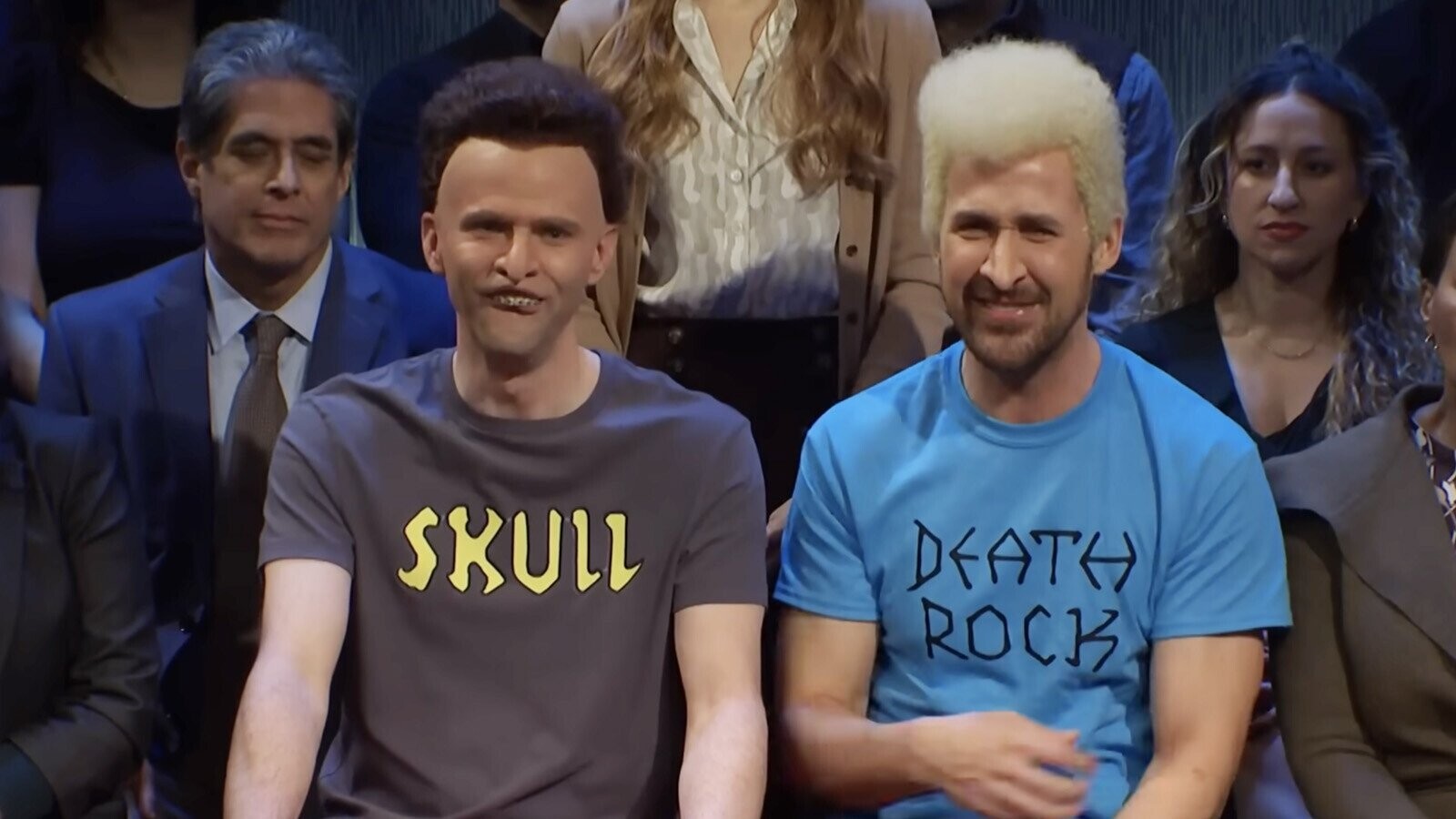
Unfortunately for everyone’s composure, those ordinary guys looked exactly like human versions of Beavis and Butt-Head. Gosling appeared with a blond pompadour, prosthetic nose, and the wide-eyed vacancy of a man who had just discovered nachos and electricity at the same time. Mikey Day’s Butt-Head look was even more dangerous to the sketch’s structural integrity: tall hair, exaggerated mouth, exposed teeth, and a face that seemed scientifically engineered to make professional comedians forget their lines.
That was the magic. The writing was clever, but the visual reveal did the heavy lifting. Gardner turned, saw Day in full Butt-Head mode, and broke into laughter. Gosling struggled too. The audience roared. Kenan Thompson, normally one of the most reliable straight-faced performers in the building, had to battle through the chaos. Suddenly the sketch was not only about two men who looked like cartoon characters. It was about watching the cast try to survive the joke.
Why the Joke Worked So Well
1. The Premise Was Absurdly Simple
Great sketch comedy often depends on clarity. The audience needs to understand the game immediately. This sketch delivered its premise with billboard-sized simplicity: two normal-looking men are not normal-looking at all; they are real-life Beavis and Butt-Head, and everyone is pretending not to notice until they absolutely cannot.
There was no need for a complicated backstory. No multi-layered parody. No inside-baseball reference requiring a graduate degree in 1990s MTV programming. Even viewers who barely knew Beavis and Butt-Head could understand the joke because the visual resemblance was so specific and so silly. Comedy does not always need a mansion. Sometimes it just needs a weird face, a dumb shirt, and a room full of people trying not to explode.
2. Ryan Gosling Committed Completely
Ryan Gosling has built a strange and wonderful second career as a handsome movie star who is also extremely willing to look ridiculous. His Barbie performance as Ken reminded audiences that he can weaponize sincerity for laughs. His SNL appearances have repeatedly shown that he is not afraid to break, grin, or lean into the chaos.
In the Beavis sketch, Gosling’s performance worked because he did not wink too hard. He played Dean as a polite, slightly confused audience member who just happened to have Beavis’ face. That restraint made the absurdity sharper. He was not yelling, “Look at me, I am doing a cartoon!” He was calmly sitting there like a man who had accidentally wandered out of an animated series and into a cable-news segment.
3. Mikey Day’s Transformation Was the Knockout Punch
If Gosling as Beavis was funny, Mikey Day as Butt-Head was the moment the sketch became a comedy emergency. The hair and makeup team clearly understood that Butt-Head’s face needed to be more than a costume. It had to feel wrong in exactly the right way. The exposed teeth, altered lip shape, and stretched expression turned Day into a walking jump scare for anyone trying to keep a straight face.
That is why Gardner’s reaction became part of the legend. She did not merely laugh at a joke. She looked like someone who had opened a closet and found comedy itself crouching inside wearing braces.
From SNL Stage to The Fall Guy Red Carpet
Most viral sketches live online and stay there. This one got a sequel in real life. At the Los Angeles premiere of The Fall Guy, Gosling first appeared in traditional movie-star mode, wearing a mint-green suit and posing for photos. Then, because normal publicity is apparently for cowards, he returned as Beavis with Mikey Day beside him as Butt-Head.
The red-carpet reprise turned the sketch into a promotional event, a meme extension, and a comedy victory lap all at once. Gosling and Day posed for photographers, interacted with the premiere atmosphere, and even crashed the broader media conversation around the film. It was a brilliant piece of entertainment marketing because it did not feel like a standard advertisement. It felt like the internet’s favorite dumb joke had escaped containment.
That is also why the bit “just won’t go away.” It moved across formats. First it was a live sketch. Then it was a YouTube clip. Then it was a red-carpet stunt. Then it became interview material, fan debate, and eventually a recurring question whenever Gosling returned to SNL: Will they do it again?
The 2026 Follow-Up That Almost Happened
By 2026, the joke still had enough cultural oxygen that a follow-up reportedly reached dress rehearsal during Gosling’s return to SNL. According to entertainment coverage, the new version would have returned to the same basic format: another serious live-TV discussion interrupted by audience members who looked suspiciously like Beavis and Butt-Head. Ashley Padilla reportedly stepped into the moderator role, while Sarah Sherman was said to appear as a Tina Belcher-style animated lookalike from Bob’s Burgers.
But the sketch did not make it to air. In a way, that may have been the smartest possible ending. Comedy lightning is hard to rebottle, especially when the first strike depended on surprise. The original worked because viewers, cast members, and even parts of the performance seemed ambushed by the final look. A sequel would have arrived carrying expectations, and expectations are comedy’s ankle weights.
Still, the fact that SNL considered bringing it back proves how unusually sticky the sketch became. A lot of viral bits get a week of attention. This one kept generating headlines, speculation, and “should they or shouldn’t they?” arguments long after its first broadcast.
Why Audiences Still Care
Nostalgia Without Homework
Beavis and Butt-Head is a recognizable piece of 1990s pop culture, but the SNL sketch did not require deep knowledge of the series. That made it accessible. Older viewers got the MTV nostalgia. Younger viewers got the ridiculous faces. Everyone got the pleasure of seeing a serious panel discussion ruined by two guys who looked like they had been drawn during detention.
Live TV Still Feels Dangerous
In an age of polished streaming comedy, perfectly edited TikToks, and heavily produced celebrity content, live television still has a special electricity. When someone breaks character on SNL, viewers feel like they are seeing something unscripted. The Beavis sketch reminded audiences that the funniest moment may not be the line itself, but the moment a performer realizes the line is impossible to deliver without laughing.
It Made Celebrity Promotion Fun Again
The Fall Guy red-carpet reprise worked because it was playful rather than robotic. Movie publicity can often feel like a long hallway of the same interviews, the same compliments, and the same “we became a family on set” quotes. Gosling and Day disrupted that rhythm. Instead of merely telling people to see the movie, they gave people something to share.
What the Sketch Says About Modern Viral Comedy
The continued life of Ryan Gosling and Mikey Day as Beavis and Butt-Head shows how viral comedy now depends on movement. A sketch cannot simply be funny; it has to travel. This one traveled because it had several built-in engines: a famous actor, a beloved SNL cast member, nostalgic cartoon characters, a shocking makeup reveal, genuine laughter, and an easy-to-caption visual.
It also benefited from contrast. Ryan Gosling is not a performer audiences expect to look like a human Beavis. That contrast is the joke’s secret sauce. The more elegant the celebrity image, the funnier the fall into absurdity. Mikey Day, meanwhile, has a gift for making bizarre characters feel oddly plausible. Together, they created a comedy image that was both stupid and precise, which is harder than it sounds.
The sketch also highlights the importance of craft. Viral moments may look spontaneous, but this one depended on hair, makeup, prosthetics, timing, camera placement, and a carefully staged reveal. The chaos felt natural because the machinery behind it was strong. That is the lovely contradiction of SNL at its best: it takes a lot of professionals working very hard to create something that looks like everyone is barely holding it together.
Should SNL Bring Beavis and Butt-Head Back?
Here is the uncomfortable truth: maybe not. Or at least, not too often. The original sketch is beloved partly because it feels like a one-time accident, even though it was obviously built with intention. Repeating it risks turning a perfect dumb surprise into a predictable routine.
That does not mean Gosling and Day should retire the characters forever. A short cameo, a red-carpet appearance, or a perfectly timed digital sketch could still work. But another full panel-discussion sketch would need a fresh angle, not just “look, they are back.” Once the audience is waiting for the prosthetic reveal, the reveal has already lost some of its power.
The best version of a sequel would understand that the real star of the first sketch was not only Beavis or Butt-Head. It was the collision between seriousness and stupidity. Find a new serious setting. Add a new escalation. Let the characters appear when nobody expects them. In other words, do not chase the meme. Let the meme wander in wearing a terrible T-shirt.
Experience Section: Why This Bit Feels Impossible to Escape
Watching the Ryan Gosling and Mikey Day Beavis and Butt-Head phenomenon unfold felt like seeing the internet rediscover an old rule: people love a joke they can explain instantly. In everyday conversation, the sketch became social currency. You could bring it up at work, in a group chat, or while standing near the snacks at a party, and someone would immediately say, “The Mikey Day face destroyed me.” That is when you know a sketch has crossed over. It no longer belongs only to the show; it belongs to the people quoting it badly while laughing into their coffee.
The experience of seeing it for the first time was especially memorable because it did not ask for patience. Some sketches warm up slowly. This one arrived like a comedy fire alarm. At first, the panel-discussion format seemed familiar: serious anchor, serious guest, serious topic. Then the camera cut to Gosling, and the room shifted. The laugh was immediate, but the sketch still had another card to play. When Mikey Day entered the frame as Butt-Head, the joke became almost unfair. It was the kind of visual that makes you laugh before your brain can file the paperwork.
What made it linger was the shared feeling of losing control. Viewers were not just laughing at the characters. They were laughing with Heidi Gardner as she tried to recover, with Gosling as he fought his own grin, and with the audience as the sketch turned into a live comedy group project. That kind of laughter feels generous. It is not mean. It is not complicated. It is everyone in the room admitting, “Yes, this is incredibly dumb, and yes, I am powerless against it.”
The red-carpet reprise added another layer to the experience. It was the rare promotional stunt that felt like a bonus joke rather than a marketing obligation. Seeing Gosling and Day bring the characters to The Fall Guy premiere made the whole thing feel delightfully unnecessary, which is exactly why it worked. Nobody needed Beavis and Butt-Head at a movie premiere. That was the point. It was silly, excessive, and weirdly charmingthree qualities modern celebrity culture could use more often.
By the time reports surfaced about a possible follow-up being cut before broadcast, the sketch had entered a new stage: comedy folklore. Fans were debating a sequel they had not even seen. Some wanted it released. Others argued it was better left alone. That debate says everything about the sketch’s staying power. A normal bit ends when the episode ends. This one kept creating new chapters: the live laugh break, the viral clip, the premiere cameo, the behind-the-scenes makeup stories, the almost-sequel, and the ongoing question of whether lightning should be invited back for a scheduled appointment.
Personally, the most enjoyable part of the whole saga is how proudly lowbrow it is while still being expertly made. It is a dumb joke built by very smart people. It reminds us that comedy does not always need to solve the world’s problems. Sometimes it just needs Ryan Gosling in a blond wig, Mikey Day with horrifying teeth, and a room full of professionals failing beautifully at professionalism.
Conclusion
Ryan Gosling and Mikey Day as Beavis and Butt-Head will not go away because the bit hit every modern comedy pressure point at once: nostalgia, celebrity surprise, live-TV unpredictability, meme-ready visuals, and genuine human laughter. The sketch was silly, but its success was not accidental. It worked because SNL built a clean premise, the performers committed, and the makeup team created images viewers could not unsee even if they tried.
The smartest move may be to let the original breathe. Not every viral sketch needs to become a franchise. But whether the characters return or remain a glorious one-and-a-half-time miracle, the legacy is secure. Gosling and Day did not just play Beavis and Butt-Head. They turned two ridiculous cartoon silhouettes into one of SNL’s most unforgettable recent comedy moments. Heh-heh, indeed.
Note: This article is written for web publication and is based on real entertainment reporting, official SNL context, and public coverage of the sketch, premiere appearance, and reported follow-up discussions.