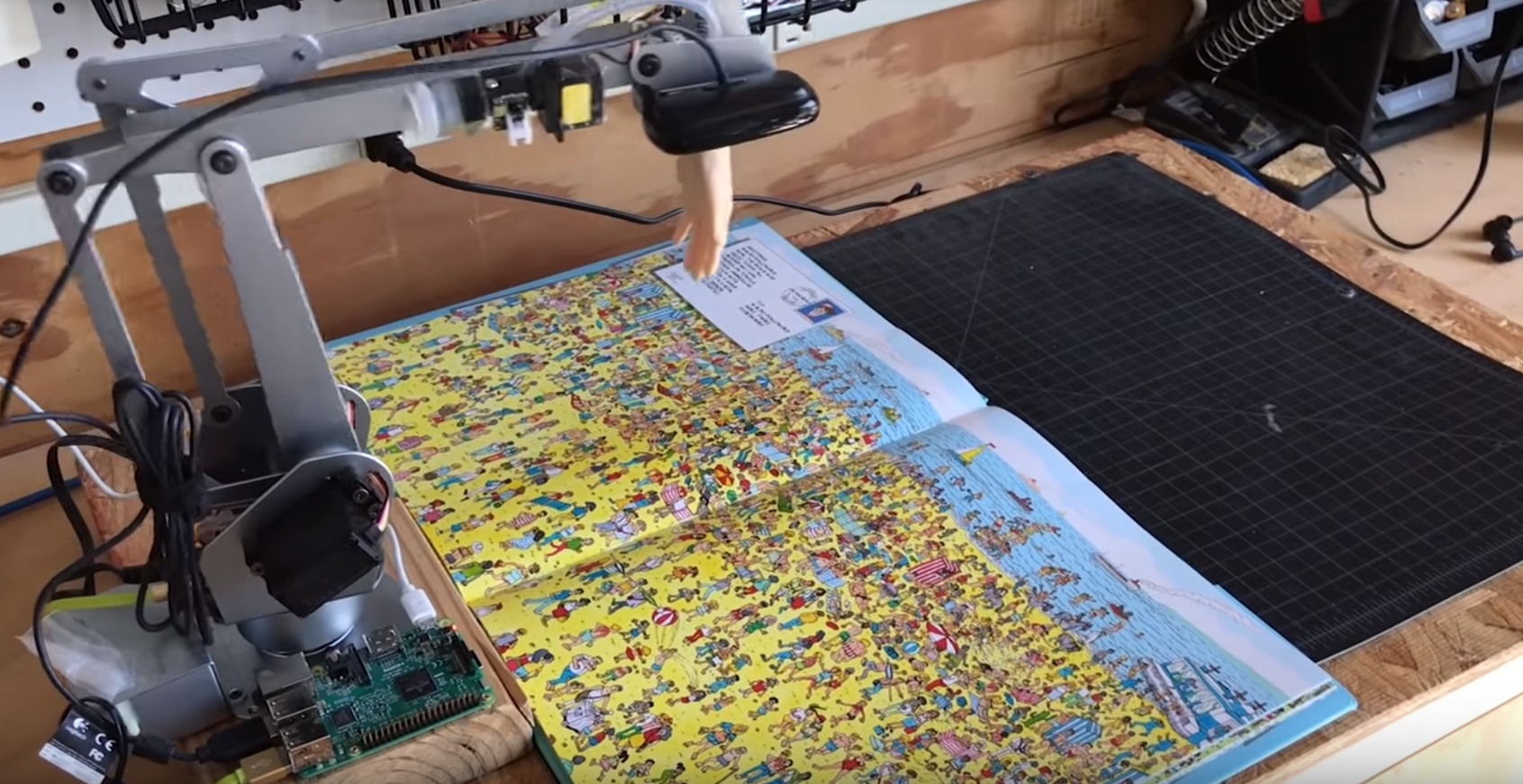
Some inventions cure disease. Some help cars avoid collisions. Some map the stars, predict storms, or make spreadsheets slightly less soul-crushing. And then there is the glorious, absolutely unnecessary, deeply entertaining machine built to answer humanity’s most urgent question: “Where is Waldo?” Yes, a robot really was shown using AI to find the world’s most famous striped introvert, and naturally the internet reacted with equal parts awe, suspicion, and wounded childhood nostalgia.
If you saw the video and immediately thought, “No way, that has to be fake,” you were not alone. The demo looked almost too smooth, too fast, too perfectly theatrical. A robot arm hovered over a Waldo page, snapped an image, analyzed faces, and then smugly pointed at the hidden character as if it had just solved world peace before lunch. It had the polished vibe of an ad campaign, which made people wonder whether the technology was genuine or whether Waldo had simply been betrayed by editing software and a very confident narrator.
The truth is more interesting than a simple yes-or-no answer. The Waldo-finding robot appears to have been a real prototype built as a proof of concept, not a fake hoax. At the same time, the demo was presented like marketing content, not like a lab-grade benchmark with a referee and a stopwatch. In other words, the robot was real enough to matter, polished enough to trigger doubt, and silly enough to become unforgettable. That combination is exactly why this story still works as a smart little case study in AI, computer vision, and the difference between technical reality and internet spectacle.
The Short Answer: Real Prototype, Showbiz Presentation
Let’s clear the striped air. The robot itself was real, and the technical stack behind it made sense. Reports described a system built around a robotic arm, a small onboard computer, image capture, OpenCV face detection, and a custom-trained image classification model. The machine’s job was not to “understand” Waldo the way a human does. It did not laugh at the crowded beach scene, appreciate the illustrator’s chaos, or feel the childhood panic of being the last person in the room to spot the red-and-white hat. It simply looked for patterns.
That is a crucial distinction. Humans search for Waldo using visual attention, context, memory, and a bit of stubbornness. The robot used computer vision. First, it narrowed the problem by identifying candidate faces or face-like regions. Then it passed those candidates through a trained model that had learned what Waldo looked like. If the confidence level crossed a threshold, the robot arm pointed to the match. That is not magic. It is not fake. It is just a very literal-minded machine doing a very literal-minded job.
Still, the “fake” question did not come from nowhere. The demonstration video was clean, fast, and dramatic. It was made to entertain, not to document every failed detection, every pause, or every awkward moment where the robot probably looked less like an AI overlord and more like a confused kitchen gadget. So the fairest verdict is this: the robot was real, the concept was legitimate, and the video likely showed the machine at its most flattering angle. In modern tech terms, it was not a fraud. It was a demo with good lighting.
How the Waldo Robot Actually Worked
A puzzle book meets computer vision
Waldo is a perfect victim for machine vision because he is distinctive and repetitive. He has the hat, the glasses, the red-and-white stripes, and the general aura of a man who should really stop dressing like a candy cane if he values privacy. In a sea of busy illustrations, those repeated features give a model something to latch onto. The trick is not finding “a person.” The trick is finding that person among many look-alike distractions.
The robot tackled that problem in stages. A camera captured the page. OpenCV was used to locate possible faces or regions worth checking. This mattered because scanning every pixel of a full Waldo page would be wasteful. By pulling out likely face candidates first, the system reduced the search space. That made the next step faster and more focused, like asking a detective to check the suspects instead of interviewing every houseplant in the building.
Training the model to recognize Waldo
After candidate faces were identified, the images were sent to a trained AI model. Reports said the project used Google’s AutoML Vision tools, which were designed to let users build image-classification systems without needing a PhD, a basement server farm, or the tears of three exhausted graduate students. The creator reportedly trained the model on dozens of Waldo images pulled from online search results, then tested whether the model could recognize Waldo in new scenes it had not seen before.
That is what makes the demo charming from a technology angle. It was not showing some giant secret military system or trillion-parameter robot wizard. It was showing that relatively accessible machine-learning tools could be connected to ordinary hardware and turned into a surprisingly effective visual search machine. The robot arm was the theatrical flourish. The real story was that custom computer vision had become usable enough for a playful side project.
The final insult: the robot points at him
Once the model found a match above its chosen confidence threshold, the system calculated coordinates and sent instructions to the robotic arm. Then the little hand swung into position and pointed at Waldo with maximum disrespect. This final gesture is why the demo became so shareable. If the system had only displayed a bounding box on a screen, people would have said, “Nice.” But the arm physically pointing at Waldo turned a technical exercise into a tiny comedy sketch. It was machine learning with impeccable comedic timing.
Why Waldo Is a Brilliant Test for AI
For humans, finding Waldo is a game. For AI, it is a compact visual-search problem hiding inside a children’s book. The page is crowded. The target is small. Distractors are everywhere. Colors repeat. Shapes overlap. And the object of interest can appear at different scales, positions, and angles. That makes Waldo more than a joke challenge. It is a simplified version of a real vision problem: how do you locate one important thing in a noisy visual environment?
Researchers have long used “Waldo-like” tasks to think about attention and search. Human beings do not examine every inch of a scene equally. We use selective attention. We jump around visually. We weigh features. We rule out regions. We make fast guesses and sometimes very dumb mistakes. That is one reason Waldo puzzles are oddly revealing: they expose how visual attention works when the scene is cluttered and the target is rare. A machine doing the same task creates an immediate, intuitive comparison between biological vision and computer vision.
That is also why the Waldo robot resonated beyond novelty. It translated abstract AI language into something anyone could understand. You did not need to know what a classifier was. You just had to know that Waldo is annoying to find, and a robot found him. Suddenly ideas like object recognition, candidate filtering, model confidence, and pattern matching became visible in one ridiculous, memorable moment.
Why People Thought It Might Be Fake
Because the internet has been hurt before. Also, because tech demos often arrive with dramatic music, slick edits, and suspiciously perfect outcomes. The Waldo robot video landed right in that sweet spot where a real prototype can look a little too cinematic for comfort. Viewers reasonably wondered whether the machine was truly locating Waldo live or whether the sequence had been stitched together to make the process appear smoother and faster than it really was.
That skepticism was healthy. A lot of AI marketing depends on people confusing “interesting proof of concept” with “robust product ready for everyday use.” The Waldo robot was almost certainly the former. It was built to demonstrate possibility, not to survive ten thousand messy, uncontrolled real-world tests. That does not make it fake. It makes it normal. Most memorable AI demos are curated, and some are extremely curated. The important question is not whether the footage was polished. It is whether the underlying system could plausibly do what the demo claimed.
In this case, the answer appears to be yes. The components were believable, the pipeline was technically coherent, and multiple reports described the same mechanism: capture the page, detect likely faces, classify candidates, then point at the correct location. Even the fastest time claim sits in a reasonable zone for a narrow visual task like this. So while the demo may have worn makeup, the face under the makeup still seems to have been real.
What This Demo Really Proves About AI
The biggest lesson is not that robots are coming for puzzle books, though that headline is admittedly more fun. The real lesson is that AI works best when the task is tightly defined. The Waldo system had one job. It did not need to explain the joke on the page, hold a conversation about Waldo’s travel itinerary, or detect existential loneliness in striped knitwear. It only needed to answer a narrow visual question: “Is this candidate region Waldo?”
That is how a large share of useful AI works in the real world. It handles bounded problems. It classifies images. Flags anomalies. Sorts documents. Detects objects. Highlights likely matches. When you ask AI to operate inside a clear lane, it can look impressively smart. When you ask it to understand the whole highway, things get bumpier. The Waldo robot is a wonderful example of this principle because the task is so easy to grasp. Narrow scope, strong performance, funny outcome.
It also shows the power of combining simple tools rather than worshipping one giant model. The system did not rely on a single magical brain. It used a pipeline: image capture, region detection, classification, coordinate mapping, robotic motion. That is how many practical systems succeed. They break the work into stages. Each stage does one thing well. Together, they create an experience that feels smarter than any single part.
What It Does Not Prove
It does not prove that AI “understands” art, children’s books, or search puzzles the way people do. It does not prove that a custom-trained model can effortlessly handle every cluttered scene. It does not prove that a flashy demo equals general intelligence. And it definitely does not prove that your childhood has been invalidated by a robotic arm with better aim than you.
Humans still bring something the machine lacks: context. A person can infer where Waldo is likely to be based on composition, habits, and visual storytelling. A person can enjoy the page. A person can get distracted by the guy falling off a boat, the penguin wearing sunglasses, or the fact that one illustrator somewhere made a career out of drawing absolute chaos with the confidence of a deity. The robot cannot appreciate any of that. It is not playing the game. It is ending the game.
That is why the Waldo robot feels both impressive and faintly rude. It solves the task while skipping the experience. And that, in miniature, is one of the most important tensions in modern AI: efficiency is not the same thing as meaning. Sometimes we want the answer fast. Sometimes the search is the point.
The Human Experience of Watching AI Find Waldo
What makes this story stick is not just the technology. It is the emotion around it. Watching a robot find Waldo creates a weird cocktail of reactions. First comes curiosity. Then admiration. Then a tiny pang of betrayal, as if the machine has broken an unwritten childhood rule. Waldo was never supposed to be found by a device with a camera, a classifier, and a smug little pointing finger. Waldo was supposed to be found by a bored kid on the living room floor, by a parent pretending not to help, or by an older sibling who definitely cheated and definitely will not admit it.
There is also something deeply recognizable about the robot’s appeal. We love watching machines do absurdly specific tasks with total commitment. A robot that folds laundry is useful. A robot that finds Waldo is art. It takes a problem nobody needed solved and solves it with such confidence that the result becomes funny, memorable, and oddly revealing. It reminds us that technology often reaches the public first through spectacle. People may not care about abstract computer vision pipelines, but they absolutely care when a machine humiliates them at a puzzle from elementary school.
For teachers, parents, and curious readers, the demo also offers a useful teaching moment. It turns AI into something visible. You can explain that the machine is not “seeing” like a person. It is comparing patterns. You can talk about training data, false positives, thresholds, and why a robot might confuse a fake Waldo for the real one if the clues are similar enough. Suddenly AI is not a spooky cloud word. It is a practical system with strengths, limits, and hilarious applications.
There is a more personal layer too. A lot of people who watched the Waldo robot felt a mix of delight and discomfort because it mirrored a larger cultural shift. We are living in a time when machines are doing more of the searching, filtering, sorting, and deciding that people used to do manually. Email gets prioritized. Photos get tagged. Music gets recommended. Feeds get ranked. The Waldo robot is just a tiny cartoon version of that larger truth: increasingly, the machine is the one scanning the crowd.
And yet, the demo does not feel dystopian so much as comically honest. It shows AI in a form small enough to laugh at. The robot is not replacing a surgeon or a judge. It is ruining a puzzle book. That makes the larger lesson easier to digest. We can laugh at the silly use case while noticing the serious structure underneath it. Pattern recognition plus automation plus a narrow objective equals powerful behavior. Today it is Waldo. Tomorrow it is quality control, medical triage, warehouse scanning, fraud screening, or assistive technology.
That is why the experience of watching the robot is so satisfying. It works on two levels at once. On the surface, it is a goofy flex from a machine with no respect for the spirit of play. Underneath, it is a clean demonstration of how modern AI often enters everyday life: not as a philosopher, not as a genius, but as a specialist. Fast. Focused. Effective. Slightly annoying. Weirdly impressive.
And maybe that is the most human reaction of all. We do not watch the Waldo robot and think, “Behold, the singularity.” We watch it and think, “Okay, that is clever… but I still kind of want to find him myself.” The machine wins the stopwatch. We keep the story. That feels like a fair trade.
Final Verdict
So, real or fake? Real enough to count, polished enough to raise eyebrows, and funny enough to live far longer than most tech demos deserve. The Waldo robot was not a grand fraud. It was a playful, believable application of computer vision wrapped in the kind of presentation that makes the internet suspicious for all the right reasons.
Its real achievement was not just locating Waldo. It located something else too: the exact point where AI stops being abstract and becomes memorable. A robot using pattern recognition to point at a striped cartoon man should not be such an effective explainer for machine learning. And yet, here we are. Waldo did not just get found. He helped reveal how modern AI works when it is narrow, trained, and given a stage.
Bad news for Waldo. Great news for anyone trying to explain computer vision without putting a room full of people to sleep.