Many people approach investing as if the market were a stubborn combination lock: stare hard enough, study enough charts, and eventually the next winning number will click into place. Unfortunately, markets are less like a lock and more like weather in a mountain town. Forecasts can help, conditions change quickly, and the person carrying a raincoat usually looks smarter than the person arguing with the clouds.
Playing the probabilities means accepting that no investor can know exactly what happens next. Instead of demanding certainty, you create a process that gives you a reasonable chance of reaching your goals across many possible futures. That shiftfrom prediction to preparationis one of the most useful ideas in long-term investing.
What Does “Playing the Probabilities” Mean?
In finance, probability is not a promise. A 70% chance of success still includes a 30% chance of disappointment, awkward silence, and perhaps a strongly worded conversation with your spreadsheet.
Probabilistic thinking asks a better question than, “Will this investment go up?” It asks, “What outcomes are plausible, how likely is each one, and can I survive the unfavorable cases?”
This approach is closely related to expected value, a basic concept in decision analysis. Expected value weighs each possible outcome by its estimated probability. It does not tell you what will happen on one attempt. Instead, it helps evaluate whether a repeatable decision is likely to produce favorable results over time. Decision-analysis programs at MIT, Stanford, and Harvard use probability, alternatives, preferences, and the value of information to structure choices under uncertainty.
A Simple Expected-Value Example
Suppose an opportunity has a 60% chance of producing a $20 gain and a 40% chance of causing a $10 loss. Its simple expected value is $8:
(0.60 × $20) − (0.40 × $10) = $8
That does not mean every attempt earns exactly $8. You might gain $20 or lose $10. The calculation merely suggests that the setup may be favorable when repeated, assuming the probabilities are reasonably accurate and the possible loss remains manageable.
Investing is more complicated because probabilities change, outcomes are connected, and nobody hands investors a tidy answer key. That is precisely why a consistent process matters more than pretending to know the future.
Time Horizon Changes the Odds
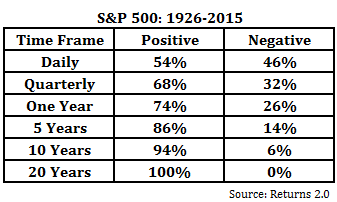
Tomorrow Is Noisy; Decades Are About Economics
Over a day or week, stock prices can react to headlines, interest-rate expectations, earnings surprises, political events, forced selling, or a celebrity chief executive posting something unusual at 2:13 a.m. Short-term price movements can resemble a coin toss.
Over longer periods, investment returns are more strongly connected to business growth, profits, dividends, valuation, inflation, and the price originally paid. Historical U.S. market data maintained by NYU Stern extends back to 1928 and illustrates why investors should examine long stretches rather than one unusually cheerful or miserable year. Fidelity notes that positive outcomes have historically become more common as holding periods lengthen, while Vanguard emphasizes that longer horizons improve an investor’s opportunity to recover from down markets.
None of this guarantees future gains. It simply explains why time horizon is central to investment planning.
Money needed next month should not be invested like money intended for retirement in 25 years. A stock-heavy portfolio may be reasonable for a distant goal and reckless for next semester’s tuition. An asset is not automatically good or bad; its suitability depends on when the money is needed and how much loss the investor can tolerate.
Compounding Rewards Investors Who Can Remain Invested
Compounding is often described as a magical snowball. However, the snowball grows only if it remains on the hill. Reinvested earnings can generate additional earnings, but panic selling, excessive fees, leverage, and concentrated bets can interrupt the process.
The practical objective is not to maximize excitement. It is to remain financially and emotionally capable of staying invested through uncomfortable periods.
Prediction Is Optional; Risk Management Is Not
A forecast may be useful, but a portfolio that works only when one forecast is exactly right is dangerously fragile. Strong probabilistic planning assumes that recessions, inflation shocks, bear markets, bubbles, and surprising recoveries will occur without requesting an appointment.
The SEC’s Investor.gov explains that every investment involves risk and that higher potential returns generally come with greater uncertainty or potential loss. FINRA similarly distinguishes broad market risks from risks concentrated in one company, industry, or asset. It identifies asset allocation and diversification as important tools for managing those risks.
This leads to a useful rule: never accept a risk merely because the best-case outcome looks attractive. Ask whether the downside could permanently damage your plan.
A 50% loss requires a 100% gain just to return to the starting point. Avoiding financial ruin matters more than collecting bragging rights at brunch.
Why Smart People Still Make Bad Probability Bets
Loss Aversion
People generally feel losses more intensely than equivalent gains. Prospect theory, developed by Daniel Kahneman and Amos Tversky, challenged the idea that people evaluate risky choices with perfectly consistent logic.
Investors may hold a losing position to avoid admitting a mistake, sell a sound investment after a frightening decline, or refuse reasonable risk because a previous loss still feels freshly microwaved.
Recency Bias
When markets rise for several years, investors can begin treating unusually strong returns as normal. When prices fall, those same investors may assume the decline will continue indefinitely.
The latest experience becomes the entire history. Probabilistic thinking counters this bias by using long-term evidence, written rules, and reasonable outcome ranges rather than one dramatic chart.
Overconfidence
Success can be especially dangerous when luck dresses up as skill. A concentrated stock pick that doubles may encourage an even larger second bet, although the original result says little about whether the success can be repeated.
Good decision-makers separate outcome quality from decision quality. A sensible choice can produce a poor result, while a foolish choice occasionally arrives in a limousine.
Action Bias
Doing nothing can feel irresponsible during market turbulence, even when doing nothing is exactly what a well-designed plan requires. Financial media operates every day; your portfolio does not need to.
Activity creates the sensation of control, but frequent changes can add taxes, costs, stress, and additional opportunities for error.
How to Put the Odds More Firmly in Your Favor
1. Match Every Investment to a Goal
Start with the purpose, amount, and deadline. Keep near-term spending needs in assets designed for stability and liquidity. Use riskier growth assets only where the time horizon and your financial position can tolerate volatility.
Investor.gov connects longer time horizons with the ability to consider higher-risk asset categories, while cash and cash equivalents may be more appropriate for short-term goals.
2. Diversify Across Independent Sources of Return
Diversification is not owning 25 technology stocks and congratulating yourself on the number 25. It means spreading exposure across companies, industries, regions, and asset classes whose outcomes are not identical.
FINRA describes diversification as spreading investments both among and within asset classes. Rebalancing is then used to restore the intended mix. Morningstar also cautions that different fund names do not necessarily provide true diversification when their underlying holdings overlap.
3. Automate Regular Contributions
Regular investing turns a difficult emotional decision into a routine. Dollar-cost averaging means investing equal or similar amounts at scheduled intervals regardless of current market conditions.
It cannot guarantee a profit or prevent losses, but FINRA notes that scheduled investing may remove some emotion and reduce impulsive buying and selling.
4. Rebalance Instead of Reacting
Rebalancing means periodically returning a portfolio to its target allocation. After stocks surge, that may involve trimming them and adding to bonds or cash. After a decline, it may require buying assets that currently make television commentators frown.
Rebalancing provides a disciplined way to sell relatively high and buy relatively low without pretending to identify exact market tops and bottoms.
5. Keep Costs and Taxes Under Control
Future market returns are uncertain; fees are wonderfully punctual. Expense ratios, trading spreads, advisory fees, and taxes reduce the return an investor keeps.
A low-cost, tax-aware strategy does not guarantee success, but it improves the arithmetic before the market even opens.
6. Maintain an Emergency Fund
A cash reserve can prevent a temporary financial problem from becoming a permanent investment loss. Without emergency savings, an investor may be forced to sell volatile investments during a downturn to cover repairs, medical expenses, or lost income.
Liquidity is not glamorous, but neither is selling at the worst possible moment because the water heater has declared independence.
7. Limit the Size of Speculative Positions
There is nothing inherently wrong with making a small speculative investment when you understand the risk. The problem begins when one exciting idea becomes large enough to threaten an essential financial goal.
Position sizing lets an investor explore uncertain opportunities without allowing one incorrect prediction to wreck the entire portfolio.
The Hidden Cost of Trying to Time the Market
Market timing requires two correct decisions: when to get out and when to return. The second decision is often harder because recoveries can begin while economic news remains terrible.
Vanguard notes that the market’s best and worst days frequently occur close together. In one J.P. Morgan illustration covering a 20-year period, seven of the market’s 10 best days occurred within 15 days of one of its 10 worst days. Missing the 10 best days substantially reduced the annualized return compared with remaining invested throughout the period.
This does not mean investors must hold every asset forever. Selling can be rational when a financial goal changes, a portfolio becomes too concentrated, a company’s fundamentals deteriorate, cash is needed, or rebalancing calls for a reduction.
The important distinction is between a planned adjustment and an emotional escape.
What Probabilities Cannot Do
Probability is a framework for managing uncertainty, not a machine for converting uncertainty into certainty. Historical averages can become less useful when valuations, inflation, taxes, regulations, technology, or investor behavior change.
Models can fail because their assumptions are wrong. Even a strategy with favorable long-term odds may experience years of disappointing results.
Robust plans therefore use margins of safety. Make conservative assumptions, avoid excessive leverage, and do not place an essential goal on one outcome. Review debt, insurance, savings rates, cash flow, and spendingnot only investment returns.
The world’s finest portfolio cannot rescue a financial plan that requires impossible performance.
A Practical Probability Checklist
- Define the decision: What are you choosing, and what happens if you do nothing?
- List plausible outcomes: Include ordinary, optimistic, and painful scenarios.
- Estimate ranges: Treat probabilities as guides, not decorative decimals pretending to be certainty.
- Measure the downside: Can your plan survive the unfavorable case without forced selling or dangerous debt?
- Look for repeatability: Is this a one-time gamble or a disciplined process that can work across many decisions?
- Examine the evidence: Is the forecast supported by data, or is someone earning a commission from your enthusiasm?
- Write rules in advance: Establish contribution, rebalancing, and selling rules before emotions arrive with a megaphone.
Experiences From Playing the Probabilities
The most memorable investing lessons usually arrive when the market refuses to cooperate with a carefully prepared opinion. Consider a composite investor named Maya, whose story reflects experiences shared by many long-term investors.
Maya began with a simple retirement portfolio and a monthly contribution. Then a sharp market decline arrived. Her account balance fell, financial headlines became apocalyptic, and every ordinary grocery trip somehow felt connected to global monetary policy.
Her first instinct was to sell everything and “get back in when things settled down.” That sentence sounded prudent until she tried to define “settled down.” Would she return after prices recovered 5%? After economic growth improved? After news anchors stopped using red graphics?
There was no objective signal. Maya realized that selling would replace one uncomfortable decision with two even harder decisions: choosing when to exit and when to return.
Instead, she examined the foundation of her plan. She had several months of expenses in cash, no immediate need for the invested money, broad diversification, and a contribution schedule tied to payday. The portfolio was falling, but the plan itself had not failed.
She continued contributing. Some purchases declined further, which felt like being punished for following instructions. Later contributions bought more shares at lower prices, and the market eventually recovered. The important lesson was not that every decline ends quickly. It was that liquidity and a long horizon gave her the ability to wait.
A second lesson came during a booming market. One fast-growing company dominated conversations at work. Several coworkers owned it, and their confidence expanded in direct proportion to the stock chart.
Maya bought a small position. It rose immediately, and she felt unusually talented. Rather than doubling the investment, she wrote down why she had bought it, how much she was prepared to lose, and the maximum percentage of her portfolio it could occupy.
Months later, the stock dropped sharply after disappointing results. The loss was irritating but not catastrophic because position sizing had converted an exciting story into a controlled experiment.
Her third lesson involved diversification. During one period, international stocks and bonds lagged the hottest U.S. companies. The diversified parts of her portfolio looked like guests who had arrived at the party wearing sensible shoes.
She considered removing them. Her rebalancing policy required the opposite: trim assets that had grown beyond their targets and add to areas that had fallen below them. Not every lagging investment later became a winner, but her portfolio became less dependent on a narrow group of companies continuing to exceed enormous expectations.
The fourth lesson was that behavior improves when decisions become boring. Automatic deposits, an annual allocation review, and written rebalancing bands removed dozens of opportunities to panic. Maya stopped checking her balance several times a day. Nothing fundamental about the portfolio changed, yet her experience improved because she reduced the number of emotional decisions.
The final lesson was humility. Maya learned to say, “I do not know what happens next, but I know what I will do under several conditions.”
If stocks rose, she would rebalance when necessary. If they declined, she would continue scheduled contributions while her income and emergency fund remained secure. If her goals changed, she would adjust the allocation. If a single investment became dangerously large, she would trim it.
That is the heart of playing the probabilities: not predicting one future, but preparing for many.
Conclusion: Build a Process That Can Be Wrong and Still Work
Successful investing is not a contest to produce the most impressive forecast. It is the quieter work of aligning risk with time, diversifying, controlling costs, saving consistently, and avoiding decisions that could permanently remove you from the game.
You will sometimes make a sound decision and receive a poor outcome. You will occasionally make a questionable decision and get rewarded. Do not allow either result to teach you the wrong lesson.
Judge the quality of your process, update your assumptions when evidence changes, and protect yourself from outcomes you cannot afford.
The future will remain stubbornly uncertain. That is not a flaw in the system; it is part of the price investors pay for potential returns. You do not need certainty. You need favorable odds, enough time, sufficient resilience, and a plan sturdy enough to survive both bad markets and your own worst impulses.