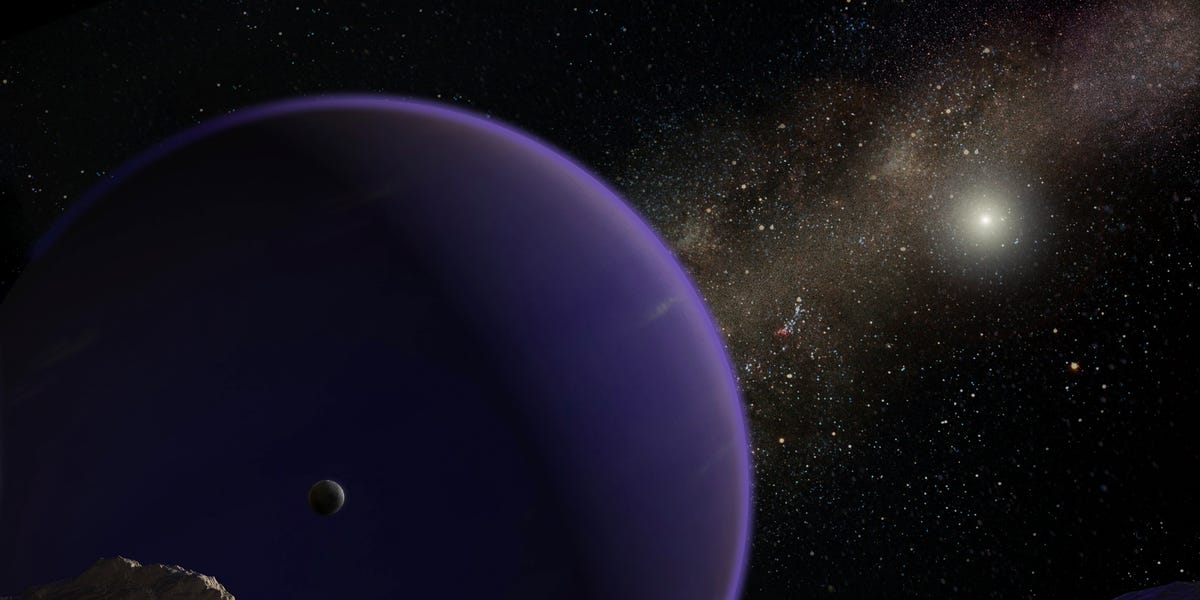
Some mysteries arrive with thunder, flashing lights, and dramatic theme music. Planet 9 arrived more like a quiet knock from the dark edge of the solar system. No one has photographed it. No spacecraft has visited it. No telescope has yet waved excitedly and said, “Found it!” And yet, the idea refuses to go away.
Planet 9, also called Planet Nine or sometimes Planet X, is a proposed planet that may orbit far beyond Neptune and Pluto. It is not confirmed, but astronomers have spent years studying strange patterns in the orbits of distant icy objects. These patterns suggest that something massive may be shaping their paths. In other words, Planet 9 is not a rumor from a sci-fi forum; it is a serious scientific hypothesis built on gravity, math, telescope surveys, and a healthy amount of cosmic patience.
If Planet 9 exists, it would likely be much larger than Earth, much farther away than Neptune, and so cold that even your freezer would look tropical by comparison. The search is one of the most fascinating detective stories in modern astronomy because the suspect is invisible, the footprints are gravitational, and the crime scene is billions of miles wide.
What Is Planet 9?
Planet 9 is a hypothetical planet thought to exist in the distant outer solar system. The most popular version of the theory proposes a world roughly five to ten times the mass of Earth, following a long, stretched-out orbit far beyond Neptune. If real, it may take between 10,000 and 20,000 Earth years to complete one trip around the Sun. That is not a year; that is a geological sigh.
The idea became widely known in 2016 when Caltech researchers Konstantin Batygin and Michael Brown presented evidence that a distant giant planet could explain unusual orbital patterns among extreme trans-Neptunian objects. These objects are small, icy bodies that orbit beyond Neptune, many in the remote Kuiper Belt and beyond. Their paths appear too oddly organized to dismiss easily, though scientists continue to debate whether the pattern is real or partly caused by how and where telescopes have searched.
Planet 9 should not be confused with Pluto. Pluto was considered the ninth planet for decades before being reclassified as a dwarf planet in 2006. Planet 9, if discovered, would be a completely different object: larger, more distant, and likely powerful enough gravitationally to clear and control its orbital neighborhood. Pluto is the charming former planet with a heart-shaped glacier; Planet 9 is the mysterious heavyweight hiding somewhere in the dark.
Why Do Scientists Think Planet 9 Might Exist?
The case for Planet 9 comes from indirect evidence. Astronomers have noticed that some distant solar system objects seem to have orbits that point in similar directions. Imagine dropping a handful of pencils on the floor and discovering that several of them landed in a suspiciously neat arrangement. One pencil? Random. Two pencils? Still possible. Several pencils? Now the room starts looking guilty.
In the outer solar system, gravity is the organizer. Neptune influences many Kuiper Belt objects, but some distant bodies are too far away to be easily explained by Neptune alone. Their elongated orbits, high perihelia, and strange clustering suggest that another massive object could be tugging them over millions or billions of years.
Orbital Clustering
The strongest argument for Planet 9 involves orbital clustering. Some extreme trans-Neptunian objects have elongated orbits whose closest approaches to the Sun seem to group together instead of being randomly scattered. Planet 9 could act like a distant gravitational shepherd, slowly arranging these objects into patterns.
Detached Objects
Objects such as Sedna and 2012 VP113 follow unusual paths that keep them far from Neptune’s strong influence. They are often called detached objects because they do not behave like ordinary Kuiper Belt residents. A distant massive planet could help pull objects into these strange, detached orbits.
High-Inclination and Retrograde Orbits
Some bodies beyond Neptune orbit at steep angles, and a few even move in directions that seem upside down compared with the main planetary plane. Planet 9 models can produce some of these oddball paths over long timescales. In astronomy, “oddball” is not an insult; it is often where the good science lives.
Why Hasn’t Planet 9 Been Found Yet?
The simple answer is distance. The outer solar system is enormous, dark, and inconveniently unwilling to label its planets with neon signs. A planet far beyond Neptune would reflect very little sunlight. Even if it is several times more massive than Earth, it could appear as a faint point moving slowly against a crowded background of stars.
There is also the problem of sky coverage. Telescopes do not search every patch of sky with equal depth. Some areas are harder to observe because they lie near the Milky Way’s dense star fields, where a faint moving planet could blend into the cosmic confetti. Other regions may require repeated observations over long periods to detect slow motion.
Recent searches have narrowed the possibilities. The Pan-STARRS1 survey, combined with earlier searches using data from the Zwicky Transient Facility and the Dark Energy Survey, has ruled out a large portion of the predicted search space for certain Planet 9 models. That does not kill the hypothesis, but it does make the remaining hiding places smaller and more specific. The suspect has fewer rooms left in the mansion.
How Far Away Could Planet 9 Be?
Neptune orbits about 30 astronomical units from the Sun, where one astronomical unit, or AU, is the average distance between Earth and the Sun. Planet 9 may orbit hundreds of AU away, depending on the model. At those distances, sunlight is weak, temperatures are extremely low, and orbital motion is painfully slow from our perspective.
If Planet 9 is near the farthest part of its orbit, it would be especially difficult to detect. A planet does not shine by itself in visible light; it reflects sunlight. The farther it is from the Sun, the less light reaches it and the less light returns to Earth. Searching for it is like trying to spot a charcoal-gray marble in a dark stadium from another city. With astronomy, the stadium is also moving.
What Would Planet 9 Be Like?
If it exists, Planet 9 may resemble a mini-Neptune or super-Earth. Our solar system has small rocky planets like Earth and Mars, and giant planets like Jupiter, Saturn, Uranus, and Neptune. What it does not have, at least among confirmed planets, is a common type of world seen around other stars: planets between Earth and Neptune in size. Planet 9 could fill that missing category in our own backyard.
A mini-Neptune-like Planet 9 might have a rocky or icy core wrapped in a thick atmosphere of hydrogen, helium, methane, or other volatile compounds. It would not be a pleasant vacation spot. The sunlight would be faint, the temperature brutal, and the travel time absurd. Even the most enthusiastic travel blogger would need a very flexible return policy.
Scientists have proposed several origin stories. Planet 9 may have formed closer to the Sun and been scattered outward by gravitational interactions with Jupiter or Saturn. It may have formed in a distant orbit during the Sun’s early years. Some researchers have even explored whether the Sun could have captured such a world from another star when the solar system was young and still living in a crowded stellar nursery.
Planet 9 vs. Planet X: Are They the Same?
The names can get messy. “Planet X” historically referred to any unknown planet proposed to explain orbital puzzles. It was used during the search that eventually led to Pluto’s discovery in 1930. Today, NASA and many science communicators sometimes use Planet X and Planet 9 to describe the same modern hypothetical object beyond Neptune.
However, Planet 9 is not the same as internet myths about a doomsday planet. There is no credible evidence that a hidden planet is about to collide with Earth, darken the skies, or ruin everyone’s weekend. The scientific Planet 9 hypothesis describes a distant, stable orbit far beyond Pluto. If it exists, it is not coming for us. It is minding its business in the frozen suburbs of the solar system.
The Debate: Strong Clues or Selection Bias?
Planet 9 is exciting, but it is not settled science. The biggest challenge is observational bias. Telescopes discover objects only where they look, when they look, and to the depth they can see. If surveys focus on certain parts of the sky, the discovered objects may appear clustered even if the real population is more random.
Some surveys, including the Outer Solar System Origins Survey, have argued that the apparent clustering may weaken when researchers carefully account for where telescopes were capable of finding objects. Other scientists respond that the clustering and related orbital features remain difficult to explain without a massive perturber. This is science doing what science does best: arguing politely with equations.
New discoveries can also complicate the picture. A distant object with an orbit that does not fit the expected alignment may weaken some versions of the Planet 9 hypothesis. On the other hand, unusual new objects can also reveal that the outer solar system is more complex than anyone thought. Either way, the mystery deepens, which is excellent news for astronomers and mildly stressful news for textbook writers.
How Astronomers Are Searching for Planet 9
Astronomers search for Planet 9 by comparing images of the same sky region taken at different times. Stars and galaxies remain almost fixed in position, while solar system objects move. A distant planet would shift very slowly, so researchers need careful image processing, repeated observations, and a lot of patience.
Large sky surveys are especially useful. Pan-STARRS, the Dark Energy Survey, and the Zwicky Transient Facility have all contributed to narrowing the possible search region. Far-infrared searches using archival data have also been explored because a cold distant planet may emit more detectable heat than reflected visible light. So far, no confirmed Planet 9 has appeared.
The Vera C. Rubin Observatory may become a major player in the search. Its Legacy Survey of Space and Time is designed to scan the southern sky repeatedly over ten years, creating a time-lapse movie of the universe. That makes it excellent for spotting moving objects, from asteroids to distant Kuiper Belt bodies. If Planet 9 is bright enough and located in the surveyable sky, Rubin could either find it or seriously tighten the noose around the remaining possibilities.
Why Planet 9 Matters Even If It Does Not Exist
The search for Planet 9 has already improved our understanding of the outer solar system. Scientists have refined models of Kuiper Belt dynamics, discovered new distant objects, improved survey methods, and tested ideas about planet formation. Even a failed search would still be valuable because it would tell astronomers what is not out there.
This is one of the beautiful things about science: a wrong answer can still be useful if it is tested honestly. If Planet 9 is found, it would be one of the most important solar system discoveries in modern history. If it is not found, scientists will need better explanations for the strange behavior of distant objects. Either result expands the map.
Common Myths About Planet 9
Myth 1: Planet 9 Has Already Been Discovered
No. Planet 9 has not been directly observed. Astronomers have evidence that may point to it, but no confirmed image, orbit, or official planetary status exists.
Myth 2: Planet 9 Is Pluto Coming Back
Also no. Pluto remains a dwarf planet. Planet 9 would be a different object, likely much more massive and much farther away.
Myth 3: Planet 9 Is Dangerous
There is no credible scientific evidence that Planet 9 threatens Earth. If it exists, it is extremely distant and follows a long orbit in the outer solar system.
Myth 4: Scientists Are Just Guessing
They are not guessing in the casual sense. The Planet 9 hypothesis comes from mathematical modeling, orbital analysis, telescope surveys, and computer simulations. It remains unconfirmed, but it is not random speculation.
Experience Section: Thinking About Planet 9 Like a Backyard Skywatcher
Planet 9 is not something most people can step outside and see through a backyard telescope. That can feel disappointing at first. After all, astronomy has a special magic when you look up and spot something with your own eyes. The Moon is obvious. Jupiter is bright. Saturn is unforgettable through a telescope, looking almost suspiciously perfect, as if someone pasted a sticker in the eyepiece. Planet 9, by contrast, is the cosmic equivalent of a whispered clue.
But that is exactly what makes the experience of learning about it so interesting. Planet 9 teaches a different kind of wonder. Instead of “Look, there it is,” the experience becomes “Look at what gravity may be telling us.” It invites readers, students, and casual space fans to think like detectives. You begin with objects that are known, such as Sedna and other distant trans-Neptunian bodies. Then you ask why their orbits look unusual. You compare possible explanations. You examine bias. You wait for better data. That process is slower than a viral space photo, but it is deeply satisfying.
A good way to experience the Planet 9 mystery is to imagine standing at the edge of a frozen lake at night. You cannot see what is moving under the ice, but you notice ripples, cracks, and patterns. Something may be down there, or the patterns may come from wind, temperature, or the shape of the lake itself. Planet 9 is similar. Astronomers are studying the ripples in the outer solar system and asking whether a hidden world is responsible.
For educators and science writers, Planet 9 is a perfect topic because it shows that science is not just a list of finished facts. It is a living process. Students often hear about planets as if the solar system were fully settled: Mercury, Venus, Earth, Mars, and so on. Planet 9 interrupts that neat classroom chant and says, “Actually, we may not be done counting.” That is a thrilling message. It reminds us that exploration is not only about rockets. Sometimes it begins with a strange orbit and a question mark.
For amateur astronomy fans, following the Planet 9 search can be a lesson in humility. The sky is vast, and human knowledge is still incomplete. Even with advanced telescopes and powerful computers, a possible planet in our own solar system can remain hidden. That does not make science weak; it makes the universe big. Very big. Rudely big, one might say.
The best personal experience connected to Planet 9 may be the habit of curiosity itself. Read updates from observatories. Track new Kuiper Belt discoveries. Learn how astronomers separate real patterns from survey bias. Watch how one hypothesis evolves over years as evidence accumulates, changes, or breaks apart. Whether Planet 9 turns out to be a real planet or a beautiful mistake, the search is already a reminder that discovery is not always a single dramatic moment. Sometimes it is a long conversation between data and doubt.
Conclusion: The Planet That May Be Waiting in the Dark
Planet 9 remains one of the most compelling unsolved questions in planetary science. The evidence is intriguing but indirect. Some orbital patterns seem to point toward a hidden massive planet, while survey bias and new discoveries keep the debate honest. No one has confirmed Planet 9 yet, but the search has already pushed astronomers to map the outer solar system with greater care.
If Planet 9 is discovered, it would reshape our understanding of the solar system’s architecture and history. If it is not, the mystery will still demand an explanation. Either way, the hunt is worth following. Somewhere beyond Neptune, the outer solar system is keeping secrets. Scientists are listening with telescopes, simulations, and patience. The rest of us get to enjoy the suspense, preferably with snacks.