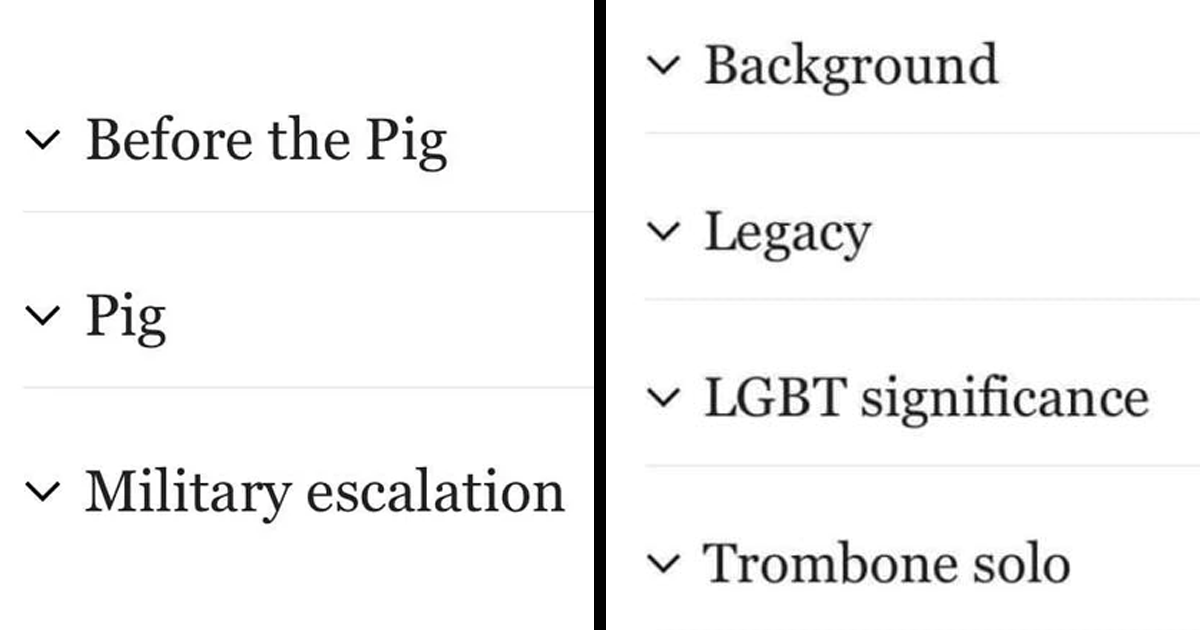
There are many kinds of internet comedy. Some rely on timing. Some rely on absurdity. Some require years of cultural homework and at least one group chat full of people who type “I hate that I understand this” before sending a screenshot. And then there is this delightfully specific genre: screenshots of Wikipedia tables of contents, ripped out of context, launched onto Twitter, and left there like tiny academic grenades of confusion.
The premise is almost suspiciously simple. You take a Wikipedia article, ignore the body text, crop straight to the section headings, and let the headings do all the work. Suddenly, a perfectly serious encyclopedia entry looks like a cursed movie outline, a breakup playlist, or the world’s driest recap of total chaos. A 2021 viral roundup collected 15 of these screenshots, and people were very understandably amused. Not because Wikipedia was trying to be funny, but because it absolutely was not. That’s the secret sauce. The humor comes from the collision between the platform’s serious tone and the deeply unserious conclusions our brains immediately jump to.
This is also why the joke feels so internet-native. It rewards curiosity, pattern recognition, and the universal online hobby of seeing one weird thing and immediately needing ten strangers to look at it too. In a feed full of outrage, ads pretending not to be ads, and people announcing they are “circling back,” a contextless Wikipedia table of contents is refreshingly honest. It says: here are some headings, and somehow they already tell a whole story.
Why Contextless Wikipedia Screenshots Are So Funny
Section headings are accidental punchlines
A Wikipedia table of contents is supposed to be useful. It is built to organize information into neat, logical chunks so readers can move from background to details to impact without getting lost in a wall of text. In theory, it is the opposite of comedy. In practice, once you isolate those headings, they can read like the funniest summary you have ever seen.
That is because headings strip away explanation and leave only sequence. And sequence is powerful. A list of short, formal phrases can imply a rise, a fall, a scandal, a feud, a breakdown, a comeback, and a weird afterlife in roughly six lines. Your brain fills in the missing details with maximum dramatic flair. Wikipedia says “contents.” Your imagination says “limited series coming this fall.”
The effect gets stronger when the topic is already unusual. A page about a strange historical event, a niche cultural phenomenon, or an oddly specific person can produce headings that look like they were written by a deadpan sketch-comedy writer who got locked in a library. Except the material is real. That contrast makes the joke land even harder.
Context collapse turns readers into co-writers
Another reason these screenshots spread so easily is that they invite participation. You do not need to know the full article. You do not need to be an expert. You only need eyes, a functioning sense of absurdity, and the ability to type something like, “How did we get from chapter two to chapter five that fast?”
That kind of humor is democratic in the best way. Everyone becomes part of the bit. One person posts a screenshot, another adds a joke, another finds an even stranger table of contents, and suddenly the whole thing becomes collaborative entertainment. It is basically improv, except the straight man is Wikipedia and the stage directions are section headers.
Wikipedia Is Weird Enough To Support the Joke
The site contains all of humanity, including the messy parts
Wikipedia has always had an odd dual identity. On one hand, it is a practical reference source people use to settle arguments, check dates, scan biographies, and figure out what exactly happened in a war, election, invention, or celebrity feud. On the other hand, it is a museum of human weirdness. If humanity has ever done something brilliant, trivial, chaotic, obscure, petty, noble, or deeply confusing, there is a decent chance someone has documented it.
That breadth matters. The joke works because Wikipedia covers the obvious stuff and the gloriously non-obvious stuff with equal seriousness. A mainstream political biography and a page about an extremely specific historical oddity can both get the same sober formatting, the same calm headings, and the same “we are being professional here” energy. That is comedy gold. It means the platform can unintentionally frame nonsense with the confidence of a textbook.
The tone is formal, even when the subject is bananas
Wikipedia’s voice is famously restrained. It does not gasp. It does not wink. It does not say, “Folks, you will not believe what happened next.” It simply places a heading on the page and keeps moving. That neutral tone is one of the biggest reasons these screenshots are funny. The site treats even bizarre topics like they are calmly waiting for a midterm exam.
Online humor often depends on overreaction, but this genre depends on underreaction. A heading will quietly suggest that something truly unbelievable occurred, and the page will remain emotionally unavailable about it. That emotional flatness gives readers room to laugh. Wikipedia never begs for the joke. It just accidentally sets the table.
The volunteer-made structure leaves visible human fingerprints
There is another layer here, too. Wikipedia is made by people. Lots of people. Volunteers organize topics, debate phrasing, create subsections, refine terminology, and decide how a page should flow. That means every table of contents is a tiny record of editorial judgment. Someone, somewhere, had to look at a mess of information and decide, “Yes, this deserves its own heading.”
When readers see that structure without context, they are not only reading a topic. They are also glimpsing how humans chose to arrange the chaos. And sometimes that arrangement is unintentionally hilarious. The headings can feel like the neatest possible filing system for the least neat subject imaginable.
Why Twitter Was the Perfect Home for the Trend
Short posts love high-speed confusion
Twitter was built for fragments. It rewards material that is instantly readable, instantly shareable, and just confusing enough to make people stop scrolling. A screenshot of a Wikipedia table of contents checks every box. You can understand the format in one second, laugh in two, and send it to a friend in three with a message that reads, “Please explain why this looks like prestige television.”
That kind of post thrives in a timeline environment because it leaves room for reaction. It does not over-explain itself. It assumes that the audience enjoys doing a little interpretive work, which is basically the internet’s favorite unpaid internship.
Internet culture loves “out of context” material
The phrase “out of context” has become a genre marker online. It signals that the fun lies in the gap between what something really means and what it appears to mean when stripped of its background. Screenshots of Wikipedia contents fit that formula perfectly. They are factual, but they are also deeply misleading in the most entertaining way possible.
There is something satisfying about seeing official-looking information become unintentionally ridiculous through cropping alone. No editing. No fake captions. No elaborate setup. Just a simple act of removal that turns neutral reference material into accidental theater.
What These 15 Screenshots Say About Internet Humor
People love miniature mysteries
The best internet jokes often create a tiny mystery. You see a strange image or phrase and feel compelled to reverse-engineer the story behind it. Contextless Wikipedia contents do exactly that. They hand you a puzzle in list form. You are not just laughing; you are also mentally reconstructing a narrative from headings like a detective with a very weird case file.
That mix of laughter and curiosity is powerful. It keeps people engaged longer than a throwaway meme because it activates the same instinct that makes Wikipedia itself so addictive. You click because you want to know more. Then you keep clicking because now you need to understand why there was apparently an entire subsection for whatever on earth that was.
The joke flatters the audience a little
These screenshots also appeal to a very online kind of intelligence. Not academic snobbery, exactly, but the pleasure of recognizing structure, appreciating dry humor, and enjoying a joke that feels a little niche without being exclusionary. You do not need a PhD to laugh at a bizarre sequence of headings, but you do get to feel like someone who notices how absurd formal language can become in the wild.
In other words, this is smart-person silliness. It lets people be goofy without turning their brains off. The internet tends to cherish that combo. It is one reason memes about spreadsheets, museum labels, maps, and Wikipedia pages do so well. We love when serious formats accidentally become funny because it feels like finding a secret passage in a very respectable building.
It is comedy with a side effect: learning
The funniest part may be that this kind of post often sends people straight back to Wikipedia. The screenshot is the bait; the article is the rabbit hole. A person laughs at a weird table of contents, clicks through to the page, and twenty minutes later has learned something oddly specific about history, language, culture, crime, geography, media, or all five at once.
That is a rare internet win. Usually, a viral post steals your attention and leaves you with nothing except the memory of having seen a raccoon open a cooler. Here, the joke can actually lead somewhere. Even if readers arrive for the chaos, they often stay for the facts.
The Real Charm of the Trend
What makes the whole thing memorable is not just that the screenshots are funny. It is that they reveal something sweet about online culture at its best. People still enjoy weird knowledge. They still like discovering obscure corners of the web. They still respond to a format that says, “Here is a tiny glimpse of human history arranged in a way that accidentally sounds insane.”
That charm matters because the modern internet can feel exhausting. Platforms are crowded with performance, branding, manufactured outrage, and enough algorithmic sludge to make a person nostalgic for the dial-up tone. In that environment, a plain screenshot of a Wikipedia contents box feels refreshingly low-tech and oddly pure. It is just information, structure, and a group of strangers collectively realizing that structure can be hilarious.
So yes, people were amused by those 15 screenshots, and rightly so. But the joke is bigger than one thread. It taps into a durable truth about the web: humans love finding accidental comedy in systems designed for order. Give us a serious format and a slightly unhinged subject, and we will do the rest. We always do.
Experiences That Make This Trend So Relatable
If you have ever opened Wikipedia for one innocent fact and resurfaced 47 minutes later with six new tabs, a cold cup of coffee, and sudden knowledge about a 14th-century tax dispute, this trend probably feels personal. The screenshots are funny because they capture the exact emotional rhythm of using Wikipedia: curiosity, confusion, escalation, acceptance, and then the quiet realization that you somehow now care deeply about something you did not know existed an hour ago.
One of the most relatable experiences is the “I was not planning to learn this today” moment. You see a heading, laugh at how dramatic it sounds, and then immediately need the backstory. This is how a normal day gets derailed by a topic you would never have searched on purpose. Wikipedia has always been excellent at this. It is less a reference site than a trapdoor disguised as homework.
Then there is the social part. People rarely keep these discoveries to themselves. They send screenshots to friends with zero explanation. They post them in group chats like emergency bulletins from the Department of Unexpected Knowledge. They say things like, “Why does this sound like the wildest episode of television ever made?” That reaction is half the fun. The joke does not feel complete until someone else sees it and replies with all caps.
Another common experience is recognizing how much of life can be made funnier by formal organization. The moment a messy human story gets divided into calm little sections, it becomes oddly entertaining. It is the same reason museum labels can be hilarious, legal documents can sound dramatic, and corporate PowerPoint slides can accidentally read like poetry written by exhausted robots. Wikipedia tables of contents belong in that hall of fame. They make chaos look neatly bullet-pointed, which is apparently one of the funniest things our species can witness online.
There is also a small thrill in feeling like you have discovered a secret feature of the internet. Once you realize Wikipedia contents can be funny on their own, you can never quite unsee it. Every article becomes a potential comedy sketch in outline form. You start scanning headings not just for information but for accidental storytelling. Background. Incident. Reaction. Legacy. Adaptations. Lawsuits. Suddenly the page is not just a page. It is a trailer.
And maybe the most relatable experience of all is this: the trend reminds people that learning can be playful. Not childish, not shallow, not fake-smart, but genuinely playful. It gives the same satisfaction as overhearing a bizarre historical fact at a dinner table and watching everyone lean in. The internet often treats knowledge as either a weapon or a performance. These screenshots bring back another possibility. Knowledge can also be funny. It can be weird. It can arrive through a side door, wearing a nametag and behaving like a meme.
That is why the screenshots linger. They are not just jokes about Wikipedia. They are jokes about how we read, how we share, and how the internet still occasionally delivers a little burst of communal delight. You laugh, you click, you learn, you send it to someone else, and the cycle continues. For once, the rabbit hole feels less like doom and more like a party with excellent footnotes.
Conclusion
The viral appeal of these context-free Wikipedia screenshots comes down to one delicious contradiction: the web’s most orderly encyclopedia keeps accidentally producing some of its most chaotic jokes. By stripping articles down to their headings, the thread exposed how much drama, absurdity, and accidental comedy can hide inside a perfectly respectable format. Twitter gave the bit speed, Wikipedia gave it structure, and readers gave it life.
In the end, the joke works because it celebrates two things people still love online: sharing odd discoveries and falling headfirst into weird knowledge. Not bad for a table of contents, which is usually just trying its best to be helpful.