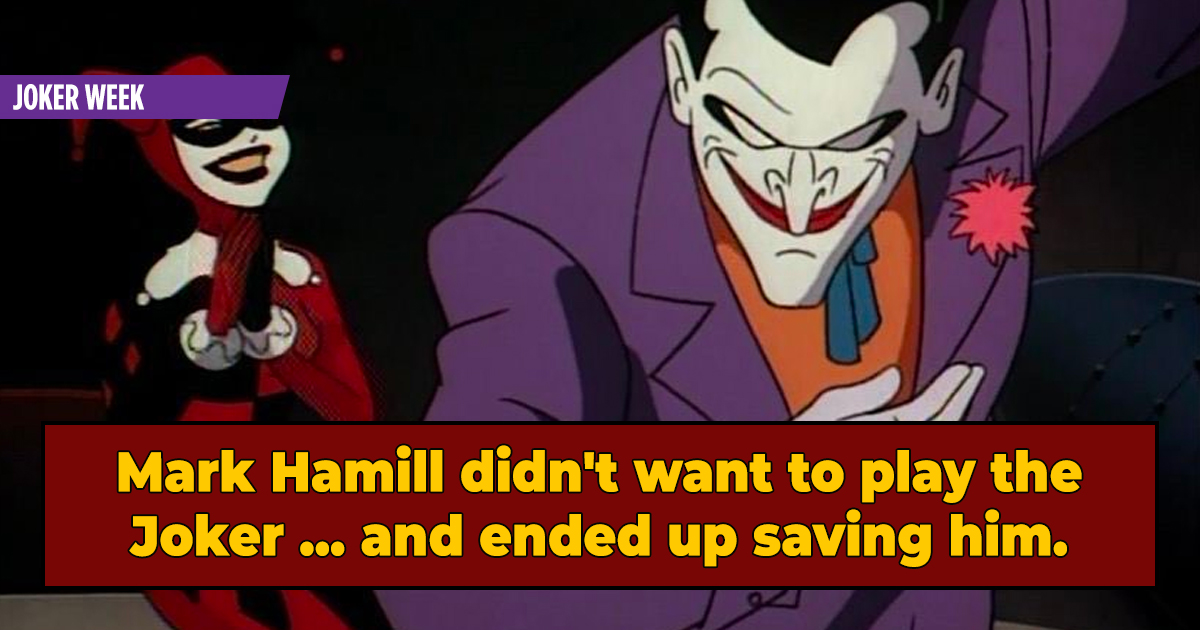
Before Mark Hamill became the laugh echoing through Gotham’s darkest alleyways, he was already carrying one of the heaviest pop-culture backpacks in history: Luke Skywalker. That is not exactly a lightweight suitcase. When most audiences heard his name, they pictured a farm boy, a lightsaber, destiny, and maybe a lot of sand-adjacent family trauma. What almost nobody expected was that Hamill would become the definitive voice of the Joker for a generation of Batman fans.
And here is the delicious twist worthy of the Clown Prince of Crime himself: Hamill did not walk into the role assuming he was about to own it. He thought the odds were laughably low. In his mind, casting Luke Skywalker as Batman’s most deranged villain sounded like the kind of idea that would make comic-book fans flip a table, then politely explain continuity for forty minutes. That freedom, strangely enough, helped him deliver a wild, fearless audition.
The result was not just a good voice performance. It was a career-shaping reinvention. Mark Hamill’s Joker in Batman: The Animated Series became sharp, theatrical, cruel, funny, musical, and terrifying without needing a drop of live-action makeup. He turned a cartoon villain into a full-body storm of chaos. The laugh alone deserves its own parking space at Arkham Asylum.
From Jedi Hero to Gotham Nightmare
By the early 1990s, Hamill was famous in a way that can be both a blessing and a professional bear trap. Luke Skywalker made him beloved, but it also made some people see him in only one lane. Hollywood has a funny habit of confusing success with limitation. If an actor becomes iconic as a hero, the industry often squints suspiciously when that same actor wants to play someone unhinged enough to turn a birthday party into a hostage situation.
That is why Hamill’s move into voice acting mattered. Animation gave him room to disappear. Instead of asking audiences to forget Luke Skywalker’s face, voice work allowed him to build characters out of rhythm, breath, pitch, timing, and attitude. He could be sly, monstrous, goofy, regal, or completely bananas without the audience’s first thought being, “Hey, why is Luke doing that?”
His path into the Batman universe began before the Joker fully claimed him. Hamill contributed to Batman: The Animated Series in another role, and his enthusiasm for playing a major villain helped place him near the opportunity that would change everything. The series itself was already doing something daring. It was a children’s animated show with film-noir shadows, art deco design, mature storytelling, and villains who felt emotionally wounded rather than merely colorful.
In that world, the Joker could not simply be loud. He had to fit the show’s sophisticated mood while also detonating it. Hamill understood the assignment so well that he practically drew a smile on the assignment, escaped through the window, and left Batman a riddle.
Why Hamill Thought He Would Never Get the Role
One of the most fascinating parts of the Mark Hamill Joker story is that his confidence came from not expecting to be hired. He has explained in interviews that the public backlash to Michael Keaton’s casting as Batman inspired him in a strange way. Keaton had been doubted because many saw him primarily as a comic actor, yet he proved himself as a serious Dark Knight. Hamill looked at that controversy and realized that audience expectations could be wrong.
Still, he figured his own association with Star Wars would make him an unlikely choice. That belief removed the pressure. Instead of performing with the stiff anxiety of someone desperate to win the job, he performed like someone who had nothing to lose. That is often when actors do their most interesting work. No overthinking. No polite restraint. Just commitment.
It is easy to imagine the audition room hearing something unexpected: not a safe imitation of earlier Jokers, not a generic villain voice, but a character with gears grinding inside him. Hamill’s Joker could sound like a vaudeville host one second, a spoiled child the next, and a cold-blooded predator right after that. The voice had bounce, but it also had teeth.
The Laugh That Changed Everything
Every great Joker needs a laugh, but Hamill treated the laugh as more than a spooky sound effect. His Joker laugh functioned like dialogue. Sometimes it was delighted. Sometimes it was mocking. Sometimes it sounded like a man falling down an elevator shaft and enjoying the trip. That range made the performance unforgettable.
Voice acting is not just “talking funny into a microphone,” although that is probably how a very confused uncle at Thanksgiving might describe it. A great animated performance must communicate face, posture, movement, and psychology through sound alone. Hamill did not just voice the Joker; he physically performed him. You can hear the grin. You can hear the shoulders rising. You can hear the character deciding, mid-sentence, whether something is hilarious or fatal.
That is why his Joker worked across different tones. In a lighter episode, he could be a theatrical nuisance with a flair for terrible showmanship. In a darker story, the same voice could become genuinely disturbing. The performance had elasticity. It stretched without snapping.
Batman: The Animated Series Needed That Exact Joker
Batman: The Animated Series was not an ordinary Saturday-morning cartoon. It gave Gotham emotional architecture. The city looked haunted. Batman felt wounded. Villains like Mr. Freeze, Two-Face, Clayface, and Harley Quinn were treated as characters with histories, heartbreaks, delusions, and motives. The show respected young viewers enough to believe they could handle atmosphere and moral complexity.
Inside that serious world, Hamill’s Joker became the perfect blast of poisonous confetti. He was funny, but the comedy never made him harmless. That balance is harder than it looks. Too silly, and Joker becomes a clown with poor impulse control. Too grim, and he loses the carnival energy that makes him unique. Hamill found the middle: a villain who could make you laugh and then make you regret laughing.
His chemistry with Kevin Conroy’s Batman was essential. Conroy played Batman with controlled intensity, a voice that sounded like discipline wearing a cape. Hamill played Joker as chaos with a microphone and no adult supervision. Together, they created one of the cleanest hero-villain contrasts in modern superhero media. Batman was restraint. Joker was eruption. Batman lowered the temperature in the room. Joker arrived with matches, gasoline, and a joke book nobody asked for.
The Joker Beyond the TV Series
Hamill’s performance did not remain trapped in one show. It traveled through animated films, spin-offs, video games, and fan memory. In Batman: Mask of the Phantasm, the Joker fit into a story that many fans still consider one of the strongest Batman films ever made. In Batman Beyond: Return of the Joker, Hamill pushed the character into a darker futuristic context, proving that his version of the villain could survive outside the original series format.
Later, projects such as Batman: The Killing Joke gave Hamill a chance to revisit the character through one of the most famous and controversial Joker stories in comic-book history. Whether viewers loved or debated the adaptation, Hamill’s return was a major reason fans paid attention. His name carried credibility because audiences had learned to trust his understanding of the character.
Then came the Batman: Arkham games, especially Arkham Asylum, Arkham City, and Arkham Knight. These games introduced Hamill’s Joker to players who may not have grown up watching the animated series. The performance became interactive, surrounding players through taunts, threats, jokes, and psychological games. In that format, Joker did not merely appear in scenes; he invaded the player’s experience.
Why His Joker Felt So Complete
There have been many brilliant Joker performances. Jack Nicholson brought gangster showmanship. Heath Ledger delivered anarchic menace. Joaquin Phoenix explored psychological collapse. Each interpretation belongs to a different artistic universe. Hamill’s advantage was time and range. Across decades, he played Joker in comedy, tragedy, action, mystery, satire, and horror-leaning stories.
Because animation and games allowed the character to stay visually consistent while the storytelling shifted, Hamill could build a long-form Joker. His version was not limited to one movie’s arc. He could be petty in one episode, apocalyptic in another, absurd in one moment, and chilling in the next. That accumulation made his Joker feel complete, almost like the comic-book version had climbed off the page and stolen a recording booth.
Another reason the performance endured is that Hamill understood Joker’s theatricality. The character is not simply evil; he performs evil. He wants an audience. He wants Batman to react. He wants every crime to have a punchline, even if the punchline is horrifying. Hamill leaned into that showman quality without making it hollow. His Joker was always acting for someone, and the scariest possibility was that he was also acting for himself.
The Kevin Conroy Connection
It is impossible to discuss Hamill’s Joker without discussing Kevin Conroy’s Batman. Their performances became linked in the minds of fans because they sharpened each other. Conroy’s Batman gave Hamill’s Joker a wall to bounce off. Hamill’s Joker gave Conroy’s Batman a force that tested his discipline, morality, and patience.
After Conroy’s death in 2022, Hamill spoke movingly about how difficult it would be to continue as Joker without him. That sentiment made perfect sense to longtime viewers. Their Batman and Joker were not just two separate voice roles. They were a duet, though admittedly one of the singers kept trying to destroy Gotham between verses.
Their partnership helped define how millions of fans hear the characters while reading comics. That is a rare achievement. Most actors interpret a role; Hamill and Conroy became reference points for the imagination. For many fans, Batman’s voice is Conroy’s voice. Joker’s laugh is Hamill’s laugh. That kind of cultural imprint cannot be planned in a studio meeting. It happens when performance, writing, timing, and audience affection collide.
Mark Hamill’s Career Reinvention
Hamill’s Joker did more than add a legendary credit to his résumé. It helped reshape public understanding of him as an actor. Instead of being remembered only as Luke Skywalker, he became one of the most respected voice performers in pop culture. His work in animation and games demonstrated versatility, discipline, and a deep love for genre storytelling.
This is why the phrase “least of all Mark Hamill” feels so fitting. Nobody was fully prepared for the role to hit the way it did, including the actor himself. He entered the audition thinking the casting was unlikely. He left behind a performance that fans still measure other animated villains against.
That is the beautiful weirdness of entertainment history. Sometimes the role that seems least obvious becomes the one that reveals a whole new side of a performer. Sometimes the Jedi becomes the Joker. Sometimes the laugh wins.
What Modern Voice Actors Can Learn From Hamill’s Joker
Hamill’s Joker remains a masterclass because it shows that a voice role should be built from character, not gimmick. The laugh is iconic, but it works because it belongs to a fully imagined personality. The pitch changes, the sudden bursts of anger, the musical timing, the fake sweetness, and the explosive glee all come from a clear understanding of who this Joker is.
Modern voice actors can learn three big lessons from that. First, commit completely. Halfway weird is just awkward. Hamill went all in, and that commitment gave the performance authority. Second, create contrast. His Joker is not always loud; he shifts gears. That makes the loud moments land harder. Third, respect the material. Hamill has long approached comics and animation with genuine affection, not as a lesser form of acting. That respect comes through in the work.
For writers and directors, the lesson is just as useful: unexpected casting can become magic when the actor understands the emotional engine of the role. Hamill was not the obvious choice to everyone, but he had the imagination, vocal control, and theatrical nerve to make Joker feel dangerous and fun at the same time.
Experiencing Mark Hamill’s Joker Today
Watching or replaying Mark Hamill’s Joker today is a strange and rewarding experience because the performance still feels alive. Some older animated performances can feel locked in their decade, like they are wearing shoulder pads and asking where the fax machine went. Hamill’s Joker does not have that problem. The voice still moves. The timing still snaps. The laugh still sounds like a fire alarm installed by a circus.
For new viewers, the best way to experience this Joker is not to treat him as a museum piece. Do not watch only because people online say he is legendary. Watch how he changes from scene to scene. Notice how he toys with Batman verbally before anything physical happens. Listen to how a line can begin as a joke and end as a threat. That is where the performance lives: in the turns.
For longtime fans, returning to Hamill’s Joker can feel oddly personal. Many people first heard that voice as kids, when Batman: The Animated Series was simply “the cool Batman cartoon.” Years later, they realized the show was far more sophisticated than they knew. The writing was sharper. The visuals were moodier. The performances were richer. Hamill’s Joker becomes part of that rediscovery. What once seemed entertaining now reveals craft.
The Arkham games offer a different experience. Instead of sitting back and watching Joker cause trouble, players are trapped in his orbit. His voice interrupts, mocks, teases, and needles. That interactive pressure makes Hamill’s performance feel even more invasive. He is not just talking to Batman; he is practically leaning over the player’s shoulder, grinning at every mistake. It is annoying in exactly the right way, which is basically Joker’s entire brand.
There is also something meaningful about hearing Hamill and Conroy together after knowing how deeply fans value both performances. Their scenes carry the weight of a long creative partnership. Even when the story is wild, their dynamic feels grounded because each actor knows the other’s rhythm. Batman does not need to overreact because Conroy’s stillness says enough. Joker does not need to explain himself because Hamill’s laugh tells us the machinery is already broken.
For anyone interested in acting, Hamill’s Joker is worth studying with headphones. Pay attention to breath. Pay attention to pace. Pay attention to how often he lets the voice smile. The performance proves that great voice acting is not invisible labor; it is full acting translated through sound. Hamill gave Joker a body we could not see, a face the animators could amplify, and a personality that could survive across television, film, and games.
That is why the role still matters. Mark Hamill did not merely escape the shadow of Luke Skywalker. He used another shadow, Gotham’s biggest and weirdest one, to show audiences how much more he could do.
Conclusion
Mark Hamill’s Joker worked because it surprised everyone at every level. Fans did not expect Luke Skywalker to become the voice of comic-book chaos. Hamill did not expect to be cast. The animated series did not know it was creating one of the most durable villain performances in superhero history. Yet somehow, all the pieces clicked.
His Joker is funny without being safe, theatrical without being empty, and terrifying without losing the twisted joy that defines the character. Paired with Kevin Conroy’s Batman, Hamill helped create a version of the Dark Knight’s greatest rivalry that still shapes how fans hear these characters decades later.
Note: This article is fully rewritten for web publication, based on widely documented interviews, public entertainment reporting, and official DC-related information. It avoids copied source text and does not include unnecessary citation placeholders.