Kyrgyzstan is the kind of place that makes your camera feel underqualified. One minute you are standing beside a lake so blue it looks suspiciously edited, and the next you are bouncing along a mountain road wondering whether your driver, your backpack, or your breakfast will reach the destination first. This small, landlocked country in Central Asia is not loud about its beauty. It does not chase you with neon signs or over-polished tourist traps. Instead, it waits quietly with snow-capped peaks, high-altitude lakes, red canyons, green jailoo pastures, yurt camps, bazaars, horses, and tea so warm it feels like hospitality in liquid form.
This photo journey through Kyrgyzstan is built around 29 moments that capture why the country deserves far more attention from travelers, photographers, hikers, and anyone who has ever looked at a mountain and thought, “Yes, I would like to stand dramatically in front of that.” From Bishkek’s leafy streets to the legendary shores of Issyk-Kul Lake, from Song-Kul’s open pastures to Osh’s ancient spiritual landscape, Kyrgyzstan offers one of the most rewarding travel photography experiences in Central Asia.
Why Kyrgyzstan Feels Like Central Asia’s Best-Kept Secret
Kyrgyzstan sits between Kazakhstan, China, Tajikistan, and Uzbekistan, but its identity is fiercely its own. Much of the country is shaped by the Tian Shan mountains, giving travelers endless chances to photograph alpine valleys, glacier-fed rivers, and ridgelines that seem to roll into forever. This is not a destination where you simply “see the sights.” You feel the altitude in your lungs, the dust on your shoes, and the quiet wonder of watching a horse graze beside a lake at nearly 10,000 feet.
For photographers, Kyrgyzstan is a dream because the landscape changes constantly. Morning light turns the mountains silver. Afternoon storms sweep across empty plains like moody theater curtains. Sunset paints yurt camps gold. Even the roads are photogenic, which is helpful because you will spend a lot of time on them. Consider it scenic cardio for your patience.
The 29 Photos That Tell My Kyrgyzstan Story
1. Bishkek Before the Mountains Begin
My first photo is of Bishkek, the capital city, where Soviet-era architecture, leafy boulevards, cafés, public squares, and mountain views coexist in a surprisingly relaxed rhythm. Bishkek is not the wild heart of Kyrgyzstan, but it is the doorway. It gives you time to buy supplies, drink coffee, visit Osh Bazaar, and mentally prepare for roads that will soon make Google Maps look hilariously optimistic.
2. Osh Bazaar: Color, Noise, and Delicious Confusion
Osh Bazaar is a sensory workout. Stalls overflow with dried fruit, nuts, spices, bread, textiles, and household goods. The best photo here is not one perfect shot but a collection of details: stacked apricots, patterned fabrics, golden rounds of bread, and shoppers bargaining with the focus of chess grandmasters.
3. Ala-Archa National Park, Bishkek’s Mountain Escape
Just outside Bishkek, Ala-Archa National Park offers the first big “Oh, so Kyrgyzstan is serious” moment. The park’s alpine scenery, rushing river, and steep trails make it a favorite day trip. My photo here frames hikers as tiny dots below massive slopes, which is also a helpful reminder that nature does not care how many steps your fitness app says you did last week.
4. The Road to Issyk-Kul Lake
The journey east toward Issyk-Kul Lake is a road-trip highlight. Mountains rise on the horizon, villages pass by in flashes of blue gates and roadside fruit stands, and the landscape slowly opens into something vast and cinematic. This is where Kyrgyzstan travel begins to feel less like an itinerary and more like a long, beautiful exhale.
5. Issyk-Kul Lake: The Pearl of Central Asia
Issyk-Kul is one of Kyrgyzstan’s most famous natural wonders, a huge alpine lake surrounded by mountains. Its name is often translated as “warm lake,” a nod to the fact that it does not freeze in winter. My favorite photo shows the lake shifting from turquoise to deep blue, with snow-touched peaks sitting in the background like they were hired for the shot.
6. The South Shore’s Wild Beauty
The southern shore of Issyk-Kul feels more rugged than the resort-heavy north. It is full of raw landscapes, quiet beaches, canyons, and small villages. The photos here are less polished and more powerful: empty roads, wind-bent grass, and mountains that seem to rise straight from the water.
7. Skazka Canyon, Also Known as Fairy Tale Canyon
Skazka Canyon looks like someone spilled red, orange, and gold paint across the desert and decided to call it geology. The formations resemble castles, animals, waves, and whatever your imagination can handle before the sun gets too strong. It is one of the best places in Kyrgyzstan for bold landscape photography.
8. Jeti-Oguz and the Seven Bulls
Jeti-Oguz is famous for its dramatic red sandstone cliffs known as the Seven Bulls. The rock formations glow beautifully in warm light, especially when clouds add depth to the sky. Nearby valleys offer green meadows, grazing animals, and a peaceful contrast to the canyon’s fiery color.
9. Karakol: The Adventure Base with Soul
Karakol is a natural base for trekking, food, and cultural exploration. It has a charming mix of wooden houses, mountain views, local restaurants, and access to some of Kyrgyzstan’s best hiking routes. My photo from Karakol is simple: a quiet street, a mountain backdrop, and a feeling that adventure is waiting just around the corner.
10. A Bowl of Ashlyanfu After a Long Day
Travel photography is not only about landscapes. Sometimes the most honest photo is lunch. Ashlyanfu, a cold noodle dish strongly associated with Karakol, is refreshing, tangy, and perfect after a dusty day outdoors. It may not pose like a mountain lake, but your stomach will remember it fondly.
11. Mountain Horses at Golden Hour
Horses are woven deeply into Kyrgyz culture, and they appear everywhere: beside roads, in pastures, at festivals, and near lakes. My photo of horses at golden hour captures one of Kyrgyzstan’s most iconic scenes. No staging needed. The horses did all the modeling. Very professional. Did not ask for payment.
12. Song-Kul Lake: Silence at High Altitude
Song-Kul Lake feels remote in the best possible way. Set high in the mountains, it is surrounded by open pastureland where families often spend the summer grazing livestock. The landscape is wide, quiet, and almost dreamlike. A photo here does not need drama. A yurt, a horse, a lake, and a huge sky are more than enough.
13. Yurt Camps Under a Big Kyrgyz Sky
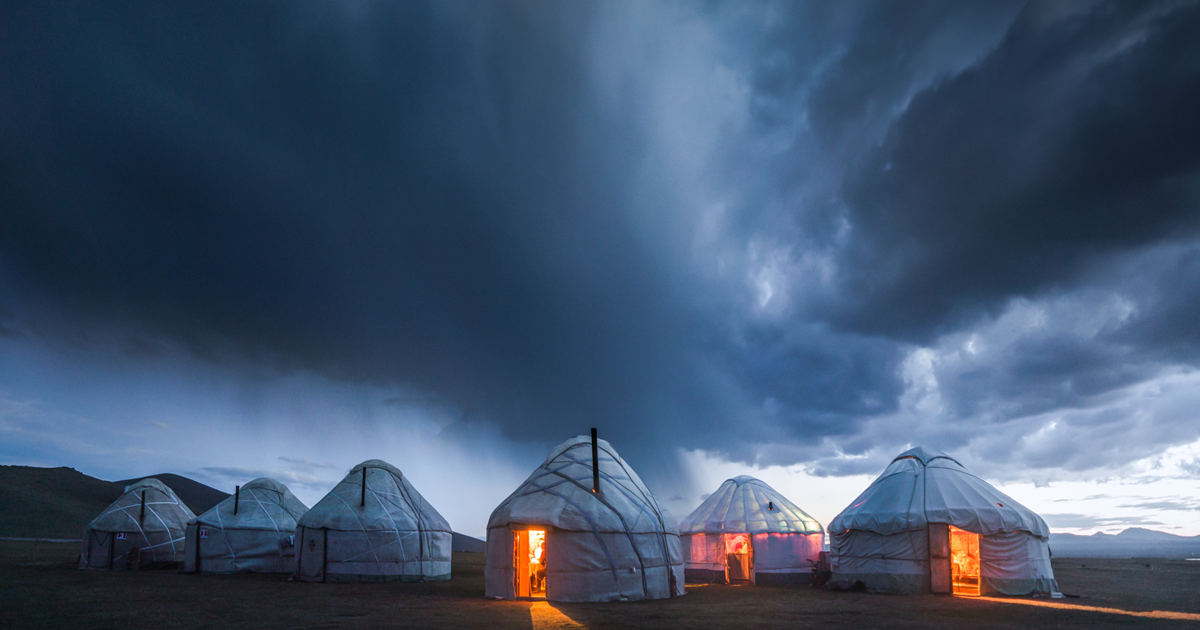
The yurt camp is one of the defining images of Kyrgyzstan photography. Traditional felt yurts are practical, beautiful, and deeply connected to nomadic life. At sunset, their round white shapes glow against the grasslands. At night, the sky fills with stars, and suddenly your phone camera starts making nervous excuses.
14. Tea Inside a Yurt
Some of my favorite travel memories in Kyrgyzstan happened indoors, sitting cross-legged around low tables with bread, jam, cream, tea, and friendly conversation. The photo is cozy: patterned textiles, steam rising from cups, and soft light filtering through the yurt. It is proof that hospitality photographs beautifully.
15. Felt Carpets and Handmade Patterns
Kyrgyz felt-making is more than decoration. It is a living craft connected to nomadic homes, family traditions, and cultural identity. Close-up photos of felt carpets and embroidered details reveal symbols, colors, and textures that tell stories without needing captions. These images add depth to any Kyrgyzstan travel photo essay.
16. A Storm Rolling Over the Pasture
Mountain weather in Kyrgyzstan can change quickly. One of my favorite shots captures a dark storm sliding over a bright green pasture. It is dramatic, slightly intimidating, and a good reminder to pack layers. In Kyrgyzstan, “just a light jacket” is sometimes comedy.
17. Tash Rabat, the Stone Caravanserai
Tash Rabat, a historic stone caravanserai in the mountains, connects travelers to the Silk Road era. Its lonely setting makes it especially photogenic. The best image here includes the structure against the surrounding valley, showing how trade, travel, and survival once depended on places like this.
18. The Road Itself
Some of Kyrgyzstan’s most memorable photos happen between destinations. Winding roads, river crossings, mountain passes, roadside cafés, and distant peaks make the journey part of the story. The roads can be rough, but the views are generous. Your spine may complain; your camera will not.
19. A Shepherd on the Horizon
A single figure on horseback against a wide mountain plain can say more about Kyrgyzstan than a paragraph of travel marketing. These quiet human moments show scale, tradition, and the relationship between people and landscape.
20. Children Playing Near a Yurt Camp
Some photos are gentle reminders that daily life continues even in places visitors describe as “epic.” Children playing near a yurt camp, dogs sleeping in the shade, and families preparing food all show Kyrgyzstan as a living culture, not a backdrop built for travelers.
21. The Salbuurun Festival Spirit
Traditional festivals in Kyrgyzstan can include music, poetry, horseback skills, archery demonstrations, crafts, and eagle-related cultural displays. These events are powerful to photograph because they bring movement, costume, music, and heritage together in one place. The key is to observe respectfully and understand that the camera is a guest, not the main character.
22. Osh: A City with Ancient Layers
Osh feels different from northern Kyrgyzstan. It is warmer, older, and tied closely to the Fergana Valley. The markets are lively, the food is excellent, and the city carries centuries of movement, trade, faith, and cultural exchange.
23. Sulaiman-Too Sacred Mountain
Sulaiman-Too Sacred Mountain in Osh is one of Kyrgyzstan’s most important cultural landmarks. Its peaks, paths, caves, and sacred sites create a landscape where history and spirituality meet. A good photo here captures both the mountain and the city below, showing how ancient meaning still rises above modern life.
24. Bread Fresh from the Market
Round Kyrgyz bread, often decorated with stamped patterns, deserves its own portrait. Food photography in Kyrgyzstan is wonderfully humble: bread, tea, fruit, noodles, soups, and shared plates. Nothing screams for attention, but everything feels connected to place.
25. A Village Road at Sunset
One of my simplest photos shows a village road at sunset, dust glowing in the air as animals wander home. It is not a landmark, but it may be the most honest picture in the collection. Kyrgyzstan rewards travelers who look beyond the famous stops.
26. Lake Reflections After the Wind Stops
When the wind drops, Kyrgyzstan’s lakes become mirrors. Mountains appear twice, clouds stretch across the water, and the world briefly looks symmetrical. These are the moments photographers wait for, usually while pretending they are not cold.
27. A Mountain Pass Above the Clouds
High mountain passes are part of the Kyrgyzstan experience. The views can be astonishing, with valleys falling away on both sides and clouds drifting below the peaks. This is where wide-angle photography shines, especially if you can keep your hands steady in the wind.
28. Night Sky Over a Yurt
Far from city lights, the night sky can be spectacular. A yurt under stars is one of the classic Kyrgyzstan photography images, and for good reason. It combines wilderness, culture, and stillness in a single frame.
29. The Photo I Almost Missed
The final photo is not the grandest. It is a quick shot from a moving car: a horse, a child waving, mountains in the distance, and sunlight breaking through clouds. It is slightly imperfect, but it feels alive. That is Kyrgyzstan in one frame: beautiful, unexpected, and impossible to fully plan.
Photography Tips for Capturing Kyrgyzstan
To photograph Kyrgyzstan well, pack for variety. A wide-angle lens helps with mountain landscapes and yurt interiors, while a zoom lens is useful for distant riders, wildlife, and compressed mountain layers. Bring extra batteries because cold weather drains them quickly, especially at high-altitude lakes. A protective cover is also smart because dust, rain, and wind may all show up on the same day like an overenthusiastic travel committee.
Light matters enormously. Sunrise and sunset are magical in the mountains, but midday can be harsh, especially near lakes and canyons. Use strong sunlight for bold shadows in places like Skazka Canyon, and save softer light for portraits, markets, and yurt camps. Most importantly, ask permission before photographing people closely. A smile, a gesture, or a brief conversation can turn a photo from awkward to meaningful.
Best Time to Visit Kyrgyzstan for Travel Photography
Summer, especially from June through September, is generally the most popular season for trekking, high mountain lakes, yurt stays, and road access to remote areas. Late spring can bring green valleys and snow-covered peaks, while autumn offers golden colors and fewer visitors. Winter is beautiful but more challenging, with snow, limited access, and colder conditions in mountain regions.
If your dream Kyrgyzstan travel itinerary includes Song-Kul, high passes, and long treks, summer is usually the most practical choice. If you prefer cultural photography, markets, city life, and lower-elevation landscapes, the shoulder seasons can also be rewarding.
Why Kyrgyzstan Belongs on Your Travel List
Kyrgyzstan is not hidden because it lacks beauty. It is hidden because it has not been packaged into the predictable shape of mass tourism. That is exactly what makes it special. The country still feels raw, personal, and generous. You can hike through valleys where the only traffic jam is a herd of sheep. You can sleep in a yurt and wake up to horses grazing outside. You can photograph landscapes that look impossibly grand and then be invited for tea like you are a neighbor who simply took a very long walk.
For anyone planning Central Asia travel, Kyrgyzstan offers a rare combination of adventure, culture, affordability, and visual drama. It is ideal for photographers, hikers, overland travelers, and curious visitors who prefer real experiences over polished perfection.
Extra Experience: What These 29 Photos Taught Me About Kyrgyzstan
The longer I look at these 29 photos of Kyrgyzstan, the more I realize they are not just travel pictures. They are small reminders of how a place can surprise you when you stop expecting it to behave like a brochure. Kyrgyzstan does not always make travel easy. Distances can feel longer than they appear on a map, mountain roads can test your sense of humor, and the weather has a dramatic personality. But that is also why the experience feels so real. Every view feels earned, every cup of tea feels comforting, and every quiet moment seems to arrive exactly when you need it.
One of the strongest memories behind these photos is the feeling of space. In many destinations, you are always sharing the frame with crowds, signs, fences, and someone’s selfie stick making a surprise guest appearance. In Kyrgyzstan, there were moments when the landscape felt almost unbelievably open. At Song-Kul, the horizon stretched so far that time seemed to slow down. Horses moved like tiny brushstrokes across the grass. Clouds cast shadows over the lake. A yurt door opened, and someone called out for tea. It was simple, but it felt cinematic.
The people also shaped the journey as much as the mountains did. A landscape can impress you, but hospitality stays with you. In villages and yurt camps, meals were not treated like transactions. They were invitations. Bread was placed on the table with care. Tea appeared constantly, as if cups had magical refill powers. Even when language was limited, kindness did most of the translation. Some of the best “photos” are actually the ones I did not take because I was too busy being present.
Kyrgyzstan also changed the way I think about travel photography. Before visiting, I imagined the best shots would be the obvious ones: lakes, peaks, canyons, horses, yurts. And yes, those were spectacular. But the images that stayed with me were often quieter. A dusty window view. A hand pouring tea. A child laughing near a roadside stand. A shepherd disappearing into evening light. These moments made the country feel human, not just beautiful.
If there is one lesson from this Kyrgyzstan photo journey, it is this: leave room for the unexpected. Do not plan every minute. Let the road take longer. Stop when the light is good. Say yes to tea. Walk a little farther than you intended. Look behind you after taking the “main” photo, because sometimes the better shot is waiting in the opposite direction. Kyrgyzstan rewards patience, curiosity, and travelers who understand that the best hidden gems are not hidden because they are small. Sometimes they are hidden because they are too vast to fit neatly into a caption.
Conclusion
My 29 photos of Kyrgyzstan tell the story of a country that feels both ancient and alive, rugged and welcoming, remote and unforgettable. From Bishkek’s markets to Issyk-Kul’s blue water, from Song-Kul’s yurt camps to Osh’s sacred mountain, Kyrgyzstan proves that Central Asia travel can be deeply moving, visually stunning, and refreshingly unscripted. It is a hidden gem not because no one knows it exists, but because the people who do visit often struggle to explain just how beautiful it is without sounding slightly dramatic. Fortunately, that is what photos are for.