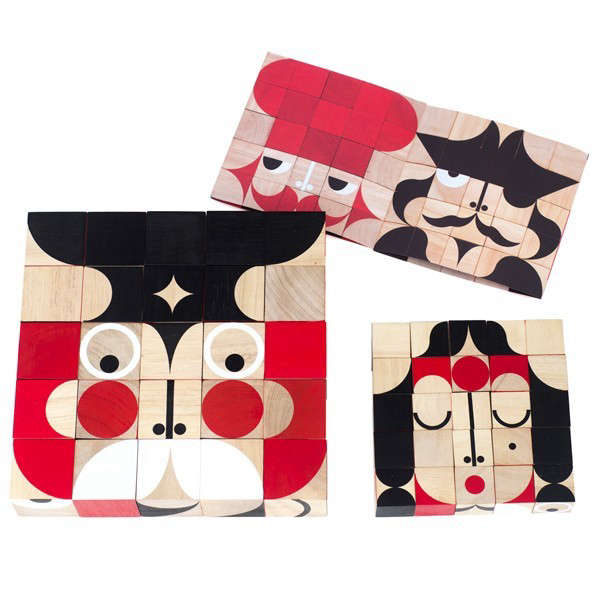
The Mini FaceMaker Block Set is the kind of toy that looks quiet on a shelf but becomes suspiciously powerful once someone starts turning the cubes. One minute, it is a tidy set of printed wooden blocks. The next, it is a parade of characters: a grumpy professor, a sleepy pirate, a surprised aunt, a tiny rock star, and someone who definitely forgot where they parked. That is the charm. This toy does not shout, blink, sing, or ask for batteries. It simply invites hands, eyes, and imagination to join the party.
Designed as a compact version of the well-known FaceMaker concept by MillerGoodman, the Mini FaceMaker Block Set uses printed wooden cubes that can be arranged into expressive faces. The idea is simple: each cube carries visual fragments such as eyes, noses, mouths, hair, cheeks, eyebrows, or other facial details. By rotating and rearranging the blocks, children and adults can create a surprising number of portraits. Some faces look elegant. Some look silly. Some look like they just opened the electric bill.
For parents, teachers, gift shoppers, and design-loving adults, this small wooden face puzzle offers more than cute entertainment. It supports open-ended play, storytelling, visual thinking, fine motor practice, emotional recognition, and social interaction. In other words, it sneaks learning into play without wearing a tiny graduation cap.
What Is the Mini FaceMaker Block Set?
The Mini FaceMaker Block Set is a portable wooden block puzzle based on the concept of building faces from interchangeable cube pieces. Unlike a traditional puzzle with one correct answer, this set works more like an “endless jigsaw puzzle.” There is no single finish line. Instead, every arrangement creates a new personality.
The set is commonly described as including 25 hand-printed wooden blocks, often made from rubberwood and printed with non-toxic dyes or paints. The compact size makes it easier to carry than larger block sets, which is useful for travel, classrooms, waiting rooms, playdates, grandparents’ houses, and coffee tables that need a little more personality.
A Toy That Blends Art, Puzzle Play, and Character Design
At first glance, the Mini FaceMaker Block Set may seem like a simple wooden toy. Look closer and it becomes part puzzle, part art kit, part storytelling tool, and part miniature character design studio. Children can copy example faces from an included booklet or invent their own. Adults may pretend they are “just helping,” then spend twenty minutes trying to create the perfect skeptical detective face. This is normal. The blocks are persuasive.
The toy’s strength is its openness. A fixed puzzle rewards accuracy. A face-making block set rewards curiosity. The player asks, “What happens if this eye goes here?” or “Can I make a face that looks confused, brave, fancy, tired, or wildly over-caffeinated?” That kind of playful experimentation is exactly why open-ended toys remain valuable even in a world full of screens and smart devices.
Why Wooden Face Blocks Still Feel Fresh
Wooden blocks are among the oldest and most trusted toys, but the Mini FaceMaker Block Set gives the classic format a clever twist. Instead of building towers, houses, or castles, the player builds expressions. That small change creates a different kind of learning experience.
Traditional block play helps children explore balance, size, shape, cause and effect, and spatial relationships. Face-building blocks add visual sequencing, pattern recognition, emotional vocabulary, and storytelling. When a child builds a face and says, “He looks worried,” the toy has already moved beyond stacking. It has entered the world of feelings, language, and imagination.
Screen-Free Fun With Real Creative Work
The Mini FaceMaker Block Set is a screen-free toy, and that matters. It does not perform for the child. It waits for the child to do something. That waiting is a feature, not a flaw. A toy that requires active participation encourages children to make choices, solve problems, and continue adjusting until something “clicks.”
Modern children have access to plenty of digital entertainment, much of it fast, loud, and designed to hold attention. A wooden block set works differently. It slows the moment down. It gives the child control. There is no score, no level, no pop-up ad, and no cartoon raccoon demanding a subscription. The reward is the face itself, plus the story that grows around it.
Educational Benefits of the Mini FaceMaker Block Set
The Mini FaceMaker Block Set may be small, but it touches several areas of childhood development. It is not a formal curriculum, and it does not need to be. The best toys often teach through repeated, joyful use.
Fine Motor Skills
Picking up, rotating, lining up, and arranging small wooden cubes helps children practice hand control and coordination. These movements are useful for early writing, drawing, cutting, and other everyday skills. The toy encourages careful placement without feeling like a worksheet in disguise.
Spatial Reasoning
To build a face, children must think about position: above, below, beside, left, right, center, corner, top row, bottom row. They learn that moving one cube can change the whole picture. That is spatial reasoning in action, only with more eyebrows.
Problem-Solving
Every face is a tiny design challenge. Does the nose line up? Do the eyes match the expression? Does the mouth make the character look happy, annoyed, shocked, or like they just tasted unsweetened cocoa powder? Children test ideas, revise them, and try again. This trial-and-error process builds flexible thinking.
Emotional Recognition
Because the toy focuses on faces, it naturally invites conversations about emotions. Parents or teachers can ask, “How does this person feel?” “What changed when we swapped the mouth?” or “Can you make a face that looks excited?” These questions support emotional vocabulary and social understanding.
Storytelling and Language
Once a face appears, a story usually follows. A child may name the character, give them a job, invent a problem, or describe what they are thinking. Suddenly, the blocks are not just blocks. They are Mayor Picklebeard, Captain Noodle, or Dr. Suspicious Hat. Storytelling strengthens language, sequencing, humor, and confidence.
Who Is the Mini FaceMaker Block Set Best For?
The Mini FaceMaker Block Set can appeal to a wide range of users, but it is especially strong for preschoolers, school-age children, families, educators, therapists, design fans, and adults who appreciate clever objects.
For Preschool and Elementary-Age Children
Children who enjoy puzzles, pretend play, drawing, blocks, or funny characters are likely to enjoy this set. It gives them enough structure to begin quickly but enough freedom to keep returning. A child does not have to “win.” They simply make, laugh, change, and make again.
For Parents and Families
This toy works well as a shared activity. A parent can build one half of a face while a child builds the other. Siblings can take turns changing one block at a time. Grandparents can create a character and ask, “What do you think this person is saying?” It is low-pressure, portable, and easy to start.
For Classrooms and Therapy Spaces
Teachers can use the blocks during art centers, social-emotional learning activities, storytelling prompts, morning meetings, or quiet play. Speech therapists and occupational therapists may also find value in the toy because it encourages descriptive language, turn-taking, motor planning, and expression recognition.
For Adults Who Love Design Toys
Not every toy disappears into a plastic bin. Some toys are attractive enough to leave on a desk, shelf, or coffee table. The Mini FaceMaker Block Set has that design-object appeal. It is playful without being messy, artistic without being precious, and compact enough that it does not take over the room like a plastic volcano.
How to Play With the Mini FaceMaker Block Set
The best part of the Mini FaceMaker Block Set is that there is no complicated setup. Open the box, spread out the cubes, and begin. Still, a few play ideas can help families and teachers get even more from the set.
1. Make a Mood
Ask the player to create a face that looks happy, nervous, proud, sleepy, surprised, or confused. After building the face, ask what details created that mood. Was it the mouth? The eyes? The eyebrows? This helps children connect visual clues with emotions.
2. Build a Character
Create a face and then invent a character profile. What is the character’s name? Where do they live? What do they like for breakfast? What secret are they keeping? A face with one raised eyebrow can launch an entire detective series.
3. One-Block Challenge
Build a face, then change only one block. How much does the character change? This game helps children notice how small details affect the whole design. It also teaches revision, which is a fancy word for “try again, but with less panic.”
4. Family Portrait Remix
Invite each family member to build a face inspired by themselves. The results may be flattering, hilarious, or legally questionable. Either way, it creates laughter and conversation.
5. Story Chain
One player makes a face and starts a story with one sentence. The next player changes one block and adds the next sentence. Continue until the story becomes delightfully strange. This is excellent for language development and group creativity.
What Makes This Toy Different From Regular Building Blocks?
Regular blocks are wonderful for construction. The Mini FaceMaker Block Set is wonderful for expression. Instead of asking, “How tall can I build?” it asks, “Who can I create?” That shift makes the play more character-driven and emotionally rich.
It also has a strong visual design element. Children must think like artists: line, color, shape, balance, contrast, and proportion all matter. A face can look calm or chaotic depending on how the blocks align. This gives children a playful introduction to graphic design and visual composition.
Safety and Buying Considerations
As with any small toy, adults should check the manufacturer’s age recommendation and supervise younger children. Small parts can be unsafe for children under three, especially if pieces fit in a mouth. Buyers should also inspect blocks for smooth edges, durable printing, and sturdy construction.
When purchasing a Mini FaceMaker Block Set or similar wooden face puzzle, look for clear product details. Useful information includes the number of blocks, material, paint or dye safety, recommended age range, size, weight, and whether the product includes an idea booklet. Buying from reputable retailers is wise, especially with toys that may be resold, discontinued, or offered by third-party sellers.
Questions to Ask Before Buying
- Is the set made from durable wood?
- Are the colors printed or painted with child-safe materials?
- What age range does the seller or manufacturer recommend?
- Are the blocks small enough to be a choking concern for toddlers?
- Does the set include a storage box or booklet?
- Is it new, used, vintage, or collectible?
Gift Ideas: When the Mini FaceMaker Block Set Makes Sense
The Mini FaceMaker Block Set makes a thoughtful gift because it is creative, compact, and different from the usual toy aisle suspects. It is especially good for birthdays, holiday stockings, classroom reward shelves, art-loving kids, travel bags, and family game nights.
It is also a smart choice for families trying to reduce noisy plastic toys. There is nothing wrong with a toy that makes sounds, but sometimes the most peaceful gift is one that does not yell “banana dance” at 6:42 a.m. A wooden block set keeps the fun in the child’s hands rather than inside a speaker.
How to Store and Care for the Blocks
Wooden toys last longer when treated with basic care. Keep the blocks dry, store them in their box or a small pouch, and wipe them gently with a soft cloth when needed. Avoid soaking wooden blocks in water because moisture can affect the finish or cause swelling.
For classrooms or shared play spaces, consider setting simple rules: use the blocks on a table or rug, return all pieces after play, and count the cubes before storing. A 25-piece set is easy to manage, but one missing cube can suddenly become the most important cube in the universe.
Real-Life Experiences With the Mini FaceMaker Block Set
One of the most enjoyable experiences with the Mini FaceMaker Block Set is watching how differently people approach it. A young child often begins by matching obvious features: eyes near the top, mouth near the bottom, hair somewhere above the face. The first few creations may be simple, but they usually come with immediate commentary. “This one is mad.” “This one is a grandma.” “This one is a robot who needs pizza.” The toy becomes a doorway into conversation.
Adults tend to start more cautiously. They look for symmetry. They try to make the face “work.” Then, after a few minutes, they loosen up. A mismatched eye becomes funny. A strange mouth becomes the best part. The adult who said, “I’ll just watch,” is suddenly rotating blocks like a professional portrait detective. This is one of the quiet strengths of the set: it gives permission to play without making anyone feel childish.
In a family setting, the toy works beautifully as a coffee-table activity. It does not require reading instructions, charging a device, downloading an app, or clearing a huge space. Someone can make a face in two minutes, walk away, and another person can change it later. Over time, the set can become a tiny rotating art gallery. Today’s face might be cheerful. Tomorrow’s might look like it just heard the dishwasher leak. Both are valid artistic statements.
For children who are shy or hesitant to talk about feelings, the blocks can be surprisingly helpful. Asking “How do you feel?” may feel too direct. Asking “Can you make a face that feels worried?” is softer and more playful. Once the face exists, the child can talk about the character instead of themselves. That little bit of distance can make emotional conversations easier.
The Mini FaceMaker Block Set is also excellent during travel. In a hotel room, at a relative’s house, or during a quiet moment at a restaurant, it gives kids something tactile and creative to do. Because it is compact, it does not require a full toy expedition. The only caution is piece management. A small pouch or zippered case can prevent the dramatic tragedy of a missing eyebrow block.
In classroom use, the set can support quick creative prompts. A teacher might ask students to build a face for a story character, show how a character changes from the beginning to the end of a book, or create a face that represents a vocabulary word such as “astonished,” “brave,” or “gloomy.” This turns the blocks into a literacy tool as well as an art toy.
Perhaps the best experience is the laughter. Some toys are educational but feel like homework wearing a fake mustache. This one feels genuinely playful. The learning happens through curiosity, humor, and hands-on experimentation. A child builds, reacts, changes, names, explains, and starts again. That cycle is simple, but it is rich. It is the kind of play that reminds adults why good toys do not need to be complicated. Sometimes 25 little blocks and a few ridiculous eyebrows are more than enough.
Conclusion: Small Blocks, Big Personality
The Mini FaceMaker Block Set proves that a toy does not need batteries, screens, or complicated rules to be engaging. With a small collection of printed wooden cubes, it encourages creativity, emotional expression, storytelling, fine motor practice, and visual problem-solving. It is part puzzle, part art tool, part conversation starter, and part comedy machine.
For families, it offers screen-free play that grows with the child. For teachers and therapists, it provides a flexible tool for language, feelings, and social interaction. For design lovers, it is a charming object with real play value. Most importantly, it keeps inviting players back because no two faces have to be the same.
If you are looking for a compact wooden toy that sparks imagination without taking over the living room, the Mini FaceMaker Block Set is a delightful choice. It is small enough to carry, clever enough to keep adults interested, and silly enough to make children laugh. That is a rare face indeed.