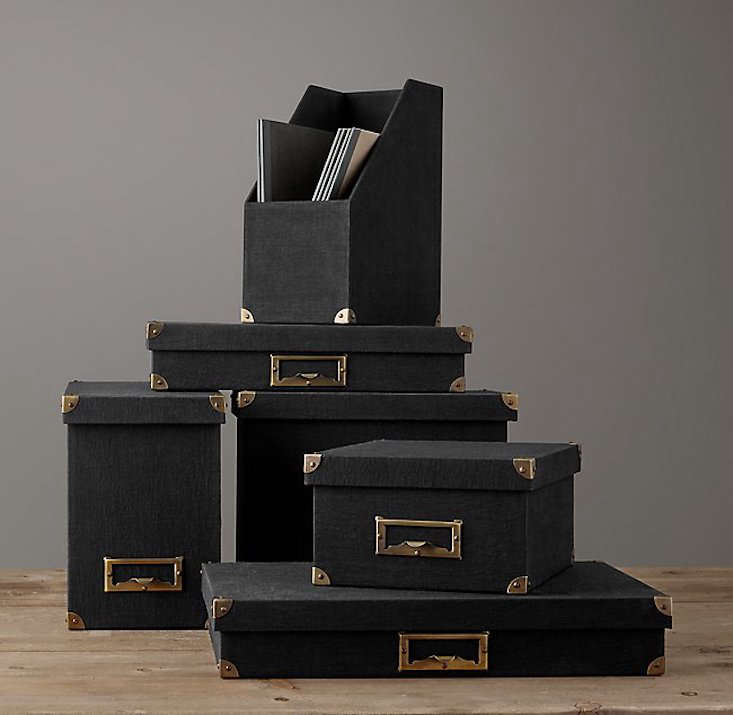
Black linen office storage accessories offer a rare combination: they hide clutter like hardworking containers while looking polished enough to appear in a design magazine. From document boxes and magazine holders to desktop organizers, these accessories soften the appearance of a workspace without sacrificing the crisp, modern character of black.
Why Black Linen Office Storage Accessories Work So Well
A productive office does not need to resemble a joyless cubicleor the aftermath of a stationery-store tornado. The right storage creates a designated home for paperwork, cables, notebooks, and supplies while leaving enough open desk space for actual work.
Black is visually grounding and easy to coordinate with common office finishes such as walnut, oak, white lacquer, glass, and metal. Linen and linen-look coverings add texture, preventing an all-black collection from feeling severe. Together, the color and fabric create accessories that are practical, understated, and more inviting than industrial plastic bins.
There is also a useful visual trick at work. A group of matching black containers makes assorted objects appear organized even when the contents are not arranged with military precision. Nobody needs to know that one box contains contracts while another is protecting a heroic collection of mystery charging cables.
Natural Linen Versus Linen-Look Fabric
The phrase “linen office storage” does not always mean the accessory is covered in pure flax linen. Many products use polyester, cotton blends, woven paper, or synthetic fabric engineered to resemble linen. The distinction matters because each material behaves differently.
Natural linen has an irregular weave and an organic, premium appearance. It can be more vulnerable to stains, moisture, and fading, however. Synthetic linen-look fabric is generally more uniform, affordable, and resistant to everyday wear. Some collapsible fabric bins also contain paperboard or fiberboard inserts, which provide structure but should not be soaked or machine-washed.
Check the material description and care label before purchasing. If a listing says only “linen texture,” assume it describes the appearance rather than the fiber content unless the manufacturer states otherwise.
Essential Types of Black Linen Office Storage
Document Boxes With Lids
Lidded document boxes are excellent for tax records, project archives, photographs, spare stationery, and papers that do not require daily attention. A lid reduces dust and allows compatible boxes to be stacked, making better use of vertical shelf space.
Before ordering, compare the internal dimensions with the paper sizes you use. A box that looks generous in a photograph may not accommodate letter-size folders without bending their tabs. Legal-size documents require even more room. Reinforced sides are helpful when the box will hold heavy paper, since unsupported fabric walls can bow outward.
Magazine Files
Black linen magazine holders keep catalogs, binders, reports, and notebooks upright. They are particularly useful on open shelves, where horizontal paper stacks have an uncanny ability to become archaeological sites.
Arrange files by project, client, or frequency of use. Position the label side outward when quick identification matters, or turn the solid side forward for a calmer appearance. A mixture of both orientations can balance function and style.
Desktop Trays and Letter Sorters
A desktop tray can prevent active paperwork from merging with completed work and unopened mail. Two or three categories are usually enough: “incoming,” “action needed,” and “file or scan.” Creating twelve categories may feel impressively organized until sorting the mail becomes a second career.
Choose rigid, level trays that support a full stack without sagging. If the accessory is covered in fabric, inspect the edges for clean seams and enough clearance to pull papers out without rubbing them against rough corners.
Pencil Cups and Compartment Organizers
Small divided organizers are ideal for pens, scissors, sticky notes, USB drives, and other frequently used supplies. They work best when placed within comfortable reach but outside the main keyboard and mouse area.
Ergonomic workstation guidance recommends keeping frequently used items easy to reach so repetitive tasks do not require awkward stretching. Store daily essentials on the desk and move backup supplies to a drawer, cabinet, or nearby shelf.
Collapsible Storage Bins
Collapsible black fabric bins are useful for bulkier objects, including printer paper, product samples, camera accessories, headphones, and craft materials. They can slide into cube shelving or stand alone on deeper bookcases.
Measure the shelf’s width, height, and usable depthnot merely its outside dimensions. Handles should remain accessible, and a small amount of clearance makes a bin easier to pull out. Foldable models save space when empty, although their paperboard construction may be less suitable for unusually heavy contents.
Cable and Technology Storage
A fabric-covered cable box or compact lidded bin can hide adapters, power banks, and spare cords. Wrap each cable individually with a reusable tie and label it before storage. Otherwise, the container may become a retirement community for electronics nobody can identify.
Do not enclose operating power strips or heat-producing devices unless the product is specifically designed for that purpose and provides suitable ventilation. Decorative storage should never block airflow or create an electrical hazard.
How to Choose the Right Accessories
Start With an Inventory
Buying containers before examining the clutter often creates a new category of clutter: empty containers. Sort office items into daily-use supplies, active documents, reference materials, archives, technology, and items that can be discarded or donated.
Measure each category before shopping. Count folders, estimate paper volume, and note unusually tall or wide objects. Select storage based on what must be contained rather than choosing an attractive set and hoping your belongings develop better manners.
Match Storage to Frequency of Use
Daily essentials belong within easy reach. Weekly materials can occupy a nearby drawer or shelf, while archived records can move to higher or lower storage zones. This approach protects the primary work surface and limits unnecessary reaching.
Keep adequate room for the monitor, keyboard, mouse, document holder, and comfortable movement. A beautifully organized desktop is not successful if a decorative box forces the mouse into an awkward position.
Examine Construction Quality
Good black linen office storage accessories should have straight seams, firmly attached fabric, smooth corners, and a rigid base. Handles need reinforcement if the container will carry files or books. On lidded boxes, check that the lid sits evenly and remains easy to remove.
Interior lining is another useful detail. A smooth lining reduces snagging and makes crumbs or loose debris easier to remove. Protective feet or a nonabrasive bottom can help prevent scratches on wood and painted shelves.
Choose a Consistent Black
Black comes in more varieties than its simple name suggests. Warm black may look slightly brown, cool black may lean blue, and charcoal can appear gray in strong daylight. Matte woven fabric absorbs light, while coated materials and metal trim reflect it.
For a coordinated set, purchase accessories from one collection when possible. When mixing brands, use repetition to make variation look intentional. For example, combine charcoal bins with black magazine files and repeat both shades elsewhere in the room.
Styling Black Linen Storage in Different Offices
Modern Minimalist Office
Pair matte black linen boxes with a white or pale wood desk. Keep labels small and consistent, and limit desktop storage to one tray and one divided organizer. Closed boxes can handle the less photogenic necessities.
Warm Executive Workspace
Black fabric accessories look refined beside walnut furniture, brass lighting, and cognac leather. Choose pieces with metal label frames or subtle decorative stitching. The combination feels established and professional without requiring a desk large enough to land a small aircraft.
Small Home Office
Use matching bins on floating shelves or in cube storage to take advantage of vertical space. A narrow rolling cart can hold less frequently used supplies while remaining easy to move. Keep the desktop mostly open so the room feels functional rather than crowded.
Creative Studio
Black linen storage can calm a room filled with samples, colored paper, and tools. Assign one bin to each material category and use clear, high-contrast labels. Open trays are suitable for active projects, while lidded boxes protect finished work and delicate supplies from dust.
Cleaning and Maintaining Linen Office Accessories
Always follow the manufacturer’s care instructions. Many fabric-covered office boxes cannot be submerged because water can damage the paperboard or adhesive beneath the textile.
For routine cleaning, remove loose dust with a lint roller, upholstery attachment, or soft brush. A microfiber cloth can clean handles and label frames. If spot cleaning is permitted, test a small hidden area first and use as little moisture as possible. Blot instead of scrubbing, since aggressive rubbing can distort the weave or create a lighter patch.
Keep black linen containers away from prolonged direct sunlight, which can fade dark fabric unevenly. Avoid damp basements and humid areas, especially when storing paper. Never place a wet mug directly on a fabric-covered lid; add a coaster or give the coffee its own less absorbent neighborhood.
Empty the containers periodically and vacuum their interiors. This is also a convenient opportunity to remove expired notes, obsolete manuals, dried-out pens, and cables that have not been connected to a living device since the previous decade.
A Simple Office Organization System
- Remove everything: Clear the desk and nearby shelves so the available space is visible.
- Discard unnecessary items: Recycle outdated papers, test pens, and separate usable technology from electronic waste.
- Create broad categories: Group documents, supplies, cables, reference materials, and active projects.
- Assign containers: Use trays for active work, magazine files for upright materials, and lidded boxes for archives or backups.
- Label discreetly: Choose short, specific labels such as “Invoices 2026” instead of the philosophical but unhelpful “Important Stuff.”
- Place by priority: Keep frequently used objects within easy reach and store occasional items farther away.
- Reset regularly: Spend five minutes at the end of the workday returning supplies and processing loose paper.
A weekly reset prevents the system from quietly collapsing. Monthly or quarterly reviews can address archived records and supplies that accumulate more slowly. Storage works best as a routine, not as a heroic annual battle against every receipt you have ever touched.
Common Buying Mistakes to Avoid
- Assuming “linen” always means natural linen fiber.
- Ordering from photographs without checking exact dimensions.
- Using soft-sided bins for more weight than their bases can support.
- Covering every inch of the desk with organizers.
- Choosing open storage for confidential or dust-sensitive documents.
- Ignoring the manufacturer’s cleaning instructions.
- Purchasing multiple containers without deciding what each one will hold.
Price should be considered alongside construction, capacity, and expected use. An inexpensive collapsible bin can be perfect for lightweight supplies. Frequently handled files may justify stronger walls, reinforced handles, and a durable lining. The best value is the accessory that survives its intended jobnot necessarily the one with the fanciest label frame.
Experience Notes: Living With Black Linen Office Storage
The following composite scenarios illustrate the practical experiences people commonly encounter when organizing a workspace with black linen accessories.
The First-Day Transformation
The immediate improvement usually comes from visual consistency. Imagine a home office with tax folders, spare notebooks, printer supplies, and cables spread across two shelves. Replacing those mismatched piles with four black linen boxes does not change the quantity of belongings, but it changes how the room feels. The shelves become quieter, the desk looks more deliberate, and beginning work requires less visual negotiation.
The surprise is that matching containers can expose weak categories. If one box is labeled “Technology” and fills up immediately, it probably needs to become two categories: “Current Devices” and “Spare Cables.” Storage reveals how possessions are actually used, which is far more valuable than arranging them for a single photograph.
The One-Week Reality Check
After several workdays, convenience matters more than appearance. A lidded box may look elegant but become irritating if it contains a notebook needed six times a day. Moving the notebook to an open magazine file solves the problem. Meanwhile, the lid is ideal for archived paperwork accessed only occasionally.
Desktop organizers may also migrate. A pencil cup placed on the dominant-hand side feels natural, while one positioned behind the monitor encourages unnecessary reaching. Small changes like this can make the office more comfortable without buying another product.
The Dust and Lint Lesson
Black fabric makes pale dust and lint visible sooner than beige material. This sounds like a drawback, but it can encourage regular maintenance. A lint roller stored nearby handles surface debris in seconds. Vacuuming during the weekly office reset prevents dust from settling deeply into the weave.
Pet owners may notice hair collecting along textured edges. Tightly woven or synthetic linen-look coverings are often easier to maintain than loose natural weaves. A removable or wipeable interior lining is especially helpful when storage is positioned near the floor.
The Overloading Experiment Nobody Intended
A fabric box intended for stationery may eventually acquire printer paper, books, a camera lens, three adapters, and the gravitational pull of a small moon. Soft walls may bow, and a thin base can flex when lifted. Dividing heavy contents between containers preserves their shape and makes them safer to handle.
Frequently moved boxes benefit from reinforced handles. A bin that remains on a shelf can prioritize appearance, while a portable project box needs stronger construction. This distinction is easy to miss during online shopping but obvious after the third trip between rooms.
The Thirty-Day Result
After a month, the most successful system is rarely the most complicated one. It typically includes an inbox for new paper, a tray for active work, several labeled files, a cable container, and lidded boxes for archives. Every accessory has a defined purpose, and the desktop retains open space.
Black linen storage also tends to age gracefully in changing interiors. It can move from a white minimalist office to a warmer wood-and-brass room without looking misplaced. If a storage system is easy to use, simple to clean, and flexible enough to evolve, it becomes part of the workspace rather than another decorating phase destined for the closet.
Conclusion
Black linen office storage accessories combine tactile warmth, visual order, and flexible function. The most useful collection is chosen according to real dimensions, material construction, access frequency, and maintenance requirements. Begin with a careful inventory, select only the containers needed, and reserve the desktop for daily work.
Whether the goal is a minimalist home office, an executive study, or a compact creative corner, coordinated black fabric storage can make the room feel calmer and more intentional. It will not answer emails, finish reports, or explain why the printer is “offline” while sitting three feet awaybut it will give everything else a proper place.