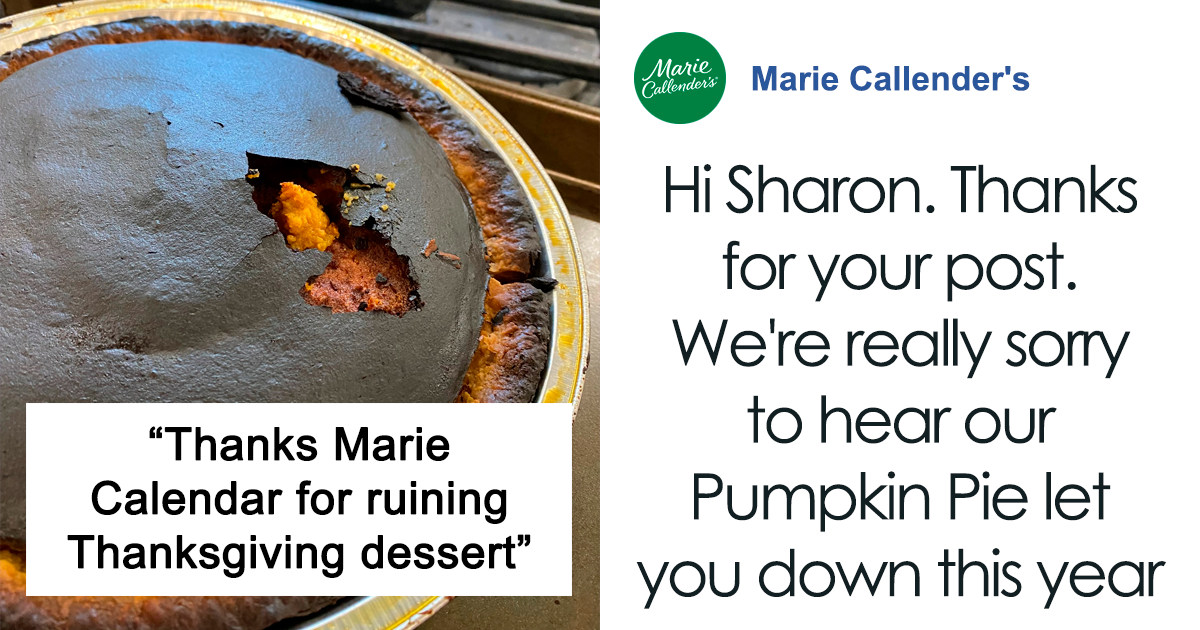
Every Thanksgiving table has a little drama. Someone forgets the cranberry sauce. Someone insists the turkey is “perfectly moist” while everyone quietly reaches for gravy like it is a rescue helicopter. But every now and then, a holiday mishap becomes so spectacular that it escapes the dining room, flies onto Facebook, and gets roasted by the entire internet.
That is exactly what happened in the now-famous Marie Callender’s burnt pie story. A woman, widely identified online as Sharon Weiss, posted a photo of a severely burned Marie Callender’s pumpkin pie and blamed the brand for “ruining Thanksgiving dessert.” The pie was not just overbaked. It looked like it had survived a volcanic event, filed a complaint, and lost. Instead of sympathy, the internet delivered jokes, memes, and comments so sharp they could slice cleaner than a pie server.
The story became a perfect viral moment because it had everything: holiday pressure, a beloved frozen dessert brand, public blame, customer-service politeness, and thousands of people asking the same basic question: “Did Marie Callender sneak into your kitchen and turn the oven into a furnace?”
The Burnt Pie Heard Around the Internet
The incident reportedly began around Thanksgiving 2021, when the burned pumpkin pie appeared on Marie Callender’s Facebook page. The complaint was short, dramatic, and instantly meme-ready. The customer thanked “Marie Callender” for ruining Thanksgiving dessert, posting the photo as evidence. The problem, at least to most observers, was that the evidence seemed to point less toward corporate wrongdoing and more toward a pie that had spent too much quality time in the oven.
Marie Callender’s responded professionally, which only made the situation funnier. The brand apologized and invited the customer to contact them privately so they could help. That was a smart customer-service move. Brands do not win by arguing with angry customers in public, even when the public is already laughing so hard it can barely type. Still, many commenters felt the company had nothing to apologize for. To them, the pie looked like a classic case of user error wearing a burnt crust disguise.
That contrast is what made the Marie Callender’s pie meme explode. On one side, there was a frozen pie company calmly doing damage control. On the other, there was an internet jury examining a blackened dessert and unanimously declaring, “Ma’am, this is between you and your oven.”
Why the Internet Roasted the Complaint So Hard
Online audiences love a good fail, but they especially love a fail that arrives with misplaced confidence. Burning a pie is human. Blaming the brand in public is where the story grew wings, put on sunglasses, and flew straight into meme history.
Frozen pies generally come with clear baking instructions. Depending on the product size and version, Marie Callender’s pumpkin pies are commonly baked in a conventional oven for roughly 65 to 80 minutes at a specified temperature, often on a baking sheet and with reminders to check doneness. The larger point is simple: frozen pies are not magic. They still require a functioning oven, attention, and at least one person in the home willing to ask, “Why does it smell like a campfire in here?”
The comments became brutal because the photo seemed so extreme. This was not a golden crust that went one shade too far. This was a dessert that looked like it had been carbon-dated. People joked that the pie had been baked on the surface of the sun, left in the oven for three business days, or prepared using the “cremate” setting. The humor was exaggerated, but the message was clear: the internet believed Marie Callender’s was innocent.
The Perfect Recipe for a Viral Food Fail
Food mishaps go viral because everyone can relate to them. Almost every home cook has forgotten something in the oven, confused teaspoons with tablespoons, or produced a dish that looked nothing like the recipe photo. The difference is that most people quietly scrape the evidence into the trash and pretend dessert was “never part of the plan.”
This story became bigger because it mixed three powerful internet ingredients:
1. A Familiar Brand
Marie Callender’s is a recognizable name in American comfort food. The brand’s roots go back to pies, home-style meals, and family dining. When a familiar brand is involved, people immediately understand the setup. They know what a frozen pie is supposed to look like. They know what a holiday dessert is supposed to do. And they know that “turning black” is not usually listed under serving suggestions.
2. Public Blame
Complaining privately to customer service is one thing. Posting a dramatic accusation on a brand’s Facebook page is another. Public posts invite public reactions. Once the complaint moved into the open, it no longer belonged only to the customer and the company. It became entertainment.
3. A Photo That Told the Whole Story
Some viral posts require explanation. This one did not. One glance at the pie and people understood the joke. The visual was so strong that even people who had never purchased a Marie Callender’s pie could participate. The image said, “Something went very wrong,” and the caption said, “I blame the pie company.” That gap between image and blame created the comedy.
What the Marie Callender’s Pie Incident Says About Online Reviews
The burnt pie story is funny, but it also says something useful about online reviews. Customers have more power than ever to criticize brands publicly. A single post can attract thousands of reactions, screenshots, shares, and jokes. That power can be helpful when a company truly makes a mistake. But when the complaint is unfair, vague, or obviously self-inflicted, the internet may not take the customer’s side.
People often read online reviews not only for information but also for judgment. They want to know whether the complaint makes sense. If someone gives a restaurant one star because it was closed on Christmas, readers may not blame the restaurant. If someone burns a pie and blames the manufacturer, readers may not blame the manufacturer either. In fact, they may turn the review itself into the main course.
This is why good reviews are specific, fair, and honest. A helpful review explains what happened, what instructions were followed, and what result occurred. “The pie burned after 40 minutes at the recommended temperature” is useful. “Thanks for ruining Thanksgiving” is dramatic, but it gives readers very little to work with, except comedy.
Why Marie Callender’s Customer Service Response Worked
One underrated part of the story is how the brand responded. Marie Callender’s did not mock the customer. It did not argue. It did not say, “Sharon, please stop cooking with dragon breath.” The company simply apologized and offered help.
That kind of response matters. In public customer service, tone is everything. A brand can be technically correct and still look rude. By staying polite, Marie Callender’s allowed the audience to defend the brand on its behalf. That is the dream scenario for any company facing an unfair complaint. The brand stayed calm, and the comment section did the roasting.
There is also a lesson here for businesses: not every viral complaint requires a dramatic corporate statement. Sometimes the best response is calm, human, and brief. The more professional the brand remained, the funnier the public defense became. Marie Callender’s looked reasonable, patient, and very much not responsible for operating a stranger’s oven.
The “Karen” Factor: Why the Label Stuck
The title of this story often uses the term “Karen,” a popular internet label for someone seen as entitled, unreasonable, or quick to demand blame from others. In this case, the label stuck because the complaint appeared to shift responsibility away from the person who cooked the pie and onto the company that made it.
Still, it is worth using the term carefully. Real people make real mistakes. A funny internet moment can quickly become overwhelming for the person at the center of it. The lesson should not be that one burned pie makes someone a villain forever. The better takeaway is that public blame can backfire when the facts are sitting right there in the photo, smoking gently.
The humor works best when aimed at the situation, not when it becomes a lifetime sentence for one person’s bad holiday moment. After all, many of us have made kitchen mistakes. Most of us are just lucky nobody turned ours into a national meme.
What Home Cooks Can Learn From the Burnt Pumpkin Pie
Beyond the jokes, the Marie Callender’s burnt pie incident offers practical kitchen wisdom. First, always read the full package instructions before cooking. Frozen foods may look simple, but time, temperature, rack position, baking sheet use, and resting time can matter. The U.S. Department of Agriculture and food-safety experts regularly remind consumers to follow package directions, especially with frozen foods that may need thorough cooking.
Second, know your oven. Ovens can run hot, heat unevenly, or behave differently depending on rack placement. A pie on the top rack may brown faster than one in the center. A dark baking sheet can increase browning. An oven set too high can transform a flaky crust into a charcoal briquette with cinnamon notes.
Third, use your senses. If the kitchen smells aggressively burnt, investigate. Do not wait until the smoke alarm files a formal complaint. Check the pie near the lower end of the recommended baking time. If the crust browns too quickly, use foil around the edges. If the filling needs more time, keep baking carefully while monitoring the crust.
Finally, when something goes wrong, pause before posting. The internet has a long memory and a short fuse. A burned dessert can be replaced. A viral screenshot may outlive the leftovers.
Specific Examples of How This Could Have Gone Differently
Imagine the same situation with a different post. Instead of blaming the brand, the customer could have written: “Well, I accidentally destroyed my Thanksgiving pie. Has anyone else had trouble with the baking time, or did my oven choose violence today?” That would still be funny, but it would invite help instead of backlash.
Or she could have contacted customer service privately: “I followed the package directions, but the pie burned badly. Could you help me understand what may have happened?” That kind of message gives the company room to respond and investigate without turning the customer into a meme.
Even better, she could have owned the mistake: “Thanksgiving update: the turkey survived, the pie did not. Please send whipped cream and emotional support.” That post would likely have earned laughs, sympathy, and maybe even a few rescue dessert ideas.
The difference is accountability. People are remarkably forgiving when someone says, “Oops, I messed up.” They are much less forgiving when someone points at a smoking pie and says, “The pie company did this to me.”
Why We Love Watching Kitchen Disasters Online
Kitchen disasters are oddly comforting. They remind us that perfection is fake, holidays are chaotic, and even simple recipes can go sideways. Social media is full of polished tablescapes, glossy pies, and turkeys that look like they were styled by a magazine team. A burnt pie cuts through all of that. It says, “Relax. Somewhere, someone’s dessert looks like a roofing shingle.”
That is why the Marie Callender’s pie story became more than a joke. It became a shared holiday ritual for many people online. Every Thanksgiving, the meme resurfaces as a reminder to check the oven, read the box, and avoid blaming Marie unless Marie personally arrives with a blowtorch.
There is also a little social justice baked into the laughter. People enjoy seeing unfair blame corrected, especially when the correction is obvious. The comments were not just about a pie. They were about responsibility, common sense, and the absurdity of turning a personal cooking mistake into a corporate accusation.
The Bigger Lesson: Accountability Is Always in Season
The funniest part of the story is the burnt pie. The most useful part is the accountability lesson. Everyone makes mistakes. The important question is what we do next. Do we laugh, learn, and move on? Or do we blame the nearest brand, appliance, weather pattern, or innocent frozen dessert?
In daily life, people often have “burnt pie moments.” A deadline gets missed, and the software gets blamed. A plant dies, and the nursery gets blamed. A phone battery dies after being ignored at 3 percent for two hours, and the phone gets blamed. These moments are human, but they become ridiculous when we refuse to admit our role.
The Marie Callender’s meme endures because it captures that universal instinct in one unforgettable image. It is funny because it is extreme, but it is relatable because we have all wanted to blame something else when our plans went crispy.
Extra Experiences and Real-Life Takeaways From the Burnt Pie Saga
Many people have experienced their own version of the Marie Callender’s pie incident, even if their disaster never made it to Facebook. Maybe it was a birthday cake that sank in the middle like it heard bad news. Maybe it was cookies that went from pale to hockey puck in the time it took to answer one text. Maybe it was a frozen pizza that looked perfectly normal until someone realized the cardboard was still underneath. Kitchen mistakes are practically a rite of passage.
One common experience is holiday overconfidence. Thanksgiving, Christmas, Easter, and big family gatherings have a way of turning casual cooks into temporary banquet managers. Suddenly, one person is responsible for turkey, sides, rolls, dessert, timing, seating, and Uncle Dave’s annual speech about traffic. In that chaos, a frozen pie can feel like the easy part. That is exactly when mistakes happen. The “easy” dish gets ignored because everyone assumes it can take care of itself. Spoiler: pies cannot babysit themselves.
Another relatable experience is oven mystery. Many home cooks do not realize their ovens run hotter or colder than the display says. A setting of 375 degrees may not produce the same result in every kitchen. Older ovens may have hot spots. Convection settings may brown food faster. Dark pans absorb more heat. Rack placement can change everything. This is why experienced bakers peek, rotate, shield crusts with foil, and trust visual cues as much as timers. The timer is a guide, not a courtroom witness.
There is also the emotional side of holiday cooking. When people are stressed, embarrassed, or disappointed, blame can come out faster than logic. A ruined dessert feels bigger when guests are waiting. Nobody wants to be the person who burned Thanksgiving pie. In that moment, blaming the brand may feel easier than saying, “I messed up.” But the internet is not a gentle kitchen. It is a stadium full of people holding microphones, and some of them have been waiting all day to make a joke.
For families, the best response to a food fail is usually humor. A burned pie can become a family legend instead of a disaster. Someone can run to the store for ice cream. Someone can cut around the edible parts. Someone can declare it “smoked pumpkin tart” and serve it with a straight face. The difference between a ruined holiday and a funny memory is often the willingness to laugh before blaming.
For brands, the experience shows how important it is to respond with patience. Marie Callender’s did not need to win the argument because the audience had already done the math. A polite reply protected the company’s image and kept the focus on the absurdity of the situation. In a world where brands sometimes try too hard to be witty, restraint can be the smartest move.
For social media users, the biggest takeaway is simple: before posting a complaint, ask whether the evidence supports the accusation. If the photo makes your side look worse, consider a rewrite. The internet loves accountability, but it loves irony even more. A fair complaint can pressure a company to improve. An unfair complaint can turn you into the punchline.
And for anyone baking a frozen pie this holiday season, the advice is beautifully simple. Read the box. Set the timer. Check early. Use the center rack. Keep foil nearby. Do not wander too far. And if your dessert comes out looking like a fossil, take a breath before tagging the brand. Sometimes the villain is not Marie Callender. Sometimes the villain is the oven, the timer, the distraction, or the tiny voice that said, “It’ll be fine.”
Conclusion
The story of the burnt Marie Callender’s pumpkin pie remains one of the internet’s funniest Thanksgiving food fails because it is simple, visual, and painfully human. A customer burned a pie, blamed the brand, and the comment section turned into a comedy roast. But beneath the jokes is a useful reminder: mistakes happen, especially in the kitchen, but public blame should come with evidence, humility, and maybe a quick glance at the oven timer.
Marie Callender’s walked away looking professional. The internet walked away with a meme. And the rest of us walked away with a timeless holiday rule: never leave your pie unattended long enough for it to develop a villain origin story.
SEO Tags
Note: This article is written as original SEO commentary based on publicly reported details about the viral Marie Callender’s burnt pie incident, general food-safety guidance about following package cooking instructions, and common customer-service and social media review practices.