Note: This article is based on publicly available information about illustrator Joe Kim, including his official portfolio, documented Hackaday work, professional background, and broader research on digital illustration, movie poster art, and technology-driven creative workflows.
Some artists make technology look cold, shiny, and slightly intimidatinglike a robot politely asking for your Wi-Fi password before taking over the kitchen. Joe Kim does the opposite. His work gives circuits, machines, software, hackers, movie icons, and pop culture myths a pulse. In his illustrations, technology is not just a pile of components or a glowing screen. It becomes a story, a character, a joke, a mood, and sometimes a tiny visual wink that says, “Yes, this circuit board has feelings.”
Joe Kim is best known to many readers as the illustrator and art director connected with Hackaday and Supplyframe, where his original artwork has helped shape the visual identity of one of the internet’s most beloved engineering and maker communities. But reducing him to “the guy who draws cool tech art” would be like calling a synthesizer “a noisy keyboard.” Accurate? Maybe. Complete? Not even close.
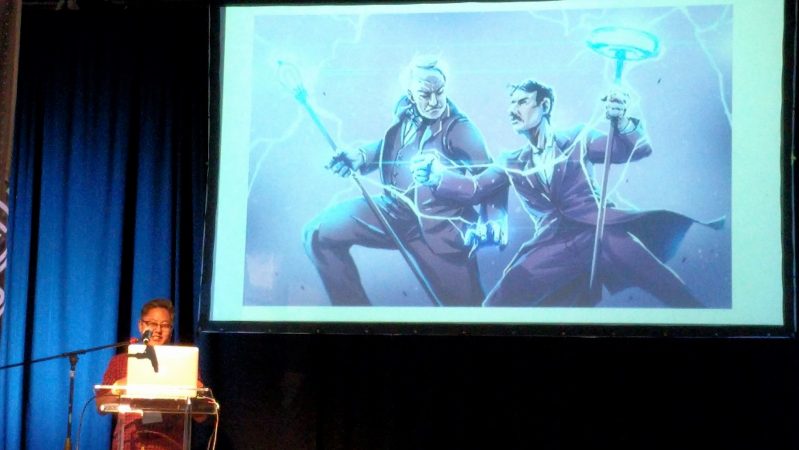
Born in South Korea, raised across California, trained at ArtCenter College of Design in Pasadena, and based in Los Angeles, Kim sits at a fascinating intersection: editorial illustration, entertainment art, film poster culture, digital tools, engineering storytelling, and late-night creative discipline. His client list has included names such as McDonald’s, Disney, Sony, Arrow Video, Scion, and Hackaday. His portfolio stretches across film, comics, editorial art, and personal projects, with subjects ranging from 2001: A Space Odyssey and Dune: Part Two to The Batman, Everything Everywhere All at Once, Crouching Tiger, Hidden Dragon, and “Edison v Tesla.”
The title “Joe Kim: Where Technology And Art Collide” fits because Kim’s work does not merely decorate technology. It translates it. He turns abstract ideas into visual scenes that feel human, cinematic, and surprisingly approachable. That is a rare skill in a world where many people still think “technical illustration” means gray diagrams, microscopic labels, and arrows pointing at things no one wants to admit they do not understand.
Who Is Joe Kim?
Joe Kim is an illustrator and art director whose creative identity blends entertainment design, editorial storytelling, and technology culture. His official biography describes him as an illustrator born in South Korea and raised throughout California. He earned his BFA from ArtCenter College of Design in Pasadena and now lives in Los Angeles. Professionally, he has served as an art director at Supplyframe, the company connected with Hackaday, a major platform for engineers, hackers, designers, and open-source hardware enthusiasts.
That background matters because Kim’s art is not floating in a vacuum. It comes from a world where visual communication has to do real work. On Hackaday, an illustration may need to introduce a story about Tesla and Edison, artificial intelligence, Linux, cam security, MRI machines, tools, biological systems, or some wonderfully unhinged maker project that sounds like it was invented in a garage at 2:13 a.m. by someone fueled entirely by solder fumes and optimism.
In that setting, art cannot be random. It has to grab attention, explain tone, reward curiosity, and respect the technical audience. Engineers can smell fake enthusiasm from three browser tabs away. Kim’s work succeeds because it is visually stylish without being empty. It understands the subject just enough to make it funny, dramatic, or emotionally sharp.
The Hackaday Connection: Making Engineering Feel Alive
Hackaday has long been a gathering place for people who enjoy taking things apart, building things back better, and occasionally discovering that smoke is not supposed to come out of that component. Within that culture, Joe Kim’s illustrations have played a special role. They are not generic stock images. They are custom editorial artworks that frame technical stories with personality.
When an article discusses a dense topicsay, computer history, hardware design, high-frequency trading, or artificial intelligenceKim’s visual approach helps readers enter the subject before the first paragraph has finished warming up. His images often use cinematic composition, expressive characters, bold lighting, and clear graphic staging. The result feels less like a technical manual and more like a movie poster for an idea.
That is especially important online, where attention is a tiny, skittish animal. A strong illustration can stop the scroll, but a smart illustration can also shape interpretation. Kim’s art often hints at the argument of the piece. It can satirize hype, dramatize conflict, or make a technical concept feel less sterile. In other words, he does not simply make technology look “cool.” He makes it readable.
Original Art in a World of Stock Images
One reason Kim’s Hackaday work stands out is that the internet is drowning in sameness. Search for technology images and you will find endless glowing blue networks, faceless people touching invisible screens, and robots that look like they have just been asked to explain blockchain at a dinner party. Kim’s illustrations avoid that trap by being specific.
Specificity is where editorial illustration earns its keep. A custom image can say, “This article is about this exact idea, from this exact angle, with this exact mood.” That is why Kim’s work feels memorable. It is not visual wallpaper. It is part of the article’s argument.
Technology as Tool, Not Replacement
One of the most interesting aspects of Joe Kim’s public discussion around art and technology is his nuanced view of digital tools. He works digitally and has been associated with Photoshop-based workflows, yet he has also raised concerns about technology removing the artist from the art. That tension is not a contradiction. It is the central creative question of our era.
Digital tools have made image-making faster, more flexible, and more accessible. Artists can sketch, paint, revise, layer, color-correct, and deliver finished work without waiting for paint to dry or praying that a scanner behaves like a civilized machine. But speed can also create sameness. Templates, filters, shortcuts, and algorithmic trends can flatten personality. When everyone uses the same tools in the same way, visual culture starts looking like it came from one very busy laptop.
Kim’s work argues, visually, that the artist still matters. The software may provide brushes, layers, masks, and undo buttonsthe holy grail of anyone who has ever drawn a hand badly at 1 a.m.but taste, timing, composition, humor, and interpretation come from the person using the tool.
The Human Hand Behind the Digital Image
Great digital illustration does not erase craft. It relocates it. Instead of mixing pigments, the artist may tune color digitally. Instead of scraping a canvas, the artist may revise a layer. Instead of physically cutting paper, the artist may build shapes with a stylus. The medium changes, but the old problems remain: Where should the eye go? What is the emotional center? What should be simplified? What should be exaggerated? What story is the image telling before words arrive?
Kim’s best work feels digital in execution but human in judgment. His characters have attitude. His compositions have rhythm. His movie-inspired pieces often show an understanding of poster design traditions, from bold silhouettes and dramatic lighting to the iconic economy associated with artists like Saul Bass and the painterly drama associated with classic film poster illustrators.
Film Poster Energy Meets Engineering Culture
Joe Kim’s portfolio reveals a strong relationship with film and entertainment imagery. His work includes pieces inspired by major films and series such as Superman, Dune: Part Two, Past Lives, Ahsoka, The Mandalorian, Blade Runner 2049, Drive, Minari, Watchmen, The Green Knight, and 2001: A Space Odyssey. That range is not just a list of fandom credentials; it shows how deeply he understands cinematic storytelling.
Movie posters have to compress narrative into a single image. They must suggest genre, mood, stakes, character, and world-building almost instantly. Kim brings that same compression skill into editorial and tech illustration. When he draws a piece about a technology topic, the image often feels like the poster for a tiny film about the idea.
That is a powerful technique because technology stories can be abstract. A microcontroller does not naturally have a dramatic arc. A security vulnerability is not usually photogenic. A debate about artificial intelligence ethics does not arrive wearing a cape. But an illustrator can create a symbolic scene that gives the concept shape.
Why Pop Culture Fluency Matters
Kim’s art often feels accessible because it speaks fluent pop culture. He can borrow the visual grammar of comics, cinema, noir, science fiction, retro futurism, and editorial cartoons without making the work feel like a cheap parody. This matters because technology itself is now part of pop culture. Artificial intelligence, space exploration, robotics, cybersecurity, maker hardware, and electric vehicles are not niche subjects anymore. They are everyday conversation topics.
By using cinematic and comic-book visual language, Kim builds a bridge between technical subjects and general curiosity. A reader may not understand every engineering detail immediately, but they can feel the mood of the story. That emotional entry point is often what keeps people reading.
Art Direction: The Invisible Architecture of Visual Identity
Illustration is only part of Joe Kim’s contribution. As an art director, his work also involves shaping visual consistency, tone, and creative standards. Art direction is one of those jobs that looks magical when done well and very noticeable when done badly. If a site or brand has a strong visual identity, people may simply say, “This feels right.” If it lacks one, people may say, “Why does this look like six unrelated PDFs got into a blender?”
For a platform like Hackaday, visual identity must balance several personalities at once. It needs to appeal to engineers, hobbyists, hackers, students, educators, and curious general readers. It has to be clever but not smug, technical but not dry, playful but not childish. Kim’s work helps maintain that balance by giving the community a recognizable visual voice.
That voice is energetic, witty, and slightly rebellious. It says that technology is serious, but not too serious to have fun with. It suggests that invention is not merely a matter of specs and code; it is also culture, imagination, and style.
What Makes Joe Kim’s Illustration Style Distinct?
Several qualities make Joe Kim’s work recognizable. First is his sense of composition. His images tend to guide the eye clearly, often using strong silhouettes, layered depth, and dramatic focal points. Second is his comfort with character. Whether the subject is a historical inventor, a fictional hero, or a symbolic figure representing technology, Kim gives the image presence.
Third is his humor. Not every piece is a joke, but many have a knowing energy. They understand the absurdity of tech culturethe grand ambition, the strange gadgets, the heroic debugging, the occasional “why did we build this?” moment. Fourth is his range. His portfolio moves comfortably from film poster homage to comic-book energy to editorial concept art. That flexibility is a major advantage in a digital media environment where every topic demands a slightly different visual temperature.
Style Without Repetition
Many artists become trapped by their own signature. They find one successful look and repeat it until the work feels like a brand mascot wearing different hats. Kim’s portfolio shows a more adaptable approach. A piece inspired by Crouching Tiger, Hidden Dragon does not need to look like a piece about Linux. A film poster tribute does not need to behave like an editorial image about AI detection. The through-line is not sameness; it is intelligence.
That is a valuable lesson for designers and illustrators. A strong style is not just a set of visual tricks. It is a way of thinking. Kim’s work feels connected because it consistently solves visual problems with clarity, mood, and narrative punch.
The Broader Meaning: Why Art and Technology Need Each Other
The phrase “where technology and art collide” can sound dramatic, as if a graphics tablet and a paintbrush met in a parking lot and settled their differences with jazz hands. In reality, art and technology have always influenced each other. Cave pigments, bronze casting, oil paint, photography, printing presses, film cameras, animation software, 3D modeling, tablets, and generative AI all changed what artists could make and how audiences could see it.
What makes the current moment different is speed. Tools evolve quickly, platforms change constantly, and visual trends spread almost instantly. For artists, that creates both opportunity and pressure. The opportunity is obvious: more tools, more audiences, more ways to publish. The pressure is sneakier: more competition, more imitation, more temptation to let the tool make creative decisions.
Joe Kim’s career offers a useful model. Embrace the tool, but do not worship it. Learn the software, but do not let software become the style. Use technology to accelerate craft, not to avoid it. Make images that feel authored, not assembled.
Lessons Creators Can Learn From Joe Kim
1. Understand the Subject Before Drawing It
Kim’s editorial work works because it feels connected to the idea behind the article. For creators, this is a reminder that research is part of art. Before designing an image for a technology topic, understand the central tension. Is the story about danger, curiosity, history, hype, failure, elegance, or absurdity? The image should answer that question.
2. Build a Visual Vocabulary Outside Your Niche
Kim’s film and comic influences enrich his technology work. Designers should study widely: movie posters, classic illustration, comics, animation, product design, typography, photography, and even memes. Especially memes. They are the folk art of people who have been online too long, which is to say, all of us.
3. Let Humor Serve the Idea
Humor in illustration should sharpen the message, not distract from it. Kim’s playful approach often makes technical subjects less intimidating while still respecting the audience’s intelligence. That balance is hard to fake. It requires timing, restraint, and confidence.
4. Keep the Artist in the Art
Digital tools can help artists work faster, but speed should not replace intention. The strongest images still come from choices: what to leave out, what to exaggerate, where to place the light, how to shape the mood, and when to stop before the image becomes overcooked visual lasagna.
Experiences Related to “Joe Kim: Where Technology And Art Collide”
Experiencing Joe Kim’s work is a reminder that technology content does not have to look like a corporate slide deck that gave up on joy. Anyone who has spent time reading about engineering, hardware, or software knows the familiar visual routine: photos of circuit boards, screenshots of code, exploded diagrams, and stock images of people pointing at transparent screens that definitely do not exist in their office. Those images can be useful, but they rarely create emotional momentum. Kim’s illustrations do.
A reader arriving at a Hackaday article with original Joe Kim artwork often gets two stories at once. The written story explains the technical subject; the image sets the stage. Before reading a single sentence, the viewer may already sense conflict, curiosity, nostalgia, danger, or comedy. That first impression matters. It turns passive browsing into active attention.
For writers, the experience is equally meaningful. A strong custom illustration can make an article feel complete. It is the difference between serving a homemade meal on a paper towel and plating it like you meant to impress somebody. The words may carry the information, but the image gives the piece a public face. Kim’s art often appears to understand the article’s hidden personalitythe little spark that makes a technical subject worth discussing.
For designers, studying Kim’s approach can be a practical exercise. Pick a dry technology headline and ask: What is the human drama here? Is it invention versus limitation? Is it old technology refusing to die? Is it a tiny component doing heroic work? Is it the absurdity of modern life, where a refrigerator can connect to Wi-Fi but still cannot tell you who finished the orange juice? This kind of questioning moves an image beyond decoration.
For engineers and makers, Kim’s work validates something important: building is creative. A breadboarded prototype, a custom PCB, a hacked appliance, or a software tool is not just functional output. It is imagination made physical. When art treats engineering with drama and wit, it helps the broader public see technical work as culture, not just labor.
There is also a lesson for anyone worried that new toolsAI image generators, automated design templates, smarter editing softwarewill erase human creativity. Kim’s career suggests a more grounded view. Tools change the surface of production, but they do not automatically create taste. They do not know why a joke lands, why a silhouette feels heroic, why a color palette suggests melancholy, or why a tiny visual exaggeration can make an idea unforgettable. The artist still supplies judgment.
The best experience related to Joe Kim’s “technology and art collide” theme is trying it yourself. Take a technical concept you care about and sketch it as a movie poster. Give your favorite programming language a personality. Turn a cybersecurity flaw into a noir scene. Draw an old tool as a retired superhero. The result may not be portfolio-ready, but it will change how you think. You will begin to see that technology is full of characters, conflicts, histories, and moods. Kim’s work shines because he sees those possibilities and gives them form.
Conclusion: The Collision Is the Point
Joe Kim’s art matters because it refuses to choose between technology and humanity. His illustrations prove that machines, software, engineering debates, and maker culture can be visually rich, emotionally sharp, and deeply entertaining. He brings the discipline of an illustrator, the instincts of a film poster designer, the adaptability of an editorial artist, and the curiosity of someone who understands that technology is never just about objects. It is about people building, dreaming, failing, fixing, and trying again.
In a digital world overflowing with images, Kim’s work stands out because it feels considered. It has a point of view. It respects craft while using modern tools. It understands nostalgia without being trapped by it. Most importantly, it keeps the artist visible inside the process. That may be the real lesson of “Joe Kim: Where Technology And Art Collide.” The collision is not a disaster. It is the spark.