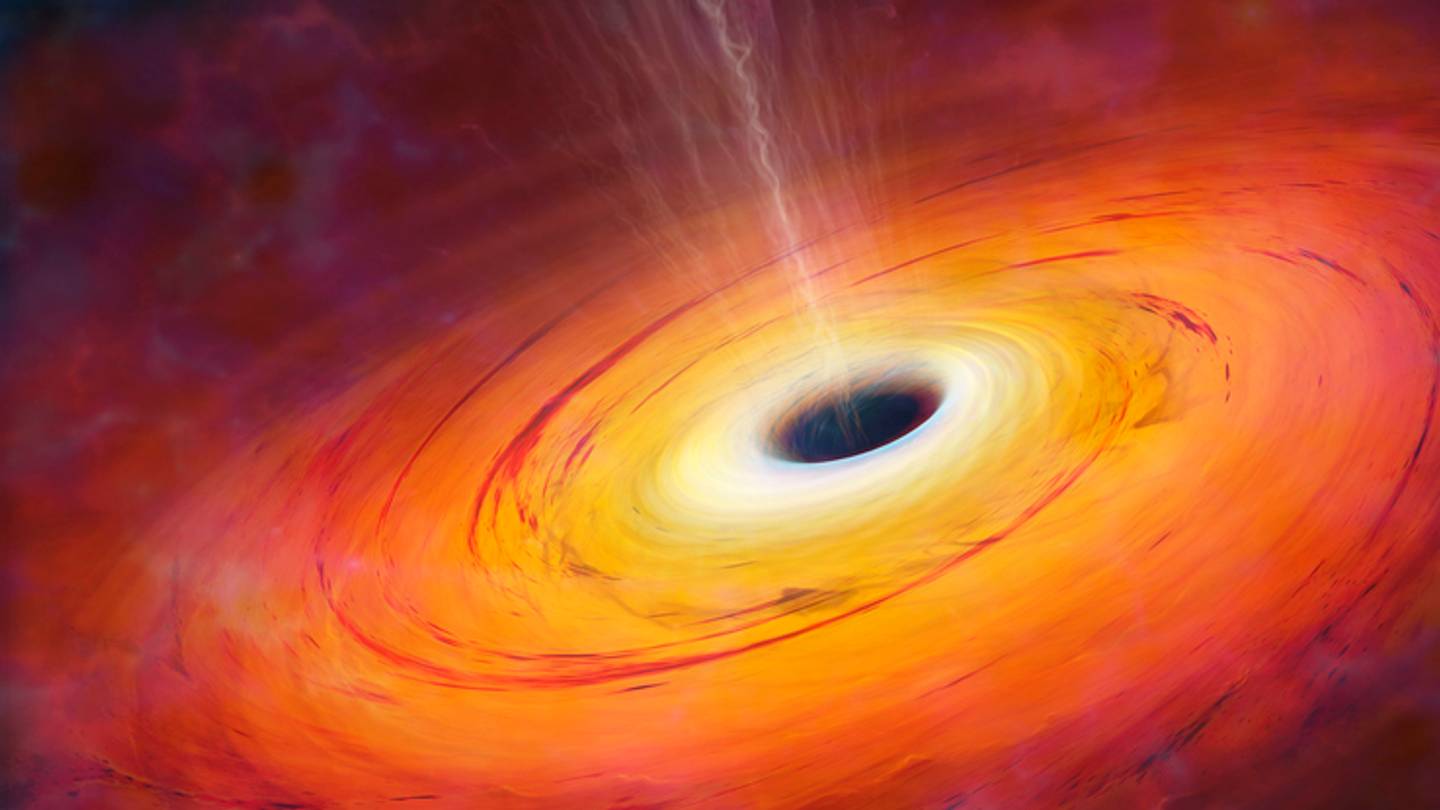
Some news arrives quietly. Other news kicks down the cosmic door, wearing a lab coat and carrying 13.3 billion years of evidence. Astronomers have confirmed what is currently considered the universe’s earliest confirmed black hole, hiding inside a tiny, bright, ruby-colored galaxy called CAPERS-LRD-z9. It appears as it existed roughly 500 million years after the Big Bang, back when the universe was still in its cosmic toddler phase and had not yet learned to clean up after supernovae.
This discovery is not just another “space is weird” headline, although, to be fair, space continues to be extremely committed to that brand. The confirmed black hole in CAPERS-LRD-z9 gives scientists a rare look at how supermassive black holes may have formed so early, so quickly, and so dramatically. The finding also strengthens a growing idea in modern astronomy: some of the first black holes may not have started small and slowly grown into giants. They may have been born with a serious head start.
For readers searching for the main point: astronomers used the James Webb Space Telescope, especially its infrared spectroscopy power, to identify the telltale signs of fast-moving gas around an active black hole. That evidence turns CAPERS-LRD-z9 from a mysterious red speck into one of the most important early-universe objects ever studied.
What Exactly Did Astronomers Confirm?
Astronomers confirmed an active supermassive black hole inside CAPERS-LRD-z9, a distant galaxy belonging to a puzzling group known as Little Red Dots. These galaxies are compact, bright, and red in James Webb Space Telescope images. They appear mostly in the first 1.5 billion years of cosmic history, which already makes them suspiciously interesting. In astronomy, “suspiciously interesting” often means scientists are about to lose sleep in the best possible way.
CAPERS-LRD-z9 has a redshift of about z = 9.288, meaning its light has been stretched dramatically by the expansion of the universe. That redshift places the galaxy at a time when the universe was only about half a billion years old. Because looking deep into space also means looking back in time, Webb is not showing us CAPERS-LRD-z9 as it looks “today.” It is showing us a baby picture from the universe’s earliest scrapbook.
The black hole itself is estimated to have a mass of roughly 38 million times the mass of the Sun, though scientists allow for a wide range because measuring black holes at such extreme distances is not exactly like weighing groceries at a supermarket. Depending on assumptions and uncertainties, its mass could be much lower or much higher, but the central message remains the same: this object is enormous for such an early era.
How Webb Found the Oldest Confirmed Black Hole
The Power of Infrared Vision
The James Webb Space Telescope was built for discoveries like this. Its infrared instruments can detect light from extremely distant galaxies whose original ultraviolet and visible light has been stretched into infrared wavelengths by cosmic expansion. Without infrared astronomy, many of these early galaxies would be like text messages sent from the dawn of time with the font set to invisible.
CAPERS-LRD-z9 was first noticed as a promising high-redshift candidate in Webb imaging. But a pretty red dot is not enough to confirm a black hole. Astronomers needed spectroscopy, which splits light into its component wavelengths. Think of it as the universe’s barcode scanner. By reading that barcode, scientists can determine what elements are present, how fast gas is moving, and whether something extreme is happening near the galaxy’s center.
The Smoking Gun: Broad Emission Lines
The key evidence came from broad emission lines, especially hydrogen emission. When gas falls toward a black hole, it accelerates to extraordinary speeds. Some gas moves toward us, shifting light bluer. Some moves away, shifting light redder. The combined result is a broadened spectral line, a signature astronomers associate with an active galactic nucleus, or AGN.
In CAPERS-LRD-z9, researchers found a broad hydrogen-beta line with gas moving at thousands of kilometers per second. That is not ordinary galaxy behavior. Stars can be dramatic, but gas screaming around a compact central object at those speeds is a major clue that a black hole is feeding. A black hole itself emits no light, but the material falling toward it heats up and glows intensely, like a cosmic food processor with terrible table manners.
Why This Discovery Matters
The phrase oldest black hole in the universe can sound simple, but it raises a giant scientific question: how did such a massive black hole exist so early? In standard models, black holes can form from the collapse of massive stars. These “light seed” black holes might begin with tens or hundreds of solar masses. Over time, they grow by swallowing gas, merging with other black holes, and generally behaving like the least polite dinner guests in physics.
The problem is time. CAPERS-LRD-z9 existed when the universe was only about 500 million years old. That may sound like a lot of time if you are waiting for a software update, but in cosmic terms it is barely a warm-up lap. Growing a black hole from a small stellar remnant to tens of millions of solar masses in that short window is difficult unless the black hole ate at an extreme rate, merged efficiently, or started out unusually large.
This is where the idea of massive black hole seeds becomes important. Some theories suggest early supermassive black holes formed from the direct collapse of huge gas clouds, creating seeds of perhaps 10,000 to 100,000 solar masses. That gives the black hole a major head start. Instead of starting life as a cosmic acorn, it begins as a respectable tree and then grows into a forest.
CAPERS-LRD-z9 and the Mystery of Little Red Dots
One of the most exciting parts of the discovery is its connection to Little Red Dots. These objects surprised astronomers after Webb began science operations. They are small, red, and unexpectedly bright. At first glance, their brightness might suggest they contain huge numbers of stars. But at such early cosmic times, forming that many stars so quickly can be hard to explain.
A growing black hole offers another explanation. As gas falls inward, it becomes extremely hot and luminous. Dust and dense gas around the black hole can redden the light, making the galaxy appear as a Little Red Dot. In other words, some of these mysterious red specks may not be star-packed baby galaxies alone. They may be galaxies whose central black holes are helping steal the spotlight.
CAPERS-LRD-z9 provides strong evidence for that idea. Its spectrum suggests a dense, gas-enshrouded active galactic nucleus. That means the black hole may be wrapped in thick material, changing the way its light appears to us. The result is a galaxy that looks red, compact, and strangely brightbasically the universe’s version of a suspiciously glowing ember.
How It Compares With GN-z11 and UHZ1
CAPERS-LRD-z9 is not the only early black hole candidate or record-breaker that has made headlines. Two important names often appear in this conversation: GN-z11 and UHZ1.
GN-z11 is an exceptionally distant galaxy observed by Webb and Hubble. Webb observations found strong evidence that GN-z11 hosts an active supermassive black hole of around a few million solar masses. That galaxy appears as it was roughly 430 million years after the Big Bang, making it incredibly early. However, CAPERS-LRD-z9 stands out because its broad-line spectroscopic signature gives astronomers a particularly clear confirmation of an active black hole at a very high redshift.
UHZ1 is another remarkable early-universe object. It was studied using both Webb and NASA’s Chandra X-ray Observatory. Chandra detected X-rays from UHZ1, which can indicate hot gas near a growing supermassive black hole. UHZ1 became important because it may represent an “outsize black hole,” where the black hole’s mass is comparable to the stellar mass of its host galaxy. That is wildly different from many nearby galaxies, where central black holes are usually a much smaller fraction of the host galaxy’s stellar mass.
Together, CAPERS-LRD-z9, GN-z11, and UHZ1 are changing how astronomers think about early black hole growth. They suggest that supermassive black holes were not late arrivals to the cosmic party. Some were already raiding the snack table before the universe had finished setting out the chairs.
The Big Scientific Puzzle: Which Came First, the Galaxy or the Black Hole?
In the modern universe, supermassive black holes and galaxies seem deeply connected. Most large galaxies have central black holes, and the masses of those black holes often correlate with properties of their host galaxies. This relationship suggests that galaxies and black holes evolve together over billions of years.
But early-universe discoveries complicate that neat picture. Some ancient black holes appear surprisingly massive compared with their host galaxies. In CAPERS-LRD-z9, the black hole may represent a large fraction of the galaxy’s stellar mass. If that holds up, it raises a wonderful chicken-and-egg question: did the galaxy build the black hole, or did the black hole help shape the galaxy from the beginning?
One possibility is that black holes formed early and influenced star formation by heating gas, driving winds, or regulating how material flowed into young galaxies. Another possibility is that early galaxies were dense, chaotic environments where black holes could grow at unusually fast rates. The honest scientific answer is that both may be true in different places. The universe rarely chooses one plotline when it can run six at once.
Why “Confirmed” Is Such a Big Word in Astronomy
Science headlines often use words like “possible,” “candidate,” “may,” and “could.” That is not weakness; it is honesty. Astronomy is difficult because scientists are often studying faint light that has traveled for billions of years through an expanding universe, past dust, gas, gravitational lenses, and every other cosmic inconvenience imaginable.
Calling CAPERS-LRD-z9 the earliest confirmed black hole matters because the evidence includes spectroscopic features strongly associated with an active black hole. Candidates are important, but confirmation requires a higher standard. Webb’s spectroscopy provides that standard by showing the fingerprint of fast-moving gas near a central massive object.
That does not mean every detail is settled. The exact black hole mass, the structure of the surrounding gas, and the galaxy’s true stellar mass remain active research questions. But the case for an accreting black hole is strong enough that CAPERS-LRD-z9 now serves as a benchmark for future discoveries.
What This Means for the Future of Space Science
The discovery of the universe’s oldest confirmed black hole is not the final answer. It is more like finding the first page of a book and realizing the plot is far stranger than expected. Webb will continue surveying distant galaxies, and future telescopes may add even more detail. Astronomers will look for more Little Red Dots, more broad-line AGN, and more examples of black holes that seem too large for their young homes.
These discoveries may also help scientists understand cosmic reionization, the period when the first stars, galaxies, and black holes transformed the universe from a foggy sea of neutral hydrogen into the transparent cosmos we observe today. Active black holes produce energetic radiation, and if enough of them existed early, they may have played a role in changing the universe’s large-scale environment.
In short, CAPERS-LRD-z9 is not just a record-holder. It is a clue. It tells us that black holes were already powerful players in the first few hundred million years of cosmic history. It also reminds us that every time astronomers build a better telescope, the universe responds by becoming more interesting and slightly less cooperative.
Experience Section: What This Discovery Feels Like From Earth
There is something strangely personal about learning that astronomers have confirmed the oldest black hole ever observed. On one level, the discovery is pure science: redshift values, hydrogen lines, solar masses, infrared spectra, and models with enough Greek letters to make a chalkboard nervous. On another level, it hits the imagination like a door opening in a dark hallway. Suddenly, the early universe feels less like an abstract chapter in a textbook and more like a real placehot, young, crowded, and already full of drama.
For anyone who has ever looked up at the night sky and felt small, CAPERS-LRD-z9 adds a new flavor to that feeling. It is not just that the galaxy is far away. It is that its light began traveling when the universe was only a tiny fraction of its current age. While Earth did not exist, while the Sun had not formed, while the Milky Way was still becoming itself, that ancient galaxy was already hosting a hungry black hole. The light then crossed space for more than 13 billion years, only to land in the mirrors and instruments of a telescope built by human hands. That is not just impressive. That is cosmic mail delivery with historic timing.
The experience of reading about this discovery also changes how we think about time. Human life moves in years, deadlines, birthdays, school calendars, bills, and weekend plans. Astronomy deals in millions and billions of years as casually as someone ordering fries. A black hole from 500 million years after the Big Bang makes ordinary time feel both tiny and precious. It reminds us that our moment in the universe is brief, but not meaningless. We are the part of the cosmos that can build a telescope, detect ancient light, and ask, “Wait, how did that thing get so big so fast?”
There is also a refreshing humility in the discovery. For decades, scientists built elegant models of how galaxies and black holes should grow. Then Webb arrived and started finding objects that looked too bright, too red, too compact, or too mature. CAPERS-LRD-z9 does not destroy astronomy; it improves it. Good science is not embarrassed by surprise. Good science keeps receipts, checks the spectrum, updates the model, and maybe drinks more coffee.
For science lovers, this discovery is exciting because it makes the universe feel active rather than finished. The early cosmos was not a quiet waiting room before “real” galaxies showed up. It was already busy. Gas was collapsing, stars were forming, radiation was spreading, and black holes were feeding. CAPERS-LRD-z9 lets us glimpse that wild beginning with better clarity than ever before.
And for everyone else, the takeaway is simple: the universe is older, stranger, and more inventive than our first guesses. Somewhere near the beginning of time, a black hole was already growing inside a small red galaxy. Billions of years later, a species on a blue planet noticed. That may be the most human part of the storynot the black hole, not the redshift, not even the telescope, but the act of noticing.
Conclusion: A Tiny Red Dot With a Giant Message
The confirmation of a black hole inside CAPERS-LRD-z9 marks a major moment in the study of the early universe. Seen roughly 500 million years after the Big Bang, this object pushes astronomers closer to the cosmic beginning and challenges traditional ideas about how quickly supermassive black holes can form. Its connection to Little Red Dots may help explain why some early galaxies look so compact, bright, and red in Webb images.
The discovery does not close the case on early black hole formation. Instead, it opens a better investigation. Did the first supermassive black holes grow from light stellar remnants, massive direct-collapse seeds, rapid feeding episodes, or some combination of all three? CAPERS-LRD-z9 cannot answer every question alone, but it gives scientists a powerful new clue. In a universe full of mysteries, this tiny red dot has become a giant signpost pointing toward the first chapters of cosmic history.