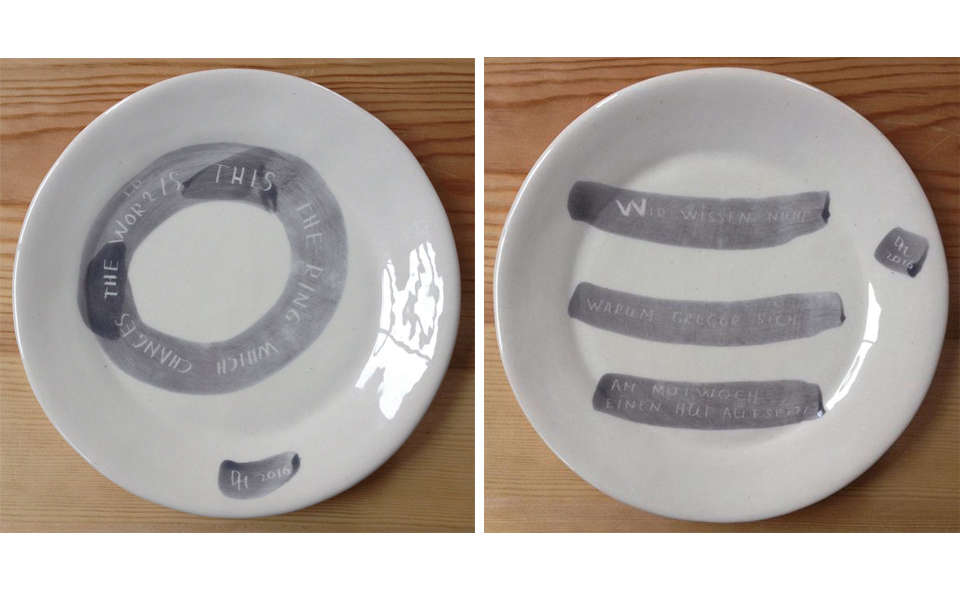
Some plates carry pasta. Some carry pie. Dieter Meier’s enSoie plate carries an existential question large enough to interrupt dinnerand possibly make the pasta feel intellectually underdressed.
A Plate That Refuses to Be Just a Plate
“Is This the Ring Which Changes the World?” sounds like a line from a mysterious science-fiction film, a marriage proposal conducted under unusual circumstances, or the opening question at a philosophy conference with excellent catering. Instead, it appeared on a special-edition ceramic plate created by Swiss artist Dieter Meier for enSoie.
The archived product description explains that Meier regularly traveled to enSoie’s ceramics manufacturing location in Poland to create distinctive special-edition collections. For this particular series, he concentrated on plates and decorated them with poetic sentences. The piece was made entirely from ceramic, recommended for hand washing, and originally offered through enSoie in Zurich and online. It has since been discontinued.
That discontinued status has only strengthened the plate’s appeal as a collectible design object. It belongs to the intriguing category of household goods that sit halfway between functional tableware and art. Technically, it can hold a pastry. Emotionally, it would rather hold your attention.
Who Is Dieter Meier?
Dieter Meier is difficult to summarize without making him sound like several people sharing one extremely stylish coat. Born in Zurich in 1945, he has worked across conceptual art, performance, filmmaking, writing and music for more than five decades. He became internationally recognizable as the vocalist and visual personality of the electronic duo Yello, but his artistic experiments began before the band’s rise.
From Conceptual Art to Electronic Pop
Meier’s early work often transformed ordinary gestures into oddly significant events. He explored time, anticipation, bureaucracy, absurdity and the human desire to discover meaning in nearly everything. In one famous project connected with Documenta 5, he installed a plaque announcing that he would stand on that exact spot during a specific hour more than two decades later. He eventually returned and fulfilled the promise.
Museum accounts of his work emphasize the contrast between carefully organized actions and their apparent irrationality. A mundane event could become fascinating simply because it had been announced, documented and performed with absolute seriousness. Meier repeatedly challenged viewers to ask whether meaning was present in the action itself or created by the audience’s expectations.
That approach helps explain why a sentence on a ceramic plate feels completely natural within his artistic universe. The plate does not deliver an answer. It sets a small intellectual trap. You notice the words, wonder about the ring, invent possible interpretations and suddenly realize that the object has persuaded you to participate.
The Yello Connection
In the late 1970s, Meier began collaborating with composer and producer Boris Blank in Yello. The group became known for imaginative electronic production, theatrical vocals, surreal humor and visually inventive music videos. Meier’s work as a director helped shape the group’s presentation during the MTV era, while songs such as “Oh Yeah” and “The Race” introduced Yello’s eccentric sound to international audiences.
The connection between Yello and the enSoie plate is not merely biographical. Both depend on compression. A Yello track can create a cinematic atmosphere using a peculiar voice, an unexpected noise and a perfectly timed rhythm. The plate does something similar with a familiar object, a brief sentence and one unanswered question.
Understanding the enSoie Design World
enSoie is a family-led Swiss design house based in Zurich. Its creative world spans ceramics, textiles, fashion, jewelry, accessories and interior pieces. Rather than separating art from domestic life, the brand allows patterns, drawings, phrases and handcrafted details to move freely between scarves, clothing, table linens and tableware.
The business grew from the vision of Monique Meier, Dieter Meier’s wife, and developed into a multigenerational family enterprise. Its identity combines craftsmanship with an unmistakable sense of play. Checks, bright colors, embroidery and charmingly imperfect details appear throughout its collections, creating objects that feel personal rather than clinically luxurious.
When enSoie expanded its presence in Los Angeles, American design coverage highlighted its artist-designed silk scarves, jewelry, clothing and ceramics. The Silver Lake boutique was conceived not as a stereotypical Alpine fantasy but as a contemporary expression of Zurich’s creative culture. The result connected Swiss craft traditions with the relaxed visual energy of Los Angeles.
Within that environment, Meier’s sentence plates made perfect sense. They were refined but not solemn, artistic but not untouchable, humorous without behaving like novelty merchandise. One archived listing priced the “Ring” plate at $150, alongside another Meier plate carrying an equally puzzling German sentence about why someone wears a hat on Wednesdays. Clearly, ordinary Tuesday tableware was not invited to this party.
What Does “The Ring Which Changes the World” Mean?
The sentence is deliberately open-ended. There is no official instruction requiring viewers to interpret the ring as one particular object. That ambiguity is the engine of the design.
A Symbol of Commitment
The most immediate interpretation is a wedding or engagement ring. A small circle placed on one person’s finger can reorganize two lives, connect families and launch an impressive number of conversations about seating charts. From that perspective, the plate asks whether personal commitment can change the wider worldor at least the worlds of the people involved.
A Circle of Influence
The ring might also represent a social circle, a community or a chain of relationships. Cultural change rarely arrives as one enormous cinematic event. More often, an idea passes from person to person until a small circle becomes a movement. A ring can suggest continuity, connection and influence without beginning or end.
A Target, Boundary or Portal
Visually and conceptually, a ring can resemble a target, a border, an orbit or an opening. Each possibility changes the question. Are we aiming at a better world? Trapped inside an existing one? Circling the same problems? Looking through a portal toward something new?
Meier’s phrasing refuses to settle the matter. Even the word “this” is mischievous. It implies that a specific ring is present, although the viewer may be unsure what qualifies as the ring. The plate’s circular form may itself become part of the joke. Perhaps the plate is the ring. Perhaps the rim is. Perhaps your attention completes it.
When Tableware Becomes Conceptual Art
Artist-designed dinnerware has a long history. Plates have served as miniature canvases for botanical studies, political imagery, geometric experiments, commemorative scenes and avant-garde compositions. Museums devoted to design preserve ceramics alongside furniture, textiles, appliances and graphic works because domestic objects reveal how people combine usefulness with cultural expression.
Cooper Hewitt’s extensive design collection, for example, includes everyday items as well as celebrated works of decorative art. Museum leaders have described such objects as records of their creators, societies and historical moments. A dish can therefore be more than a dish: it can preserve changing ideas about taste, technology, humor and daily life.
American design culture has also embraced plates that compete with the food for attention. Architects and artists have used porcelain and ceramics for bold graphics, illusionistic patterns and postmodern jokes. A memorable plate can turn dinner into a small performance, especially when guests pause before covering the design with mashed potatoes.
The Dieter Meier enSoie plate fits comfortably into this tradition while maintaining its own personality. Its primary decoration is not an elaborate landscape or ornamental border but a thought. The plate functions as a physical delivery system for language.
Why the Plate Still Feels Contemporary
Although the piece is no longer in standard production, its concept feels unusually current. Modern interiors often rely on restrained furniture and neutral backgrounds, leaving smaller objects to provide character. A text-based plate can deliver that character without requiring an entire room to dress like an art fair.
The design also suits today’s fascination with conversational objects. In a world of nearly identical mass-produced accessories, people increasingly value pieces that have a story, a known maker or a slightly eccentric point of view. The Meier plate offers all three.
It Rewards Slow Looking
Online shopping trains the eye to decide in seconds. This plate resists that habit. Its sentence cannot be absorbed as simple decoration. The viewer must read it, pause and decide whether the question is profound, ridiculous or somehow both.
It Blends High and Low Culture
The object brings conceptual art into one of the least intimidating settings possible: the dining table. No museum whispering is required. No one has to stand six feet away with folded arms. The work can coexist with coffee, crumbs and an argument over who finished the cheese.
It Makes Humor Look Elegant
Many humorous household objects announce the joke from across the room. Meier’s plate is subtler. Its comedy emerges gradually through uncertainty. The sentence acts serious enough to be philosophical while remaining strange enough to make you smile.
How to Display a Dieter Meier enSoie Plate
Because the item is discontinued and potentially collectible, many owners would reasonably choose to display it rather than include it in the nightly dishwasher Olympics. The archived care advice recommends hand washing, reinforcing the idea that the plate should be treated thoughtfully rather than tossed beneath a tower of greasy cookware.
Use It as Wall Art
A secure plate hanger can transform the piece into a compact text artwork. Give it enough empty wall space for the sentence to remain readable. It works especially well in a kitchen, dining area, breakfast nook or hallway where guests can encounter it unexpectedly.
Place It on a Shelf or Sideboard
A stable display stand allows the plate to join books, small sculptures or other ceramics. Avoid crowding it with too many patterned objects. The question deserves room to hover dramatically, like a guest who has just said something fascinating and refuses to elaborate.
Build a Conversation Wall
Collectors can pair it with other artist plates, typographic ceramics or enSoie pieces. The arrangement need not match perfectly. In fact, a mixture of checks, handwritten phrases and simple white ceramics can enhance the brand’s informal, family-workshop atmosphere.
Serve Something Simple
For occasional use, choose food that does not completely conceal the design. A few chocolates, small pastries or pieces of fruit allow the message to remain visible. Serving an enormous portion of lasagna may be delicious, but it temporarily changes the title to “Is This the Cheese Which Covers the World?”
Collecting a Discontinued enSoie Plate
Finding the original plate may require patience. Because the archived listing identifies it as discontinued, buyers are more likely to encounter it through specialty design dealers, estate sales, auctions or resale platforms than through enSoie’s regular online inventory.
Before purchasing, request clear photographs of the front, back, rim and foot. Look for chips, hairline cracks, glaze damage, stains or repairs. Confirm dimensions and ask whether the seller knows anything about the object’s purchase history. Original packaging, receipts or labels can add useful context, although their absence does not automatically mean the plate is inauthentic.
Price should be evaluated carefully. The historical retail listing of $150 provides a reference point, not a guaranteed present-day value. Condition, scarcity, provenance and demand can raise or lower resale prices. A hopeful seller may call anything “museum quality,” including an object photographed next to a houseplant. Documentation remains more persuasive than adjectives.
The Experience of Living With the “Ring” Plate
Imagine placing the Dieter Meier enSoie plate on a dining-room shelf for the first time. From across the room, it appears calm and decorative. A visitor steps closer, reads the sentence and immediately asks what it means. That is the moment when the plate begins doing its real work.
You could offer your interpretation, but explaining it too quickly would almost spoil the experience. It is more entertaining to return the question. What kind of ring could change the world? A wedding ring? A political circle? A ripple in water? A planetary orbit? The discussion may last thirty seconds or dominate the evening. Either outcome is a victory for an object normally expected to sit quietly beneath lunch.
Displaying the plate also changes how nearby objects are perceived. A plain bowl suddenly looks more sculptural. A patterned napkin seems more intentional. A stack of ordinary dishes becomes the supporting cast. Good design often works this way: one unusual piece teaches the eye to notice the entire setting.
Using it for food produces a different experience. Suppose the plate holds six small pastries during an afternoon gathering. At first, the sentence is partially hidden. As guests take the pastries, the question slowly appears. The design becomes a miniature performance structured by appetite. Dessert reveals philosophy, one cookie at a time.
There is also a pleasant tension between caring for the plate and refusing to treat it as sacred. Its discontinued status encourages caution, yet its identity remains tied to the table. An owner may reserve it for birthdays, anniversaries or intimate dinners, allowing the object to collect memories rather than dust. Hand washing afterward becomes less of a chore and more of a brief preservation ritual.
The emotional experience depends on the viewer. One person may see romance in the ring. Another may see systems of influence. Someone else may simply enjoy the absurd confidence of a plate asking whether it is about to reorganize civilization. The piece accommodates all three reactions without demanding that anyone select the officially correct one.
Over time, the plate could become part of a household’s private vocabulary. A family might refer to it whenever a small decision feels comically important. Choosing a new lamp? Is this the lamp that changes the world? Ordering a different pizza topping? Is this the pepperoni that alters history? The humor extends beyond the ceramic surface and enters everyday conversation.
That may be the most satisfying ownership experience the plate offers. It is not merely something to admire. It creates a recurring way of looking at ordinary choices. It reminds us that important change sometimes begins with small objects, small promises and small circles of people. It also reminds us not to trust any dinner plate that appears unusually interested in global transformation.
Whether displayed as art or used on special occasions, the enSoie plate rewards curiosity. Its ceramic form is familiar, but its message destabilizes that familiarity just enough. You approach expecting tableware and leave considering commitment, repetition, influence and possibility. That is quite an achievement for something with no batteries, no screen and no user manual.
Conclusion: A Small Circle With a Large Question
“Is This the Ring Which Changes the World?” captures Dieter Meier’s ability to make ordinary situations feel theatrical and philosophically unstable. Created within enSoie’s colorful, craft-centered design culture, the plate merges poetic language, conceptual art and functional ceramics.
Its appeal does not depend on solving the question. The uncertainty is the point. The ring can represent love, community, repetition, influence, a boundary or the plate itself. Each interpretation brings the viewer into the work and turns a domestic object into an active conversation.
The plate may be discontinued, but its idea remains lively. It demonstrates how collectible tableware can preserve an artist’s voice, animate an interior and make guests think before reaching for another cookie. Whether or not this is the ring that changes the world, it is certainly the plate that changes the table.