Some crafts refuse to disappear quietly. They may retreat into attics, old barns, county fairs, museum cases, and the patient hands of a few stubborn makers, but they keep whispering: “I’m still useful. I’m still beautiful. Please stop turning everything into plastic.” Straw weaving is one of those crafts.
At first glance, straw looks humble. It is the dry stalk left after grain has been harvested, the kind of material many people step over without a second thought. Yet in skilled hands, straw becomes baskets, ornaments, hats, wall art, sculptural forms, mats, charms, and delicate plaited patterns that look far too elegant to have started life in a field. That transformation is exactly why the art of weaving from straw deserves a modern revival.
Reviving straw weaving is not about pretending we live in the 1800s or replacing every storage bin in the house with a rustic basket named Mildred. It is about reconnecting with natural materials, preserving traditional craft knowledge, supporting sustainable design, and giving people a slower, more meaningful way to make things. In a world where we can order a plastic container in three taps and forget it exists by next Tuesday, straw weaving invites us to pay attention again.
What Is Straw Weaving?
Straw weaving is the craft of preparing, softening, plaiting, braiding, folding, or interlacing dried plant stalksmost commonly wheat, rye, oats, or similar grassesinto decorative or functional objects. It overlaps with basketry, straw art, wheat weaving, corn dollies, straw plaiting, and natural fiber craft. The techniques vary by region and purpose, but the basic idea is beautifully simple: take a flexible plant material and turn it into structure.
Traditional basketry uses materials such as grasses, rushes, cane, willow, bark, roots, pine needles, and other plant fibers. Straw belongs comfortably in that family. It can be braided into long strips, woven into flat surfaces, shaped into ornaments, or combined with other fibers for strength and texture. Some straw work is purely decorative, while other pieces are designed to hold, carry, protect, or store things.
The charm of straw weaving lies in its honesty. The material does not pretend to be marble, gold, or luxury leather. It remains visibly connected to the field. You can see the segments, nodes, shine, and color of the stalk. That natural character gives handmade straw baskets and straw art their warmth.
Why Straw Weaving Matters Today
It Preserves Cultural Memory
Crafts are not just hobbies with better lighting. They are memory systems. Every weaving pattern, preparation method, and finishing trick carries knowledge passed from one maker to another. In many communities, basketry and straw work were practical household skills long before they became gallery objects or weekend workshops.
Across American basketry traditions, makers often emphasize that gathering and preparing materials can be just as important as weaving itself. Choosing the right stalk, soaking it properly, splitting it cleanly, and understanding when a plant is ready all require observation. This is knowledge built through touch, season, weather, and repetitionnot just a quick tutorial watched at double speed.
When straw weaving disappears, we lose more than a pretty craft. We lose vocabulary, local material wisdom, family stories, and the quiet confidence of knowing how to make something useful from what the land already gives.
It Supports Sustainable Craft
Straw is often treated as an agricultural byproduct, but that “leftover” status is exactly what makes it exciting. Instead of relying only on synthetic materials, straw weaving uses renewable plant matter that can be locally sourced, biodegradable, and visually beautiful. Of course, not every straw product is automatically eco-friendly; dyes, glues, shipping, and farming practices all matter. Still, as a raw material, straw offers a strong starting point for sustainable crafts.
Modern design is rediscovering what traditional makers have known for centuries: natural fibers are not primitive; they are intelligent. They bend, breathe, flex, age, and carry the story of place. A handmade straw basket may not survive being run over by a delivery truck, but frankly, neither do most of my life plans. Used properly, straw can be surprisingly durable and endlessly adaptable.
It Brings Slow Making Back Into Daily Life
Straw weaving asks for patience. You cannot bully dry straw into cooperation. It needs soaking, sorting, trimming, and gentle handling. The maker learns rhythm: over, under, pull, pause, adjust. This slow repetition is part of the value.
For many people, craft has become a form of rest that still feels productive. Instead of doom-scrolling through another hour of digital confetti, a person can braid straw into a small ornament, weave a coaster, or practice a simple plait. The result is not only an object but also a calmer nervous system and possibly fewer mysterious online purchases at 1:14 a.m.
A Brief Look at Straw Weaving and Basketry History
Basketry is one of the oldest human crafts because it solves an ancient problem: how do you carry, store, sift, gather, protect, or display things using materials nearby? Long before mass-produced containers, people used plant fibers to create baskets, mats, trays, hats, fish traps, cradles, and storage vessels.
Straw plaiting also played an important role in hat making. In Europe and America, wheat and rye straw were prepared and braided into long strips that could be sewn into hats and other goods. In some places, this work became a cottage industry, with families or local workers producing plait for broader markets. In the United States, wheat weaving is also recognized as a form of straw art, often used for ornaments, harvest symbols, jewelry, and sculptural pieces.
Many Indigenous basketry traditions in North America use regionally specific materials such as sweetgrass, black ash, willow, cedar bark, spruce root, pine needles, river cane, and other plant fibers. While straw weaving has its own materials and methods, it belongs to this wider world of plant-based making. Any revival of straw weaving should respect that wider context and avoid treating all basketry traditions as interchangeable. Craft revival works best when it honors origins, credits teachers, and learns with humility.
How Straw Is Prepared for Weaving
The first lesson in straw weaving is that material quality matters. Good straw should be long, clean, flexible when dampened, and strong enough to bend without snapping. Wheat straw is commonly used because it has a smooth surface and a pleasing golden color. Rye straw can be longer and useful for certain forms. The best choice depends on the project.
Basic Preparation Steps
First, the straw is sorted by length and thickness. Consistency helps the finished piece look even. Next, damaged or crushed stalks are removed. The straw may be soaked or lightly moistened so it becomes flexible. After soaking, it should be wrapped in a towel or kept damp while working. Too dry, and it cracks. Too wet, and it becomes floppy or weak. Straw is a tiny diva, but at least it is biodegradable.
Some makers split straw to create flatter strips. Others use whole stems for braiding, plaiting, or decorative forms. For fine straw art, the glossy outer surface can create beautiful highlights. For sturdier functional pieces, straw may be bundled or combined with other fibers.
Common Straw Weaving Techniques
Plaiting or Braiding
Plaiting is one of the most accessible straw weaving techniques. It involves crossing strands in a repeated pattern to create a long braid or band. Simple three-strand braids are beginner-friendly, while more complex plaits may use five, seven, or more elements. These strips can be coiled, sewn, joined, or shaped into ornaments and decorative borders.
Coiling
Coiling uses a foundation material that spirals outward or upward while another strand stitches or binds it in place. In basketry, coiling can produce tight, strong forms with detailed surfaces. Straw can be used as part of the bundle, the stitching element, or the decorative wrapping, depending on the design.
Twining
Twining involves twisting or crossing weft elements around vertical or structural elements. It is common in many basketry traditions and can create sturdy surfaces. While straw is not always the strongest material for every twined basket, it can be used in smaller forms or combined with sturdier fibers.
Decorative Straw Art
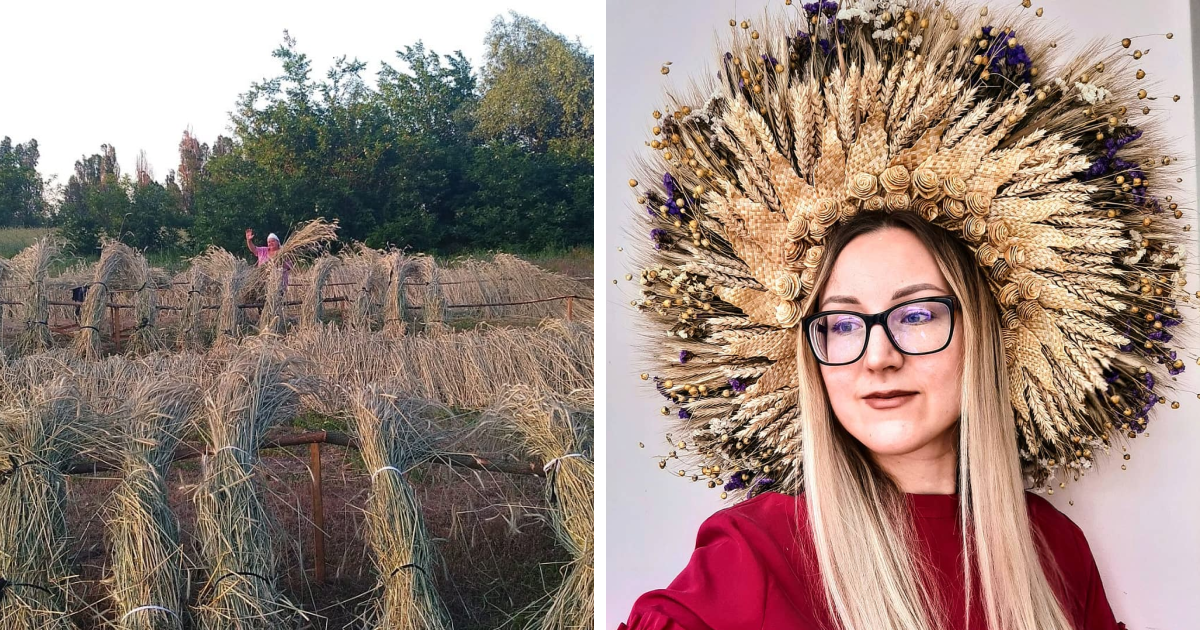
Straw can also be flattened, folded, braided, and arranged into stars, flowers, wall hangings, harvest figures, and geometric ornaments. This is where straw shows off. Under light, the surface can shine like satin. A simple wheat star can look delicate enough for a holiday tree and sturdy enough to survive storage if packed with care.
Modern Ways to Revive the Art of Weaving From Straw
1. Teach Beginner-Friendly Workshops
The fastest way to revive a craft is to put it into people’s hands. A beginner workshop does not need to start with a large basket. In fact, please do not hand a beginner forty-seven damp stalks and say, “Make a functional hamper.” Start with a small plait, a bookmark, a straw star, a coaster, or a simple wall charm.
Community centers, schools, libraries, farmers markets, craft guilds, and local museums can all host straw weaving classes. Short workshops make the craft less intimidating and help people experience the pleasure of natural fiber work.
2. Connect Farmers and Makers
Straw weaving becomes more meaningful when makers know where their material comes from. Local grain farmers may have straw available after harvest, though it must be clean, suitable, and free from treatments that would make it unsafe for craft handling. A small partnership between farmers and artisans can turn agricultural residue into local art.
This also gives farmers another story to tell about their crops. Wheat becomes bread, yes, but the stalk can become ornament, basket, sculpture, or teaching material. That is a nice upgrade from “stuff in the field that makes your socks itchy.”
3. Create Contemporary Designs
Revival does not mean copying the past forever. Traditional knowledge should be respected, but new makers can also create modern straw pieces: minimalist wall panels, lampshades, table decor, plant holders, jewelry, holiday ornaments, packaging accents, and mixed-media sculptures.
Contemporary design helps straw weaving reach people who may not think of themselves as “craft people.” A clean, modern straw wall piece can fit into a city apartment as easily as a farmhouse kitchen. The material is old; the presentation can be fresh.
4. Document Techniques Before They Disappear
Many craft techniques vanish because they live only in the hands of a few elders or specialized makers. Recording oral histories, photographing process steps, filming demonstrations, and writing clear instructions can preserve knowledge for future students.
This documentation should be ethical. Teachers should be credited. Community-specific traditions should not be copied without permission. A respectful revival asks, “Who taught this? Where did it come from? What is appropriate to share?” That question matters more than producing trendy content.
5. Sell Straw Work With a Story
Handmade straw art competes in a marketplace full of cheap, machine-made decor. The advantage of straw weaving is story. Buyers want to know who made the piece, what material was used, how long it took, and why it matters.
A product description should not simply say “cute basket.” It should explain that the piece was woven from prepared wheat straw, shaped by hand, and inspired by traditional plaiting techniques. Add care instructions. Show process photos. Let customers see the human skill behind the object. Handmade work needs context, not apology.
Challenges in Reviving Straw Weaving
Revival sounds romantic until you try sourcing good straw, teaching beginners, pricing handmade work, and explaining to someone that no, a handwoven basket should not cost the same as a plastic bin from a discount aisle. The challenges are real.
First, high-quality straw can be harder to find than expected. Modern agricultural varieties are often bred for grain yield, not long, flexible stalks. Second, craft knowledge may be scattered across books, guilds, individual teachers, and small organizations. Third, handmade straw work takes time, which makes pricing difficult. Finally, many people underestimate basketry and straw art because they confuse simple materials with simple skill.
The solution is education. Show the process. Explain the preparation. Invite people to try it. Once someone has snapped ten stalks in a row and produced a braid that looks like it fought a lawn mower, they develop instant respect for skilled straw weavers.
Experiences Related to Reviving the Art of Weaving From Straw
The first experience most people have with straw weaving is surprise. Straw looks too fragile to become anything serious. You pick up a dry stem, bend it, and it breaks with a tiny, judgmental snap. But after the straw is soaked and softened, the personality changes. Suddenly it bends. It listens. It becomes workable. That moment feels like unlocking a small secret from the natural world.
A beginner may start with a simple three-strand braid. At first, the hands feel clumsy. One strand slips, another points in the wrong direction, and the whole thing looks less like heritage craft and more like a confused breadstick. But after a few minutes, the rhythm appears. Left over center, right over center, tighten, repeat. The braid grows. The maker relaxes. The material begins to teach.
One of the best experiences in straw weaving is learning to respect preparation. Many modern hobbies let us skip straight to the exciting part. Straw does not. It asks you to sort, soak, trim, and wait. That waiting is not wasted time; it is part of the craft. You begin to understand why older makers often speak about materials with affection. They are not being poetic for no reason. They have learned that every stalk behaves slightly differently.
Another memorable experience is seeing how people respond to finished straw work. A small woven ornament can start conversations faster than expected. Someone will ask, “Is that really made from straw?” Then another person will touch it carefully, as if it might float away. Children are especially interested because the transformation is visible. They know what dry grass looks like. Seeing it become a star, flower, basket, or braided band feels almost magical.
Teaching straw weaving also reveals how craft builds confidence. A student who says, “I’m not artistic,” may still learn to make a neat plait. The project is structured enough to feel achievable but flexible enough to allow personality. Some people make tight, precise pieces. Others create loose, expressive forms. Both approaches have value. Straw weaving quietly reminds us that creativity is not always a lightning strike; sometimes it is a repeated motion done with care.
There is also an emotional experience in working with an agricultural material. Straw carries the memory of fields, harvest, weather, and labor. Even when bought from a supplier, it feels closer to the land than many craft materials. That connection can make the finished object feel grounded. A woven straw basket or ornament is not just decor; it is a conversation between plant, hand, and time.
Reviving straw weaving, then, is not only about saving an old technique. It is about creating new experiences around patience, sustainability, beauty, and shared learning. It gives families a craft to pass down, artisans a material to explore, farmers another use for straw, and communities a reason to gather around making. In a culture obsessed with speed, straw weaving offers a friendly rebellion: slow down, soften the material, and make something with your hands.
Conclusion
The art of weaving from straw deserves revival because it is practical, beautiful, sustainable, and deeply human. It teaches respect for natural materials. It preserves traditional craft knowledge. It offers modern makers a way to create objects with warmth, texture, and meaning. Most importantly, it proves that humble materials can become extraordinary when skill enters the room.
Straw weaving does not need to remain a forgotten craft tucked behind museum glass or remembered only during harvest festivals. It can live in classrooms, studios, farmers markets, design shops, community workshops, and homes. With thoughtful teaching, ethical sourcing, modern design, and good storytelling, straw weaving can become relevant againnot as nostalgia, but as a living craft with a future.
So yes, I want to revive the art of weaving from straw. Not because the past was perfect, but because it still has useful things to teach us. And if a simple stalk of wheat can become a basket, a flower, a star, or a work of art, maybe we should stop underestimating humble beginnings.